







































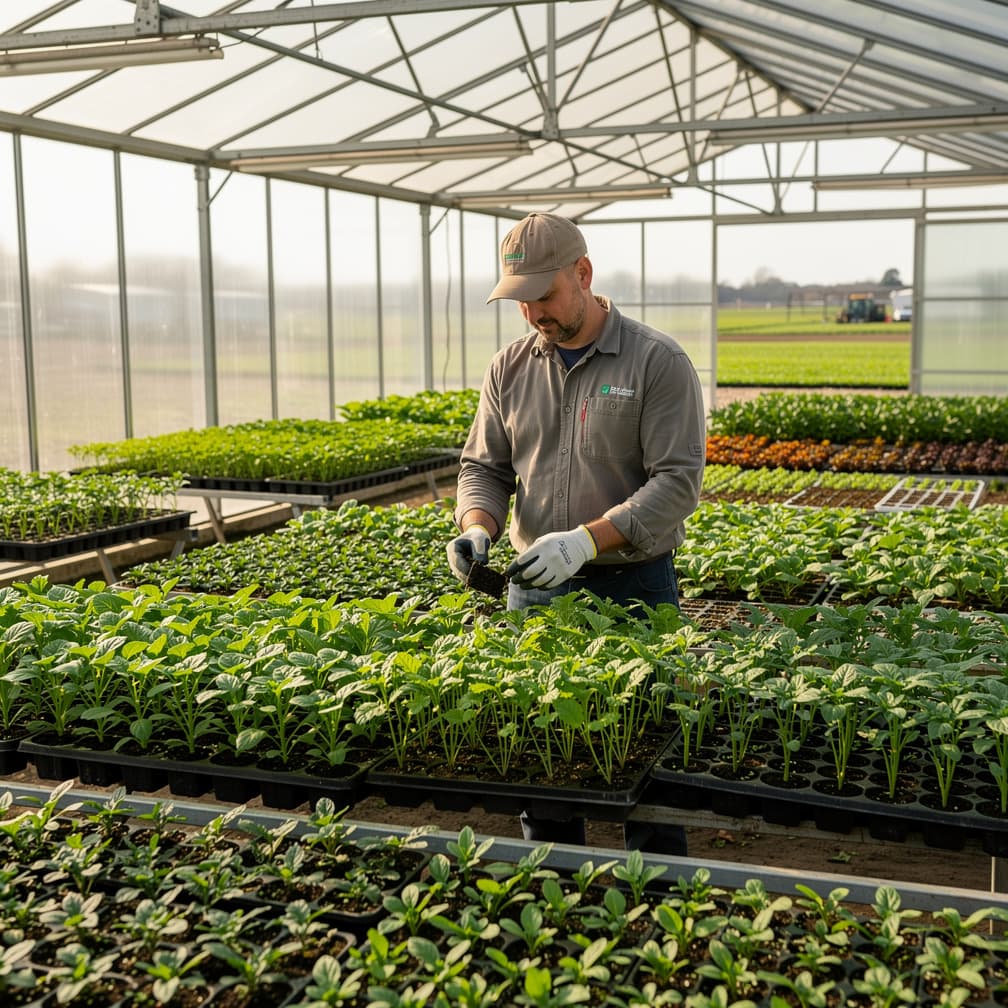

As a nursery and greenhouse business in Buckeye, the paperwork finds you long before any loss does. A wholesale account wants a certificate naming it as an additional insured. A property manager wants proof on file before a truck touches the dock. An event organizer wants limits at a number someone picked years ago. None of those requests care what your yard actually risks, and every one of them can stall a sale until it is satisfied. Nursery and greenhouse insurance in Buckeye serves two masters at once: the contracts already sitting in your drawer, and the injuries and property losses that keep you awake. Gather every insurance clause you have signed, mark the highest limit among them, and treat that as the floor when you compare quotes from participating carriers.
What Makes Buckeye Different
Density decides who you compete with for a repair crew, not who you compete with for a customer. Maricopa County counts about 108,000 businesses, and after a rough storm week every one of them is calling the same glaziers, electricians, and restoration outfits. Your torn poly house sits in that queue behind a lot of ordinary roofs. The lost weeks are the real injury, because stock does not wait for a contractor's calendar. The income provisions in a policy are worth reading closely for exactly this reason, and the waiting period buried inside them is the number to find. Ask underwriters what happens when repairs stall for reasons nobody controls. Ask whether rented heat, a generator, or leased cooler space counts as an expense worth submitting. Those answers are worth more here than a small difference in premium.
Local Risk Factors in Buckeye
Heat hurts your crew before it hurts your crop. People move stock in full sun, inside a house that runs hotter than the air outside, and heat illness arrives fast in anyone who skipped water. Workers Compensation may respond to a work-related heat illness, though what actually helps is shifting the heavy lifting to the cool hours and making breaks a rule rather than a suggestion. Injuries climb when people are tired, so the sprain and the fall arrive with the heat as well. Document the break schedule. Ask how participating carriers in Arizona view a heat plan when they price a seasonal crew in Maricopa County, since a documented routine is one of the few things you can hand them.
What Coverage Does a Nursery & Greenhouse in Buckeye Need?
General Liability
Landlords, wholesale buyers, and event coordinators ask for this one by name before you open, ship, or set up a stand. It generally answers third-party injury and property damage: the shopper who goes down on a wet aisle, the basket that falls off its hook onto someone. Your own crew's injuries and damage to your own stock sit elsewhere.
Example: A customer reaches for a pot near the top of a display, the stack shifts, and a falling planter breaks her wrist beside the register. A claim like that could respond to her medical bills and the suit that follows.
Commercial Property
Glass, poly film, hoop ribs, benches, heaters, controllers, and the stock standing under all of it: this line is built around the things you own. Fire, storm damage, theft, and vandalism are the usual covered causes, subject to your values and your deductible. Flood typically sits outside it, and wear on hard-run equipment usually does too.
Example: A heater in the propagation house shorts overnight and fire takes the structure, the benches, and six weeks of seedlings with it. Commercial Property could pick up the rebuild and the lost stock, up to the values on your schedule.
Workers Compensation
General Liability does nothing for your own people, and that gap is what this line exists to fill. Medical care and lost wages after a work injury are the core of it: a back strained on a balled tree, a hand caught under a cart, heat illness in a closed house. Rules vary by state, and the Arizona Department of Insurance and Financial Institutions publishes the current requirements for employers.
Example: A seasonal hire lifts a heavy container off a low bench, feels something give in his back, and is out for a month at the worst point of the year. Workers Compensation might handle the treatment and part of his lost pay.
Business Owners Policy
Buying the property and liability pieces separately works fine; bundling them into a single form is often cheaper for a small yard, and that bundle is the Business Owners Policy. It typically packages buildings, stock, and third-party injury together, sometimes with income provisions attached. Unusual structures or heavy outdoor inventory can outgrow the form.
Example: Hail perforates the film on two houses in Buckeye, the stock beneath is stripped bare, and sales stop for a month. One packaged policy might take the repairs, the ruined plants, and a share of the lost income together.
How Much Does Nursery & Greenhouse Insurance Cost in Buckeye?
Nursery & Greenhouse Insurance is a bundle of separate policies, priced separately. The ranges below are typical figures for Buckeye for each line, except workers compensation, which is rated per $100 of payroll; a quote prices each one against your own operations.
| Coverage | Typical range | What moves your price |
|---|---|---|
| General Liability Insurance | $75 - $250 per month | Industry and risk classification, annual revenue, number of employees |
| Commercial Property Insurance | $180 - $675 per month | Building value and construction type, roof age and condition, fire protection class |
| Workers Compensation Insurance | $0.75 - $2.74 per $100 of payroll | Employee classification codes, total annual payroll, experience modification rate |
| Business Owners Policy Insurance | $140 - $430 per month | Annual revenue and industry class, building and contents values, square footage and building age |
Prices shown are general estimates, not guaranteed rates or quotes. Your actual premium will depend on the insurer, coverage selected, business details, location, claims history, and other underwriting factors. Learn about our pricing methodology.
What Are the Insurance Requirements for a Nursery & Greenhouse in Buckeye?
Workers' comp is generally required once you have your first employee. Arizona generally requires employers to carry workers' compensation at that point. Common exemptions include sole proprietors, partners, and working members of LLCs. Confirm current thresholds with your state's workers' compensation agency before you hire.
Flood damage is typically excluded from standard policies. Standard commercial property and builders-risk-type policies typically exclude flood damage. Flood exposure varies address by address, so check your premises in FEMA's Flood Map Service Center before deciding; if you sit in a mapped flood zone, a separate policy through the National Flood Insurance Program is the usual starting point.
Where to verify licensing and coverage rules. The Arizona Department of Insurance and Financial Institutions publishes consumer guidance and current insurance requirements for Arizona businesses. When a contract or lease demands specific wording, the Arizona Department of Insurance and Financial Institutions's guidance is the authoritative place to check.
Get Your Nursery & Greenhouse Quote in Buckeye
Compare rates from multiple carriers. Free quotes, no obligation.
Operating in Buckeye
- Forklifts run past benches and shoppers in the same aisle during delivery weeks. A worker hurt and a customer hurt in that same moment travel down two different policies with two different adjusters.
- Payroll triples for a few weeks and then disappears, and the workers compensation audit at renewal squares your estimate either way. Guess low and a bill arrives; guess high and you financed somebody else's year.
- Delivery trucks, customer cars, and a cart loaded with trees share one strip of concrete at the gate. A lease in Buckeye can make that apron your responsibility whether or not you ever wanted it.
- A wholesale buyer in Buckeye can withhold a purchase order until the certificate names its parent entity correctly, and that correction takes days you do not have in the middle of the season.
How to Buy: Advice for Buckeye Owners
Inventory is the exposure owners insure last and lose first. Pots, tools, trays, fittings, and stock disappear in small increments, and a deductible eats most of those losses before any policy engages. Decide what you would genuinely file on, then set the deductible where it makes sense rather than where it looks inexpensive. Commercial Property is where stock and equipment usually sit, and its definitions repay a slow read: outdoor property, property of others, and locked storage are often three separate things. A Business Owners Policy folds those same questions into one form for smaller yards. Check the Arizona Department of Insurance and Financial Institutions's guidance before deciding how much of the small stuff to carry yourself. Then ask participating carriers in Arizona to quote the inventory list you actually keep.
FAQ
Nursery & Greenhouse Insurance in Buckeye: FAQ
Nobody hands you a slip that says insurance, but the people around you ask anyway. A landlord in Buckeye can want proof before keys change hands, and a wholesale supplier can want a certificate before the first delivery lands. Past the paperwork, the day you let strangers walk your aisles is the day a fall becomes your problem. General Liability is the line those requests usually name.
Cost follows drivers rather than a map. Payroll, retail foot traffic, the values on your houses and stock, the deductible you pick, and your claim history do most of the work. A yard with heavy weekend retail prices differently than a wholesale grower of the same size. Building values in Buckeye matter because rebuild costs are local. Quote identical limits across participating carriers and the real differences become visible.
Landlords and property managers ask before you take possession. Wholesale accounts and institutional buyers ask before shipping. Event coordinators ask before you set up a booth. Municipal purchasing offices ask before an order clears. None of them read the policy itself, only the certificate and the limits printed across it, so the wording has to be on file before the deadline rather than after it.
It depends on what killed them and how the form defines stock. Property coverage typically keys off physical damage from a covered cause, so a wind event that opens a house reads differently than a cold snap that simply outran the heaters. Living inventory also gets valued differently than packaged goods. Ask whether plants in the ground and plants in containers are handled the same way.
Usually not. Property forms typically exclude flood, and that gap gets filled by a separate flood policy rather than by an endorsement on the same form. Surface water pushing through a hoop house or across a sales yard is exactly the scenario that lands outside. If your ground sits low or drains slowly, price flood on its own and ask how long the waiting period runs.
Mechanical breakdown is its own conversation. Many property forms treat a failure inside the equipment as maintenance rather than a covered cause, while damage from a fire that heater started is handled differently. Equipment breakdown coverage can often be added, and it may respond to the burner itself and sometimes to stock lost when the temperature dropped. Ask which of those two your form actually includes.
Sources
- 1.U.S. Census Bureau, County Business Patterns (2022), Maricopa County(Maricopa County has about 108,000 business establishments.)
- 2.Arizona Department of Insurance and Financial Institutions(Arizona Department of Insurance and Financial Institutions publishes consumer guidance for insurance buyers.)
- 3.FEMA / FloodSmart(Flood coverage is typically purchased separately; FEMA administers the National Flood Insurance Program.)


