
Overview of Commercial Auto Insurance Requirements
Commercial auto insurance is required by law in nearly every state for vehicles used for business purposes. New Hampshire is the notable exception, enforcing financial responsibility rules rather than an insurance purchase mandate. The specific requirements differ based on the type of vehicle, the nature of the business, and whether the vehicle operates within a single state or across state lines. Unlike personal auto insurance, where requirements are set solely by state law, commercial auto insurance is regulated at both the federal and state levels, creating a layered system that every business owner with vehicles needs to understand.
At the most basic level, nearly every state requires motor vehicles to carry minimum liability insurance, and these requirements apply equally to commercially operated vehicles. Commercial vehicles are generally subject to higher minimum limits than personal vehicles because they tend to be larger, heavier, and driven more miles, all of which increase the potential severity of accidents. Beyond state minimums, the federal government imposes additional insurance requirements on vehicles that cross state lines, transport passengers for hire, or haul certain types of cargo.
The consequences of operating a commercial vehicle without proper insurance are more severe than those for personal vehicles. Businesses face fines, vehicle impoundment, loss of operating authority, suspension of business licenses, and personal liability for accident damages. For interstate carriers, the Federal Motor Carrier Safety Administration can revoke your operating authority entirely, effectively shutting down your business. CPK Insurance helps businesses compare options from participating providers so they can understand the full scope of their commercial auto insurance obligations and put together coverage that satisfies applicable requirements.
Federal vs. State Requirements
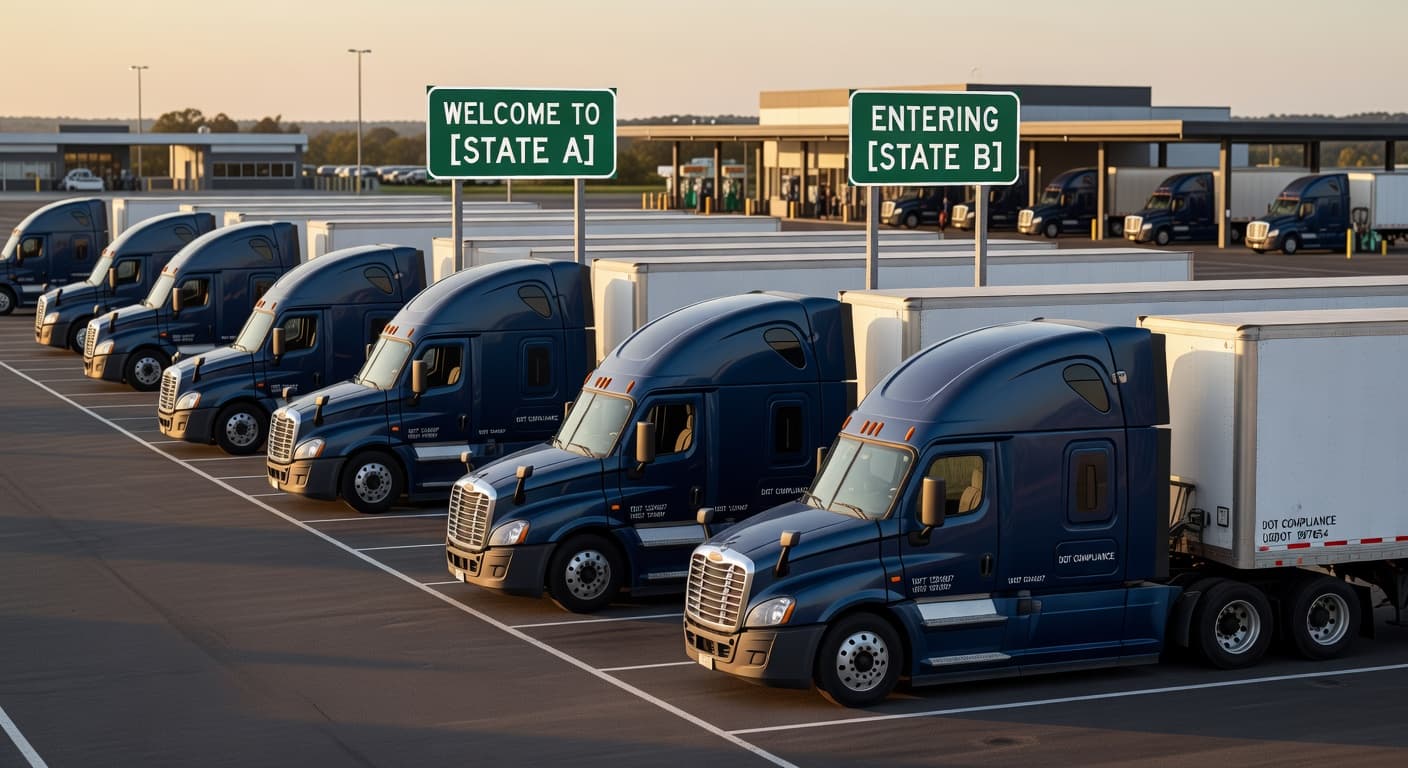
Understanding the distinction between federal and state commercial auto insurance requirements is critical because many businesses are subject to both, and compliance requires meeting the higher of the two standards. Federal requirements apply to motor carriers operating in interstate commerce, meaning any business that transports goods or passengers across state lines. State requirements apply to all vehicles operating within the state, including those that never cross a state border.
The Federal Motor Carrier Safety Administration establishes minimum insurance requirements for interstate motor carriers under 49 CFR Part 387. For-hire carriers transporting general freight must carry a minimum of $750,000 in combined single limit liability coverage. Carriers hauling oil and certain hazardous substances face a $1 million minimum, while carriers transporting bulk hazardous materials such as explosives, compressed gases, and radioactive materials must carry $5 million in liability coverage. These federal minimums apply regardless of the state where the carrier is based or operates, and they must be documented through federal filings (Form BMC-91 or BMC-91X) on file with the FMCSA.
State-level commercial auto insurance requirements vary significantly. Most states set their minimum liability limits for commercial vehicles at the same level as personal vehicles, which ranges from as low as $25,000 per person and $50,000 per accident in some states to $100,000 or more in others. However, many states impose higher minimums for specific types of commercial vehicles. For-hire passenger vehicles like taxis and limousines often face state minimums of $300,000 to $1.5 million. Vehicles used for transporting hazardous materials within the state may face minimums that match or approach federal levels. Some states, including California, Illinois, and New York, have their own commercial vehicle insurance requirements that exceed the general personal auto minimums.
When both federal and state requirements apply to your vehicles, you must carry coverage that satisfies the higher of the two. In practice, the federal $750,000 minimum for general freight carriers exceeds every state's standard liability minimum, so interstate carriers are effectively governed by the federal requirement. However, intrastate carriers that operate solely within one state may face state-specific requirements that differ from the federal standard. A licensed insurance professional from a participating provider can review your operating profile to determine exactly which requirements apply to your vehicles, and CPK Insurance can help you compare options that meet all applicable standards.
Minimum Liability Limits by State
Nearly every state mandates minimum liability insurance for vehicles operating on its roads, and these minimums apply to commercial vehicles as well. While many states apply the same minimum limits to both personal and commercial vehicles, several states set higher requirements for commercial operations, particularly for vehicles used to transport passengers or hazardous materials.
States with some of the lowest general minimum liability requirements include Florida, which requires only $10,000 in property damage liability and $10,000 in personal injury protection but no bodily injury liability unless the driver has certain violations on their record. California requires $30,000 per person and $60,000 per accident in bodily injury liability plus $15,000 in property damage following the SB 1107 increase that took effect January 1, 2025, and commercial vehicles can face higher requirements depending on the vehicle type and use. Texas requires minimums of $30,000 per person, $60,000 per accident in bodily injury, and $25,000 in property damage for all vehicles.
States with higher minimum requirements include Alaska, which mandates $50,000 per person and $100,000 per accident in bodily injury liability plus $25,000 in property damage. Maine requires $50,000/$100,000/$25,000 as well. New York requires $25,000/$50,000/$10,000 for personal vehicles but imposes significantly higher requirements for commercial vehicles, including $100,000/$300,000 for taxis and limousines and up to $1.5 million for certain for-hire vehicles depending on seating capacity.
For businesses operating medium and heavy trucks, several states impose specific commercial vehicle minimums that exceed the general minimums. Illinois requires $100,000 in combined single limit coverage for trucks over 10,000 pounds gross vehicle weight. Pennsylvania requires higher limits for vehicles used in the transportation of goods for hire. Michigan's no-fault system requires personal injury protection, and although the July 2020 reform lets drivers choose from several PIP coverage levels, PIP still adds meaningfully to the cost of commercial auto coverage in that state.
It is important to recognize that state minimums represent the legal floor, not a recommendation for adequate coverage. A serious accident involving a commercial vehicle can easily produce damages in the hundreds of thousands or millions of dollars. Many risk professionals suggest that businesses carry commercial auto liability limits of at least $1 million combined single limit, regardless of the state minimum, to protect against the financial exposure of a major accident.
Special Requirements for Trucking and Transportation
The trucking and transportation industry faces the most complex and stringent commercial auto insurance requirements of any sector. These requirements are layered across federal law, state regulations, and the practical demands of shippers, brokers, and freight platforms, creating a compliance landscape that requires careful navigation.
Interstate motor carriers must register with the FMCSA and obtain operating authority, commonly known as an MC number, before transporting goods or passengers across state lines. As part of this registration, carriers must file proof of insurance meeting the federal minimums with the FMCSA. The required liability insurance must be filed by the insurance carrier on Form BMC-91 or, when more than one insurer shares the required limits, on Form BMC-91X, while carriers using a surety bond file Form BMC-82. If your insurance lapses and the filing is withdrawn, the FMCSA will issue a notice to revoke your operating authority after 30 days, and you cannot legally operate during that period. For an owner-operator or a small fleet, even a brief lapse in insurance filings can mean lost operating authority and weeks of parked trucks.
Cargo insurance requirements add another layer of complexity for for-hire carriers. FMCSA eliminated its cargo insurance minimums and the related BMC-34 filing for general freight carriers in 2011, so federal cargo filing requirements now apply only to household goods carriers. For general freight, cargo coverage is a contract requirement imposed by shippers and brokers rather than a federal mandate, and the market has effectively imposed its own standards. Major freight brokers, load boards, and shippers typically require carriers to maintain $100,000 to $250,000 in cargo coverage, and some high-value freight lanes require $500,000 or more.
Specialized transportation operations face additional requirements. Household goods movers must carry cargo insurance of at least $5,000 per vehicle and $10,000 per occurrence under federal law, but many states impose higher minimums for movers. Passenger carriers including buses, shuttles, and limousines face liability minimums that scale with seating capacity, reaching $5 million for vehicles with a seating capacity of 16 or more passengers. Hazmat haulers must comply with both the higher federal liability minimums and the additional insurance and permit requirements imposed by states through which they transport hazardous materials.
CPK Insurance helps owner-operators and fleet companies compare quotes from participating providers that write trucking and transportation risks. A licensed insurance professional from a participating provider can help you review the federal, state, and market-driven requirements that carriers must meet while keeping costs competitive.
Penalties for Non-Compliance
Operating a commercial vehicle without the required insurance carries severe penalties at both the federal and state level. These penalties are designed to be punitive enough to deter non-compliance, and they can escalate quickly from fines to criminal charges and business closure.
At the federal level, the FMCSA can revoke the operating authority of any interstate motor carrier that fails to maintain the required insurance filings. Once your authority is revoked, you cannot legally operate any commercial motor vehicles in interstate commerce. Continuing to operate without authority is a federal violation that can result in fines of up to $16,000 per violation per day. Additionally, if you are involved in an accident while operating without proper insurance, you are personally liable for all damages with no coverage to protect your assets.
State-level penalties vary but are universally significant. In California, operating a commercial vehicle without insurance can result in fines of $1,000 to $5,000, impoundment of the vehicle, and suspension of the vehicle's registration. In Texas, driving any vehicle without insurance is a misdemeanor that carries fines of $175 to $350 for a first offense and up to $1,000 for subsequent offenses, plus a $250 fee to reinstate your registration. New York imposes one of the harshest penalty structures, with fines of $150 to $1,500, civil penalties, and suspension of the vehicle registration and driver license until coverage is restored; New York does not use SR-22 filings. Illinois can suspend your vehicle registration and impose reinstatement fees of $100 or more.
For commercial fleets, the financial impact extends well beyond fines. Vehicles impounded for lack of insurance are not generating revenue, drivers are idled, delivery commitments go unfulfilled, and customer relationships are damaged. If a commercial vehicle is involved in an accident while uninsured, the business owner is personally liable for medical expenses, property damage, lost wages, and pain and suffering claims that can easily reach hundreds of thousands or millions of dollars. Courts have shown little sympathy for businesses that operated without required insurance, often awarding enhanced damages.
The reputational damage is also significant. In the trucking industry, insurance violations appear on your FMCSA safety record and can make it difficult to secure contracts with reputable shippers and brokers. Maintaining continuous coverage, keeping federal filings current with your insurer, and tracking policy changes and renewals well in advance can help businesses avoid all of these consequences. CPK Insurance can help you compare options from participating providers when it is time to quote or renew.
How to Ensure Compliance Across All States
For businesses that operate vehicles in multiple states, ensuring insurance compliance requires a systematic approach that accounts for every jurisdiction where your vehicles travel or are domiciled. The challenge is that requirements can change from state to state and from year to year, and non-compliance in even a single state can expose your entire operation to risk.
The first step is to identify every state in which your vehicles operate, even if they only pass through occasionally. Create a comprehensive list of your base state, every state where you have facilities or employees, and every state your vehicles travel through on regular routes. For each state on the list, verify the minimum liability insurance requirements for commercial vehicles of your type and weight class. If you operate interstate, confirm that your federal insurance filings are current and that your policy limits meet or exceed the applicable FMCSA minimums.
Most commercial auto insurance policies are written to provide coverage that meets the requirements of any state where the insured vehicle is operated. This is typically accomplished through what is known as an out-of-state coverage provision or a state minimum limits endorsement. These provisions automatically adjust your coverage to meet the minimum requirements of any state your vehicles enter, even if those requirements exceed your policy's stated limits for a specific coverage. Verify with your agent that your policy includes this provision, as it is essential for multi-state operations.
For interstate trucking operations, maintaining your FMCSA insurance filings is a critical compliance task. Your insurance carrier is responsible for filing the BMC-91 form with the FMCSA, but you should verify that the filing is active by checking your carrier's SAFER system record regularly. If your policy changes carriers, renews, or adjusts in any way, confirm that the new carrier has filed the required forms before the previous filings are withdrawn. A gap in your FMCSA filings, even for a single day, can trigger the revocation process.
Staying compliant is ultimately a partnership between your business and your insurer. Your insurance carrier files and maintains the required federal forms, and you should verify those filings regularly, confirm state-specific requirements as you expand into new markets, and coordinate carrier transitions carefully to prevent gaps. CPK Insurance can help you compare options from participating providers as your operation grows, so your vehicles can remain legally insured everywhere they operate and your business avoids the costly consequences of non-compliance.
Request a Quote Comparison
Enter your ZIP code to compare insurance rates from top carriers.
Updated July 17, 2026