Updated July 16, 2026

Key Takeaways
- Size Coverage A, your dwelling limit, to what it costs to rebuild your home today, not market value, purchase price, or loan balance. Coverage B, C, and D usually scale off it, so getting this one number right sets the rest.
- A standard policy excludes flood, earthquake, and sewer or sump pump backup. Price flood separately, and add a water backup endorsement if a drain or sump pump can back up into your home.
- Confirm your payout basis before you buy: replacement cost pays to rebuild without deducting depreciation, while actual cash value subtracts it, and on an older roof that gap can be significant.
- Your two largest levers on price are a higher deductible you can comfortably pay and bundling home with auto. Then re-shop at renewal, because a rate that was competitive two years ago may not be now.
Homeowners Insurance in Kansas
The decision point usually arrives right before closing, at renewal, or after a roof replacement. That timing changes what you should review first. If you are buying, you need proof of coverage lined up before the lender's deadline. If you are renewing, you have a chance to correct limits, deductibles, and endorsements before another policy term locks in. If you just updated the roof or other major systems, your quote should reflect the home as it stands now, not as it looked several years ago.
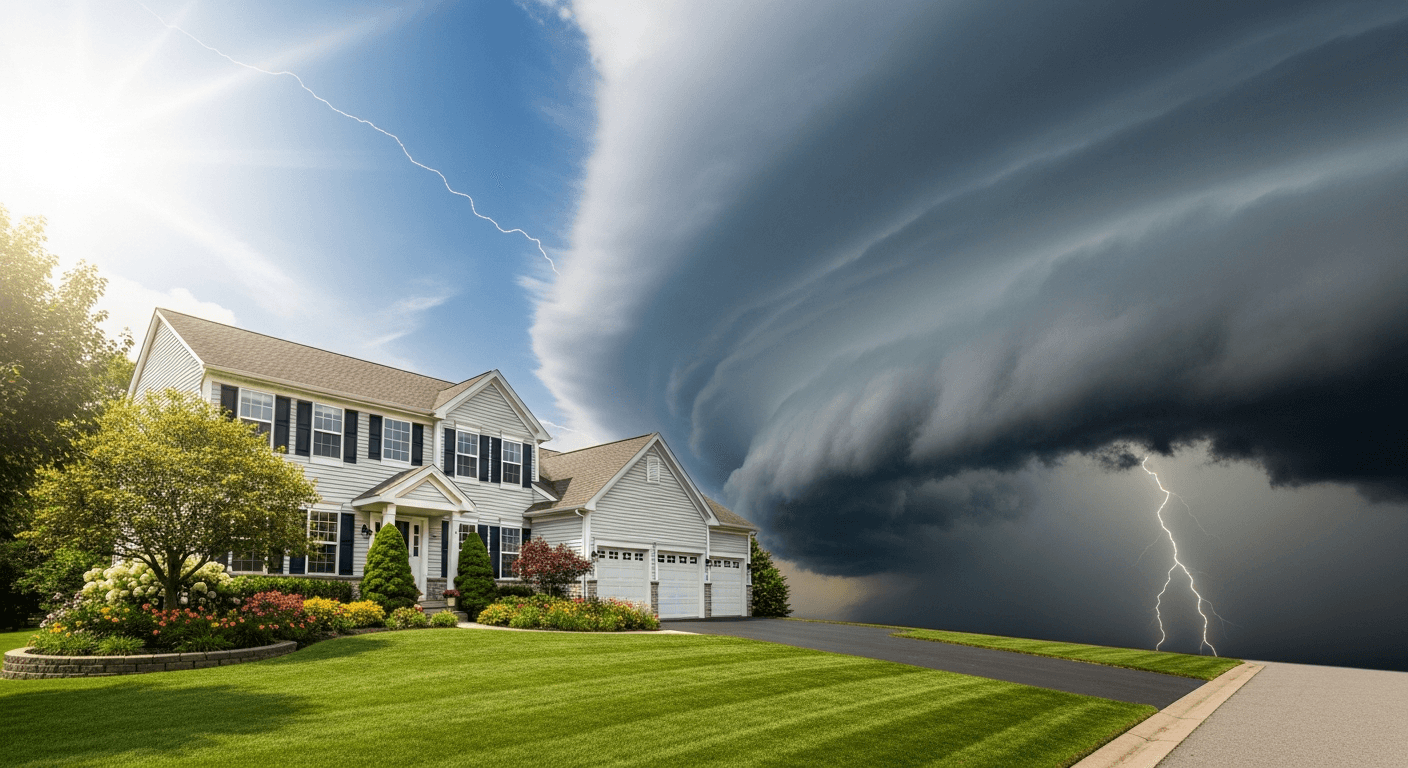
For homeowners insurance in Kansas, that timing matters because weather-driven losses can turn a routine renewal into a serious coverage review. You are not just checking for a lower bill. You are checking whether your dwelling limit, roof settlement language, wind and hail deductible structure, and water-related exclusions still fit the house you own today. Kansas households also need to read policy forms carefully instead of assuming every quote handles storm damage the same way. Start with the address, the age and condition of the roof, any recent updates, and the deductible you could realistically absorb after a loss.
What Homeowners Insurance Covers
In Kansas, the most useful coverage review usually centers on how your policy may respond to the losses homeowners here actually worry about. That means reading the quote beyond the declarations page and checking how the form handles wind, hail, roof damage, detached structures, temporary living costs after a covered loss, and water events that may fall outside the base policy.

Coverage A
Dwelling
Repairs or rebuilds your home itself, the walls, roof, floors, built-in appliances, and attached structures like a garage, after a covered loss. Set this limit to the full cost of rebuilding, not market value.

Coverage B
Other Structures
Detached structures on your property, such as a fence, shed, detached garage, or gazebo. Usually set at about 10 percent of your dwelling limit [2].

Coverage C
Personal Property
Your belongings, furniture, clothing, electronics, and appliances, generally written at 50 to 70 percent of your dwelling limit [2]. High-value items like jewelry and art carry special limits.

Coverage D
Additional Living Expenses
Also called loss of use. Pays your added living costs, hotel stays, meals, and a temporary rental, while a covered loss makes your home uninhabitable. Usually set at about 20 percent of your dwelling limit.

Coverage E
Liability
Covers you if someone is injured on your property, or you damage someone else's property, and you are found responsible. The standard $100,000 limit [2] is often raised to $300,000 or $500,000.

Coverage F
Medical Payments
Pays small medical bills, commonly $1,000 to $5,000, if a guest is hurt at your home regardless of fault, without a formal liability claim.
What a standard policy doesn't cover, and what to add
Start by asking whether the roof is settled at replacement cost or with depreciation in some situations. That single detail can change what you collect after a storm claim. Next, review whether your deductible is a flat dollar amount or a separate wind or hail deductible. A higher deductible may reduce premium, but it also changes what you must pay out of pocket before repairs begin.
Kansas buyers should also look closely at exclusions and optional endorsements. Flood damage may fall outside a standard homeowners policy, so if your property has drainage concerns, low spots, or prior water issues, ask about a separate flood policy instead of assuming the base form responds. Sewer or drain backup is another area worth reviewing because many homeowners only discover the gap after a loss.
If you host guests often, have a dog, a pool, a trampoline, or frequent service providers at the house, ask how the policy addresses those exposures and whether any restrictions apply. Personal property coverage may also work better when you identify items that may need special scheduling, such as jewelry, collectibles, or equipment kept at home.
Example
Replacement cost vs. actual cash value: a $15,000 roof
Say a covered storm destroys your roof. A new one costs $15,000 and your deductible is $1,000.
Start with the depreciation, because that is what splits the two policies. Insurers base it on how much of an item's useful life is already gone. Take the item's age divided by its expected life: a roof with a 30-year expected life that is 15 years old has used 15 of 30 years, so it is depreciated about 50 percent. Half of the $15,000 roof is $7,500 of depreciation.
- Replacement cost policy: pays the full $15,000 to put on a new roof, minus your $1,000 deductible. You receive $14,000.
- Actual cash value policy: pays $15,000 minus the $7,500 depreciation, then minus the $1,000 deductible. You receive $6,500.
Same storm, same roof, but the actual cash value policy leaves you about $7,500 short. That is why it is worth confirming your roof and big-ticket belongings are written for replacement cost.
Homeowners Insurance Requirements in Kansas
- Kansas storm exposure makes roof settlement language worth reading line by line, because similar premiums can still produce very different claim payments after hail damage.
- If your property has basement water concerns, low spots, or recurring drainage issues, ask about flood and backup gaps before relying on the base homeowners form.
- A recent roof replacement or major system update can change both underwriting and pricing, so submit documentation before renewal rather than after the policy is issued.
- Detached garages, sheds, fences, and other outbuildings are common claim points after severe weather, so confirm those structures are still reflected correctly in the quote.
How Much Does Homeowners Insurance Cost in Kansas?
Average Cost in Kansas
$120 - $300
per month
In Kansas, homeowners insurance premiums typically run $120 - $300 per month, which tends to run 17% above the national range of $110 - $250 per month.
- Home replacement cost, age, and construction type
- Roof age, material, and condition
- ZIP code and local weather risk (wind, hail, wildfire, hurricane)
- Coverage limits and endorsements
- All-peril and percentage wind/hail deductibles
- Claims history and insurance score where allowed
Typical range for many standard homeowners profiles; lower-risk homes fall below it and coastal, wildfire, or older-roof homes can run well above. Final pricing depends on property details, location, underwriting, and selected coverage.
Homeowners premiums in Kansas vary widely because the quote is built from the house, the location, and the way the policy is structured. Many homes see premiums from $120 to $300 per month, depending on the home's rebuild profile, roof age and material, prior claims, deductible choice, and whether the carrier sees elevated wind or hail exposure at that address. Well below that range, check whether the dwelling limit or roof settlement language has been trimmed. Well above it, look at roof age, prior claims, or wind and hail deductibles as likely drivers.
The most important pricing inputs are usually the dwelling limit, construction details, roof condition, and claims history. If your quote seems high, do not assume the answer is simply to cut coverage. First check whether the rebuild estimate is accurate, whether the roof age is listed correctly, and whether the quote includes endorsements you actually want. Then compare deductible options and roof settlement language side by side.
Kansas weather also makes policy form differences matter. One quote may look cheaper because it applies more restrictive roof loss terms or a different wind and hail deductible. Another may cost more because it includes broader settlement terms or stronger water-related options. That is why a fair comparison uses the same address, occupancy, dwelling limit, and deductible structure across quotes.
If you are shopping after a claim or after several years without reviewing the policy, expect the premium to move for reasons beyond inflation alone. Ask what changed in the underwriting assumptions, what discounts are available for updated roofing or bundled policies, and which coverage choices are driving the price.
Example
Sizing your dwelling limit: rebuild cost vs. purchase price
This is the number people most often get wrong, because the price you paid and the cost to rebuild are two different figures.
Say you buy a 2,000-square-foot home for $320,000. Part of that price is the land, and land does not burn down, so it is not what you insure. What you insure is the cost to rebuild the structure. At an illustrative local rebuild cost of $200 per square foot, that same 2,000-square-foot home costs about $400,000 to rebuild from the ground up.
- Insure to purchase price ($320,000): after a total loss you are short roughly $80,000 of the rebuild, and an underinsured dwelling limit can also reduce partial-loss payouts under a coinsurance clause.
- Insure to rebuild cost ($400,000): the limit matches what it actually takes to put the house back, which is the point of the coverage.
Rebuild cost can sit above or below purchase price depending on land value and local construction prices, so size Coverage A to a replacement-cost estimate rather than what you paid or what the home would sell for today.
| Coverage Part | What It Protects | Watch For |
|---|---|---|
| Dwelling (A) | Main house, roof, attached garage, built-ins | Set limit by rebuild cost, not market value |
| Other Structures (B) | Detached garage, fence, shed, workshop | Default limit may be too low for large structures |
| Personal Property (C) | Furniture, clothing, electronics, appliances | Replacement cost is stronger than actual cash value |
| Loss of Use (D) | Hotel, rental, meals, and extra living costs | Review dollar and time limits |
| Personal Liability (E) | Injury and property damage lawsuits | $300K to $500K is often a better starting point |
| Medical Payments (F) | Smaller guest injury medical bills | Usually low limits; not a liability replacement |
| Flood Insurance | Rising water, storm surge, surface flooding | Separate policy; not standard homeowners coverage |
| Water Backup | Sewer or sump pump backup | Usually endorsement-based |
| Wind/Hail Deductible | Storm-related roof and exterior damage | May be percentage-based in high-risk areas |
| Roof Settlement | How roof claims are paid | Replacement cost vs. actual cash value matters |
Dwelling (A)
- What It Protects
- Main house, roof, attached garage, built-ins
- Watch For
- Set limit by rebuild cost, not market value
Other Structures (B)
- What It Protects
- Detached garage, fence, shed, workshop
- Watch For
- Default limit may be too low for large structures
Personal Property (C)
- What It Protects
- Furniture, clothing, electronics, appliances
- Watch For
- Replacement cost is stronger than actual cash value
Loss of Use (D)
- What It Protects
- Hotel, rental, meals, and extra living costs
- Watch For
- Review dollar and time limits
Personal Liability (E)
- What It Protects
- Injury and property damage lawsuits
- Watch For
- $300K to $500K is often a better starting point
Medical Payments (F)
- What It Protects
- Smaller guest injury medical bills
- Watch For
- Usually low limits; not a liability replacement
Flood Insurance
- What It Protects
- Rising water, storm surge, surface flooding
- Watch For
- Separate policy; not standard homeowners coverage
Water Backup
- What It Protects
- Sewer or sump pump backup
- Watch For
- Usually endorsement-based
Wind/Hail Deductible
- What It Protects
- Storm-related roof and exterior damage
- Watch For
- May be percentage-based in high-risk areas
Roof Settlement
- What It Protects
- How roof claims are paid
- Watch For
- Replacement cost vs. actual cash value matters
How Kansas compares with the national baseline
Property crime per 100,000 residents
2,640 vs 2,200 baseline
Property crime in Kansas runs above the national average, at 2,640 vs 2,200 incidents per 100,000 residents.
Blue bar: Kansas. Gray line: national baseline.
Prices shown are general estimates, not guaranteed rates or quotes. Your actual premium will depend on the insurer, coverage selected, personal details, location, claims history, and other underwriting factors. Learn about our pricing methodology.
Request a Quote Comparison
Enter your ZIP code to compare homeowners insurance rates from top carriers.
Home insurance starting at $50/mo
Who Needs Homeowners Insurance?
Kansas homeowners usually need a policy review at a few specific moments: buying a house, renewing after a storm-heavy year, finishing major updates, converting a home to rental use, or paying off a mortgage and deciding how much risk to keep personally. If you have a mortgage, your lender will expect proof of insurance before closing or renewal processing is complete. If you own the home outright, the decision becomes even more important because there is no lender forcing the review for you.
This product matters most if a large property loss would be hard to absorb from savings. That includes owners of primary residences, newer builds with high rebuild costs, older homes with aging roofs or systems, and households that would struggle to pay for temporary housing after a covered loss. It also matters if your property has features that can complicate claims, such as detached garages, sheds, fences, finished basements, home offices, or higher-value personal property.
Kansas buyers should be especially careful if they have had prior roof claims, own an older home, or have not updated the policy since renovations were completed. A kitchen remodel, room addition, detached structure, or major roof replacement can all change what should be insured and how the home is underwritten. If the policy still reflects the old version of the property, the quote may be inaccurate in either direction.
A new dog, frequent guests, a pool, or a child who now drives can all affect liability discussions. The right time to shop is before the next renewal notice becomes automatic. Gather your current declarations page, note any property updates, and compare quotes on matching assumptions so you can see whether the policy still fits the way you live in the home.
Homeowners Insurance by City in Kansas
Homeowners Insurance rates and coverage options can vary across Kansas. Select your city below for localized information:
How to Buy Homeowners Insurance
Buying a Kansas homeowners policy goes more smoothly when you organize the house details before you request quotes. Start with the property address, year built, square footage, roof age, roof material, and any updates to electrical, plumbing, heating, or foundation. Then pull your current declarations page if you already have coverage.
If your main concern is storm recovery, ask each quote to show the same deductible structure and explain any roof settlement limitations. If your concern is budget, compare several deductible options without stripping out important endorsements by accident. If you have water concerns, ask directly what is excluded, what can be added, and what requires a separate policy.
As you compare offers, read the form details, not just the premium. Check whether the quote assumes owner occupancy, whether any prior claims are listed correctly, and whether detached structures and personal property limits still fit the home. If you have jewelry, firearms, collectibles, or business equipment at home, ask whether standard sublimits apply and whether scheduling is appropriate.
Kansas buyers should also know where to verify licensing and consumer information. If you need to confirm that an insurer or producer is properly authorized, or you want consumer guidance before you bind coverage, check with the state insurance regulator. Use that step before payment, not after a claim problem appears.
Before you buy, request the full quote package, not only the summary page. Then compare the deductible, roof terms, exclusions, endorsements, and settlement basis line by line. Once the terms make sense, request a quote through CPK Insurance to compare your options with participating licensed providers.
| Your situation | Request HO-3 if | Request HO-5 if |
|---|---|---|
| Home age and value | Older or budget-driven home | Newer or higher-value home |
| What you want protected most | Mainly the structure | Structure and belongings equally |
| Belongings payout you are buying | Often actual cash value by default | Replacement cost more commonly available |
| Who carries the burden on a contested claim | You show the loss was covered | Insurer shows the peril was excluded |
| Effect on premium | Lower starting premium | Higher premium for broader protection |
| What to put on your quote | Ask for an HO-3 baseline | Ask to price the HO-5 alongside it |
Which policy form to request: HO-3 vs HO-5 as a buying decision
Home age and value
- Request HO-3 if
- Older or budget-driven home
- Request HO-5 if
- Newer or higher-value home
What you want protected most
- Request HO-3 if
- Mainly the structure
- Request HO-5 if
- Structure and belongings equally
Belongings payout you are buying
- Request HO-3 if
- Often actual cash value by default
- Request HO-5 if
- Replacement cost more commonly available
Who carries the burden on a contested claim
- Request HO-3 if
- You show the loss was covered
- Request HO-5 if
- Insurer shows the peril was excluded
Effect on premium
- Request HO-3 if
- Lower starting premium
- Request HO-5 if
- Higher premium for broader protection
What to put on your quote
- Request HO-3 if
- Ask for an HO-3 baseline
- Request HO-5 if
- Ask to price the HO-5 alongside it
How to Save on Homeowners Insurance
The cleanest way to save on a Kansas homeowners policy is to improve the quote quality before you try to cut the premium. Start by making sure the home details are accurate. Incorrect roof age, missing updates, or overstated square footage can distort pricing. If you replaced the roof, upgraded wiring, or modernized plumbing or HVAC, ask for the quote to be rerun with those details documented.
A higher deductible may reduce premium, but only choose an amount you could actually pay after a storm loss without delaying repairs. In Kansas, that question matters because wind and hail claims can create immediate out-of-pocket costs.
Bundling can also help, especially if you are pairing home and auto with the same insurer. Ask for the bundled and unbundled numbers so you can see the real difference instead of assuming the package is automatically better. Payment method, paperless delivery, and claim-free history may also affect pricing, but those savings only matter if the underlying policy terms still fit the property.
Otherwise, a lower premium may simply mean less favorable roof settlement, weaker water protection, or lower limits on structures and belongings. Updated roofing, security devices, and system upgrades can change underwriting. Ask what documentation is needed, submit it before renewal, and request a fresh comparison rather than letting the old assumptions carry forward another year.
How a Homeowners Insurance Claim Works
If a covered loss happens, here is how a homeowners claim usually goes, so there are no surprises at the moment you need the policy most.
- 1Document and mitigate. Photograph the damage and make reasonable temporary repairs to stop it from getting worse, and keep the receipts.
- 2File with your carrier. Report the claim promptly through your insurer's claims line or app; most run around the clock.
- 3Meet the adjuster. The carrier sends an adjuster to assess the damage and estimate the repair cost.
- 4Get paid in two parts on a replacement-cost policy. You first receive the actual cash value (the depreciated amount) minus your deductible, then the held-back recoverable depreciation once repairs are finished and documented, the same mechanic as the roof example above.
- 5Mind your deductible. It comes out of the payout, so a claim only makes sense when the loss clearly exceeds it.
Our Recommendation for Kansas
In Kansas, the smartest buying move is to treat the roof and deductible as the center of the decision, not the fine print you read last. Storm-driven claims often turn on those two items. Ask each quote whether roof losses are settled the same way, whether a separate wind or hail deductible applies, and how much cash you would need before repairs start.
Standard homeowners coverage may not respond to every kind of water loss, so if the home has a basement, low-lying yard, or recurring drainage issues, that conversation should happen before binding, not after a heavy rain.
You should also match the policy to the current version of the house. If you renovated, added a structure, replaced the roof, or now keep higher-value items at home, update the quote inputs first. Then compare forms on equal assumptions.
Finally, use the state regulator once during your shopping process. The Kansas Insurance Department can help you confirm proper authorization. After that, focus on a practical side-by-side review: dwelling limit, roof terms, deductibles, exclusions, endorsements, and the premium you would actually be comfortable carrying into the next storm season.
FAQ
Frequently Asked Questions
Kansas policies can differ a lot on wind and hail, especially around deductibles and how roof losses are settled. Before you buy, compare the same address and limits across quotes and ask for the roof terms in writing, not just the premium summary.
Kansas homeowners should usually update the policy after a roof replacement because roof age and material can affect underwriting, premium, and claim settlement terms. Send the completion details before renewal so the next quote reflects the home's current condition.
Kansas buyers can verify licensing and consumer information through the state insurance regulator before they buy. Use that step before binding coverage so you know the insurer or producer is properly authorized and you have a place to start if questions come up later.
Kansas homeowners should not assume a standard policy can help cover flood damage. Flood is typically handled outside the base homeowners form, so if your property has drainage concerns or prior water issues, ask about a separate flood policy during the quote process.
Kansas homeowners should compare the deductible structure, roof settlement language, exclusions, endorsements, liability limit, and whether water-related options are included. A lower premium can come from narrower terms, so read the form details before you decide.
Kansas homeowners who own free and clear still face the same property and liability exposures, but now there is no lender forcing a review. If a major loss would be difficult to absorb from savings, keep coverage and reassess limits and deductibles carefully.
Kansas quotes can move widely because insurers weigh roof age, claims history, rebuild profile, deductible choice, and storm exposure differently. To see the real difference, ask each insurer to quote the same dwelling limit and core terms before comparing price.
No state legally mandates it, but if you have a mortgage your lender requires it and wants proof before closing. If you own the home outright it is optional, though going without leaves your largest asset uninsured. A quote gives you the proof of coverage a lender needs.
Sources
- 1.Kansas Insurance Department(The Kansas Insurance Department can help you verify that the insurer or producer you are considering is properly authorized.)
Updated July 16, 2026