
What Each Policy Covers
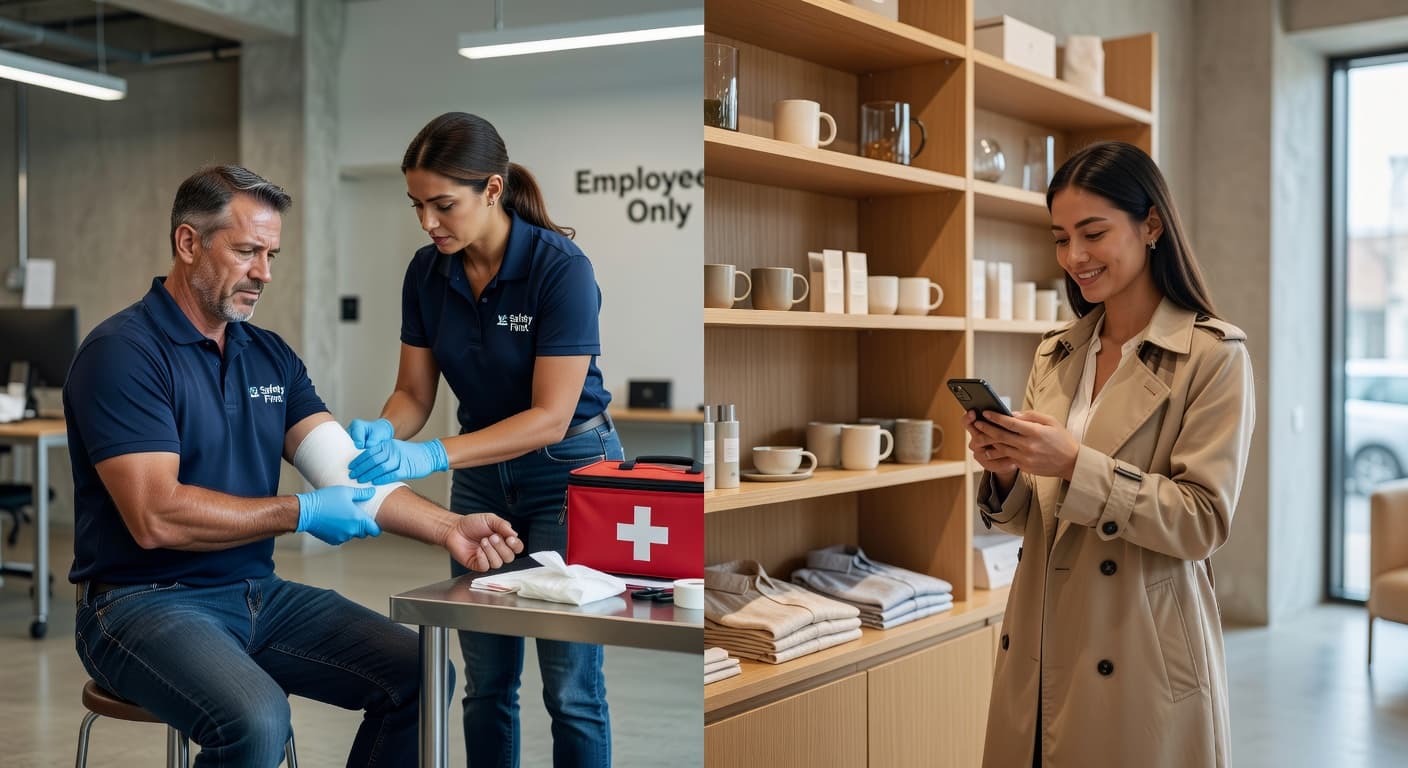
Workers compensation insurance can help pay medical expenses, lost wages, rehabilitation costs, and death benefits for employees who are injured or become ill as a result of their job duties. It is a no-fault system, meaning employees receive benefits regardless of who caused the injury. If a warehouse worker strains their back lifting boxes, a construction worker falls from scaffolding, or an office employee develops carpal tunnel syndrome from repetitive keyboard use, workers compensation can help pay for their treatment and a portion of their lost income while they recover. In the unfortunate event that an employee dies from a work-related injury or illness, workers comp provides death benefits to the employee's dependents.
General liability insurance can help cover claims made by third parties, meaning people who are not your employees, for bodily injury, property damage, and personal or advertising injury. If a customer slips on a wet floor in your store and breaks their hip, if your landscaping crew accidentally damages a client's fence, or if a visitor to your office trips over an electrical cord and is injured, general liability insurance responds. It also may cover claims of defamation, copyright infringement in your advertising, and certain other non-physical injuries that your business operations cause to third parties.
The critical distinction is who is being protected. Workers compensation responds when your own employees are hurt on the job. General liability responds when someone outside your workforce is injured or suffers damage because of your business operations. These two populations, your employees versus third parties, represent fundamentally different risk categories that require fundamentally different insurance solutions. Neither policy can substitute for the other, and a claim under one policy would not trigger coverage under the other.
Key Differences Between Workers Comp and General Liability
The legal basis for each policy represents the most fundamental difference. Workers compensation is governed by state statute and is mandatory in almost every state for businesses with employees. The specific requirements vary by state, including which businesses must carry coverage, the minimum number of employees that triggers the requirement, and whether certain types of workers like independent contractors, agricultural workers, or domestic employees are included or excluded. Failure to carry required workers compensation coverage is a serious legal violation that can result in criminal penalties, civil fines, stop-work orders, and personal liability for business owners.
General liability insurance, by contrast, is not legally required by statute in most states. However, it is effectively mandatory for most businesses because landlords require it in commercial leases, clients require it in contracts, licensing boards and professional associations may require it as a condition of membership, and banks may require it as a condition of lending. While the government may not fine you for lacking general liability coverage, the practical consequences of operating without it can be equally severe.
The claims process for each policy also differs significantly. Workers compensation claims are typically handled through an administrative system overseen by the state's workers compensation board or commission. Disputes are resolved through administrative hearings rather than civil court. The no-fault nature of the system means that in most cases, the employer does not need to prove it was not negligent, and the employee does not need to prove the employer was negligent. Benefits are determined by statutory schedules that specify the amount of wage replacement, medical coverage, and disability benefits available.
General liability claims follow the traditional civil litigation process. The injured third party files a claim or lawsuit against your business, alleging that your negligence caused their injuries or damages. Your insurance carrier provides legal defense and negotiates settlements or pays judgments up to the policy limits. Unlike workers comp, fault is a central issue in general liability claims. If the injured party cannot prove that your business was negligent or otherwise at fault, the claim may be denied or defeated. This adversarial process can be lengthy and expensive, which is why defense cost coverage is such a valuable component of general liability insurance.
When Each Policy Responds
Understanding which policy responds in various scenarios is essential for ensuring your business is properly protected. Workers compensation responds whenever an employee suffers an injury or illness that arises out of and in the course of their employment. This phrase is a legal standard that has been interpreted by courts across the country for over a century. Generally, it means the injury must be related to the employee's job duties and must occur while the employee is performing work or engaged in activities incidental to their employment.
Common workers compensation scenarios include an employee who is injured while operating machinery, a delivery driver who is hurt in a vehicle accident while making deliveries, a restaurant worker who is burned in the kitchen, or an office worker who slips on a wet floor in the workplace. Less obvious scenarios also qualify, such as a traveling employee who is injured at a hotel during a business trip, an employee who develops a repetitive stress injury over months or years of performing the same task, or an employee who contracts an occupational disease from exposure to hazardous substances in the workplace.
General liability responds when a third party suffers bodily injury or property damage caused by your business operations, your products, or your premises. A customer who slips in your store is a classic premises liability claim under general liability. A homeowner whose property is damaged by your construction crew triggers the operations coverage. A consumer who is injured by a product you manufactured or sold triggers the products liability coverage. General liability also responds to personal and advertising injury claims such as libel, slander, false arrest, or copyright infringement in your advertising.
There are situations where both policies could be implicated by the same incident, though they would cover different aspects. Consider a scenario where a construction worker accidentally drops a tool from scaffolding, injuring both a co-worker and a pedestrian below. The co-worker's injuries would be covered by workers compensation. The pedestrian's injuries would be covered by general liability. Each policy responds to help protect a different party, and having both policies in place means each injured party has a policy positioned to respond while the business is protected from both claims.
Do You Need Both Policies?
For virtually every business with employees, the answer is a definitive yes. Workers compensation is legally required in nearly every state for businesses with employees. Texas is the most notable exception, South Dakota's system is also elective for most private employers, Wyoming mandates coverage only for designated hazardous occupations, and many states apply employee-count thresholds before the requirement kicks in. Even in Texas, opting out of workers compensation exposes the business to significant legal risk because employers who do not carry workers comp lose important legal defenses if an injured employee sues them. As a practical matter, workers compensation insurance is mandatory for any business that employs people.
General liability insurance is equally essential even though it is not required by statute. Any business that interacts with the public, operates on premises that others may visit, provides services at client locations, or sells products that could cause injury needs general liability coverage. The financial exposure from a single uninsured general liability claim can be catastrophic. A serious slip-and-fall injury can result in a substantial claim when medical bills, pain and suffering, and legal costs are considered. A product liability claim can reach into the millions. Without general liability insurance, these costs come directly from your business assets.
The consequences of carrying one policy but not the other can be devastating. A business with general liability but no workers compensation faces criminal penalties if an employee is injured and discovers the employer is uninsured. The business owner may become personally liable for all medical costs, lost wages, and additional damages. Conversely, a business with workers compensation but no general liability is fully exposed to third-party claims that could result in lawsuits, judgments, and potential bankruptcy.
For most businesses with employees, carrying both workers compensation and general liability insurance is the practical minimum foundation of an insurance program. In many cases, additional policies such as commercial auto, professional liability, cyber liability, and umbrella coverage are also advisable depending on the nature of the business. But workers comp and general liability together form the essential baseline that can help protect your employees, your customers, and your business from the most common and potentially devastating types of claims.
Common Misconceptions
One of the most prevalent misconceptions is that general liability insurance may cover employee injuries. It does not. General liability explicitly excludes coverage for injuries to your own employees. This exclusion exists because workers compensation is designed to be the exclusive remedy for workplace injuries. If an employee is hurt on the job, the claim goes through workers compensation, not general liability. Business owners who assume their general liability policy will respond to an employee injury are in for a rude and expensive awakening when a claim arrives and no workers comp coverage is in place.
Another common misconception is that small businesses with only one or two employees do not need workers compensation insurance. While some states exempt very small employers from the workers comp mandate, many states require coverage as soon as you hire your first employee. Florida requires workers comp for construction companies with one or more employees and for non-construction businesses with four or more employees. California requires workers comp for all employers regardless of size. New York requires coverage for virtually all employees. Failing to research and comply with your state's specific requirements is not a viable strategy.
Many business owners also mistakenly believe that independent contractors are covered by their workers compensation or general liability policies. In general, workers compensation only covers employees, not independent contractors. However, the legal definition of employee versus independent contractor varies by state and is subject to increasing scrutiny by regulators and courts. If a worker you classify as an independent contractor is later determined to be an employee under your state's workers comp laws, you may face penalties for failing to provide coverage. General liability may cover injuries your independent contractors cause to third parties depending on your policy terms, but this is a nuanced area that requires careful review.
A final misconception worth addressing is the belief that purchasing a business owners policy, or BOP, eliminates the need for workers compensation. A BOP typically bundles general liability with commercial property insurance and sometimes other coverages, but it never includes workers compensation. Workers comp must always be purchased as a separate policy. Business owners sometimes purchase a BOP believing they have comprehensive coverage, only to learn they have no workers compensation protection at all.
How to Buy Both Policies
Purchasing workers compensation and general liability insurance can be done through several channels, and the right approach depends on your business size, industry, and complexity. The most efficient method for most small and mid-sized businesses is to get a quote with CPK Insurance and connect with a licensed insurance professional who can help you compare options for both policies. A licensed insurance professional from a participating provider can compare coverage options and pricing to find the right fit for your specific needs.
When purchasing workers compensation, you will need to provide detailed information about your business operations, including the number of employees, their job classifications, your total annual payroll, and your claims history. Workers comp premiums are calculated based on your payroll and the classification codes assigned to your employees' job duties. Higher-risk classifications like roofing, electrical work, or trucking carry significantly higher rates than lower-risk classifications like clerical work or sales. Your experience modification rate, or mod rate, also affects your premium. This factor, calculated based on your claims history relative to other businesses in your industry and size category, can increase or decrease your premium.
For general liability, carriers will want to know your business type, annual revenue, number of employees, years in business, and claims history. Premiums are typically calculated based on your revenue or payroll, depending on your industry, multiplied by a rate per thousand dollars. Cost varies based on your industry, revenue, payroll, claims history, limits, and deductibles.
CPK Insurance streamlines the shopping process by gathering your information once and helping you compare both policies through participating licensed insurance providers. A licensed insurance professional from a participating provider can help confirm that your workers compensation classifications are accurate, which is critical because incorrect classifications can result in overpaying for coverage or being underinsured, and can coordinate the effective dates, policy terms, and renewal schedules of both policies to simplify your ongoing insurance management. For businesses that qualify, general liability may be packaged with commercial property insurance in a BOP and workers compensation added as a companion policy, creating a cohesive insurance program that addresses your primary risk exposures.
Request a Quote Comparison
Enter your ZIP code to compare insurance rates from top carriers.
Updated July 17, 2026