







































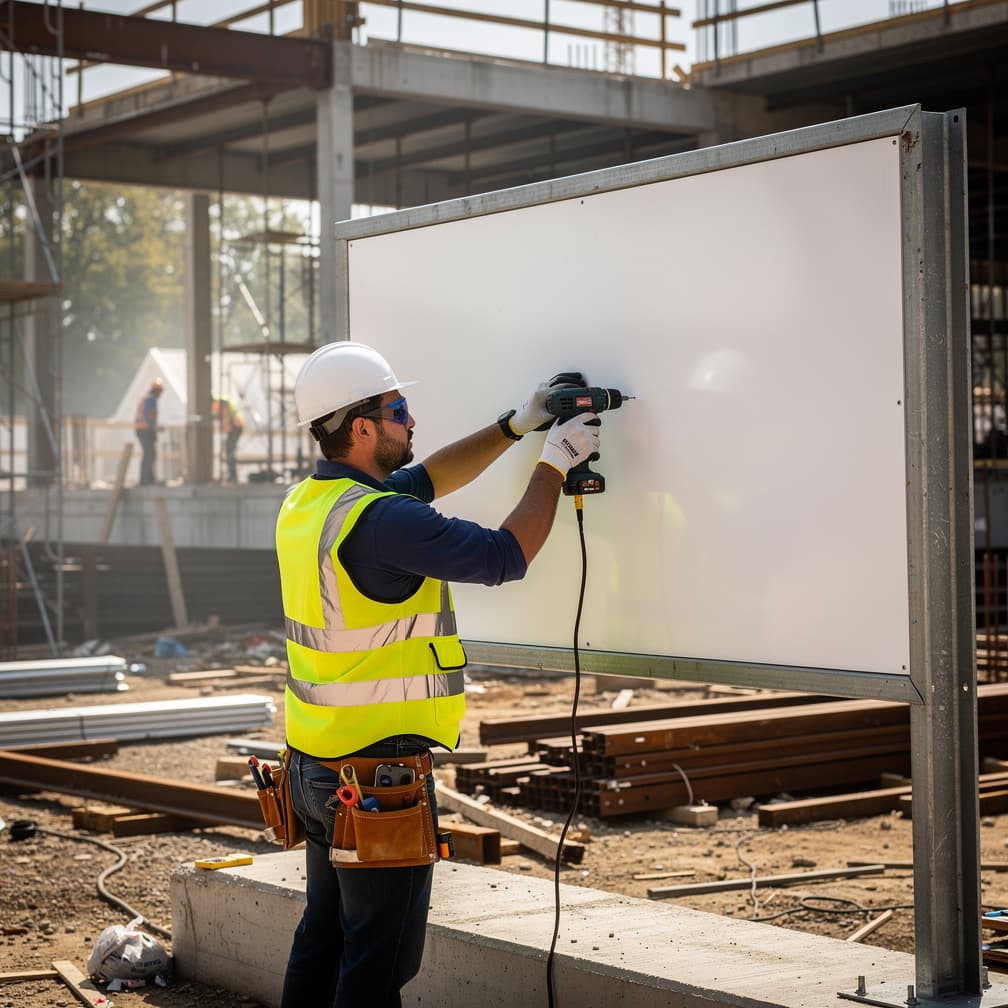

Trade counts matter to underwriters more than they matter to owners: about 540 sign installation contractors in Maricopa County share a rating class built from other people's claims. Yours gets priced against that pattern until you have enough history of your own to argue with it. Sign installation contractor insurance in Mesa therefore starts as a class question and becomes a you question after a few renewals. Clean loss runs, a documented safety routine, and an accurate payroll split are the levers you actually hold. Guessing at payroll to shave a quote tends to surface at audit, which is the expensive way to learn it. The sections below explain what each line is doing on a sign job and where the published ranges come from, so the comparison is apples to apples.
What Makes Mesa Different
Big markets do not hand you more work; they hand you more parties to satisfy. Maricopa County has about 108,000 businesses, and each storefront in that count sits under a lease with terms. The lease decides who approves your sign, who inspects the mount, and who complains later. You may deal with a tenant, a property manager, and a national brand's facility team. Three approvals means three chances that somebody demands proof of coverage before your lift moves. Every added party also widens the pool of people who can sue over one dropped panel. That is a limits question rather than a premium question, and the two get confused often. Ask what your worst realistic claim costs, then buy the limit that answers it in Mesa.
Local Risk Factors in Mesa
Plan the schedule around the heat and let the policy handle what is left over. Starting early and stopping mid-afternoon is the least expensive safety program a sign crew can run, and it costs nothing but arranging. Heat pushes claim frequency in the ways you would expect: dropped tools, mistakes on anchors, short tempers on a lift. Frequency is what moves a renewal, more than any single large claim does. Ask a carrier in Arizona how it views a documented heat policy, and put the routine in writing before a hot stretch in Maricopa County tests it.
What Coverage Does a Sign Installation Contractor in Mesa Need?
General Liability
Landlords, general contractors, and franchise facility teams ask for this one by name before a lift ever touches their property. It can respond when your work damages a customer's building or injures somebody nearby, and completed-operations wording extends that reach to failures showing up after you leave. Damage to the sign itself, caused by your own faulty work, is typically excluded.
Example: A channel letter slips during a second-story mount and cracks the storefront glass below; general liability can help cover the window, the cleanup, and the claim the tenant files afterward.
Workers Compensation
Injuries to your own crew sit outside General Liability, and that gap is what this line fills. A fall from a lift, a shoulder torn lifting a panel, or heat illness on a roof deck may be handled here, including medical bills and a portion of lost wages. Requirements vary by state, and the Arizona Department of Insurance and Financial Institutions publishes the current requirements for employers in Arizona.
Example: A groundman steadying a pylon panel takes the weight wrong and tears a shoulder; workers compensation is generally where the surgery and the missed weeks get sorted out.
Commercial Auto
Trucks, trailers, and the lift towed behind them are business vehicles, and personal auto policies commonly exclude business use altogether. This line rates on what you drive, how far, and who is behind the wheel. It might answer for damage you cause in a parking lot as well as damage to your own vehicle. Tools riding inside are a separate question worth asking about.
Example: Backing a bucket truck into a tight lot in Mesa, your crew catches a parked sedan's fender; commercial auto is typically the line that settles that repair.
Commercial Property
Everything the other lines ignore lives here: the shop, the fabrication equipment, the vinyl and substrate on the racks, and finished panels waiting on an install date. Fire, theft, and named storm perils are the usual causes of loss. Flood is typically excluded and priced separately, and tools away from the premises often fall outside this form as well.
Example: Somebody cuts the lock on your yard overnight, and the ladders, hardware, and two pallets of substrate are gone by morning; commercial property may pick up the replacement cost.
How Much Does Sign Installation Contractor Insurance Cost in Mesa?
Sign Installation Contractor Insurance is a bundle of separate policies, priced separately. The ranges below are typical figures for Mesa for each line, except workers compensation, which is rated per $100 of payroll; a quote prices each one against your own operations.
| Coverage | Typical range | What moves your price |
|---|---|---|
| General Liability Insurance | $210 - $700 per month | Industry and risk classification, annual revenue, number of employees |
| Workers Compensation Insurance | $0.75 - $2.74 per $100 of payroll | Employee classification codes, total annual payroll, experience modification rate |
| Commercial Auto Insurance | $320 - $875 per month | Fleet size and vehicle types, driver records and experience, coverage limits and deductibles |
| Commercial Property Insurance | $120 - $420 per month | Building value and construction type, roof age and condition, fire protection class |
Prices shown are general estimates, not guaranteed rates or quotes. Your actual premium will depend on the insurer, coverage selected, business details, location, claims history, and other underwriting factors. Learn about our pricing methodology.
What Are the Insurance Requirements for a Sign Installation Contractor in Mesa?
Workers' comp is generally required once you have your first employee. Arizona generally requires employers to carry workers' compensation at that point. Common exemptions include sole proprietors, partners, and working members of LLCs. Confirm current thresholds with your state's workers' compensation agency before you hire.
State auto liability minimums apply to business vehicles. Arizona's minimum auto liability limits are $25,000/$50,000/$15,000 (bodily injury per person / per accident / property damage). Contracts and lenders often require more than the state floor.
Flood damage is typically excluded from standard policies. Standard commercial property and builders-risk-type policies typically exclude flood damage. Flood exposure varies address by address, so check your premises in FEMA's Flood Map Service Center before deciding; if you sit in a mapped flood zone, a separate policy through the National Flood Insurance Program is the usual starting point.
Where to verify licensing and coverage rules. The Arizona Department of Insurance and Financial Institutions publishes consumer guidance and current insurance requirements for Arizona businesses. When a contract or lease demands specific wording, the Arizona Department of Insurance and Financial Institutions's guidance is the authoritative place to check.
Get Your Sign Installation Contractor Quote in Mesa
Compare rates from multiple carriers. Free quotes, no obligation.
Operating in Mesa
- Subcontracted crane time can be treated as your payroll at audit unless you hold the operator's certificate, and carriers in Arizona look backward, not forward.
- Anchor conditions inside a wall stay unknown until you drill, and nobody hands you the drawings for a building you did not construct.
- Work in Maricopa County can cross into a neighboring one before lunch, which puts more of your day on a highway than on a ladder.
- Deposits get spent on materials, so a job cancelled after fabrication leaves you holding a custom panel that nobody else will ever want.
How to Buy: Advice for Mesa Owners
Certificates of insurance run on a rhythm most shops learn the hard way. Someone requests one the day before an install, your carrier issues it, and the requester rejects it because the additional-insured endorsement is missing. Head that off by keeping a standing list of who needs to be named, and by asking for blanket additional-insured wording on your General Liability where a carrier offers it. Ask what a Commercial Property policy expects for the shop and the stored materials while you are in there. Set renewal at least a month ahead of your busiest stretch so certificates never expire mid-job in Mesa. The Arizona Department of Insurance and Financial Institutions publishes consumer guidance on how policies are documented in Arizona. Ask each participating carrier what it will put in writing about endorsements, and weigh that answer before the price.
FAQ
Sign Installation Contractor Insurance in Mesa: FAQ
Not automatically. A Commercial Property policy usually concentrates on what sits at your shop, and tools away from the premises can fall outside it unless the form or an endorsement addresses them. Ask specifically about equipment in transit and at a jobsite, since a sign crew's tools spend most of their life in neither spot. Keep serial numbers and photographs either way.
Two ceilings apply at once. The per-occurrence figure caps what a policy may pay on a single claim; the aggregate caps everything paid across the whole term. A sign shop with one bad fall and two cracked storefronts can burn through the aggregate while the per-occurrence number still looks healthy. Watch both, because the renewal after a year like that is a different conversation.
The deductible is the part of a loss you fund before the policy participates at all. Choosing a higher one lowers the premium and moves risk back onto you, which is a fair trade for replaceable tools and a poor one for a total shop loss. Picture a realistic claim, then pick the number you could write a check for tomorrow.
Usually yes, though territory and radius both show up on the application, and a wide operating radius gets rated. If most installs sit an hour or more from the shop, say so, because a carrier that priced you as a local operation may look at a highway claim differently. Describing the real footprint costs less than arguing about it afterward.
It depends on whose property it is and where the failure started. Damage to a customer's finished sign is generally their property loss rather than yours, unless your installation gets blamed for the failure. Once a claim points at your anchoring, General Liability is the line that comes into it. Documentation of the install method is what settles that argument.
Usually, though the price and the terms change. Participating carriers in Arizona weigh how recent the claim is, what caused it, and what you changed afterward. A documented tie-off routine or a new spotter policy adopted after an incident is evidence, and evidence is what moves an underwriter. Three clean years does more for a renewal than any negotiating tactic, so the fix starts on the jobsite.
Sources
- 1.U.S. Census Bureau, County Business Patterns (2022), Maricopa County(Maricopa County has about 108,000 business establishments.)
- 2.U.S. Census Bureau, County Business Patterns (2023), Maricopa County(Maricopa County has about 540 businesses in this trade's category (NAICS group 238990).)
- 3.Arizona Department of Insurance and Financial Institutions(Arizona Department of Insurance and Financial Institutions publishes consumer guidance for insurance buyers.)
- 4.FEMA / FloodSmart(Flood coverage is typically purchased separately; FEMA administers the National Flood Insurance Program.)


