







































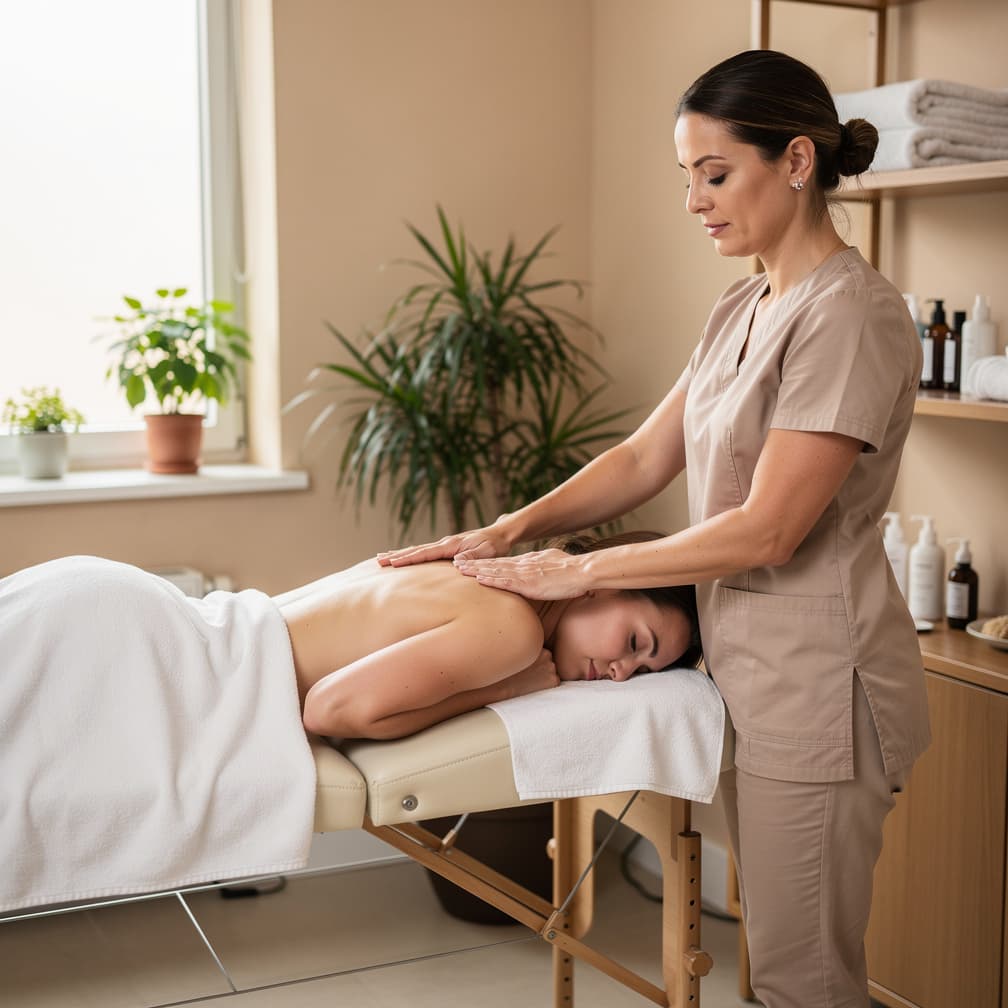

A market holding about 530 massage businesses gives contracts real weight, because chiropractic clinics, gyms, and wellness centers renting out rooms can pick whoever brings the cleanest paperwork. Being named as an additional insured on somebody else's schedule is often the price of a room in their building. Massage business insurance in Peoria ends up shaped by other people's requirements as much as by your own risk. Read what those requirements actually say, since a limit that satisfies one host can fall short for the next. The exposure underneath never changes with the venue. A client who feels worse after a session names the therapist, the studio, and the building owner, and the insurers argue about it afterward.
What Makes Peoria Different
Bad weather turns a treatment room into a storage problem before it turns into a claim. Tables get stacked, linens get moved, and equipment ends up in whatever corner of the suite stayed dry. Damage that happens during that scramble is still damage, and it still has to be explained later. Note what you moved and when, because a loss caused by handling reads differently than one caused by the storm. Every Arizona form draws that line somewhere, and the line stays invisible until you have crossed it. Weather also changes who is in your hallway: wet shoes, umbrellas, and a floor nobody has mopped yet. A slip claim from a client in Peoria does not care whether the water came from a sky or a sink. Mats, signage, and a dry floor cost less than the deductible on the claim they prevent.
Local Risk Factors in Peoria
Before the hottest stretch, put two questions to whoever quotes you: what happens if the cooling fails, and what happens if the power drops. The first is usually an equipment breakdown question and the second a utility interruption question, and different parts of a program answer them. Neither is automatic. A Peoria studio that loses three days to a dead compressor has lost real money and has no wet drywall to show anyone. Get both answers in writing from participating carriers in Arizona while the weather is still boring.
What Coverage Does a Massage Business in Peoria Need?
Professional Liability
A client who says the session left them in more pain than they arrived with is making a claim about your judgement rather than your floor. Professional Liability is the line generally aimed at that: the alleged injury, the skin reaction, the pressure that went further than it should have. It typically does nothing about a slip in the hallway.
Example: Two days after a deep tissue session a client sees a doctor about a strained shoulder and sends a demand letter naming your studio; Professional Liability may respond to the claim and to the defense that follows it.
General Liability
Wet floors, tight hallways, and clients moving slowly after a treatment produce the ordinary injuries that have nothing to do with your hands. General Liability is what landlords and hosts want proof of, and it can help cover a client's fall on your premises or a coat ruined in your room. Complaints about the treatment itself sit elsewhere.
Example: A client stands up too quickly, catches a table leg, and breaks a wrist on a Peoria reception floor; general liability limits are typically what the resulting claim gets argued against.
Commercial Property
Tables, warmers, linens, oil stock, cabinetry, and the leasehold work you paid for are the studio, and all of it sits inside a few small rooms. Commercial Property is generally built around fire, storm, theft, and vandalism damage to those things, subject to your deductible. Rising water is usually excluded and priced as a separate decision.
Example: A fire in the unit next door leaves four massage tables and every set of linens smoke-damaged; a commercial property claim could cover replacing the contents once their values are documented.
Business Owners Policy
Buying the property side and the premises liability side apart usually costs more than buying them together, which is why a Business Owners Policy is the common starting structure for a studio with its own suite. It often adds interruption terms for the weeks a covered loss keeps rooms closed. The treatment complaint is usually not inside it.
Example: A storm opens the roof above a Peoria studio and the rooms sit closed for three weeks; a business owners policy might answer for the damaged contents and for part of the income lost while everything dries.
How Much Does Massage Business Insurance Cost in Peoria?
Massage Business Insurance is a bundle of separate policies, priced separately. The ranges below are typical figures for Peoria for each line; a quote prices each one against your own operations.
| Coverage | Typical range | What moves your price |
|---|---|---|
| Professional Liability Insurance | $45 - $140 per month | The services you actually perform, annual revenue or billed fees, limit and retention selected |
| General Liability Insurance | $40 - $120 per month | Industry and risk classification, annual revenue, number of employees |
| Commercial Property Insurance | $40 - $150 per month | Building value and construction type, roof age and condition, fire protection class |
| Business Owners Policy Insurance | $55 - $170 per month | Annual revenue and industry class, building and contents values, square footage and building age |
Prices shown are general estimates, not guaranteed rates or quotes. Your actual premium will depend on the insurer, coverage selected, business details, location, claims history, and other underwriting factors. Learn about our pricing methodology.
What Are the Insurance Requirements for a Massage Business in Peoria?
Workers' comp is generally required once you have your first employee. Arizona generally requires employers to carry workers' compensation at that point. Common exemptions include sole proprietors, partners, and working members of LLCs. Confirm current thresholds with your state's workers' compensation agency before you hire.
Flood damage is typically excluded from standard policies. Standard commercial property and builders-risk-type policies typically exclude flood damage. Flood exposure varies address by address, so check your premises in FEMA's Flood Map Service Center before deciding; if you sit in a mapped flood zone, a separate policy through the National Flood Insurance Program is the usual starting point.
Where to verify licensing and coverage rules. The Arizona Department of Insurance and Financial Institutions publishes consumer guidance and current insurance requirements for Arizona businesses. When a contract or lease demands specific wording, the Arizona Department of Insurance and Financial Institutions's guidance is the authoritative place to check.
Get Your Massage Business Quote in Peoria
Compare rates from multiple carriers. Free quotes, no obligation.
Operating in Peoria
- The lease you signed for a Peoria suite sets your minimum limits, and owners tend to read that insurance article for the first time when a host demands something bigger.
- Contractor therapists working under your name get named in complaints alongside the business, and their own policy may or may not reach the session you booked for them.
- A slip in your hallway is a premises claim, and it does not care whether the water arrived on a client's umbrella or out of your own mop bucket.
- Clients leave phones, watches, and coats in a room where they undress, and a damaged one becomes your problem the moment they mention it at the desk.
How to Buy: Advice for Peoria Owners
Read the exclusions before the price, since two quotes that look alike stop looking alike three pages in. Ask whether defense costs come out of the limit or sit outside it, because that one answer moves the real value of the number. Ask what a Business Owners Policy leaves out for a studio, and expect the client injury complaint to be on that list. Professional Liability is usually the separate purchase that fills it. Ask how long the income side keeps paying after a suite closes, and get the number of days in writing. The Arizona Department of Insurance and Financial Institutions publishes consumer guidance on how to read a commercial policy's declarations page. When the wording is clear, put the same submission in front of participating carriers in Arizona and compare what came back.
FAQ
Massage Business Insurance in Peoria: FAQ
The occurrence figure is what a single client's claim can reach. The aggregate is what an entire policy year can spend across every claim combined. A studio with a full schedule works through an aggregate faster, and once it is exhausted the next complaint meets nothing. Contracts often specify both numbers for exactly that reason. Ask whether defense costs come out of those limits, since that changes what the numbers are worth.
Timing turns on whether the form is written on a claims-made or an occurrence basis. A claims-made policy generally responds to claims reported while it is in force, which is why a lapse can cost you long after you stopped working. Prior acts wording controls how far back it looks. Ask for that paragraph in writing, because two quotes with identical limits can answer this in opposite directions.
Landlords commonly ask for proof before handing over keys, and the insurance article in a commercial lease usually names the limits and endorsements a tenant has to carry. That puts the shopping before the signing. Ask for that section in writing early, because it quietly decides part of what you buy. A certificate for a Peoria suite is quick to issue once a policy exists; the policy is the part that takes time.
Room count, revenue, staff hours, the services on your menu, and your complaint history do most of the work. The address matters less than owners expect. Anything involving heat, suction, or heavy pressure moves the number, and so does a claim from three years ago that nobody ever paid out. A quote built without those questions is a placeholder. Participating carriers in Arizona weigh the same facts differently, which is why one quote settles nothing.
That complaint is about the treatment rather than the premises, so it generally points at Professional Liability instead of General Liability. The distinction matters because a studio can hold one line and not the other and never notice until a demand letter lands. What decides the outcome is usually documentation: the intake form, the contraindication questions, and notes written down at the time of the session.
A client can bring a claim for irritation, a rash, or a burn from a hot stone, and whether it goes anywhere depends on what you knew and what you recorded. Asking about allergies at intake and writing the answer down is the least expensive defense available. Complaints of that kind typically sit on the professional side of a program rather than the premises side, though wording differs between forms.
Sources
- 1.U.S. Census Bureau, County Business Patterns (2022), Maricopa County(Maricopa County has about 530 businesses in this trade's category (NAICS group 812199).)
- 2.Arizona Department of Insurance and Financial Institutions(Arizona Department of Insurance and Financial Institutions publishes consumer guidance for insurance buyers.)
- 3.FEMA / FloodSmart(Flood coverage is typically purchased separately; FEMA administers the National Flood Insurance Program.)


