







































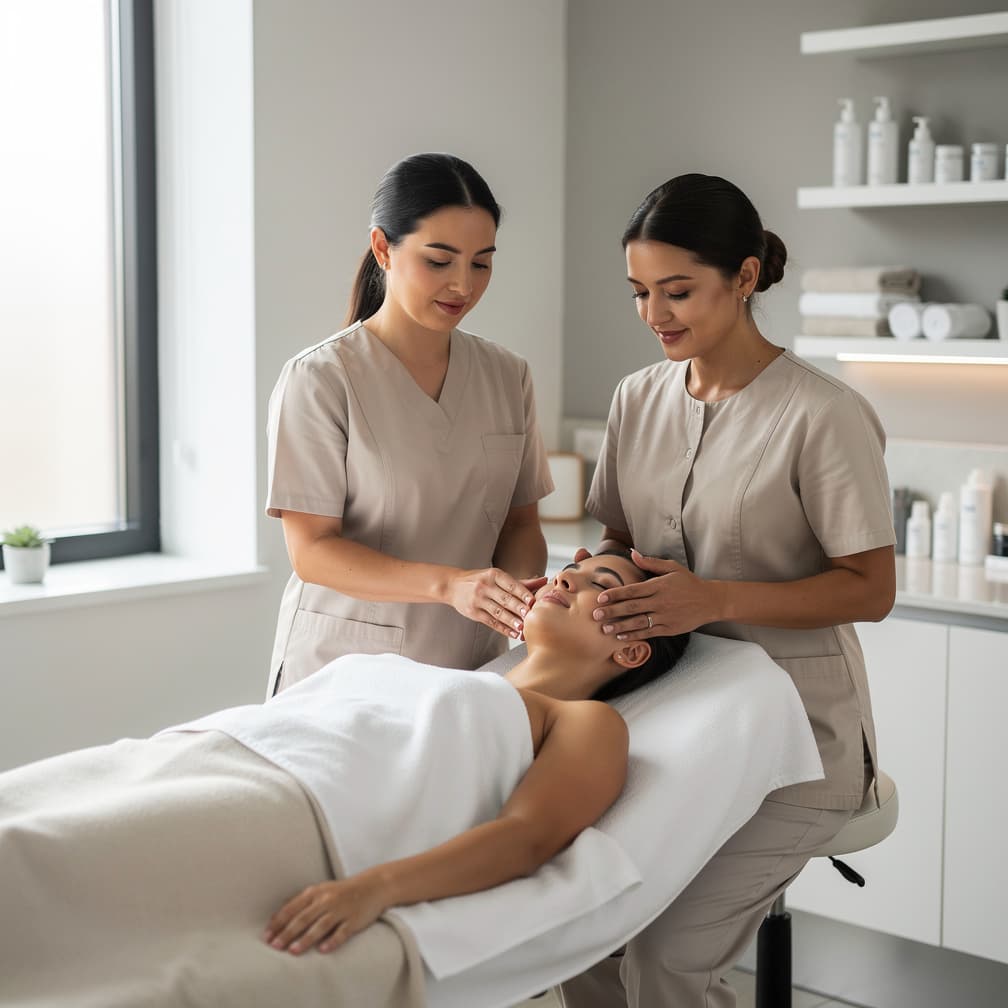

Extractions go deeper than planned, a mark forms, and six weeks later a letter arrives with your name on it. The distance between a routine facial and a legal file is the entire case for esthetician insurance in Phoenix. Slips count just as much: a client steps off the table onto a wet floor and the injury has nothing to do with skin. Equipment is the quiet version of the same problem, since a cracked steamer or a dead light device stops bookings until it is replaced. Those three losses land on different parts of a policy, and the limit that answers one may be irrelevant to another. Participating carriers in Arizona price each of them differently, which is why a single quote tells you very little. Compare a few before you commit.
What Makes Phoenix Different
About 1,300 esthetician businesses work in Maricopa County, enough for a carrier to have rated this class before. Familiar classes get priced on standard questions: service menu, treatment depth, client volume, and claims history. Unfamiliar ones get priced on caution, and caution tends to cost the applicant more money. That works in your favor, but only if you answer the standard questions accurately the first time. Understating your peel volume to win a lower number puts the whole file at risk later. Carriers verify at claim time, and a mismatch between application and reality is where disputes start. So the advantage of a well-known class is speed and price, not permission to round things down. Answer plainly, then compare what participating carriers return for a room in Phoenix on identical facts.
Local Risk Factors in Phoenix
Heat reaches the equipment in a treatment room long before anyone calls it uncomfortable. A failing air conditioner makes peels and extractions unpleasant and eventually unsafe, and product on the shelf has a temperature range it does not announce. Spoiled inventory is a real loss with an invoice attached, and it typically needs specific wording rather than a general assumption. Commercial property may respond to equipment breakdown and spoilage where the form includes them, and may say nothing at all where it does not. Ask which applies to your space, then confirm it with participating carriers in Arizona before a hot stretch closes a room in Phoenix.
What Coverage Does an Esthetician in Phoenix Need?
Professional Liability
A client says her skin reacted badly to a peel, and the argument is about the treatment rather than a wet floor. That is the territory Professional Liability is written for: alleged harm arising from the service you performed, with defense costs often the first bill to arrive. Intentional acts stay out, and damage to your own equipment sits elsewhere.
Example: An extraction leaves a small scar, and six weeks later a demand letter arrives naming you and quoting a consent form that never mentioned extractions at all. A claim shaped like that may fall to this line.
General Liability
Landlords, suite owners, and venues ask for this one by name, and the certificate they want prints its limits. General Liability is generally written for the ordinary physical accidents around a treatment room: a client who slips near the sink, a bag knocked into a retail display. Harm alleged from the treatment itself typically belongs with Professional Liability instead.
Example: A client stands up from the table, catches a heel on a trailing cord, and lands hard enough to need imaging that afternoon. The premises side of a policy in Phoenix could pick that up.
Commercial Property
Flood typically sits outside this form, and so does a device that simply wore out. What remains is the core of a treatment room: the table, the steamer, the sterilizer, the light device, the retail shelf, and the improvements you paid to install. Commercial Property might respond to fire, theft, vandalism, and storm damage, built on the values you reported.
Example: A break-in overnight empties the locked cabinet of devices and serums, and the morning's bookings leave with them. With current values already on file, a loss like that might be handled here.
Business Owners Policy
One form instead of two is the whole idea. A Business Owners Policy bundles the property side of a treatment room with the liability side, and it often adds an income piece for the weeks a room cannot open. Whether it beats separate lines depends on equipment values and the limits a lease demands, so price both.
Example: A fire two floors up closes the building for a month, and a suite in Phoenix loses its room and its schedule in the same afternoon. A bundled form is designed to answer both halves.
How Much Does Esthetician Insurance Cost in Phoenix?
Esthetician Insurance is a bundle of separate policies, priced separately. The ranges below are typical figures for Phoenix for each line; a quote prices each one against your own operations.
| Coverage | Typical range | What moves your price |
|---|---|---|
| Professional Liability Insurance | $40 - $130 per month | The services you actually perform, annual revenue or billed fees, limit and retention selected |
| General Liability Insurance | $40 - $120 per month | Industry and risk classification, annual revenue, number of employees |
| Commercial Property Insurance | $40 - $160 per month | Building value and construction type, roof age and condition, fire protection class |
| Business Owners Policy Insurance | $50 - $160 per month | Annual revenue and industry class, building and contents values, square footage and building age |
Prices shown are general estimates, not guaranteed rates or quotes. Your actual premium will depend on the insurer, coverage selected, business details, location, claims history, and other underwriting factors. Learn about our pricing methodology.
What Are the Insurance Requirements for an Esthetician in Phoenix?
Workers' comp is generally required once you have your first employee. Arizona generally requires employers to carry workers' compensation at that point. Common exemptions include sole proprietors, partners, and working members of LLCs. Confirm current thresholds with your state's workers' compensation agency before you hire.
Flood damage is typically excluded from standard policies. Standard commercial property and builders-risk-type policies typically exclude flood damage. Flood exposure varies address by address, so check your premises in FEMA's Flood Map Service Center before deciding; if you sit in a mapped flood zone, a separate policy through the National Flood Insurance Program is the usual starting point.
Where to verify licensing and coverage rules. The Arizona Department of Insurance and Financial Institutions publishes consumer guidance and current insurance requirements for Arizona businesses. When a contract or lease demands specific wording, the Arizona Department of Insurance and Financial Institutions's guidance is the authoritative place to check.
Get Your Esthetician Quote in Phoenix
Compare rates from multiple carriers. Free quotes, no obligation.
Operating in Phoenix
- Water damage rarely starts in your own room. It starts one floor up, arrives overnight, and your table, linens, and product shelf absorb it while the building argues about the pipe.
- Wet floors near the sink produce more premises claims than anything that happens on the table, and the person who slips in your Phoenix waiting area is often the one still waiting.
- The booth agreement in front of you may run a single page, with the whole insurance requirement in one line, which leaves the limit, the naming, and the renewal terms open to argument later.
- A carrier rating a room in Maricopa County asks for weekly client volume, and answering with your best month rather than your ordinary week is exactly the sort of thing that resurfaces at claim time.
How to Buy: Advice for Phoenix Owners
Price the room honestly. Owners tend to report what they paid rather than what replacement costs today, and the gap shows up when a claim settles on the number they supplied. Walk the space with a notepad: table, steamer, magnifying lamp, sterilizer, light device, retail shelf, linens, and the cabinetry you built. Add the tenant improvements, because those often belong to you rather than the landlord even when they are bolted down. Commercial Property limits are built on that total, and an undercounted room funds its own shortfall. The Arizona Department of Insurance and Financial Institutions publishes consumer guidance on valuing business property. With the list in hand, participating carriers quoting a Phoenix room are pricing the same thing, and the comparison finally means something.
FAQ
Esthetician Insurance in Phoenix: FAQ
A certificate showing a policy you already hold is straightforward. Adding a party by endorsement is a policy change, and that takes longer, which is why a request the week you open turns into a scramble. Ask for naming requirements early, confirm a carrier can issue the exact form, and keep the endorsement itself rather than only the summary page.
A Business Owners Policy bundles property and liability into one form, which can be simpler to manage and sometimes prices better than separate lines for one location. Whether it fits depends on your equipment values, the limits your lease demands, and how the form treats the treatment side of your work. Price both structures on identical facts in Arizona rather than assuming the bundle wins.
They often are, and the declarations page is where you find out. A property deductible applies to your own equipment and room; a liability claim may carry a separate one, or none at all. Choosing a high deductible to lower the monthly figure is a bet on cash flow during a slow stretch. Read the deductible line for each part of an Arizona policy before you sign.
A lapse usually breaks the insurance clause in a rental agreement, and the landlord finds out when the certificate expires rather than when a claim arrives. Some agreements let the owner suspend your access or charge you for coverage they buy on your behalf. Nothing gets issued retroactively, so a gap stays a gap. Put the renewal date beside the rent date for your Phoenix space.
Occasional does not mean unrated. A peel you perform once a month is still a peel on the application, and leaving it off is the kind of gap that surfaces when a claim gets verified. Tell the carrier the full menu, including anything a client can add on arrival, and let the price reflect it. A quote built on a partial menu is not really your quote.
The salon's own policy generally answers for the salon, not for what happens on your table. Owners who rent chairs commonly require proof of coverage in the rental agreement, and some ask for it before handing over a key. Read the agreement for the limit and the naming requirement, then price your own coverage against that wording rather than guessing at it.
Sources
- 1.U.S. Census Bureau, County Business Patterns (2023), Maricopa County(Maricopa County has about 1,300 businesses in this trade's category (NAICS group 812112).)
- 2.Arizona Department of Insurance and Financial Institutions(Arizona Department of Insurance and Financial Institutions publishes consumer guidance for insurance buyers.)
- 3.FEMA / FloodSmart(Flood coverage is typically purchased separately; FEMA administers the National Flood Insurance Program.)


