







































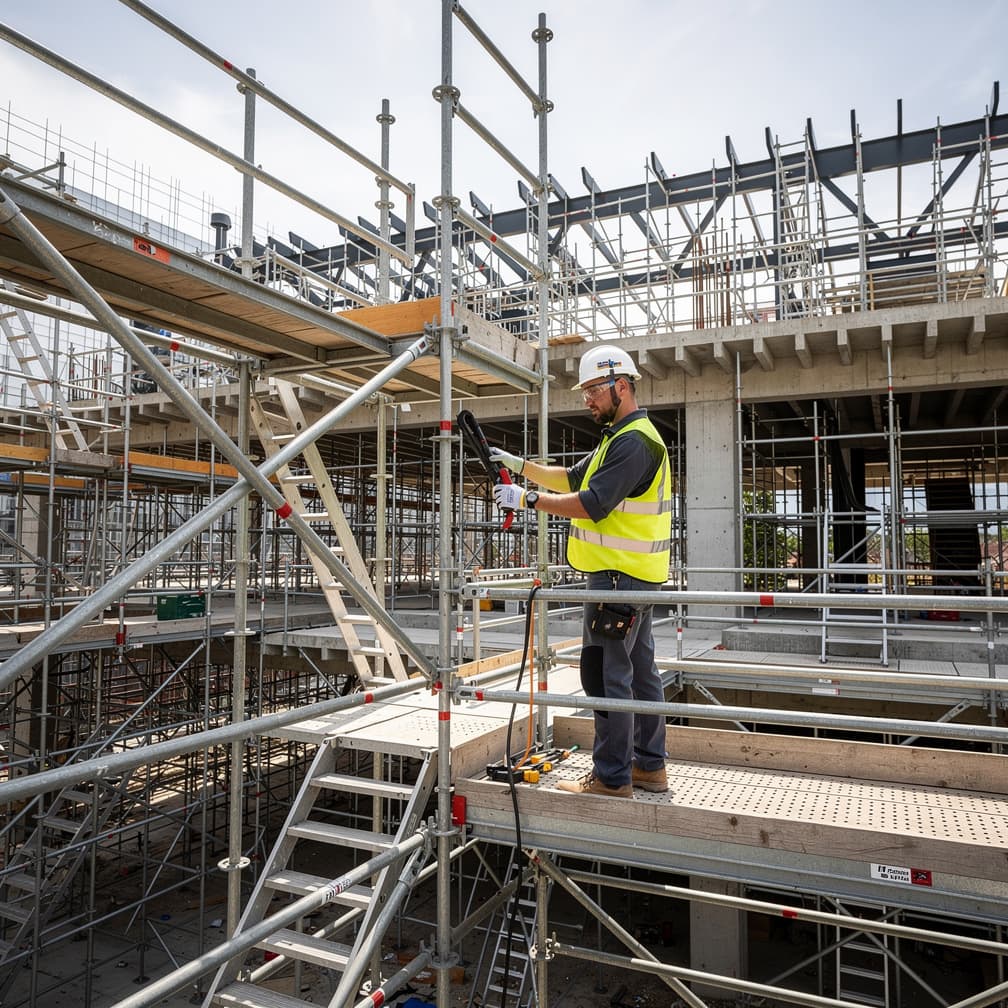

Guardrails come off when another trade needs an opening, and they do not always go back on before someone steps out onto the deck. The fall that follows is your claim even though your crew never touched the rail. Scaffolding company insurance in Phoenix starts from that fact and works outward to the injured bystander, the damaged facade, and the truck hauling braces at dawn. Workers Compensation pricing runs off payroll and class code, so your rate moves with your crew, your loss record, and how honestly the payroll gets split between yard work and work at height. Contract limits arrive separately and rarely bend. What follows sets out both sides, so a Phoenix bid can carry its real insurance cost instead of a guess.
What Makes Phoenix Different
About 540 scaffolding companies work Maricopa County, a small enough population that underwriters treat the class as its own file. Specialty classes get judged on the trade's loss picture, and this trade's loss picture is falls and collapses. Your fall program, your tag system, and your inspection log therefore carry more weight than your revenue figure does. An erector with photographs of completed tie-ins and a written dismantle sequence is a different applicant than one without. Carriers looking at a narrow class also compare you against the last submission they saw from the same trade. Being the tidy file is a pricing advantage, and it costs nothing but an afternoon. Ask what documentation moves a rate before you accept the first number you are handed. In a small class, the underwriter's questions are the real quote.
Local Risk Factors in Phoenix
Before the hot months, write the heat plan and keep the records that prove you ran it. Water, shade, rest cycles, and a buddy check are cheap, while a fall by a fatigued erector is not, and it sits on your loss run for years after a Phoenix job ends. Carriers in this class ask what you do about heat, and a documented answer is worth more than a confident one. Schedule realistically as well, since a crew rushing a dismantle to beat the afternoon is how people get hurt. Check the Arizona Department of Insurance and Financial Institutions's guidance before deciding what a policy is meant to do for a worker who collapses on the deck.
What Coverage Does a Scaffolding Company in Phoenix Need?
General Liability
Every general contractor and building owner who lets your frames onto a site asks for this one by name. General Liability aims at the people who are not your employees: the passerby struck by a dropped coupler, the mason who slips on your deck, the storefront damaged when a section comes down. Repairing your own faulty work typically sits outside it.
Example: A brace slips during dismantle and cracks the windshield of a parked car below; the owner's claim for the glass and the paintwork is the kind of loss this line is meant to answer.
Workers Compensation
Falls define this trade, and this is the line that deals with the people who fall. Workers Compensation is built around wage replacement and medical costs for your own crew, priced per hundred dollars of payroll and rated by class code. It does not answer for an injured passerby, and uninsured helpers can land on your audit as payroll.
Example: An erector's foot goes through an unsecured plank on a Phoenix facade job and he lands on the deck below; the wage and medical side of that injury is what this coverage typically handles.
Tools & Equipment (Inland Marine)
Your declarations page lists an address; your frames spend the year everywhere else. Inland Marine follows scheduled equipment in transit, at a job site, or stacked in the yard: frames, planks, braces, screw jacks, couplers. It can often be extended to scaffold you rent or lease and owe money on. Wear, rust, and gradual deterioration are usually excluded.
Example: A trailer is stripped overnight and a full load of decking is gone before the crew arrives; a sudden equipment loss like that is generally where this cover earns its keep.
Commercial Auto
Where Inland Marine watches the steel, Commercial Auto watches the truck hauling it. This line deals with the vehicles moving frames and crews between jobs: the accident you cause, the injuries and damage that follow, and, under comprehensive terms, hail or theft to the trucks themselves. Personal policies generally exclude business use, so a family pickup on a job run is a gap.
Example: A stack of braces shifts on a highway ramp and the trailer clips a sedan; the injury claim and the repair bill are the sort of thing this line is intended to take on.
Commercial Umbrella
When a contract demands a total your primary limit cannot reach, this is usually the cheaper route to it. Commercial Umbrella sits above the liability limits you already bought and can extend them once the underlying policy is exhausted. It generally follows only the policies named as underlying, so a gap below becomes a gap above too.
Example: A collapse injures two people and damages a Phoenix storefront, and the settlement runs past the primary liability limit; the excess layer is what a total like that is meant to reach.
How Much Does Scaffolding Company Insurance Cost in Phoenix?
Scaffolding Company Insurance is a bundle of separate policies, priced separately. The ranges below are typical figures for Phoenix for each line, except workers compensation, which is rated per $100 of payroll; a quote prices each one against your own operations.
| Coverage | Typical range | What moves your price |
|---|---|---|
| General Liability Insurance | $875 - $2,600 per month | Industry and risk classification, annual revenue, number of employees |
| Workers Compensation Insurance | $0.75 - $2.74 per $100 of payroll | Employee classification codes, total annual payroll, experience modification rate |
| Inland Marine Insurance | $130 - $550 per month | Total insured value of the scheduled property, type and age of the equipment, where it is stored and how far it travels |
| Commercial Auto Insurance | $410 - $1,225 per month | Fleet size and vehicle types, driver records and experience, coverage limits and deductibles |
| Commercial Umbrella Insurance | $270 - $1,150 per month | Umbrella limit requested, limits carried on the underlying policies, loss history on those underlying policies |
Prices shown are general estimates, not guaranteed rates or quotes. Your actual premium will depend on the insurer, coverage selected, business details, location, claims history, and other underwriting factors. Learn about our pricing methodology.
What Are the Insurance Requirements for a Scaffolding Company in Phoenix?
Workers' comp is generally required once you have your first employee. Arizona generally requires employers to carry workers' compensation at that point. Common exemptions include sole proprietors, partners, and working members of LLCs. Confirm current thresholds with your state's workers' compensation agency before you hire.
State auto liability minimums apply to business vehicles. Arizona's minimum auto liability limits are $25,000/$50,000/$15,000 (bodily injury per person / per accident / property damage). Contracts and lenders often require more than the state floor.
Where to verify licensing and coverage rules. The Arizona Department of Insurance and Financial Institutions publishes consumer guidance and current insurance requirements for Arizona businesses. When a contract or lease demands specific wording, the Arizona Department of Insurance and Financial Institutions's guidance is the authoritative place to check.
Get Your Scaffolding Company Quote in Phoenix
Compare rates from multiple carriers. Free quotes, no obligation.
Operating in Phoenix
- Rented scaffold makes you answerable for steel you do not own, and the rental agreement usually sets that number long before any adjuster gets involved.
- A Phoenix sidewalk shed puts pedestrians underneath your work all day, and not one of the people walking under it ever signed anything.
- Weather rarely damages your gear so much as it strands it, since a closed Phoenix site keeps your inventory parked where you can neither use it nor watch it.
- Payroll classification is the difference between a fair Workers Compensation bill and an audit correction, because hours in the yard and hours at height do not price the same.
How to Buy: Advice for Phoenix Owners
Sequence the buying so nothing stalls the Phoenix job. Workers Compensation first if you have employees working at height, General Liability next because that is what every certificate holder asks about, then the equipment schedule and the trucks. Get the certificate wording confirmed before the signature rather than after. Ask what your carrier needs in order to add an additional insured, and get the answer in writing. Set a renewal reminder thirty days out and a second one at seven, since compliance systems send no warnings of their own. Keep one folder holding the schedule of insurance from every Phoenix contract you have signed, because the strictest one is your real spec. When it is time to shop, hand identical exposure numbers to participating carriers and compare the endorsements rather than only the premium on the front page.
FAQ
Scaffolding Company Insurance in Phoenix: FAQ
The certificate describes a policy on the day somebody printed it. The endorsement changes the policy itself. A holder listed on a certificate but never added by endorsement can find nothing standing behind the paper when a frame fails. Ask for endorsement numbers and file them with the contract that demanded them.
It follows you. Carriers underwriting this class weigh fall and collapse losses heavily, so one serious claim can shape your pricing for years after the crew involved has moved on. What helps is the record of what changed afterward: a written fall program, competent-person sign-offs, inspection photographs. Bring that file to renewal instead of waiting to be asked for it.
Generally not under standard property terms. Flood typically sits outside them and gets priced as its own decision, which catches out erectors whose yard sits low. Wind damage and water rising from the ground are often treated as two different things. Ask what your equipment form says about rising water before a wet season in Phoenix, rather than during one.
Payroll split by class code, gross receipts, a vehicle list with drivers, an equipment schedule carrying values for frames, planks, and decking, and loss runs for five years. A written fall program helps. The more you document, the less an underwriter has to guess, and guesses get priced conservatively rather than generously.
Usually, though it is the wrong order. Endorsements can typically be added mid-term, but a claim arising before the endorsement exists may never reach the party you meant to name. If a Phoenix contract calls for it, get the endorsement issued before you mobilize and keep the carrier's written confirmation with the job file.
That question splits in two. Commercial Auto is generally aimed at the vehicle and the harm it does; the frames and planks riding behind it are property, and property is where an Inland Marine form usually comes in. A load that shifts and injures another driver can pull both into a single claim. Ask each quote which piece answers for the steel itself.
Sources
- 1.U.S. Census Bureau, County Business Patterns (2023), Maricopa County(Maricopa County has about 540 businesses in this trade's category (NAICS group 238990).)
- 2.Arizona Department of Insurance and Financial Institutions(Arizona Department of Insurance and Financial Institutions publishes consumer guidance for insurance buyers.)


