







































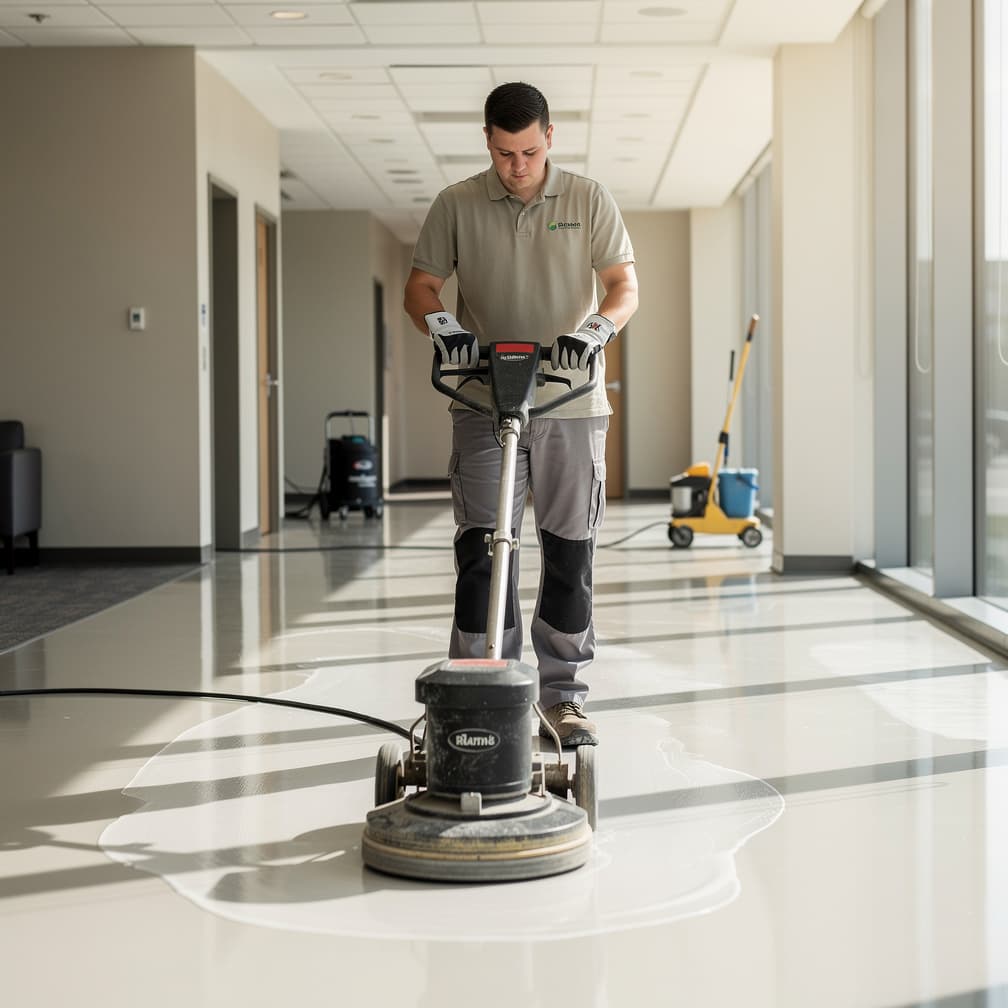

General liability for a floor waxing service typically starts around $35 a month, less than one replacement pad kit. That figure is where most owners stop reading, and it is the wrong place to stop. Price moves with payroll, with how many occupied buildings you work in after hours, and with whether a slip claim already sits in your history. Floor waxing service insurance in Corona gets quoted on those inputs, so two crews working the same block hear very different numbers. The low end of any range assumes a small operation with clean paperwork and nobody on the books. Add a helper who lifts machines and the conversation changes shape entirely. Participating carriers in California weigh those inputs differently, so compare the inputs before you compare the premiums.
What Makes Corona Different
A storm week that closes office buildings closes your schedule too, and the work rarely reschedules. Occupied buildings only free up on certain nights, and a lost night pushes everything into the next. Crews get paid for the week whether the floors got finished or not, which strains cash. In a crowded market, the buildings you lost this week can hire somebody else by the next. Wet grit tracked across a fresh finish also ruins work you have already invoiced for. Redoing a lobby at your own expense is a loss no policy is designed to answer. Ask what your form does for lost income at your own premises in Corona, and what it excludes. Then write reschedule terms into the contracts you sign in Corona, because that gap is contractual.
Local Risk Factors in Corona
Wildfire reaches a floor waxing service through smoke and closure long before flame does. Buildings in Corona shut down under poor air quality, tenants stay home, and a schedule built on after-hours access evaporates for the duration. Your shop can take smoke damage without ever being near the fire, and soot in the machines and on the pads is a real loss. Commercial Property may respond to smoke damage, subject to the wording and to how the policy treats stock. Chemicals and finish stored on site also make an underwriter in California ask harder questions in a fire-prone area. Answer them honestly, because a vague application gets priced for the worst case anyway.
What Coverage Does a Floor Waxing Service in Corona Need?
General Liability
Property managers name this line on every vendor certificate they hand out, and for a floor waxing crew the reason is a visitor who falls on a hallway you just finished. It can respond to third-party injury and to damage you cause to a client's walls, fixtures, or adjacent carpet. Damage to the floor you were actually working on is commonly excluded.
Example: A tenant crosses a lobby before the finish has cured, goes down, and files a claim through the building. Defense and settlement costs might fall to your liability limits, depending on how the form reads.
Commercial Property
Rising water sits outside this form, which surprises owners who assume water is water. What it may help cover is your shop and what fills it: burnishers, auto-scrubbers, drums of finish, and pads, against causes like fire, theft, and a burst pipe. Equipment kept in a trailer or a client's closet can fall outside a basic form, so where machines sleep belongs on the application.
Example: Someone cuts the lock on your shop overnight and two burnishers are gone before the first job of the morning. Replacement of the scheduled equipment could be addressed, less your deductible.
Workers Compensation
Payroll is the rating basis here, and the exposure is a crew that lifts heavy machines, hauls drums, and works on wet surfaces after hours. It is intended to handle medical costs and lost wages when a helper is hurt on the job. Thresholds vary by state, and many contracts demand proof whatever the threshold happens to say.
Example: A helper carrying a burnisher down a stairwell slips on a damp landing and tears a shoulder. Medical bills and time away from work would typically be handled through this line.
Business Owners Policy
Where General Liability answers for other people and Commercial Property answers for your own things, this packages both into one form, which usually means one certificate and one renewal for a small crew. It is generally meant for smaller operations, and the property limits inside it deserve a hard read against your real equipment list. Employee injuries stay outside it.
Example: A pipe bursts above the shop in Corona overnight, soaking pads, stock, and an auto-scrubber, while a client separately claims a gouged door frame. One policy might pick up both, up to the limits you chose.
How Much Does Floor Waxing Service Insurance Cost in Corona?
Floor Waxing Service Insurance is a bundle of separate policies, priced separately. The ranges below are typical figures for Corona for each line, except workers compensation, which is rated per $100 of payroll; a quote prices each one against your own operations.
| Coverage | Typical range | What moves your price |
|---|---|---|
| General Liability Insurance | $90 - $280 per month | Industry and risk classification, annual revenue, number of employees |
| Commercial Property Insurance | $95 - $280 per month | Building value and construction type, roof age and condition, fire protection class |
| Workers Compensation Insurance | $0.75 - $2.74 per $100 of payroll | Employee classification codes, total annual payroll, experience modification rate |
| Business Owners Policy Insurance | $120 - $350 per month | Annual revenue and industry class, building and contents values, square footage and building age |
Prices shown are general estimates, not guaranteed rates or quotes. Your actual premium will depend on the insurer, coverage selected, business details, location, claims history, and other underwriting factors. Learn about our pricing methodology.
What Are the Insurance Requirements for a Floor Waxing Service in Corona?
Workers' comp is generally required once you have your first employee. California generally requires employers to carry workers' compensation at that point. Common exemptions include sole proprietors and some partners. Confirm current thresholds with your state's workers' compensation agency before you hire.
Flood damage is typically excluded from standard policies. Standard commercial property and builders-risk-type policies typically exclude flood damage. Flood exposure varies address by address, so check your premises in FEMA's Flood Map Service Center before deciding; if you sit in a mapped flood zone, a separate policy through the National Flood Insurance Program is the usual starting point.
Where to verify licensing and coverage rules. The California Department of Insurance publishes consumer guidance and current insurance requirements for California businesses. When a contract or lease demands specific wording, the California Department of Insurance's guidance is the authoritative place to check.
Get Your Floor Waxing Service Quote in Corona
Compare rates from multiple carriers. Free quotes, no obligation.
Operating in Corona
- A property manager can refuse you the door code until a certificate naming the right entity is on file, so a lapse lasting a single week in Corona can cost you a full night of billable work.
- Buffers walk sideways whenever the operator's eyes stay on the pad, which is why gouged baseboards and dented door frames generate more small claims for this trade than anything the wax itself touches.
- Work in occupied buildings happens after the tenants leave, so the people who slip on your finish are strangers who never signed anything with you. An injury to a Corona tenant still begins with the building's own incident report.
- Drums of finish and cases of stripper sitting in a shop are stock and a chemical exposure at the same time, and the quantity on hand can change what a carrier is willing to write.
How to Buy: Advice for Corona Owners
A quote application asks for numbers you should gather before you open it: annual revenue, payroll by role, the address where machines are stored, and a list of equipment by value. Guessing at payroll is the most expensive shortcut available, because Workers Compensation is rated on it and a correction at audit arrives as a bill. Add your loss history honestly, including the small floor repairs you paid for yourself. Underwriters price surprises harshly and disclosed history gently. General Liability quotes also move on which surfaces you accept and whether you take occupied buildings in Corona after hours. The California Department of Insurance publishes consumer guidance on comparing business policies in California. With one clean set of facts, CPK can carry the same submission to several participating carriers, which is the only honest way to see what your risk costs.
FAQ
Floor Waxing Service Insurance in Corona: FAQ
Generally not by a standard property form. Flood is written and priced separately in most cases, which catches owners who assume water is water. Storm damage arriving through a damaged roof gets treated differently from water rising into the building, and that distinction decides who pays. If your machines and chemical stock sit anywhere near that risk in Riverside County, ask about it before the season turns rather than after.
Once a policy is bound, a certificate is usually quick. Endorsements are the slow part: additional insured wording or a waiver of subrogation is a change to the policy, and carriers differ on how fast they issue one. Start the week you win the Corona account, not the night before the first coat goes down. A job that stalls on paperwork still costs you the crew's hours.
Per-occurrence is the ceiling on one incident, so a single fall in a single lobby gets measured against it. Everything claimed across the whole policy year counts against the aggregate instead. One contested slip claim, defended for months, can consume a meaningful share of an aggregate before fault is even decided, leaving less for the rest of your season. Buildings read the per-occurrence number; your business lives on the aggregate.
A client can require whatever its vendor policy says, and a building in Corona that has held the same wording for years will not rewrite it for a two-person crew. The strictest agreement you sign quietly becomes the limit you carry everywhere, since nobody buys a separate policy per account. Read the insurance clause before the scope of work, because that clause decides what the job actually costs you.
No, and that expectation causes real friction. A cosmetic complaint about your own workmanship is a business dispute rather than an insured accident, and liability forms are built around damage to other people and their property. Redoing the lobby comes straight out of your margin. Building slack into the schedule is the only control that helps, because rushed work on damp surfaces is where callbacks come from.
Annual revenue, payroll split by role, where equipment is stored, a list of machines by value, and your loss history including the small repairs you paid for yourself. Vague answers get priced defensively. If you decline specialty flooring, say so, because what you refuse to touch is a legitimate part of the picture. Participating carriers in California weigh those inputs in their own proportions.
Sources
- 1.California Department of Insurance(California Department of Insurance publishes consumer guidance for insurance buyers.)
- 2.FEMA / FloodSmart(Flood coverage is typically purchased separately; FEMA administers the National Flood Insurance Program.)


