







































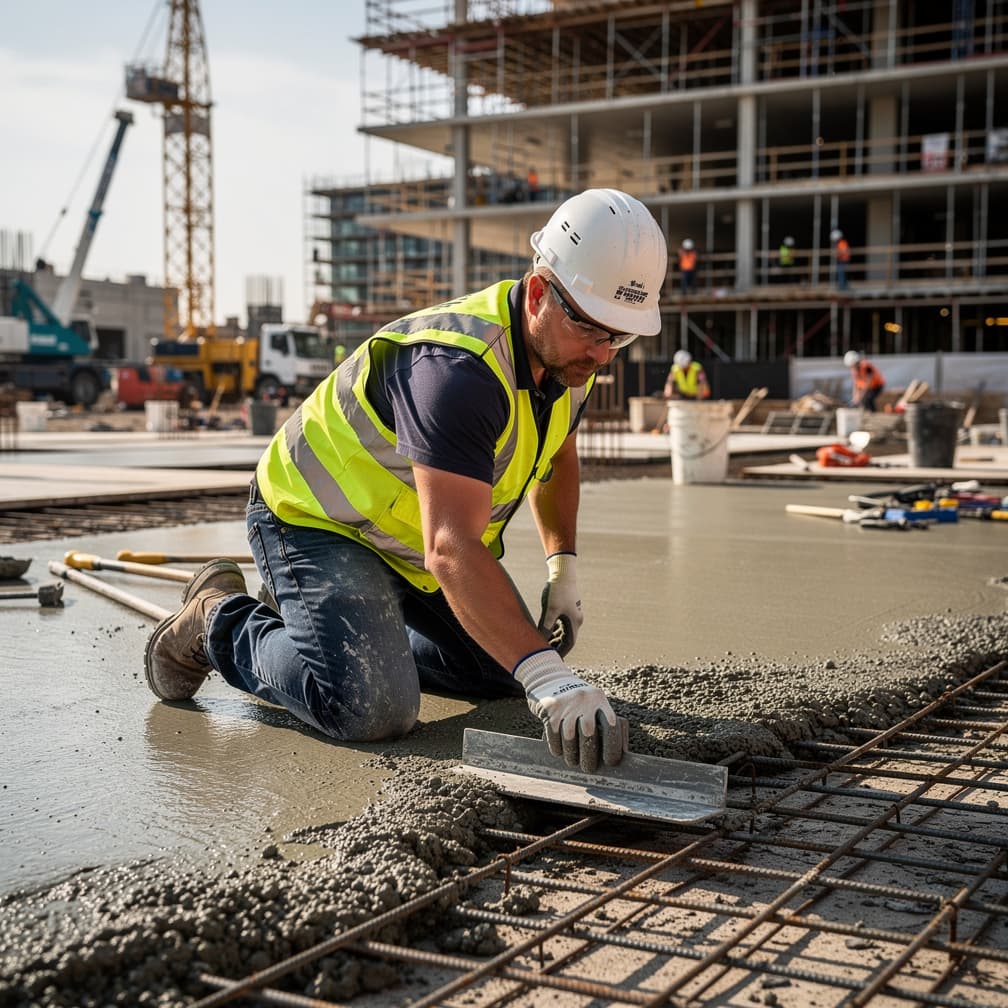

As a concrete contractor in Hayward, you are responsible for a surface long after the last trowel leaves it. A slab that settles, a sidewalk that heaves, a driveway that cracks along a saw line: each can come back as a property damage claim years after payment cleared. Concrete contractor insurance in Hayward is largely a bet on that tail, and the buying decision follows from it. Day-of exposures are easier to picture, of course, since a passerby on wet concrete or a worker hurt moving forms is an immediate problem. The tail is what owners underprice. Read the ranges below with completed work in mind, then compare quotes from participating carriers on limits, not on the monthly figure alone.
What Makes Hayward Different
Competition in a dense market pushes bids down while the paperwork behind those bids keeps getting heavier. Alameda County has about 42,000 businesses, and each owner or manager can write its own certificate rules for a pour. That means your admin time rises with the number of parties who can hold your invoice. A crowded field also means a homeowner can replace you between the estimate and the pour date. So the certificate stops being paperwork and starts being the thing that keeps you on the job. Cancellation for nonpayment lands harder here, because a lapse is easy to notice and easy to replace. Ask what a quote does when a certificate has to be reissued for a new site. The price matters, and the ability to produce clean paper on demand is what keeps crews working.
Local Risk Factors in Hayward
Before fire season, look at where your equipment sleeps, because a trailer parked at a remote pad is the asset you cannot retrieve on an evacuation order. Photograph the schedule, the serial numbers, and the storage yard, then keep that file somewhere other than the truck. Fire damage to scheduled tools and mobile property may be handled one way, subject to the form, while your own unfinished slab is a different question entirely. General Liability sits on the third-party side, which is where a claim can arrive if your work or your material contributes to somebody else's loss. Confirm the details with the California Department of Insurance before deciding how much to schedule in California.
What Coverage Does a Concrete Contractor in Hayward Need?
General Liability
Builders and property owners ask for this one by name before a truck reaches the pad. It is the line that might answer when a visitor slips on a curing slab, or when moving forms and equipment take out a fence, an irrigation line, or the curbing beside your work. Redoing your own cracked slab typically sits outside it.
Example: A homeowner walks out to admire a fresh driveway, steps onto the edge before it cures, and lands hard; General Liability can help cover the injury claim and the defense that follows it.
Workers Compensation
Finishing, cutting, and lifting are where a concrete crew gets hurt, and this line is rated for exactly that, priced per $100 of payroll. Medical care and lost wages for an injured employee are what it is meant to address. Owners and subcontractors get treated differently, and thresholds vary from state to state.
Example: A finisher lifts a form panel wrong during a slab pour and cannot work for a month; Workers Compensation is generally intended to take the medical bills and part of the missing wages.
Commercial Auto
Personal policies commonly exclude business use, which can leave the truck hauling mix, forms, and a loaded trailer unprotected at the worst possible moment. This line gets rated on the vehicles, the towing, the mileage, and the drivers, and it may respond when your truck injures someone or damages property on the road.
Example: A trailer of forms comes loose on the drive between two pours in Hayward and clips the car behind it; Commercial Auto is where those injury and repair demands would land.
Tools & Equipment (Inland Marine)
Tools and mobile equipment spend more hours in transit or parked at a jobsite than under anyone's eye. Scheduled values then decide what a theft or a loss is worth: the mixer, the trowel machine, the saws, the vibrators. Rented equipment is often handled separately, and anything left off the schedule usually stays off the payment.
Example: A trailer is emptied overnight at an open jobsite and the saws and trowel machine are gone by first light; scheduled equipment coverage could make the replacement a matter of days rather than months.
Commercial Umbrella
When a subcontract names a limit higher than your underlying policy carries, this is usually the cheaper way to reach the number. It sits above General Liability or the auto limit and follows those terms, so an exclusion underneath stays an exclusion. It is built for the rare large claim rather than the routine one.
Example: A multi-vehicle accident on the way to a pour produces injury demands well past the underlying auto limit; an umbrella layer might pick up what sits above it, subject to the terms.
How Much Does Concrete Contractor Insurance Cost in Hayward?
Concrete Contractor Insurance is a bundle of separate policies, priced separately. The ranges below are typical figures for Hayward for each line, except workers compensation, which is rated per $100 of payroll; a quote prices each one against your own operations.
| Coverage | Typical range | What moves your price |
|---|---|---|
| General Liability Insurance | $260 - $775 per month | Industry and risk classification, annual revenue, number of employees |
| Workers Compensation Insurance | $0.75 - $2.74 per $100 of payroll | Employee classification codes, total annual payroll, experience modification rate |
| Commercial Auto Insurance | $310 - $925 per month | Fleet size and vehicle types, driver records and experience, coverage limits and deductibles |
| Inland Marine Insurance | $65 - $260 per month | Total insured value of the scheduled property, type and age of the equipment, where it is stored and how far it travels |
| Commercial Umbrella Insurance | $120 - $370 per month | Umbrella limit requested, limits carried on the underlying policies, loss history on those underlying policies |
Prices shown are general estimates, not guaranteed rates or quotes. Your actual premium will depend on the insurer, coverage selected, business details, location, claims history, and other underwriting factors. Learn about our pricing methodology.
What Are the Insurance Requirements for a Concrete Contractor in Hayward?
Workers' comp is generally required once you have your first employee. California generally requires employers to carry workers' compensation at that point. Common exemptions include sole proprietors and some partners. Confirm current thresholds with your state's workers' compensation agency before you hire.
State auto liability minimums apply to business vehicles. California's minimum auto liability limits are $30,000/$60,000/$15,000 (bodily injury per person / per accident / property damage). Contracts and lenders often require more than the state floor.
Where to verify licensing and coverage rules. The California Department of Insurance publishes consumer guidance and current insurance requirements for California businesses. When a contract or lease demands specific wording, the California Department of Insurance's guidance is the authoritative place to check.
Get Your Concrete Contractor Quote in Hayward
Compare rates from multiple carriers. Free quotes, no obligation.
Operating in Hayward
- The trailer hitch is the quiet exposure on a concrete job: one loose chain at highway speed turns your equipment loss into somebody else's injury claim in a heartbeat.
- Subcontracted finishers who cannot produce their own certificate can land on your payroll at audit, so collect that paper before anyone touches a screed rather than after the term closes.
- A driveway you poured in Hayward years ago can still produce a phone call, and the job file, rather than anyone's memory, is what answers the questions that follow.
- Permit desks and inspectors work to a timetable of their own, and a job in Hayward can sit idle while paperwork clears even though the mix is already ordered.
How to Buy: Advice for Hayward Owners
List every machine that rides on the trailer and value it before you look at any premium, because the loss that stops work is usually the one nobody scheduled. A stolen mixer or a burned trowel machine idles a crew for days, and Inland Marine is the line that might answer for it. Then look at the far bigger number: a third-party injury on a green slab, where General Liability limits get tested while the defense bill runs and everyone argues. One loss costs you a week; the other can cost the business. Buy limits in that order of magnitude rather than in order of monthly price. The California Department of Insurance publishes consumer guidance on comparing coverage limits. Ask participating carriers in California to quote the same limits so the comparison means something.
FAQ
Concrete Contractor Insurance in Hayward: FAQ
That scenario is what Inland Marine is meant for: tools, mobile equipment, and contractors equipment away from a fixed location. Whether a theft from an open trailer qualifies depends on the schedule, the values you listed, and any locked-vehicle conditions in the form. Rented equipment is often handled separately, so ask about it specifically. Anything left off the schedule generally gets left out of the payment.
Per-occurrence caps what a policy may pay for one incident, such as a single fall on a single green slab. The aggregate caps the total across the whole term, however many pours produced claims. A busy year of small property damage disputes can quietly eat the aggregate, leaving less behind for the fall that comes later. Contracts often name both numbers, so read which one they actually mean.
Often, yes. Damaging someone else's property while you work, an irrigation line, a fence, curbing, or the landscaping around a pad, is third-party property damage, and General Liability is generally intended for it. Damage to the concrete you are placing is the exception, since your own work gets treated differently. Deductibles apply, and small repairs are frequently cheaper to pay directly than to run through a policy.
At the end of the term the carrier compares the payroll and receipts you estimated against what actually happened, then bills or credits the difference. Class codes matter, since forming, flatwork, and cutting can be rated separately, and those rating rules are filed state by state in California. Uninsured subcontractors are the usual surprise: with no certificate on file, their payroll can be added to yours.
Payroll by class, annual receipts, a vehicle list with mileage and drivers, an equipment schedule at current values, your loss runs, and copies of the contracts that set your limits. That last one matters most, because the strictest insurance exhibit you have signed usually decides the whole structure. With identical facts in each submission, quotes from participating carriers in California finally compare.
Less than the pitch suggests. Payroll, vehicles, equipment, limits, and claims history do the heavy lifting. Where Hayward comes into it is indirect: the contracts you sign, the traffic your trucks sit in, and the kind of work available all shift exposure. Rates also differ by state because carriers file separately, so an identical submission can price one way in California and another way across the line.
Sources
- 1.U.S. Census Bureau, County Business Patterns (2022), Alameda County(Alameda County has about 42,000 business establishments.)
- 2.California Department of Insurance(California Department of Insurance publishes consumer guidance for insurance buyers.)


