







































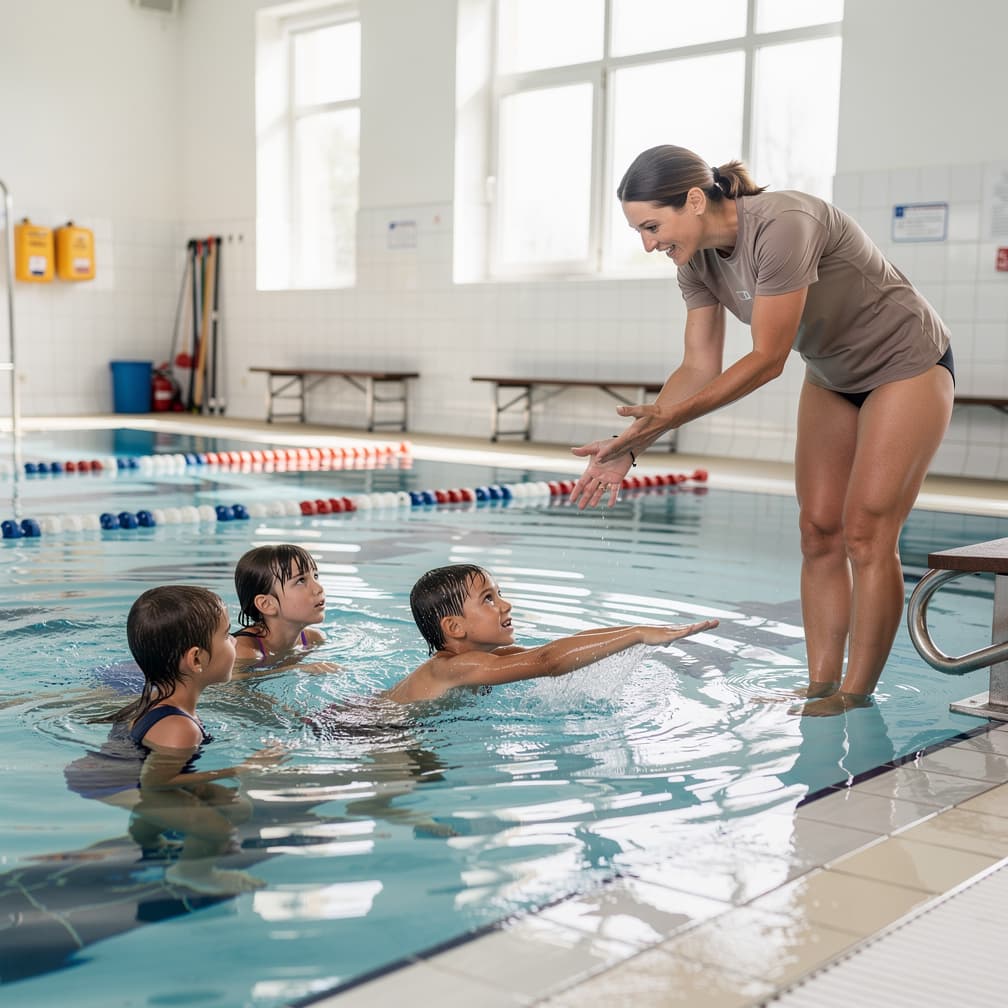

An instructor's judgment gets questioned long before anyone slips on a walkway. A parent watching from the seating area decides a class was under-supervised, and the complaint lands against the school rather than the person who was in the water. Swim school insurance in Hayward has to answer that kind of allegation as well as the fall by the entry door. Where a county holds about 42,000 businesses, certificate review is a desk job done in volume, and a form carrying the wrong additional-insured wording gets bounced with no phone call attached. Nobody rings to explain the fix. That becomes a scheduling problem when a lesson block is already sold and the water is booked. What follows sets out what the underwriting questions are really asking, and where the honest gaps sit.
What Makes Hayward Different
About 133 swim schools operate in Alameda County, and they hire from the same small pool of certified instructors. Staff move between employers in a busy market, which means your supervision standards are only as good as your onboarding. A new hire who learned deck rules somewhere else brings that habit to your water on their first shift. Underwriters ask about training for exactly this reason, and a documented answer is worth more than a confident one. Competition also compresses what you can charge, so the temptation is to run larger classes with the same staffing. That ratio is the first fact an opposing lawyer asks about after an incident. Keep it written down, keep it enforced, and keep the record somewhere you can find it under pressure. Density does not raise your risk by itself; the shortcuts it tempts you into do.
Local Risk Factors in Hayward
Wildfire rarely reaches a swim school directly, and smoke reaches everything. Ash settles onto an outdoor pool and into the filtration, and air quality closes lessons for children long before a flame gets near the building. Those closures come from advisories rather than damage, and business income provisions generally need a covered physical loss to respond at all. That is the gap worth understanding now rather than during a smoke week. Commercial Property may answer for smoke damage to the building, the contents and the plant, which is a separate question from the cancellations. Ask a participating carrier in California how smoke, ash and air quality get treated for a pool in Hayward.
What Coverage Does a Swim School in Hayward Need?
General Liability
Landlords, community centers and school districts ask for this line by name before they hand over water time. It generally answers third-party bodily injury and property damage: a parent who goes down at the entry, a visitor hurt in the seating area, a child injured on the deck between classes. Injuries to your own staff sit with Workers Compensation instead.
Example: A grandmother waiting for a lesson at your Hayward school steps in a puddle by the viewing window, breaks a wrist, and hires a lawyer four months later. Defense and any settlement may fall here, subject to your limit.
Professional Liability
Not every complaint involves a bruise. A parent alleging that an instructor pushed a nervous child too far, or watched a class carelessly, is challenging professional judgment, and that allegation is usually what this line is meant for. It typically does not answer for a fall on wet tile, which is a general liability matter.
Example: An instructor tells a family their five-year-old is ready to move up a level. The child panics in deeper water and the parents allege negligent assessment. Legal defense of that claim could sit here rather than with the deck policy.
Commercial Property
Pumps, heaters, filtration, lane ropes, the hoist chair and the sound system are the property this line is built around, along with the building itself where you own it. Sudden damage from fire, theft, vandalism or storms can be covered, subject to your limit and deductible. Rising flood water and ordinary wear on equipment typically sit outside it.
Example: A break-in through the storage room clears out lane ropes, kickboards and the pace clock overnight, leaving the morning class nothing to teach with. Replacement of the scheduled equipment might be paid, less whatever deductible you chose.
Workers Compensation
Where General Liability answers for the parent, this line is the one meant for the instructor. Employee injuries on a wet deck, in the water, or while hauling equipment fall here, and it typically covers medical care and lost wages without a fault argument. Rules vary by state, so check the California Department of Insurance's guidance before deciding what applies to your staff.
Example: A lifeguard steps down from the chair mid lesson block, slips, and tears a shoulder badly enough to need surgery. Medical bills and time away from work are generally handled here, with nobody arguing about the wet floor.
Commercial Umbrella
A contract naming a limit your primary policy cannot reach is the usual reason a swim school buys this. It sits above General Liability and can lift the money available after a catastrophic injury exhausts the underlying limit. It follows the terms below it, so an exclusion in the underlying policy generally remains an exclusion up here.
Example: One serious injury in the water produces a demand that consumes the primary limit before the case ever reaches trial. Whatever is still owed might be picked up above, once the underlying policy has paid out in full.
How Much Does Swim School Insurance Cost in Hayward?
Swim School Insurance is a bundle of separate policies, priced separately. The ranges below are typical figures for Hayward for each line, except workers compensation, which is rated per $100 of payroll; a quote prices each one against your own operations.
| Coverage | Typical range | What moves your price |
|---|---|---|
| General Liability Insurance | $220 - $675 per month | Industry and risk classification, annual revenue, number of employees |
| Professional Liability Insurance | $120 - $370 per month | The services you actually perform, annual revenue or billed fees, limit and retention selected |
| Commercial Property Insurance | $170 - $550 per month | Building value and construction type, roof age and condition, fire protection class |
| Workers Compensation Insurance | $0.75 - $2.74 per $100 of payroll | Employee classification codes, total annual payroll, experience modification rate |
| Commercial Umbrella Insurance | $110 - $340 per month | Umbrella limit requested, limits carried on the underlying policies, loss history on those underlying policies |
Prices shown are general estimates, not guaranteed rates or quotes. Your actual premium will depend on the insurer, coverage selected, business details, location, claims history, and other underwriting factors. Learn about our pricing methodology.
What Are the Insurance Requirements for a Swim School in Hayward?
Workers' comp is generally required once you have your first employee. California generally requires employers to carry workers' compensation at that point. Common exemptions include sole proprietors and some partners. Confirm current thresholds with your state's workers' compensation agency before you hire.
Flood damage is typically excluded from standard policies. Standard commercial property and builders-risk-type policies typically exclude flood damage. Flood exposure varies address by address, so check your premises in FEMA's Flood Map Service Center before deciding; if you sit in a mapped flood zone, a separate policy through the National Flood Insurance Program is the usual starting point.
Where to verify licensing and coverage rules. The California Department of Insurance publishes consumer guidance and current insurance requirements for California businesses. When a contract or lease demands specific wording, the California Department of Insurance's guidance is the authoritative place to check.
Get Your Swim School Quote in Hayward
Compare rates from multiple carriers. Free quotes, no obligation.
Operating in Hayward
- School districts and community centers lend equipment freely, and property of others is a category your policy handles on its own terms, whatever a Hayward facility assumed when it handed the box over.
- Peak capacity decisions get made months ahead of the season, and the staffing ratio you settle on then is the number an opposing lawyer reads back to you after an incident.
- Locker rooms get used by people who are barefoot, wet and frequently small, which is a combination no amount of signage has ever solved.
- A pump failure closes the water even when the building is untouched, and the one vendor in Alameda County who can rebuild it works to their own calendar rather than your lesson schedule.
How to Buy: Advice for Hayward Owners
Waivers signed at a Hayward front desk are useful, and they are not a coverage strategy. A signed release can shorten a lawsuit and rarely prevents one, and it never stops defense costs from starting. Treat the waiver as a document that supports your General Liability claim file rather than one that stands in for the policy. Ask each participating carrier whether they want to review your release language during underwriting, because some do. Ask what your reporting obligations are for an incident that produced no injury anybody noticed that day. Requirements differ by state, so treat any blanket answer about them with suspicion. Keep the signed forms somewhere a claim can find them years later. CPK's job is to put participating carriers in California side by side so you can weigh service alongside the number.
FAQ
Swim School Insurance in Hayward: FAQ
The per-occurrence limit is what one claim can draw. The aggregate is what the entire policy year can draw before the money runs out. A single serious injury in the water can consume most of a modest per-occurrence limit, leaving the aggregate thin for whatever follows that season. Ask whether defense costs erode either number, because a policy where they do buys less than it looks like it buys.
Theft of lane ropes, a hoist chair, kickboards or the sound system is generally a Commercial Property question, subject to your deductible and the limit you scheduled. What you can prove you owned decides what gets paid, so photograph the room and keep purchase records somewhere else. Equipment a school district lent you may sit outside your form entirely. Ask how property of others is handled before you rely on it.
The certificate itself is usually quick once a policy is bound. The endorsement behind it is the slow part, especially when a contract asks for specific additional-insured or waiver of subrogation wording. That timing is what catches owners the week before opening. Ask the requirement question before you bind rather than after. A facility in Alameda County can withhold access until the paper matches its template, whatever your policy actually says.
Only where the closure follows a covered physical loss, and only after any waiting period has run. Business income provisions turn on damage to property rather than on lost demand, so a soft enrollment week is not a claim. A filtration system destroyed by a storm can be a different story. Ask how a lost lesson block gets valued and which records prove it, since attendance history may be your only evidence.
Their policy answers for their building and their own liability, and it does nothing for a claim brought against you. The contract usually says as much in plain language, then asks you to indemnify them on top of it. A parent naming your school in a suit is your problem to defend. Participating carriers in California do not change that arrangement; the indemnity clause you signed does.
Payroll by role, headcount, class sizes, instructor certifications, loss runs, and a description of the water you teach in. Whether you own or rent the facility changes the property questions completely. Expect questions about supervision ratios and how incidents get recorded. The school that answers with documents gets priced on facts, and the school that answers from memory gets priced on doubt. Have the packet ready before you shop in Hayward.
Sources
- 1.U.S. Census Bureau, County Business Patterns (2022), Alameda County(Alameda County has about 42,000 business establishments.; Alameda County has about 133 businesses in this trade's category (NAICS group 611620).)
- 2.California Department of Insurance(California Department of Insurance publishes consumer guidance for insurance buyers.)
- 3.FEMA / FloodSmart(Flood coverage is typically purchased separately; FEMA administers the National Flood Insurance Program.)


