







































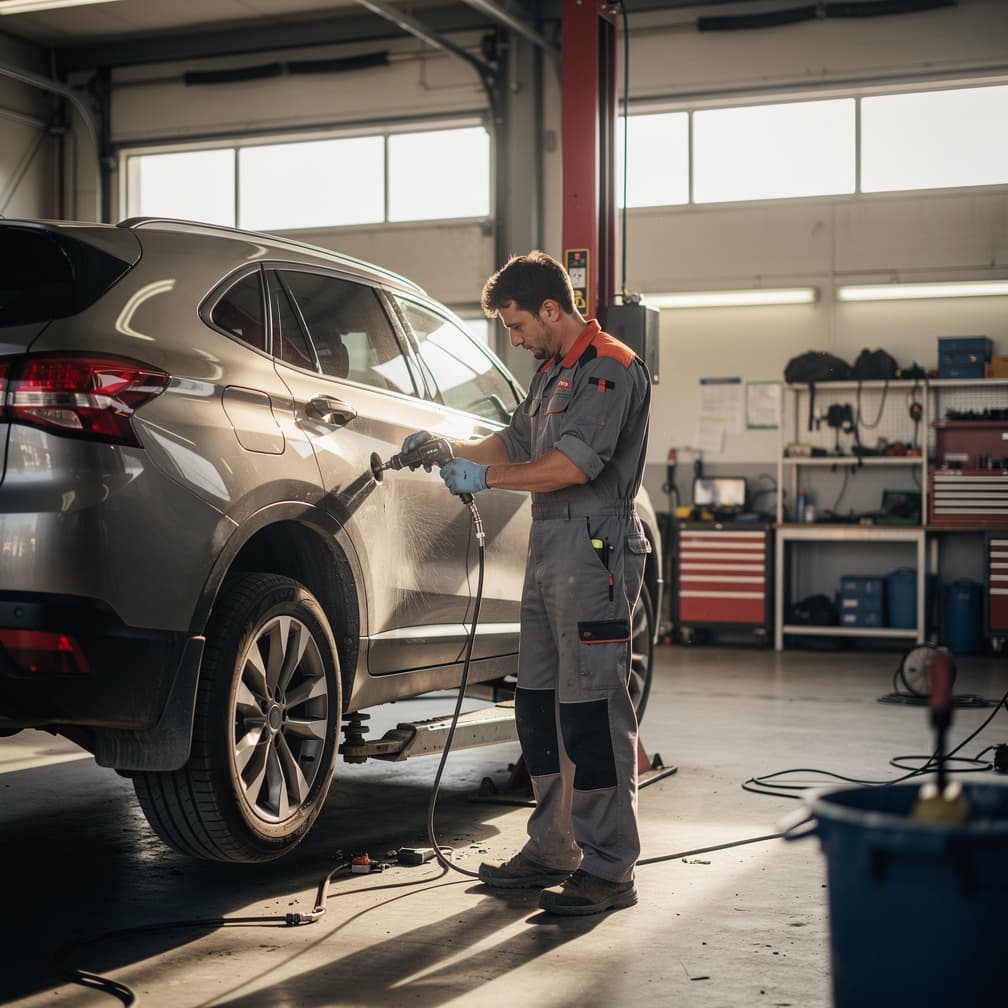

In Los Angeles County, about 1,200 auto body shops share the same pool of adjusters, parts suppliers, and equipment techs. That matters on the week a storm damages several shops at once, because everyone calls the same short list and you wait your turn. Auto body shop insurance in Lancaster has to survive that week, not an average one. The revenue gap after a fire or building damage is where a shop learns whether it bought a policy or a receipt. Customer cars stranded mid-repair do not become somebody else's problem while you rebuild, and the calls keep coming. Look past the monthly figure at what a carrier says about restoration time, limits, and what it treats as scheduled equipment. Then compare participating carriers with those answers in hand.
What Makes Lancaster Different
A storm week does not have to damage your building to cost a body shop real money. Power interruptions stop booth curing, air compressors, and the paint mixing system all at the same moment. The cars in progress stay in progress, and every promised delivery date slides together. Customers in Lancaster who cannot collect their vehicles do not care what the weather was doing. Ask what a policy treats as a covered cause of loss and what it wants documented afterward. Utility interruption is a common gap, and the terms differ between participating carriers in California. Equipment answers matter too, since surge damage to booth controls is not always read as storm damage. Get both answers before the season turns, because coverage bought during a warning is bought late.
Local Risk Factors in Lancaster
A shop under an evacuation order stops earning that hour, and the cars on the floor stay exactly where they are. Reopening is slower than closing: power, filtration, and air quality all have to return before you can spray anything. Meanwhile the customers whose vehicles you hold have questions you cannot answer, and some of them have insurers asking too. Ask what the policy calls civil authority, since coverage for a closure ordered by officials is usually narrow and time-limited. A shop in Lancaster should read that clause before the season rather than during it. Then compare what participating carriers in California put behind it.
What Coverage Does an Auto Body Shop in Lancaster Need?
General Liability
Landlords, dealers, and fleet accounts ask for this one by name before they release work or hand over keys. It can help cover a visitor hurt in your reception area or lot, damage you cause to property that is not yours, and the legal defense behind either. Injuries to your own technicians sit somewhere else entirely, and so does damage to the panel you are repairing.
Example: A customer steps around a parts cart in the walkway, catches a heel on a floor drain, and breaks a wrist; General Liability may respond to the medical claim and the defense that follows it.
Commercial Property
Rising water is typically outside this form, and so is ordinary wear, which catches owners off guard more than anything else in the policy. What it could help cover is the building, the booth, the parts room, and the contents inside them after fire, storm, or a break-in. Customer vehicles in your custody follow their own limit, so ask about that one separately.
Example: Fire starts in the spray booth after closing and smoke reaches the mixing room and the office; Commercial Property is generally the line quoted for the building and contents behind a loss like that.
Workers Compensation
A technician tears a shoulder freeing a seized panel, and the medical bills and missed wages become a payroll question rather than a liability one. This line is rated against payroll by job classification, and it typically handles work-related injury and illness for people you employ. It does not answer for a customer hurt in the same building. Requirements vary by state.
Example: A grinder kicks back and opens a technician's forearm two hours before a promised delivery; Workers Compensation might help cover the treatment and the wages lost while that arm heals.
Tools & Equipment (Inland Marine)
Where a property policy watches the building, this line follows the gear that makes the work possible: welders, spray guns, dent pullers, and the equipment that moves between bays or leaves in a technician's truck. It is priced off the schedule you file, so anything unlisted is usually anything unpaid. Wear and mechanical breakdown are commonly left out.
Example: A tool chest and two welders vanish from a locked bay in Lancaster overnight, and the schedule collapses by mid-morning; Inland Marine is the line usually quoted against a theft like that.
How Much Does Auto Body Shop Insurance Cost in Lancaster?
Auto Body Shop Insurance is a bundle of separate policies, priced separately. The ranges below are typical figures for Lancaster for each line, except workers compensation, which is rated per $100 of payroll; a quote prices each one against your own operations.
| Coverage | Typical range | What moves your price |
|---|---|---|
| General Liability Insurance | $130 - $460 per month | Industry and risk classification, annual revenue, number of employees |
| Commercial Property Insurance | $290 - $1,150 per month | Building value and construction type, roof age and condition, fire protection class |
| Workers Compensation Insurance | $0.75 - $2.74 per $100 of payroll | Employee classification codes, total annual payroll, experience modification rate |
| Inland Marine Insurance | $35 - $140 per month | Total insured value of the scheduled property, type and age of the equipment, where it is stored and how far it travels |
Prices shown are general estimates, not guaranteed rates or quotes. Your actual premium will depend on the insurer, coverage selected, business details, location, claims history, and other underwriting factors. Learn about our pricing methodology.
What Are the Insurance Requirements for an Auto Body Shop in Lancaster?
Workers' comp is generally required once you have your first employee. California generally requires employers to carry workers' compensation at that point. Common exemptions include sole proprietors and some partners. Confirm current thresholds with your state's workers' compensation agency before you hire.
Flood damage is typically excluded from standard policies. Standard commercial property and builders-risk-type policies typically exclude flood damage. Flood exposure varies address by address, so check your premises in FEMA's Flood Map Service Center before deciding; if you sit in a mapped flood zone, a separate policy through the National Flood Insurance Program is the usual starting point.
Where to verify licensing and coverage rules. The California Department of Insurance publishes consumer guidance and current insurance requirements for California businesses. When a contract or lease demands specific wording, the California Department of Insurance's guidance is the authoritative place to check.
Get Your Auto Body Shop Quote in Lancaster
Compare rates from multiple carriers. Free quotes, no obligation.
Operating in Lancaster
- A property manager in Lancaster can withhold a build-out sign-off until proof of coverage reaches the file, which delays your booth install and every job queued behind it.
- Paint booth downtime stops the entire line, because a car cannot move to reassembly until it is painted, and the bay it sits in stays occupied the whole time.
- Tool theft usually shows up as a slow bleed rather than one dramatic event: a socket set here, a welder there, all of it discovered at the next inventory count.
- Parts arriving damaged or late leave a stripped car sitting in a bay for days, and a torn-down vehicle in storage is pure exposure with no revenue attached to it.
How to Buy: Advice for Lancaster Owners
Pull the lease and any dealer agreement before you price a single line. The insurance clause names limits, certificate duties, and sometimes an additional insured, and those terms set the floor you are buying to. A shop in Lancaster can be asked to prove all of it again at every renewal, so the policy has to outlive the negotiation. Get General Liability quoted at the limit the contract names rather than the limit that felt comfortable. Then look at Commercial Property with your building value and booth in front of you, because the number you report at binding is the number a settlement gets measured against. The California Department of Insurance publishes consumer guidance on commercial coverage basics if the wording is unfamiliar. With those facts in hand, compare quotes from participating carriers and watch how differently one shop prices.
FAQ
Auto Body Shop Insurance in Lancaster: FAQ
Inland Marine is the line generally quoted for equipment that moves or sits outside a fixed building, and it is priced from the schedule you provide. Anything left off that schedule is likely to be argued about after a loss. It typically responds to sudden events such as theft or accidental damage rather than to rust, wear, or a compressor that simply reached the end of its life.
Property policies often include or offer income coverage for the period of restoration, though terms vary and documentation requirements are real. You may need to prove what the shop earned before the fire and what it lost while rebuilding. Ask what the policy calls that period and what it wants as proof. A shop in Lancaster waiting on a booked rebuild contractor can stay closed longer than anyone planned for.
Leaving vehicles on site overnight is the exposure, not an exception to it. A car in your lot after closing can be stolen, vandalized, or crushed by a falling limb, and it still belongs to a customer expecting it back on schedule. Carriers ask about locks, lighting, cameras, and where keys are stored. A shop in Lancaster with an open lot should expect more of those questions than one with a fenced yard.
Usually, and it moves the first slice of every loss back onto you. That trade is sound when the cash is there on the day a booth stops working and unsound when it is not. Theft and vandalism losses tend to be frequent rather than enormous, so a low deductible on them can cost you at renewal instead. Decide which losses you would simply absorb, then price both settings and compare.
A per-occurrence limit is the most a policy may pay for one event, such as a single customer hurt in your waiting area. The aggregate is the ceiling for the entire policy term across every event. A shop that has already spent most of its aggregate on earlier claims has less left for the next one, even though the per-occurrence number never moved. Ask where you stand at renewal rather than after a loss.
Often it does not. Damage to the very item you are working on is commonly excluded, because insurers treat the quality of your work as your responsibility rather than a chance event. Damage to the rest of the vehicle can be a different question entirely. This is the exclusion that ends the most arguments in a body shop, so ask a carrier to show you exactly where the line sits.
Sources
- 1.U.S. Census Bureau, County Business Patterns (2022), Los Angeles County(Los Angeles County has about 1,200 businesses in this trade's category (NAICS group 811121).)
- 2.California Department of Insurance(California Department of Insurance publishes consumer guidance for insurance buyers.)
- 3.FEMA / FloodSmart(Flood coverage is typically purchased separately; FEMA administers the National Flood Insurance Program.)


