







































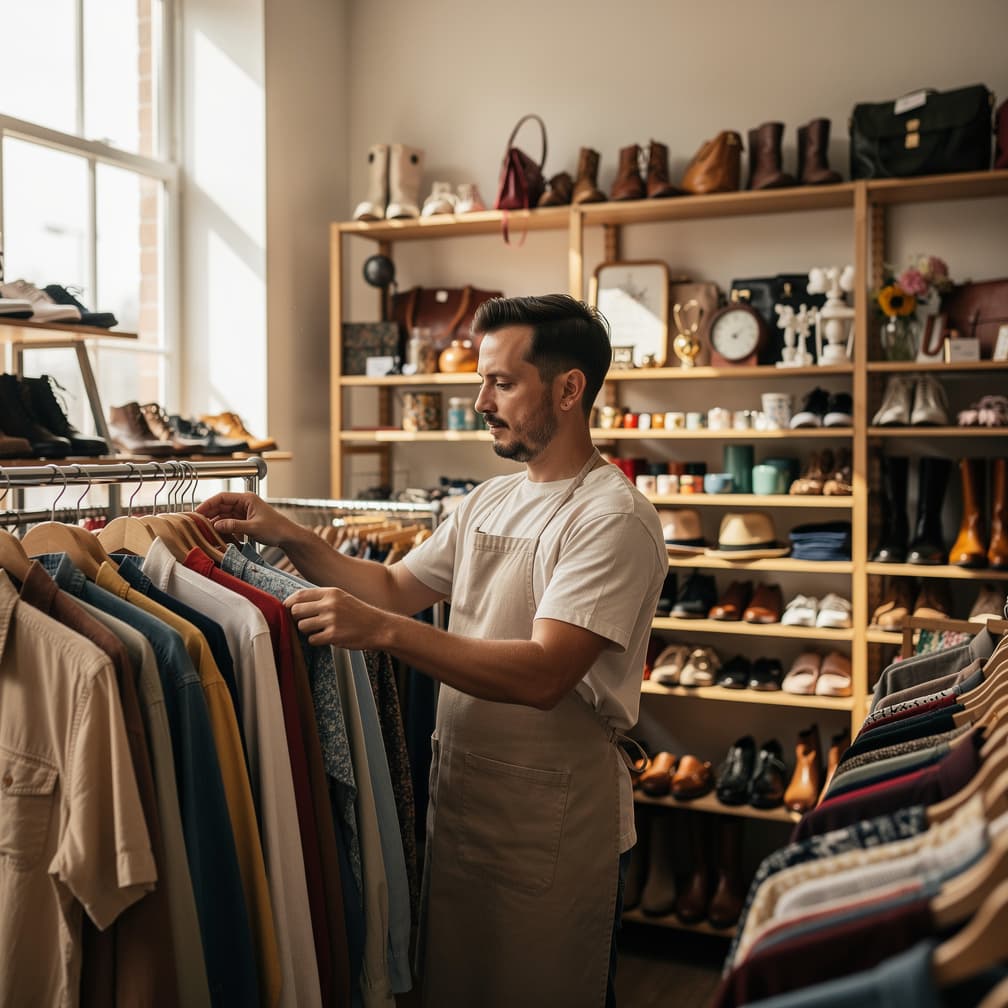

About 450 thrift stores operate in Los Angeles County, so an adjuster handling your slip claim has seen the same aisle photograph many times already. That familiarity cuts both ways: patterns get recognized fast, and a store with sloppy floor logs gets read fast too. Thrift store insurance in Los Angeles rewards the boring paperwork, because an incident pad and an inspection sheet are the only version of events that survives a year. Customers fall near intake doors. Racks give way under weight they were never rated to hold. The injured party remembers the moment differently than you do, and limits matter only if documentation lets the limit be tested at all. What follows lays out the lines a store carries and how to read two offers against each other.
What Makes Los Angeles Different
Competition sets your prices on the sales floor, and it quietly sets your insurance terms as well. A crowded retail market pushes rent up, which pushes you toward smaller spaces and taller stacking. Stacking donated goods higher is a bodily injury exposure, and underwriters ask about shelf height directly. Thin markets push the other way: more square footage, more storage, more of your money sunk into fixtures. Both roads lead somewhere an underwriter cares about, and both change what a quote should actually include. The market around Los Angeles also decides how quickly a landlord could replace you as a tenant. A tenant who is easy to replace signs whatever insurance exhibit gets slid across the table. Know which market Los Angeles puts you in before you decide how hard to push back.
Local Risk Factors in Los Angeles
Evacuation orders close a store that is still standing, and standing is what the form usually asks about. A week with no traffic is a real loss for a business built on volume, but business interruption terms commonly require physical damage first, which means an evacuation with an untouched building may find nothing to trigger. Ask whether a civil authority clause exists in your policy and what it requires, since that is the clause drafted for exactly this. In Los Angeles County, reopening also depends on utilities coming back, and a store in Los Angeles with power but no staff able to return is still shut.
What Coverage Does a Thrift Store in Los Angeles Need?
General Liability
Your landlord asks for this one by name, and a center office will ask again before you open the doors. General Liability is aimed at third-party injury and property damage: a customer who slips in an aisle, a shopper struck by falling merchandise, damage you cause to the space you rent. It does not answer for your own employees, and it typically excludes anything done deliberately.
Example: A child tugs a boxed lamp off a top shelf and it catches a shopper's shoulder on the way down. The medical bill and the demand letter that follows are the kind of claim this line is meant to meet.
Commercial Property
Flood is the first thing to know about here, since standard property forms leave it out and price it on its own. What remains is your side of the building: shelving, fixtures, terminals, the improvements you installed, and the donated stock on the floor. Fire, burst pipes, and storm damage are the usual triggers, and the valuation language on inventory without invoices decides what a claim is worth.
Example: A power strip behind a display shorts overnight and smoke reaches every rack in your Los Angeles store. The fixtures survive, the clothing does not, and a claim on that stock could turn on the photographs you took.
Business Owners Policy
Buying liability and property apart gives you control; a Business Owners Policy gives you a package that usually costs less. It folds both into one form for a single-location store and often carries business interruption terms inside it. The catch is sublimits: categories like stock may be capped tighter than you would choose, and the package wording is not yours to negotiate.
Example: Your store closes for three weeks after a roof leak soaks the sales floor. The repairs sit on the property side of the package, while the lost trading weeks may fall to the interruption clause and its waiting period.
Workers Compensation
Someone lifts a box of hardback books wrong and cannot work for a month. Workers Compensation is built for your own staff rather than your customers, and it can help with medical treatment and a share of lost wages. It is rated against payroll, so hours at the sorting table drive the price. Whether unpaid help at your intake door counts as staff is a question your state answers, not your policy.
Example: A part-timer pricing furniture drops a drawer front on their foot during an intake rush. The treatment and the days missed afterward are what this coverage is generally intended to handle.
How Much Does Thrift Store Insurance Cost in Los Angeles?
Thrift Store Insurance is a bundle of separate policies, priced separately. The ranges below are typical figures for Los Angeles for each line, except workers compensation, which is rated per $100 of payroll; a quote prices each one against your own operations.
| Coverage | Typical range | What moves your price |
|---|---|---|
| General Liability Insurance | $75 - $210 per month | Industry and risk classification, annual revenue, number of employees |
| Commercial Property Insurance | $130 - $480 per month | Building value and construction type, roof age and condition, fire protection class |
| Business Owners Policy Insurance | $130 - $400 per month | Annual revenue and industry class, building and contents values, square footage and building age |
| Workers Compensation Insurance | $0.75 - $2.74 per $100 of payroll | Employee classification codes, total annual payroll, experience modification rate |
Prices shown are general estimates, not guaranteed rates or quotes. Your actual premium will depend on the insurer, coverage selected, business details, location, claims history, and other underwriting factors. Learn about our pricing methodology.
What Are the Insurance Requirements for a Thrift Store in Los Angeles?
Workers' comp is generally required once you have your first employee. California generally requires employers to carry workers' compensation at that point. Common exemptions include sole proprietors and some partners. Confirm current thresholds with your state's workers' compensation agency before you hire.
Flood damage is typically excluded from standard policies. Standard commercial property and builders-risk-type policies typically exclude flood damage. Flood exposure varies address by address, so check your premises in FEMA's Flood Map Service Center before deciding; if you sit in a mapped flood zone, a separate policy through the National Flood Insurance Program is the usual starting point.
Where to verify licensing and coverage rules. The California Department of Insurance publishes consumer guidance and current insurance requirements for California businesses. When a contract or lease demands specific wording, the California Department of Insurance's guidance is the authoritative place to check.
Get Your Thrift Store Quote in Los Angeles
Compare rates from multiple carriers. Free quotes, no obligation.
Operating in Los Angeles
- A property manager in Los Angeles can withhold a lease amendment until a current certificate sits on file, so a policy that lapsed quietly is able to stall a renewal you already negotiated.
- Price guns, terminals, and card readers die together when a surge hits, and a floor that cannot take payment is closed for the day no matter how good the merchandise looks.
- Furniture is the item customers try to shift themselves, and the injury that follows is yours to explain even though nobody ever asked them to lift anything.
- Loss runs from your current participating carrier take days to arrive, so a store in Los Angeles shopping a renewal in the final week is shopping without the one document underwriters read first.
How to Buy: Advice for Los Angeles Owners
Two numbers do most of the work in a quote: payroll and revenue. Payroll drives Workers Compensation, which is rated against what you pay people for physical work, so the sorting table is a pricing input. Revenue and floor traffic drive General Liability. Estimate both honestly, because both get audited after the policy year and an optimistic guess arrives later as a bill. Volunteers are the question owners get wrong most often, and how they count varies by state. The California Department of Insurance publishes the current requirements for classifying unpaid workers. Get that answer before you assume free help is free. Then bring the real figures to CPK, where participating carriers in California can quote the same store and you can see how differently they read it.
FAQ
Thrift Store Insurance in Los Angeles: FAQ
Only as far as what you could write a check for tomorrow. A higher deductible does reduce the premium, and it also hands you a worse morning after a rack collapse or a soaked stockroom. The right number is the one your cash flow survives, rather than the one that makes a quote look good on a comparison page.
Yes, and it is a different line from the one that meets customer injuries. Workers Compensation is built for your own staff, and sorting, lifting, and hauling donated goods carries real injury frequency. It is rated against payroll, so hours at the intake table show up when a participating carrier audits you after the policy year. Report payroll honestly and the audit stays routine.
Usually, though the price reflects it and fewer participating carriers in California may want the submission. What moves the outcome is evidence of what changed: wider aisles, a spill routine, an incident pad someone fills in, a rule about stack height. Bring five years of loss runs and the explanation together, since an underwriter reading a bare claim count assumes the worse story.
Not automatically. Property coverage is usually tied to a described location, so stock held somewhere your policy never names can sit outside it. If you rent extra storage in Los Angeles, tell the participating carrier and ask whether that address needs to be scheduled. The answer takes one call and heads off a denial that would otherwise arrive at the worst possible time.
Usually, yes. A commercial lease routinely names an insurance requirement, and a property manager can hold the keys until a certificate lands on file with the right legal name and the right limit on it. Getting a corrected certificate reissued takes days you did not budget for, so read the insurance exhibit before signing rather than during move-in week.
Payroll, floor size, the limits you choose, and your claims history do most of the work. A store with staff sorting and lifting donated goods carries a workers compensation exposure a one-person shop does not, and that single difference moves the total further than address does. Two participating carriers can read the same store differently, which is why comparing beats guessing. Current ranges for each line sit in the table further down.
Sources
- 1.U.S. Census Bureau, County Business Patterns (2023), Los Angeles County(Los Angeles County has about 450 businesses in this trade's category (NAICS group 453310).)
- 2.California Department of Insurance(California Department of Insurance publishes consumer guidance for insurance buyers.)
- 3.FEMA / FloodSmart(Flood coverage is typically purchased separately; FEMA administers the National Flood Insurance Program.)


