







































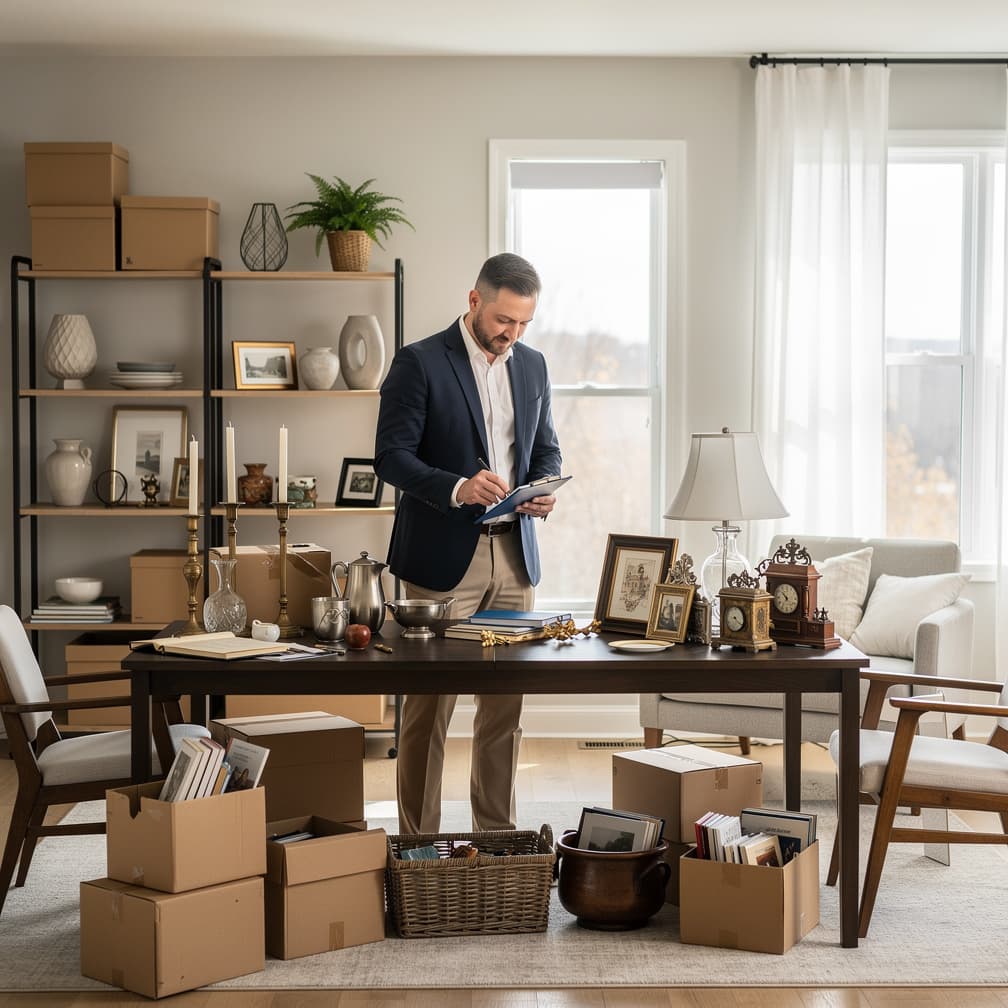

As an estate liquidator in Ontario, you carry other people's property in a van, stack it on your own tables, and hand it to strangers for cash. Ownership never transfers to you, which is exactly what makes this insurance conversation odd. A plain business property form is written around things you own, so the china on your display shelf may sit outside it entirely. Damage to goods in your care is a separate conversation, and one worth having before a shelf collapses. Estate liquidator insurance in Ontario should be assembled around that custody question first and everything else second. Ask each quote where client property lives in the form, and get the answer in writing. What follows walks the four exposures that generate almost every claim in this work.
What Makes Ontario Different
About 42,000 businesses in San Bernardino County generate a steady stream of offices, shops, and warehouses that eventually empty out. That volume changes who calls you, and corporate work brings procurement rules a grieving family never imposes. A vendor form can require limits, waivers, and wording you have never once been asked for. Turning down the job is fine; discovering the requirement on load-in morning is not. Density also multiplies the strangers at any given sale, since a listing reaches thousands within an hour. More bodies in a hallway means more chances that one of them ends up on the floor. Underwriters read that as frequency, and frequency shows up at renewal more than any single loss. Plan your crowd control now, because the alternative is letting a claim file do the planning.
Local Risk Factors in Ontario
Wildfire smoke does not have to reach a house to ruin what is inside it, and an evacuation order closes a sale with no notice at all. Contents absorb smoke, textiles hold it, and an estate you priced last week is worth less this week for reasons nobody can see. Your own gear may be in the same zone, staged for a weekend that is not happening. A Business Owners Policy may address fire at premises you occupy, subject to its terms, though smoke damage to somebody else's belongings in an Ontario residence is a much narrower question. Ask where your form draws that line before the next dry stretch in California.
What Coverage Does an Estate Liquidator in Ontario Need?
General Liability
Executors, property managers, and storage facilities ask for this one by name before they hand over a key. It is the line generally meant for third-party bodily injury and for damage to a client's floors, walls, and fixtures during setup, the sale, or removal. What it typically leaves alone is your advice about value, and your own tools.
Example: A buyer backing out of a crowded hallway catches a table leg and goes down hard on tile. The medical bills, and the letter that follows a month later, may land inside this policy's terms.
Professional Liability
Nothing here answers a broken vase or a bruised shopper. This line exists for the argument that follows your judgment: the price you assigned, the piece you told a family to donate, the collection you sorted in an afternoon. Professional Liability is generally intended to respond when an heir claims your advice cost them money.
Example: An heir has a signed print appraised months after the sale and it comes back at four times your tag. The demand letter that arrives next is the kind of claim this coverage is intended to reach.
Tools & Equipment (Inland Marine)
Folding tables, glass display cases, dollies, canopies, card readers, and the lighting that makes a dim room sellable: this gear lives in a van rather than in a building you occupy. Inland Marine is the form generally written for property that travels and sets up somewhere new each week. Ask separately how it treats goods you do not own.
Example: Your van takes a fender bender on the way to an Ontario job and a stack of display cases shatters in the back. Rebuilding that kit is what this line is generally built to handle.
Business Owners Policy
Two forms in one package: liability for the people around your work, and property for the things you actually own, usually at a price below buying them apart. For an operator with an office, a shop, or a permanent showroom, a Business Owners Policy is often the practical base. It typically leaves professional advice and client-owned goods to other wording.
Example: A pipe lets go overnight in the office where you keep records, staging shelves, and a season of signage. Repair and replacement may fall to this package, subject to the deductible you picked.
How Much Does Estate Liquidator Insurance Cost in Ontario?
Estate Liquidator Insurance is a bundle of separate policies, priced separately. The ranges below are typical figures for Ontario for each line; a quote prices each one against your own operations.
| Coverage | Typical range | What moves your price |
|---|---|---|
| General Liability Insurance | $70 - $220 per month | Industry and risk classification, annual revenue, number of employees |
| Professional Liability Insurance | $90 - $280 per month | The services you actually perform, annual revenue or billed fees, limit and retention selected |
| Inland Marine Insurance | $45 - $190 per month | Total insured value of the scheduled property, type and age of the equipment, where it is stored and how far it travels |
| Business Owners Policy Insurance | $110 - $310 per month | Annual revenue and industry class, building and contents values, square footage and building age |
Prices shown are general estimates, not guaranteed rates or quotes. Your actual premium will depend on the insurer, coverage selected, business details, location, claims history, and other underwriting factors. Learn about our pricing methodology.
What Are the Insurance Requirements for an Estate Liquidator in Ontario?
Workers' comp is generally required once you have your first employee. California generally requires employers to carry workers' compensation at that point. Common exemptions include sole proprietors and some partners. Confirm current thresholds with your state's workers' compensation agency before you hire.
Flood damage is typically excluded from standard policies. Standard commercial property and builders-risk-type policies typically exclude flood damage. Flood exposure varies address by address, so check your premises in FEMA's Flood Map Service Center before deciding; if you sit in a mapped flood zone, a separate policy through the National Flood Insurance Program is the usual starting point.
Where to verify licensing and coverage rules. The California Department of Insurance publishes consumer guidance and current insurance requirements for California businesses. When a contract or lease demands specific wording, the California Department of Insurance's guidance is the authoritative place to check.
Get Your Estate Liquidator Quote in Ontario
Compare rates from multiple carriers. Free quotes, no obligation.
Operating in Ontario
- Sale days are the exposure unit underwriters actually count, so the number you put on an application in California shapes your quote far more than your revenue does.
- Haulers you hire for one afternoon become your problem the moment something belonging to a client gets crushed, so hold their certificate before the ramp ever comes down.
- Card readers, canopies, folding tables, and glass display cases ride in the same van every week, and a form written around a building you occupy rarely reaches any of them.
- An executor's contract can name a limit you have to meet before the sale date, and endorsements move on the carrier's schedule rather than on yours.
How to Buy: Advice for Ontario Owners
Start from the biggest loss you can actually imagine: a fire in the unit where an estate's contents wait for a second sale weekend, or a fall down a basement stair during setup. Neither of those is a small number. General Liability tends to be the line that answers the fall, subject to its terms, while Inland Marine is where mobile gear and, sometimes, property in your care get addressed. Ask directly whether client-owned goods sit inside or outside that form, since the answer differs by carrier. Bring your equipment list with serial numbers and your storage address in Ontario to the quote. Check the California Department of Insurance's guidance before deciding what limits make sense for your size. Comparing quotes from participating carriers through CPK only helps when each one answers the same question, so ask it the same way every time.
FAQ
Estate Liquidator Insurance in Ontario: FAQ
Often yes, though the submission draws more attention and the questions get sharper. Carriers want to know whether you give written values, whether you hold items overnight, and how you secure them. Some decline the category entirely. Professional Liability is where valuation disputes are meant to land, and the limit you pick should reflect what one contested collection could be worth. Participating carriers in California take different positions on this work, so compare more than one.
You report it the same day, even when nobody seems hurt and everybody is apologizing. A homeowner's policy is not built to answer for a business you ran inside their house. General Liability is the line most likely to respond to a visitor injury at your sale, subject to its terms and your deductible. Photograph the stairs, the lighting, and the walkway before anything gets moved. Late reporting becomes its own problem.
Ask, because this is the gap owners find at the worst possible moment. Contents that move to a rented unit are still yours to answer for, yet many forms treat off-site property you do not own very narrowly. Give the underwriter the address, the peak value, and the security setup. In San Bernardino County that unit may be the only place a whole estate lives for a month, which makes the answer worth having in writing.
Per-occurrence is the ceiling for one incident: one fall, one gouged floor. The aggregate is the ceiling for everything inside the policy term. Run sales most weekends and a bad stretch can produce two claims sharing that aggregate, so the second one meets a smaller ceiling than the first did. Ask whether defense costs erode the limit as well, because a lawyer billing against a valuation dispute can consume it quietly.
It bundles liability and property into one form, which suits a small operator with a shop or an office. What it typically leaves alone is advice: a dispute about the price you put on a collection is not a property claim. It may also treat goods you do not own narrowly. Use it as a base and ask what sits outside it, rather than assuming a bundle is the whole answer.
Sometimes, through an endorsement naming them for that job. It is not a checkbox on a certificate, and a certificate alone does not create the status whatever the page happens to say. Ask your carrier how long the request takes and whether a fee applies. Ask also whether the wording ends when your work ends, since damage to a floor tends to surface after the last box leaves.
Sources
- 1.U.S. Census Bureau, County Business Patterns (2022), San Bernardino County(San Bernardino County has about 42,000 business establishments.)
- 2.California Department of Insurance(California Department of Insurance publishes consumer guidance for insurance buyers.)
- 3.FEMA / FloodSmart(Flood coverage is typically purchased separately; FEMA administers the National Flood Insurance Program.)


