







































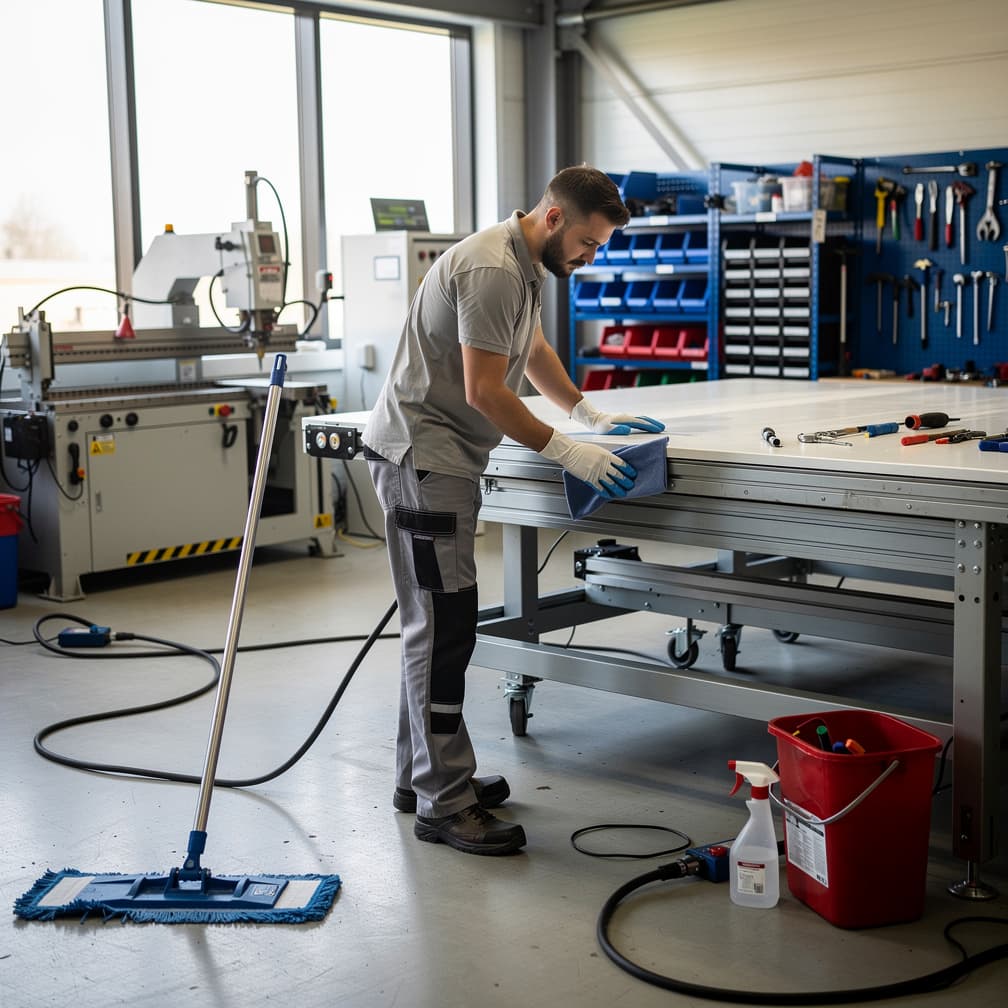

About 620 cleaning services operate in Orange County, and the number matters less than what every one of them is asked to sign. Client contracts converge on the same short list: proof of coverage, a stated limit, additional-insured status, and a certificate before a badge gets issued. Cleaning service insurance in Orange is largely the business of satisfying that list without buying things you do not need. The underlying risk is simpler than the paperwork suggests. A wet floor hurts a stranger, a cart ruins a finish, a van gets hit on the way to the second job of the day. Those three scenes account for most of what your crew will ever report. Everything else on the quote is detail arranged around them, and this page keeps them in that order.
What Makes Orange Different
Payroll is the first number an underwriter asks for, and the one that moves a cleaning quote most. Headcount and hours drive it, so a growing schedule reaches the price before revenue does. Task mix comes next: stripping floors, cleaning at height, or handling harsh chemicals reads differently than dusting. The vehicles you run matter, because a van in traffic all day is exposure no office ever sees. Then there is loss history, which is the part you cannot talk your way around at renewal. Two claims in three years read louder than a decade of clean work before them. None of those drivers are local to Orange, but the mix of work you can win there is. Price the operation you run, and ask participating carriers in California to quote that description.
Local Risk Factors in Orange
Decide in advance whether you will take smoke cleanup work, because saying yes in the moment commits your crew to a job with different exposures and a different rate. Heavy soot removal, air handling, and long hours in poor conditions are not nightly office work, and a carrier priced you on the description you gave them. Call before the truck rolls. There is also the ordinary side of it: a van in a queue on a closed road, a client who cannot open, and a week with no revenue in it. Participating carriers in California treat all of that differently, so read the form rather than a summary, and know what your Orange contracts oblige you to do when a client cannot open.
What Coverage Does a Cleaning Service in Orange Need?
General Liability
Nearly every cleaning contract names this line, because a fall in a client hallway is the loss a building owner is worried about. General Liability may answer for bodily injury to a tenant or visitor and for damage to property you do not own, subject to the form you buy. Property in your care, custody, or control is typically excluded, so the floor you are servicing can sit outside it.
Example: A visitor slips on a lobby floor your crew finished twenty minutes earlier and sues over a broken wrist. Defense costs and a settlement of that kind may fall inside the policy, subject to your limits.
Workers Compensation
A crew member comes off a ladder during high dusting, and the medical bill and the lost wages are a payroll matter rather than a liability one. Workers Compensation is rated per hundred dollars of payroll and on job classification, so a floor tech and an office cleaner price differently. What is required varies by state and by how workers are classified.
Example: A night crew member slips carrying an extractor down a stairwell and misses six weeks. Treatment and a share of lost wages are typically handled through this line, depending on how the claim gets classified.
Commercial Auto
Personal auto forms typically exclude business use, which is where cleaning crews get caught: the van carrying supplies between job sites sits outside that policy the moment it is working. Commercial Auto is written for the use and might respond to collision damage, injury to others, and, where comprehensive is included, theft or storm damage. Equipment inside the vehicle is often a separate question with its own limit.
Example: A van rear-ends a car at a light on the way to the second job of the day, with a buffer and a case of solution in the back. Repairs and the other driver's claim could be handled here, subject to the deductible.
Business Owners Policy
Where General Liability deals with what your crew does to other people, a Business Owners Policy bundles that liability with coverage for property you own: the machines, the supplies, the contents of a storage space. Small cleaning operations buy it for the simplicity. Equipment away from your own premises is often limited, and rising water generally sits outside the form entirely.
Example: A storage space is broken into overnight in Orange, and the buffer, the extractor, and a pallet of supplies are gone before the first shift. A theft loss like that is commonly what this policy is meant to address.
How Much Does Cleaning Service Insurance Cost in Orange?
Cleaning Service Insurance is a bundle of separate policies, priced separately. The ranges below are typical figures for Orange for each line, except workers compensation, which is rated per $100 of payroll; a quote prices each one against your own operations.
| Coverage | Typical range | What moves your price |
|---|---|---|
| General Liability Insurance | $60 - $180 per month | Industry and risk classification, annual revenue, number of employees |
| Workers Compensation Insurance | $0.75 - $2.74 per $100 of payroll | Employee classification codes, total annual payroll, experience modification rate |
| Commercial Auto Insurance | $190 - $525 per month | Fleet size and vehicle types, driver records and experience, coverage limits and deductibles |
| Business Owners Policy Insurance | $85 - $240 per month | Annual revenue and industry class, building and contents values, square footage and building age |
Prices shown are general estimates, not guaranteed rates or quotes. Your actual premium will depend on the insurer, coverage selected, business details, location, claims history, and other underwriting factors. Learn about our pricing methodology.
What Are the Insurance Requirements for a Cleaning Service in Orange?
Workers' comp is generally required once you have your first employee. California generally requires employers to carry workers' compensation at that point. Common exemptions include sole proprietors and some partners. Confirm current thresholds with your state's workers' compensation agency before you hire.
State auto liability minimums apply to business vehicles. California's minimum auto liability limits are $30,000/$60,000/$15,000 (bodily injury per person / per accident / property damage). Contracts and lenders often require more than the state floor.
Flood damage is typically excluded from standard policies. Standard commercial property and builders-risk-type policies typically exclude flood damage. Flood exposure varies address by address, so check your premises in FEMA's Flood Map Service Center before deciding; if you sit in a mapped flood zone, a separate policy through the National Flood Insurance Program is the usual starting point.
Where to verify licensing and coverage rules. The California Department of Insurance publishes consumer guidance and current insurance requirements for California businesses. When a contract or lease demands specific wording, the California Department of Insurance's guidance is the authoritative place to check.
Get Your Cleaning Service Quote in Orange
Compare rates from multiple carriers. Free quotes, no obligation.
Operating in Orange
- Keys, codes, and after-hours access make your crew the only party inside the building, which means an unexplained loss in it starts with a question about you. Keep a record of who held what.
- A caution sign costs almost nothing and is the first thing anyone asks about after a visitor falls in a hallway your crew just finished. Its absence tends to be the whole claim.
- Move-out cleans end with a property manager in Orange wanting photos before the keys change hands, and those photos become your record of what was already damaged when the crew arrived.
- Compliance portals cut access automatically when a certificate expires, so a lapse in Orange can stop a shift without anyone deciding to punish you, and the billing for that night is simply gone.
How to Buy: Advice for Orange Owners
Gather the paperwork before you ask anyone for a number: payroll by job type, a list of vehicles and who drives them, values for your machines, and your loss runs. Underwriters price the description they are given, and a vague description gets priced defensively. Say plainly whether your crew strips floors, works at height, or handles post-construction debris, because each of those changes the file. A Business Owners Policy can bundle liability with property for a small operation, which is often simpler than assembling the pieces separately. If a van runs your routes, Commercial Auto sits alongside that rather than inside it. Check the California Department of Insurance's guidance before deciding what your operation must carry in California. With identical facts in front of every underwriter, quotes from participating carriers become comparable instead of confusing.
FAQ
Cleaning Service Insurance in Orange: FAQ
Property managers, building owners, a general contractor on a post-construction job, and sometimes a tenant's own compliance team. Each may want different entities named and a different limit shown. The certificate is a snapshot; the endorsement on the policy is what an adjuster reads later. Get the exact legal names in writing before requesting the document, because a portal rejects a near match without explaining why.
Not automatically. General Liability may answer for damage to property you do not own, but the standard form typically excludes property in your care, custody, or control, which is exactly what a floor you are servicing can be. Ask whether an endorsement addresses that gap and what it changes. Settle it before a cart gouges a finish in an Orange lobby, not after.
Yes, and the request is routine. Additional-insured status is usually added by endorsement rather than by typing a name onto a certificate, and the two are not the same thing. A landlord behind an Orange building can require it, and the wording may reach parties you have never met. Ask a carrier what the endorsement grants before you promise a client it does what they assume.
One is the most a policy might pay for a single incident; the other is the ceiling for the entire policy year. A slip claim in the spring and a ruined floor in the autumn draw on the same annual pot, so a healthy per-occurrence figure on a certificate says nothing about what remains underneath. Ask whether the aggregate can be restored, and what that costs.
Personal auto forms typically exclude business use, so a vehicle carrying supplies between jobs can sit outside them entirely. Commercial Auto is written for that use and gets priced on the vehicles, the drivers, and the miles. If employees ever take their own cars on a run, ask about hired and non-owned exposure specifically, because it is easy to assume and expensive to assume wrongly.
Theft between appointments is one of the most ordinary losses in this trade, and where the property was kept changes the answer. A Business Owners Policy can bundle property coverage with liability, though coverage for equipment away from your own premises is often limited and sometimes optional. Total up what the buffer, the extractor, and the supplies are really worth before choosing a limit.
Sources
- 1.U.S. Census Bureau, County Business Patterns (2022), Orange County(Orange County has about 620 businesses in this trade's category (NAICS group 561720).)
- 2.California Department of Insurance(California Department of Insurance publishes consumer guidance for insurance buyers.)
- 3.FEMA / FloodSmart(Flood coverage is typically purchased separately; FEMA administers the National Flood Insurance Program.)


