







































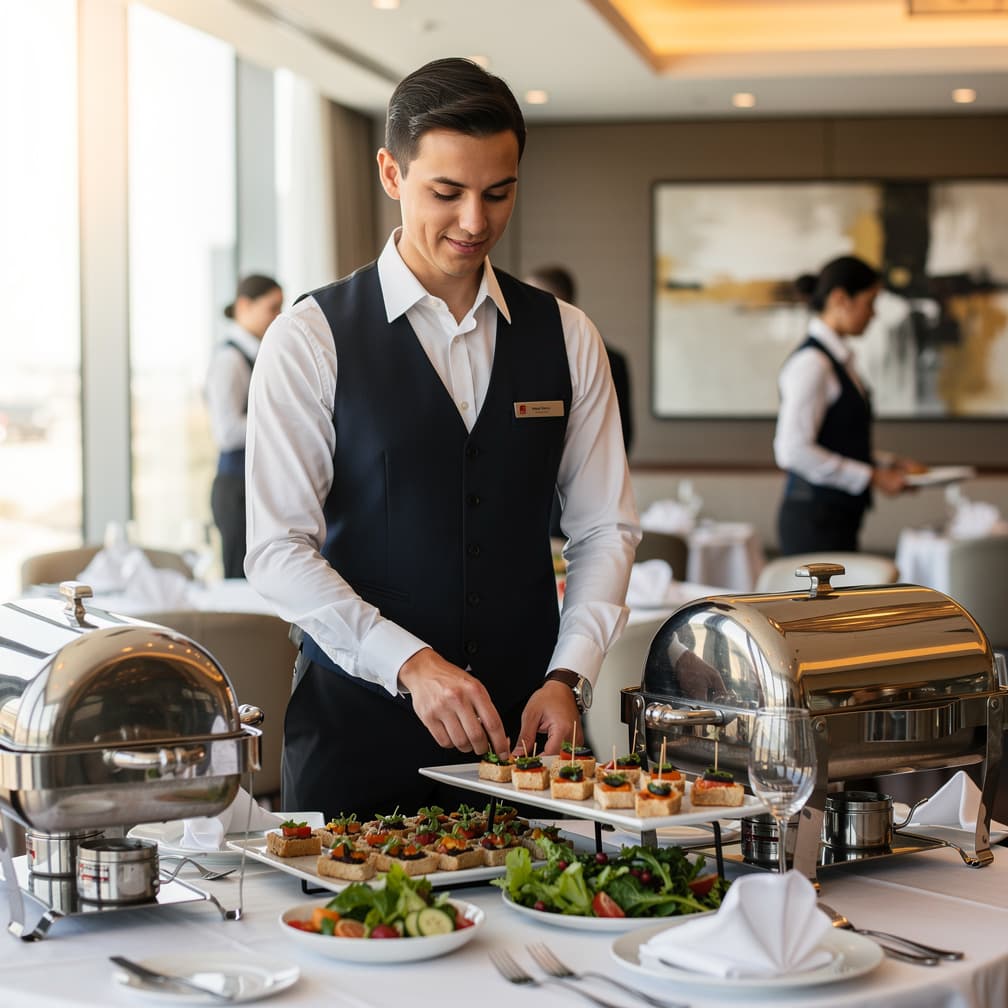

A guest catches a foot on a cable near the buffet line and lands hard, and the injury claim goes to the caterer who set that line up, not the venue that owns the floor. Catering business insurance in Riverside sits on that split: your crew works inside property you do not own, and whatever happens during service follows your name home. Hot boxes get wheeled across finished floors. Chafing fuel burns within reach of a curious kid. A sauce spill in a service aisle turns into evidence months later, long after the last plate was washed. The sections below lay out what caterers usually carry, what the published ranges look like, and where the rules in California come into it, so you can compare quotes against the jobs you actually book.
What Makes Riverside Different
The party who owns the room sets the terms, whether that room is a banquet hall or a backyard tent. A client can ask for proof of coverage at booking, at final payment, or on the morning of service. Each request is really a question about whether they inherit your problem when a guest gets hurt. Answering it the same day is an edge for a caterer in Riverside that costs almost nothing to keep. Public venues often want the certificate filed weeks ahead, which makes your renewal timing a booking issue. A policy that lapses between the deposit and the event date can void the arrangement entirely. Who must be named on the paperwork differs by venue and across California, so ask instead of assuming. Put the question on your intake form and the answer stops being an emergency.
Local Risk Factors in Riverside
Before fire season, take an hour to photograph the kitchen, the storage, and the van, then keep that record somewhere the fire cannot reach. Claims move on documentation, and an owner who evacuated with nothing but a phone still holds the file that matters. Ask what your policy says about smoke, ash, and cleaning, because those are the losses that arrive without flames. Commercial Property is generally the line involved, and the deductible decides whether a cleaning bill is even worth filing. Fire seasons vary across California, and a kitchen in Riverside can sit in a very different picture than one an hour away.
What Coverage Does a Catering Business in Riverside Need?
General Liability
A guest trips near the buffet line and files a claim, and that is the exposure this line exists for. Venues and corporate clients name it in their contracts, and it commonly answers third-party bodily injury or property damage arising out of your work. It generally excludes injuries to your own staff and damage to property in your care.
Example: A server sets a chafing dish on a folding table that gives way, and a guest reaching past it is burned; the injury claim that follows is what general liability may answer.
Commercial Auto
Anyone financing your van wants proof of this, and an event contract usually assumes it exists the moment you deliver. Rating turns on the vehicles, the drivers, and the miles, and the line can help cover liability and damage after a crash on the way to a job. A personal auto policy typically steps aside once the trip is business.
Example: Your van gets rear-ended crossing town with two hundred covered plates in the back; the truck repair sits with Commercial Auto, while the ruined food is usually a separate conversation.
Commercial Property
Flood sits outside this form, and so does wear and tear, which is where an honest reading of it starts. What it typically handles is your own equipment and stock: warmers, cold storage, racks, china, and linens, when a named peril damages them. Theft and vandalism are commonly included, subject to the deductible you choose.
Example: Somebody pries open the van overnight in Riverside and the warmers and cambros are gone by morning; commercial property might help cover the replacements once your deductible is met.
Liquor Liability
General Liability commonly excludes claims tied to serving alcohol, and this line exists to fill that hole. It is meant for the wedding or corporate event where your own staff pours, and it may respond when an overserved guest causes harm to someone. Venues often require it in writing before a bar opens in their room, and the terms vary by carrier.
Example: A guest keeps drinking well past the point your bartender should have stopped, then injures somebody on the way home; liquor liability is the line that gets tested.
Workers Compensation
Burns, knife cuts, and slips on a wet prep floor are the routine injuries in a catering kitchen, and this is the line built for them. Pricing runs per $100 of payroll and gets audited afterward, and the coverage can help cover medical costs and lost wages for staff hurt on the clock. Whether it is required depends on where you operate and how many people you employ.
Example: A server carrying a tray goes down in a wet service aisle in Riverside and misses three weeks; workers' compensation is generally where that medical bill and those lost wages land.
How Much Does Catering Business Insurance Cost in Riverside?
Catering Business Insurance is a bundle of separate policies, priced separately. The ranges below are typical figures for Riverside for each line, except workers compensation, which is rated per $100 of payroll; a quote prices each one against your own operations.
| Coverage | Typical range | What moves your price |
|---|---|---|
| General Liability Insurance | $95 - $310 per month | Industry and risk classification, annual revenue, number of employees |
| Commercial Auto Insurance | $240 - $675 per month | Fleet size and vehicle types, driver records and experience, coverage limits and deductibles |
| Commercial Property Insurance | $120 - $490 per month | Building value and construction type, roof age and condition, fire protection class |
| Liquor Liability Insurance | $50 - $200 per month | Share of sales that comes from alcohol, type of venue and how late you serve, server training and service procedures |
| Workers Compensation Insurance | $0.75 - $2.74 per $100 of payroll | Employee classification codes, total annual payroll, experience modification rate |
Prices shown are general estimates, not guaranteed rates or quotes. Your actual premium will depend on the insurer, coverage selected, business details, location, claims history, and other underwriting factors. Learn about our pricing methodology.
What Are the Insurance Requirements for a Catering Business in Riverside?
Workers' comp is generally required once you have your first employee. California generally requires employers to carry workers' compensation at that point. Common exemptions include sole proprietors and some partners. Confirm current thresholds with your state's workers' compensation agency before you hire.
State auto liability minimums apply to business vehicles. California's minimum auto liability limits are $30,000/$60,000/$15,000 (bodily injury per person / per accident / property damage). Contracts and lenders often require more than the state floor.
Flood damage is typically excluded from standard policies. Standard commercial property and builders-risk-type policies typically exclude flood damage. Flood exposure varies address by address, so check your premises in FEMA's Flood Map Service Center before deciding; if you sit in a mapped flood zone, a separate policy through the National Flood Insurance Program is the usual starting point.
Where to verify licensing and coverage rules. The California Department of Insurance publishes consumer guidance and current insurance requirements for California businesses. When a contract or lease demands specific wording, the California Department of Insurance's guidance is the authoritative place to check.
Get Your Catering Business Quote in Riverside
Compare rates from multiple carriers. Free quotes, no obligation.
Operating in Riverside
- Servers hired for a single night still count as staff on a rating worksheet, and the classification code applied to them moves the premium more than the headcount does.
- Certificates expire quietly. A property manager in Riverside County can pull a booking the week an out-of-date one surfaces in their file, and the first call you get is the cancellation.
- Delivery timing puts your van in traffic at exactly the hours everyone else is driving, and a collision crossing Riverside County with the whole event in the back is a two-claim day.
- Public events often need paperwork on file before a tent goes up, and the office holding that file is rarely the client who booked you or the venue you are serving.
How to Buy: Advice for Riverside Owners
Ask for three quotes on identical terms for your operation in Riverside or do not bother comparing them. Same limits, same deductible, same vehicle list, same payroll, same alcohol answer. A quote that assumes you never pour wine is not a quote for your business, and the difference surfaces at the claim rather than the renewal. Watch for a General Liability policy with a thin aggregate hiding under an attractive monthly figure. Watch for Commercial Auto quoted on one van when you run two. Read the classification code on each quote and ask why it was chosen, since the code drives the rate. The California Department of Insurance publishes consumer guidance on reading a commercial insurance quote. CPK lines up quotes from participating carriers so those differences are visible before you sign rather than after.
FAQ
Catering Business Insurance in Riverside: FAQ
Have last year's revenue, payroll split by role, a list of vehicles with their drivers, and an equipment schedule carrying replacement values. Add the number of events where alcohol is served and who does the pouring. Bring the strictest contract you hold for work in Riverside, because its limits set the target. Loss runs from your current carrier round it out. Quotes built on guesses get corrected at audit, which is the expensive way to learn.
Yes, and the lease usually forces the question first. A commissary can require proof of coverage before handing over a key, and it may want to be named on the policy. Your equipment in a shared space is still your equipment, so schedule it rather than assuming the building's policy reaches it. Stock sitting in a shared cooler is worth naming to the carrier too.
It can, and it usually arrives late. Foodborne illness ties to products and completed operations wording rather than to the moment of service, so the claim may surface weeks after the plates were cleared. General Liability is commonly the line involved, subject to that wording. Temperature logs, delivery times, and prep records are what a carrier asks for, so keep them as a habit rather than a scramble.
Ask, because territory language matters. Commercial policies define where coverage applies, and a caterer taking jobs an hour away is relying on that definition without having read it. Rating can also vary by territory, so a policy priced for one area may be quoted differently for another. If your calendar regularly crosses Riverside County lines, say so at the quote rather than after a loss.
Usually payroll, revenue, or claims. Workers Compensation is audited, so a season with more staff than you estimated gets trued up at renewal rather than forgiven. Two small guest-injury claims read as frequency to an underwriter, and frequency reprices faster than one large loss. A new van, a client with higher limit demands, or a first year of pouring alcohol all move the number. Ask which factor changed before you shop.
Venues routinely ask for proof before a catering crew comes through the service door, and the contract names the limits they want. That requirement comes from the venue rather than a rule you can look up, so it changes from room to room. A venue in Riverside can hold your crew at the door until the certificate is on file. General Liability is the line venues usually name, since a guest injury during service is the claim on their mind.
Sources
- 1.California Department of Insurance(California Department of Insurance publishes consumer guidance for insurance buyers.)
- 2.FEMA / FloodSmart(Flood coverage is typically purchased separately; FEMA administers the National Flood Insurance Program.)


