







































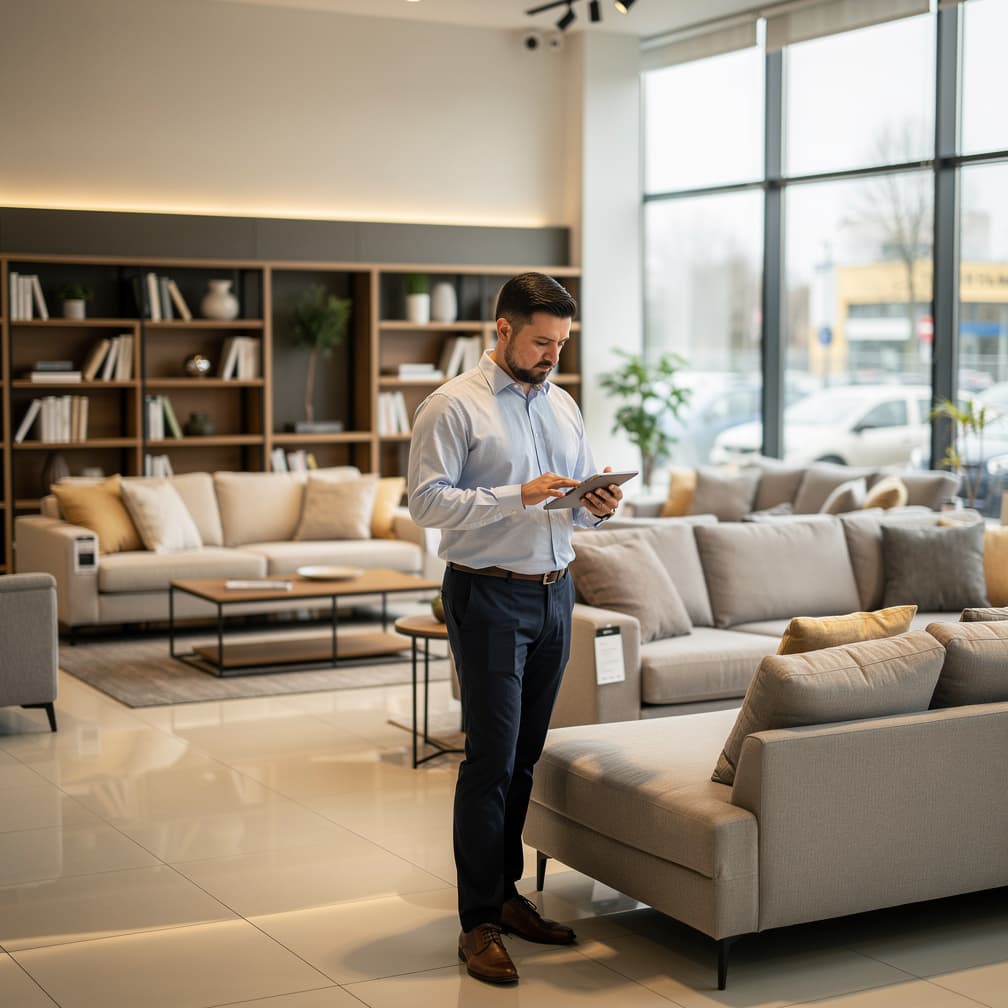

About 27 furniture stores share Monterey County, which tells you how many other buyers a carrier has already priced and almost nothing about what your own store should carry. That is the honest use of a market count: context, not limits. Furniture store insurance in Salinas turns on your selling space, your stock value, your payroll, and whether your crew or a hired one carries the couch up the stairs. Those four answers move a premium; the tally of stores nearby does not. Write them down before you request anything, and write down the claims you have had, because you will be asked for them. Then compare quotes that were all built from the same set of facts, which is the only comparison worth making.
What Makes Salinas Different
A single landlord can be the whole obligation picture when your store is the only one on the block. That concentration cuts both ways: one relationship to keep warm, and one relationship that can end your tenancy. The lease behind a Salinas storefront can require your certificate on file for as long as you occupy the space. A Salinas landlord can also require notice before you change or cancel anything, which quietly limits your ability to shop. Read that notice clause closely, because it decides whether switching carriers later is simple or a negotiation. Warehouse space you rent separately usually arrives with its own version of the same demand. Owners of small buildings are not less strict about insurance; they are simply less staffed about it. Line the demands up first so nothing you buy has to be unwound six weeks later.
Local Risk Factors in Salinas
Wildfire threatens a furniture store twice: once through fire, and once through smoke that ruins upholstery a mile from anything that actually burned. Smoke is the version stores usually see, and fabric, foam, and unfinished wood all hold odor long after the air clears. Commercial Property may respond to smoke as a fire peril, though how a form treats stock that is intact but unsellable varies, and that is the argument worth settling early. Evacuation is the other cost, since a closed store with a full warehouse earns nothing while roads stay shut. Ask what your Salinas policy requires as proof that stock is a loss rather than a markdown, and ask what carriers in California accept as that proof.
What Coverage Does a Furniture Store in Salinas Need?
General Liability
A customer who catches a heel on an entry mat or pulls a bookcase over is the exposure this line exists for. Landlords and commercial buyers commonly want it in place before a lease starts or an order ships. It can help cover defense and settlement of third-party injury and property damage claims, though it generally does nothing about your own stock or your own employees.
Example: A delivery crew swings a headboard into a client's stairwell wall on the way up, and the repair plus the argument that follows is the kind of claim general liability is meant to answer.
Commercial Property
Stock is the point of this one. Sofas, dining sets, floor samples, racking, and the point-of-sale system all sit under a limit you supplied the number for. Fire, storm, theft, and vandalism are the usual perils; flood and gradual leaking usually are not. A lender or a landlord may insist on it where the building or the improvements are financed.
Example: A receiving door left propped during a busy afternoon lets a floor sample walk out overnight, and the theft claim behind it is what a commercial property limit typically stands behind.
Commercial Auto
Every delivery puts a loaded truck between your warehouse and somebody's driveway, which is where this line earns its keep. Personal auto policies commonly exclude business use, so a store delivering in an employee's pickup can be uninsured without anybody noticing. Liability, damage to the vehicle itself, and hired or non-owned exposure are separate decisions inside it. Cargo in the back is usually its own question.
Example: A box truck clips a bollard at a Salinas loading dock with tomorrow's orders aboard; commercial auto may respond to the vehicle damage and to the liability that comes with it.
Workers Compensation
Lifting is how people get hurt in this trade: a sectional on a stair turn, a marble top on a hand truck, a warehouse pull done alone. Rating runs on payroll rather than headcount, so classifying a driver who also loads changes the number. Medical bills and lost wages for an injured employee are what it is meant to take on. Requirements vary by state, and the California Department of Insurance publishes the current requirements.
Example: A loader tears a shoulder easing a dresser around a tight landing, and the medical bills plus the weeks off are the sort of loss workers' compensation is generally there to absorb.
How Much Does Furniture Store Insurance Cost in Salinas?
Furniture Store Insurance is a bundle of separate policies, priced separately. The ranges below are typical figures for Salinas for each line, except workers compensation, which is rated per $100 of payroll; a quote prices each one against your own operations.
| Coverage | Typical range | What moves your price |
|---|---|---|
| General Liability Insurance | $95 - $280 per month | Industry and risk classification, annual revenue, number of employees |
| Commercial Property Insurance | $250 - $825 per month | Building value and construction type, roof age and condition, fire protection class |
| Commercial Auto Insurance | $250 - $750 per month | Fleet size and vehicle types, driver records and experience, coverage limits and deductibles |
| Workers Compensation Insurance | $0.75 - $2.74 per $100 of payroll | Employee classification codes, total annual payroll, experience modification rate |
Prices shown are general estimates, not guaranteed rates or quotes. Your actual premium will depend on the insurer, coverage selected, business details, location, claims history, and other underwriting factors. Learn about our pricing methodology.
What Are the Insurance Requirements for a Furniture Store in Salinas?
Workers' comp is generally required once you have your first employee. California generally requires employers to carry workers' compensation at that point. Common exemptions include sole proprietors and some partners. Confirm current thresholds with your state's workers' compensation agency before you hire.
State auto liability minimums apply to business vehicles. California's minimum auto liability limits are $30,000/$60,000/$15,000 (bodily injury per person / per accident / property damage). Contracts and lenders often require more than the state floor.
Flood damage is typically excluded from standard policies. Standard commercial property and builders-risk-type policies typically exclude flood damage. Flood exposure varies address by address, so check your premises in FEMA's Flood Map Service Center before deciding; if you sit in a mapped flood zone, a separate policy through the National Flood Insurance Program is the usual starting point.
Where to verify licensing and coverage rules. The California Department of Insurance publishes consumer guidance and current insurance requirements for California businesses. When a contract or lease demands specific wording, the California Department of Insurance's guidance is the authoritative place to check.
Get Your Furniture Store Quote in Salinas
Compare rates from multiple carriers. Free quotes, no obligation.
Operating in Salinas
- A Salinas customer can ask your loaders to shift an old sofa out of the way, and that unpaid favor is how a wall gets dented and a claim gets filed.
- Warehouse racking is inventory control until it comes down, and then it is an injury. Height limits, weight limits, and who may go up a ladder are worth writing down before an underwriter asks.
- A Salinas delivery puts your crew inside somebody else's stairwell, where rails, banisters, and door casings absorb most of the damage. A photograph taken at the door settles arguments a month later.
- Discontinued stock cannot be replaced with money alone. When a piece is gone from the line, a claim pays a number while the showroom keeps an empty spot on the floor.
How to Buy: Advice for Salinas Owners
Two quotes with the same premium can be very different policies, and the difference lives in the wording. One Commercial Property form may treat stock in transit as insured property, while another insures the truck and stops there. One General Liability form may put defense costs inside the limit, and another may leave them outside it. For a store expecting a delivery dispute eventually, that second difference deserves real attention, because a defended claim eats limit before it pays anyone. Ask for the forms rather than the summaries. Check the California Department of Insurance's guidance before deciding which differences matter to a business like yours. Then read the two forms side by side and use CPK to see what participating carriers in California put in front of a store your size.
FAQ
Furniture Store Insurance in Salinas: FAQ
Often, though rarely by default. A dock lift, a compressor, or a point-of-sale system that quits stops receiving and stops selling, and a standard property form may treat mechanical breakdown as excluded. Coverage for it is typically an endorsement with its own limit and its own waiting period before lost income counts. Ask what qualifies as a breakdown and how long the wait runs. The answers differ enough between carriers in California to be worth the phone call.
One claim rarely decides a renewal by itself, but a pattern does. Underwriters read frequency as a signal about how a store operates, so three small claims can land worse than one larger loss. That makes the useful fix operational: photographs at delivery, a two-person rule for stairs, and floor protection carried on every truck. Decide in advance which small losses you would rather pay out of the register than report, then price the deductible that matches the decision.
Probably, and this is where owners get caught. A personal auto policy commonly excludes business use, and liability from a delivery can follow the store as well as the driver. Hired and non-owned coverage exists for exactly that arrangement, and it is normally an addition rather than an assumption. Write down who drives what and whether they are employees or contractors, then put the same question to every carrier in the same words.
Whatever their schedule says, which is why the contract sets the limit rather than your own risk math. Office fit-outs, hotel refits, and property managers staging units tend to arrive with a specification attached, sometimes requiring that limits stay in force after delivery is complete. Read every contract your Salinas store has signed and take the strictest number in each column. Quote against that column, since amending a policy midterm costs more than buying it right once.
Ask before a loss, because the form answers this and you do not. Property limits are commonly set on what replacing the piece costs rather than on what it would have sold for, and stores routinely fix the number at an average instead of a peak. A showroom that fills up ahead of a big selling period can be short on exactly the worst possible date. Revisit the stock figure yearly and tell your carrier when it moves.
A certificate records that a policy was in force on the day somebody printed it, and nothing past that. A certificate does not enlarge a limit, does not create coverage the policy never had, and does not survive a cancellation. If a Salinas property manager holds your delivery slot until the certificate is on file, have it issued off the policy rather than typed from memory. Keep a copy with the contract it satisfies, because the version that matters later is the one that matched the demand.
Sources
- 1.U.S. Census Bureau, County Business Patterns (2022), Monterey County(Monterey County has about 27 businesses in this trade's category (NAICS group 442110).)
- 2.California Department of Insurance(California Department of Insurance publishes consumer guidance for insurance buyers.)
- 3.FEMA / FloodSmart(Flood coverage is typically purchased separately; FEMA administers the National Flood Insurance Program.)


