







































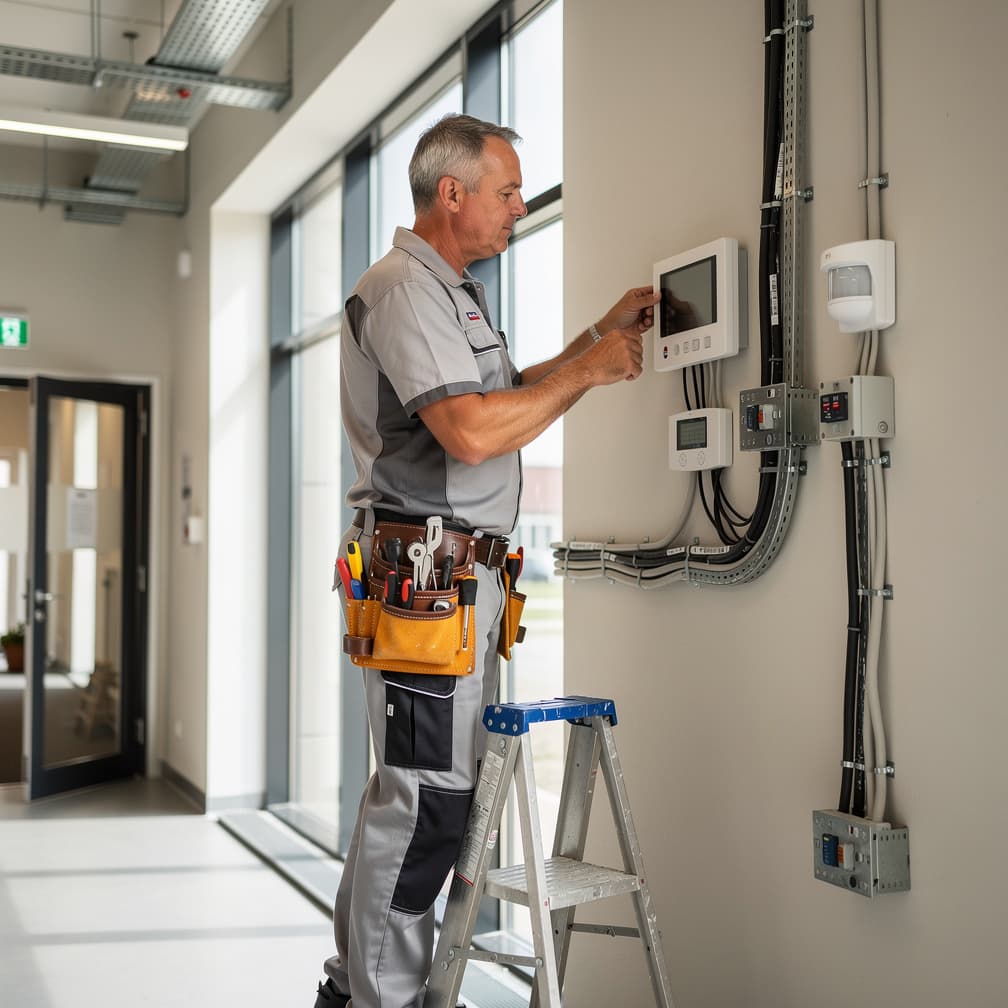

As an alarm contractor in San Bernardino, the low voltage work filling your day is also what makes your risk unusual. Your crew drills into somebody else's walls, touches somebody else's network, and leaves behind a device meant to perform months later, unattended, on the worst night of that building's year. Three kinds of trouble live in that sentence: property damage now, injury to a bystander now, and a performance dispute much later. One line rarely handles all three, which is why an alarm shop's coverage looks nothing like a handyman's. Alarm contractor insurance in San Bernardino is easiest to buy well when you map the three separately, then make each quote show where each one lands. Bring contracts, payroll, and an equipment list to that conversation.
What Makes San Bernardino Different
Deductibles are the lever owners pull last and probably should consider first. Raising one lowers the premium, and it also moves the first slice of every drilled pipe onto your books. That trade is fine if you can fund it and painful if a bad month arrives with the claim. Limits work the other way: additional limit costs less per dollar than the very first dollar did. Participating carriers in California offer different deductible steps, so one limit can be priced several ways. Somewhere between those two curves sits a structure that matches how an alarm shop in San Bernardino actually gets paid. Slow receivables and a high deductible are a bad pairing regardless of what the premium says. A low premium you cannot afford to actually claim against is not a saving.
Local Risk Factors in San Bernardino
Before fire season, get the inventory list current and the evacuation plan written down. An alarm shop in San Bernardino keeps its value in equipment, and equipment stored in a leased bay near a fire zone is a concentrated loss with no backup. Smoke damage to stock gets treated differently across forms, and standard property policies commonly exclude more than owners expect once the fine print is read. Photograph the bay, keep serial numbers somewhere offsite, and learn what a proof of loss requires before you have to build one in a hurry. Ask participating carriers in California what documentation a smoke claim asks for, because that is the part nobody prepares in advance.
What Coverage Does an Alarm Contractor in San Bernardino Need?
General Liability
Landlords, building owners, and general contractors ask for this one by name before your crew gets a key. It can help cover third-party injury and damage your work causes: a drilled pipe, a cracked ceiling, a visitor who slips beside your ladder. Damage to your own faulty work, and arguments about system design, typically fall outside it.
Example: A bit goes through a sprinkler line during a panel retrofit in San Bernardino, and water reaches the suite below. The claim for a tenant's ruined inventory may land here.
Professional Liability
Liability forms commonly exclude professional services, and that exclusion is exactly where alarm work lives. This line is intended for the argument that a design, a zone map, a programming choice, or a missed specification caused the loss. Commercial clients with written scopes are the ones who raise it. It usually runs claims-made, so the retroactive date matters.
Example: A break-in walks past a motion sensor mapped to the wrong zone, and the owner's demand letter quotes your own commissioning report back at you. A dispute like that could be answered here.
Commercial Auto
Vans, trucks, and the miles between service calls are the whole point of this line. It may respond to injury and damage after a collision on the way to an estimate or an install. Personal auto policies commonly exclude business use, so a titled company vehicle needs its own answer. A van left off the schedule generally has none.
Example: A technician rear-ends a car while pulling into a client's lot with a loaded van. Injury claims from the other driver might fall here, subject to the limits you chose.
Workers Compensation
A helper comes off a ladder in an attic and the ambulance arrives before anyone calls the office. This line is meant for employee injury: medical care, part of lost wages, and the claim a liability policy will not take. Requirements differ by state, and pricing runs against payroll rather than revenue.
Example: A technician's shoulder gives out while pulling cable through a ceiling grid, and the surgery keeps him off jobs for months. Medical and wage benefits could come from this line.
Tools & Equipment (Inland Marine)
Property forms follow a fixed address, while an alarm shop keeps its value in a van. This one follows tools and equipment between jobs: panels, test sets, drills, ladders, reels of cable, gear staged at a site overnight. Theft, damage in transit, and loss at a client's building can be in scope, depending on how items are scheduled.
Example: A van gets popped overnight in an unlit lot and the entire install kit goes with it. Scheduled tools and test gear may be replaced under this coverage, less your deductible.
How Much Does Alarm Contractor Insurance Cost in San Bernardino?
Alarm Contractor Insurance is a bundle of separate policies, priced separately. The ranges below are typical figures for San Bernardino for each line, except workers compensation, which is rated per $100 of payroll; a quote prices each one against your own operations.
| Coverage | Typical range | What moves your price |
|---|---|---|
| General Liability Insurance | $130 - $380 per month | Industry and risk classification, annual revenue, number of employees |
| Professional Liability Insurance | $120 - $390 per month | The services you actually perform, annual revenue or billed fees, limit and retention selected |
| Commercial Auto Insurance | $250 - $675 per month | Fleet size and vehicle types, driver records and experience, coverage limits and deductibles |
| Workers Compensation Insurance | $0.75 - $2.74 per $100 of payroll | Employee classification codes, total annual payroll, experience modification rate |
| Inland Marine Insurance | $35 - $120 per month | Total insured value of the scheduled property, type and age of the equipment, where it is stored and how far it travels |
Prices shown are general estimates, not guaranteed rates or quotes. Your actual premium will depend on the insurer, coverage selected, business details, location, claims history, and other underwriting factors. Learn about our pricing methodology.
What Are the Insurance Requirements for an Alarm Contractor in San Bernardino?
Workers' comp is generally required once you have your first employee. California generally requires employers to carry workers' compensation at that point. Common exemptions include sole proprietors and some partners. Confirm current thresholds with your state's workers' compensation agency before you hire.
State auto liability minimums apply to business vehicles. California's minimum auto liability limits are $30,000/$60,000/$15,000 (bodily injury per person / per accident / property damage). Contracts and lenders often require more than the state floor.
Where to verify licensing and coverage rules. The California Department of Insurance publishes consumer guidance and current insurance requirements for California businesses. When a contract or lease demands specific wording, the California Department of Insurance's guidance is the authoritative place to check.
Get Your Alarm Contractor Quote in San Bernardino
Compare rates from multiple carriers. Free quotes, no obligation.
Operating in San Bernardino
- An unlisted second truck saves nothing. The van missing from your schedule is reliably the one involved in the collision that starts the claim.
- Estimates burn windshield time. Hours spent driving across San Bernardino County to look at a job are payroll and exposure with no invoice attached, and the audit still counts them.
- Homeowners rarely read a contract, so a residential dispute opens with a phone call and a demand instead of an insurance exhibit, and the file you kept decides how it ends.
- Building access is a document rather than a courtesy. A property manager in San Bernardino can keep your crew in the lobby until a certificate with the right additional insured wording reaches their inbox.
How to Buy: Advice for San Bernardino Owners
Renewal is the one moment you hold leverage, so start six weeks out rather than six days. Pull loss runs, update payroll, drop the van you sold, add the two you bought, and correct any classification that drifted. Then read one contract you signed in the last year and confirm the policy still satisfies it. Shops find their gaps at renewal or at claim, and only one of those is free. Ask whether your Commercial Auto schedule matches the title paperwork exactly. Ask whether your Inland Marine limit still matches what a loaded van holds today. The California Department of Insurance publishes consumer guidance on reviewing coverage at renewal. Then let participating carriers in California bid on the corrected picture instead of last year's.
FAQ
Alarm Contractor Insurance in San Bernardino: FAQ
That depends on the carrier and the request, and nobody should promise you a window. What you control is having the policy in force, the endorsements already on it, and the client's exact wording in hand before you ask. A request that needs a new endorsement takes longer than one that only needs paper. A crew idling in a lobby in San Bernardino while the file catches up is the expensive version of this question.
Usually not. Liability forms commonly exclude repairing or replacing your own faulty work, even while they can respond to resulting damage that work caused. If a bad mount drops a panel and cracks a client's countertop, the countertop and the panel can be treated very differently. Owners hear that and assume an error somewhere, though it is exactly how the exclusion is written. Budget rework as a cost of running the shop.
Per-occurrence is what one loss can draw. The aggregate is the ceiling for the entire policy year, and that ceiling matters for an alarm shop running dozens of small installs. A run of little drilling claims can quietly consume it, leaving less available when a serious dispute arrives late in the term. Ask whether defense costs erode the limit too, since forms differ and participating carriers in California do not all structure defense the same way.
No, and that mismatch is where alarm contractors get hurt. A contract can promise an owner more than your policy contemplates, particularly around indemnity for the owner's own negligence. The obligation survives even when no coverage answers it, so the money comes out of your business. Read the insurance exhibit against your own form before signing rather than after a loss. If the wording asks for something you cannot produce, negotiate it or price it into the job.
Payroll by job class, annual revenue, a list of titled vehicles and drivers, an equipment schedule, and your loss runs. The split between residential retrofits and commercial contracts matters too, since a commercial system failure carries larger consequences and gets priced that way. Shops that hand over the whole packet get one clear answer. Shops that estimate get a range now and an audit correction later.
Damage to a client's property caused by your work can fall to General Liability, subject to the exclusions printed on the form. Water on the floor and the ceiling below belong to somebody else, which is the classic fit. Repairing your own miswired run is a separate question, and forms often exclude that. Photograph walls and ceilings before drilling on any job in San Bernardino, because the argument about what was already broken is common.
Sources
- 1.California Department of Insurance(California Department of Insurance publishes consumer guidance for insurance buyers.)


