







































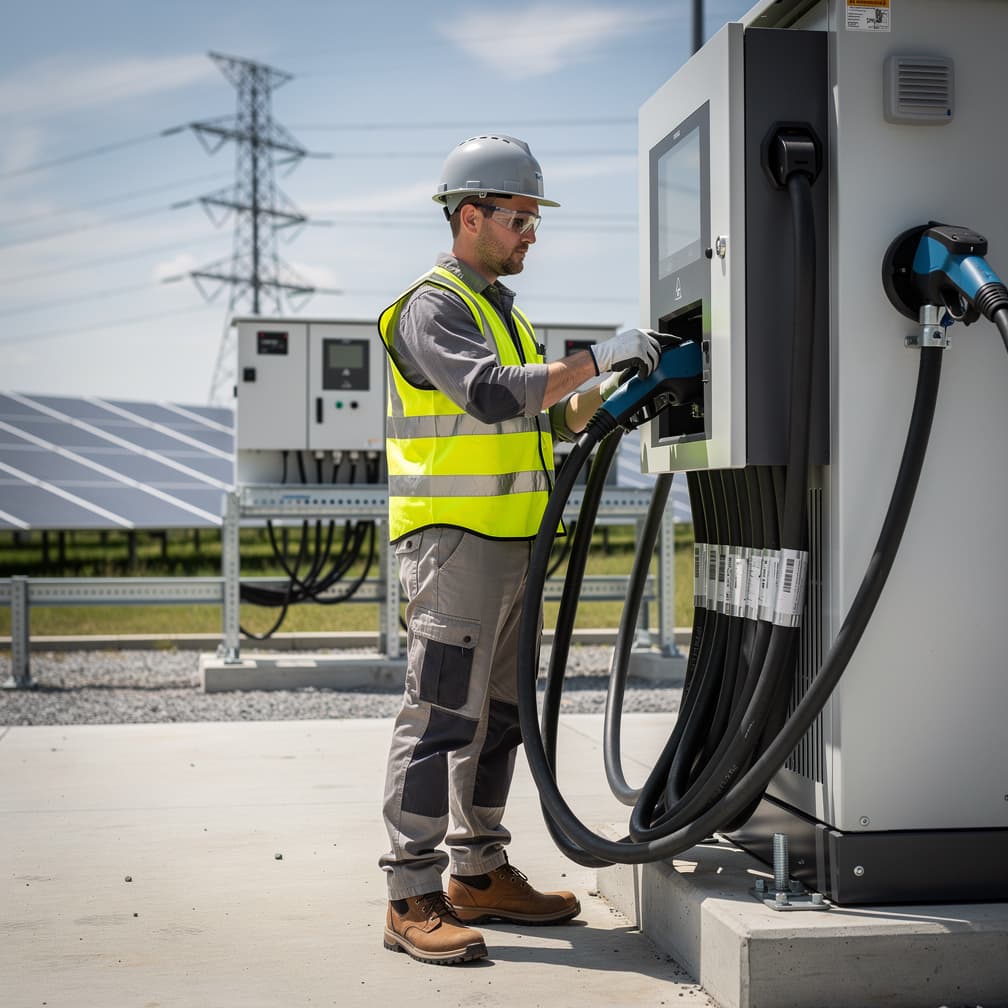

About 9,100 businesses operate in Naugatuck Valley Planning Region, and in a thin market that number doubles as your referral list and your whole pipeline. One dispute over a damaged wall travels through it faster than any lawsuit ever moves. EV charging installer insurance in Waterbury matters here for a reason no quote form mentions: a claim handled quietly does less damage to your next three bids than one you fight. Fewer repair vendors nearby also means a botched install can sit unfixed while the customer waits. A customer waiting on a fix talks to the next buyer before you do. Read the exposures below with that timing in mind.
What Makes Waterbury Different
Long drives are the weather exposure in a thin market, far more than the jobsite ever is. A rural route slick with rain or grit is where a loaded van gets bent, hours before anybody touches a charger. The crash costs you the truck, the day, the two installs booked behind it, and the customer's patience. Auto claims move differently from liability claims: a police report, a repair shop, and a rental question arrive immediately. Ask whether your policy in Connecticut includes rental reimbursement, because a van down is a business closed for a small shop. Storm seasons also empty the schedule and then flood it, and that whiplash becomes a payroll problem. Estimating payroll honestly across a lumpy year is harder than it sounds and matters at audit. Talk through the seasonality of your work in Waterbury with whoever quotes you, since a flat annual guess rarely holds.
Local Risk Factors in Waterbury
A cracked enclosure found in the spring usually started with water that got in during a freeze. An owner in Waterbury can blame the installer rather than the weather, and the argument becomes one about workmanship: sealing, drainage, whether the mount was right. General Liability generally excludes the faulty part of your own work, so redoing your seal stays your cost even when the damage around it may be a claim. Photograph seals, gaskets, and penetrations at commissioning. The picture you take today is the evidence you need in Connecticut eight months from now, when nobody remembers what the install actually looked like.
What Coverage Does an EV Charging Installer in Waterbury Need?
General Liability
Property owners and general contractors ask for this line by name before they let a crew into a garage. It can help cover third-party bodily injury and damage to a customer's building when an install goes wrong. What it typically will not do is pay to redo the faulty part of your own work.
Example: A core bit finds a hidden sprinkler branch, and water runs down two finished levels before anybody shuts it off. The owner's repair invoice may fall to this line, subject to your limit.
Workers Compensation
An apprentice pulling wire in a hot panel is the exposure this line exists for. Medical costs and lost wages after a workplace injury are generally what it responds to, and the price follows payroll rather than how many chargers you set. Who must carry it varies by state.
Example: A helper carrying a wall unit down an icy ramp tears a shoulder, and the surgery costs more than the job billed. Benefits here might pick up the treatment and part of the missed pay.
Commercial Auto
Personal auto policies generally exclude the business use behind a loaded work van, and that gap is what this line fills. It may respond to damage and injuries from a crash while a crew travels between installs, while comprehensive is the piece that answers for theft, hail, and falling debris. Ask about hired and non-owned exposure separately.
Example: A van running between two Waterbury sites rear-ends a sedan at a light, and the other driver files for injuries months later. The liability limits here are what such a claim gets measured against.
Professional Liability
Damage and injury sit on other lines; advice sits here. Load calculations, layout decisions, equipment selection, and the capacity you promised an owner are professional work, and a claim that your recommendation was wrong could fall to this coverage. Intentional acts and problems you knew about and ignored are typically outside it.
Example: You specify a charger the existing service cannot support, the panel trips repeatedly, and a tenant loses a stall for weeks. A dispute over that recommendation might land here instead of on the liability form.
Tools & Equipment (Inland Marine)
Benders, meters, cordless kits, and the compact trencher on your trailer spend their working lives away from any fixed address, which is why a building's property form does not follow them. This coverage is intended for tools and equipment in transit, in the van, or staged at a site. Wear and tear is typically excluded.
Example: A locked van left overnight at a Waterbury job is emptied by morning, taking two battery kits and a bender with it. Replacement values scheduled in advance are generally what settles a claim like that.
How Much Does EV Charging Installer Insurance Cost in Waterbury?
EV Charging Installer Insurance is a bundle of separate policies, priced separately. The ranges below are typical figures for Waterbury for each line, except workers compensation, which is rated per $100 of payroll; a quote prices each one against your own operations.
| Coverage | Typical range | What moves your price |
|---|---|---|
| General Liability Insurance | $200 - $650 per month | Industry and risk classification, annual revenue, number of employees |
| Workers Compensation Insurance | $0.75 - $2.74 per $100 of payroll | Employee classification codes, total annual payroll, experience modification rate |
| Commercial Auto Insurance | $300 - $825 per month | Fleet size and vehicle types, driver records and experience, coverage limits and deductibles |
| Professional Liability Insurance | $120 - $390 per month | The services you actually perform, annual revenue or billed fees, limit and retention selected |
| Inland Marine Insurance | $45 - $150 per month | Total insured value of the scheduled property, type and age of the equipment, where it is stored and how far it travels |
Prices shown are general estimates, not guaranteed rates or quotes. Your actual premium will depend on the insurer, coverage selected, business details, location, claims history, and other underwriting factors. Learn about our pricing methodology.
What Are the Insurance Requirements for an EV Charging Installer in Waterbury?
Workers' comp is generally required once you have your first employee. Connecticut generally requires employers to carry workers' compensation at that point. Common exemptions include sole proprietors and partners. Confirm current thresholds with your state's workers' compensation agency before you hire.
State auto liability minimums apply to business vehicles. Connecticut's minimum auto liability limits are $25,000/$50,000/$25,000 (bodily injury per person / per accident / property damage). Contracts and lenders often require more than the state floor.
Where to verify licensing and coverage rules. The Connecticut Insurance Department publishes consumer guidance and current insurance requirements for Connecticut businesses. When a contract or lease demands specific wording, the Connecticut Insurance Department's guidance is the authoritative place to check.
Get Your EV Charging Installer Quote in Waterbury
Compare rates from multiple carriers. Free quotes, no obligation.
Operating in Waterbury
- Condo boards ask for documents in threes: a certificate, an endorsement naming the association, and proof that whoever you subcontracted carries coverage of their own.
- Progress payments in Naugatuck Valley Planning Region can be withheld over a paperwork mismatch that has nothing to do with whether the charger you installed actually works.
- Load calculations get done at a kitchen table or on a phone in a parking garage, and the number you say out loud is the number an owner relies on months later.
- Apprentices working near live conductors are the reason payroll drives your largest premium line, and one arc injury can outlast every job currently on the schedule.
How to Buy: Advice for Waterbury Owners
Ask every quote the question the price never answers: what does this line not do? Each form has exclusions, and the honest ones are easy to name once somebody asks out loud. Inland Marine typically excludes wear and tear, so a bender that simply dies of old age is your problem rather than a claim. General Liability generally excludes your own faulty workmanship, even while it may answer for the damage that work did to somebody else's property. That distinction settles more disputes in this trade than any limit does. Check the Connecticut Insurance Department's guidance before deciding which gaps you can live with. Knowing what you are not buying makes comparing quotes from participating carriers in Waterbury much faster.
FAQ
EV Charging Installer Insurance in Waterbury: FAQ
Standard property and equipment forms typically exclude flood, and that gap usually gets filled through a separate program rather than an endorsement. Water from a burst pipe inside a building is a different peril and may be treated differently from rising water outside it. If hardware sits staged in a Waterbury garage before an owner accepts it, ask who carries the risk during that window.
Prior claims are among the strongest inputs on a quote, and an open file with a reserve on it can follow you through more than one renewal. Quick reporting and photographs matter for that reason: an incident documented the day it happened usually closes faster than one reconstructed later. Participating carriers weigh identical history differently, which is why gathering more than one quote is worth the hour.
Usually, because a policy already in force can be endorsed, which is far quicker than buying one from scratch under a deadline. The change is neither free nor instant, so ask before you sign a clause naming a limit you do not carry. Increases on liability lines are often smaller than owners expect, which makes the question worth asking at bid time rather than at the gate.
A property manager can hold your site access, your progress payment, or both until a current document is on file, and compliance systems flag an expiry automatically. Work rarely stops because coverage lapsed. It stops because nobody sent the renewal paperwork. Put the renewal date on the same calendar as your job schedule and send fresh certificates before anyone thinks to ask.
The lines are the same; the exposures behind them are not. Commercial jobs bring contracts, additional insured demands, higher limit floors, and more parties able to file. Residential work brings tight garages, a homeowner's finishes, and cars parked feet from your drill. A quote for a shop in Waterbury doing both should reflect the real split, since work mix is a rating input rather than a footnote.
Commercial owners and general contractors routinely ask for a certificate before a work order is signed, and many will not open a gate without one. The certificate proves a policy existed on the day somebody checked. Some contracts go further and require the owner to be added as an additional insured, which happens through an endorsement rather than a line typed onto a certificate.
Sources
- 1.U.S. Census Bureau, County Business Patterns (2022), Naugatuck Valley Planning Region(Naugatuck Valley Planning Region has about 9,100 business establishments.)
- 2.Connecticut Insurance Department(Connecticut Insurance Department publishes consumer guidance for insurance buyers.)


