







































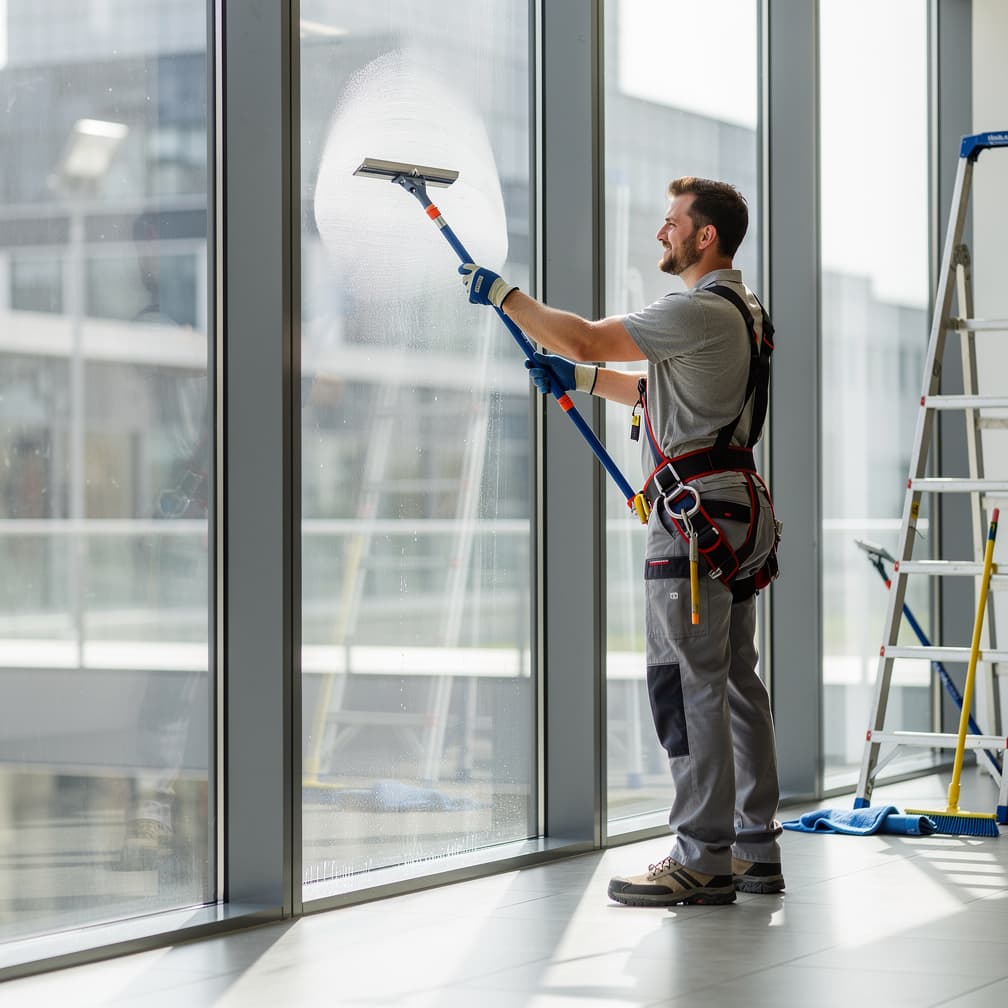

Owning a window cleaning route means your business lives in a van and on a ladder, with almost nothing at a fixed address. Window cleaning service insurance in Waterbury therefore has little to do with a building you own and everything to do with damage you can do to buildings you do not. The exposure travels with the crew: the drive across Naugatuck Valley Planning Region, the setup, the pole through a pane, the wet floor left at the entry. Property managers know this, which is why proof of coverage is a condition of entry rather than a nicety. A quote asks about vehicles, payroll, and working heights before it asks about anything else. Read on for the coverage window cleaners carry, the ranges published for each, and what to gather before comparing.
What Makes Waterbury Different
Weather cancels outdoor work everywhere, and in a thin market you cannot backfill the day with another account. When your whole week is four buildings and a long drive, losing two days loses half of it. That revenue swing is why a small book feels premium pressure more sharply during a bad stretch. Insurance does not solve it, and any policy sold as solving it deserves a hard second read. What coverage can do is stop one wind driven incident from erasing a whole season's margin. A ladder blown into a car parked outside a Waterbury storefront is a small event with a big tail. Ask what your policy does with equipment that moves, and how carriers in Connecticut word that. Then compare quotes on the wording rather than on the monthly figure alone.
Local Risk Factors in Waterbury
Freezing weather in Waterbury turns a window cleaning job into a slip hazard you built yourself. Water on a sidewalk becomes ice within minutes, and the pedestrian who goes down on it has a straightforward argument: your work created the condition. General Liability may respond to that injury claim and its defense costs, subject to your limit, though the claim is far easier to prevent than to win. Cold also shortens the workable day and stiffens equipment, and a crew rushing to finish before dark on frozen ground is how ladder falls happen. An injury to one of your own people is a payroll question rather than a liability one, priced off what you pay rather than what happened. Carriers in Connecticut ask about winter work directly, so answer honestly.
What Coverage Does a Window Cleaning Service in Waterbury Need?
General Liability
A dropped scraper that finds a shoulder, a hose that trips a customer, a pole that scars a neighbor's siding: these are the third party claims General Liability is generally built to answer, along with the defense costs behind them. It typically does not reach your own tools, and damage to the very pane you were cleaning can land inside a care, custody, and control exclusion.
Example: A pedestrian walking under a second story ladder in Waterbury is struck by a falling squeegee and needs stitches; General Liability can help cover the injury claim and the lawyer who arrives with it.
Workers Compensation
Once you put somebody on payroll, this is the line clients, landlords, and state rules expect to see. Workers Compensation is meant for your own crew's injuries: a fall from a ladder, a shoulder worn out by repetitive work, heat sickness on a summer job. It is quoted per hundred dollars of payroll and generally does not respond to anyone who is not your employee.
Example: A window cleaner slips off the third rung and breaks a wrist on a routine storefront call; Workers Compensation can respond to the medical bills and to part of the lost wages.
Commercial Auto
Personal auto forms commonly exclude business use, which leaves a van full of poles, ladders, and tanks outside the only coverage many new owners assume they have. Commercial Auto is designed for that vehicle, for the employees driving it between accounts, and for the harm it can do to other cars and people. Comprehensive coverage on it might reach theft or storm damage, subject to your deductible.
Example: A crew van loaded with extension poles rear-ends a sedan on the way to a morning route; Commercial Auto is generally where the repair bill and the injury claim both get sorted out.
Commercial Umbrella
Your primary lines each stop at their own limit, and a serious claim does not. Commercial Umbrella sits above them and starts where they end, which is the usual way a window cleaning service reaches the limit a large contract names, often for less than raising the primary to the same place. It follows the underlying forms, so it inherits their exclusions rather than filling a gap they left.
Example: A ladder falls in a lobby in Waterbury and injures three people at once, exhausting the primary limit mid-settlement; a Commercial Umbrella might carry the remainder, subject to its own terms.
How Much Does Window Cleaning Service Insurance Cost in Waterbury?
Window Cleaning Service Insurance is a bundle of separate policies, priced separately. The ranges below are typical figures for Waterbury for each line, except workers compensation, which is rated per $100 of payroll; a quote prices each one against your own operations.
| Coverage | Typical range | What moves your price |
|---|---|---|
| General Liability Insurance | $130 - $400 per month | Industry and risk classification, annual revenue, number of employees |
| Workers Compensation Insurance | $0.75 - $2.74 per $100 of payroll | Employee classification codes, total annual payroll, experience modification rate |
| Commercial Auto Insurance | $210 - $575 per month | Fleet size and vehicle types, driver records and experience, coverage limits and deductibles |
| Commercial Umbrella Insurance | $80 - $260 per month | Umbrella limit requested, limits carried on the underlying policies, loss history on those underlying policies |
Prices shown are general estimates, not guaranteed rates or quotes. Your actual premium will depend on the insurer, coverage selected, business details, location, claims history, and other underwriting factors. Learn about our pricing methodology.
What Are the Insurance Requirements for a Window Cleaning Service in Waterbury?
Workers' comp is generally required once you have your first employee. Connecticut generally requires employers to carry workers' compensation at that point. Common exemptions include sole proprietors and partners. Confirm current thresholds with your state's workers' compensation agency before you hire.
State auto liability minimums apply to business vehicles. Connecticut's minimum auto liability limits are $25,000/$50,000/$25,000 (bodily injury per person / per accident / property damage). Contracts and lenders often require more than the state floor.
Where to verify licensing and coverage rules. The Connecticut Insurance Department publishes consumer guidance and current insurance requirements for Connecticut businesses. When a contract or lease demands specific wording, the Connecticut Insurance Department's guidance is the authoritative place to check.
Get Your Window Cleaning Service Quote in Waterbury
Compare rates from multiple carriers. Free quotes, no obligation.
Operating in Waterbury
- Security desks work from a list, and nobody standing at one has the authority to add you to it. If the vendor portal shows expired coverage, your crew loses the morning no matter who you called.
- Ladders ride on the roof of the van, and a strap that fails at highway speed turns your equipment into somebody else's windshield. That claim starts on the vehicle side, not the liability side.
- The wet entry is your creation for as long as the job lasts. Anyone who goes down on it can name your business, and a Waterbury client will forward the demand letter the same day.
- High rise work brings a different buyer: a building engineer who reads your certificate and your equipment list. A crew bidding above the third floor in Waterbury should expect questions about anchors, rigging, and limits before anyone discusses price.
How to Buy: Advice for Waterbury Owners
Start with the contract, not the quote. Pull the insurance exhibit from every recurring account you hold in Waterbury and list what each one demands: limits, additional insured wording, waivers, notice periods. That list is your shopping spec, and it usually asks for more General Liability limit than a new owner would buy on instinct. If the required numbers outrun a primary policy, Commercial Umbrella is the usual way to reach them without rebuilding the whole program. Then look at the vehicle side, because a van packed with poles is rated as a commercial exposure whatever the sign on the door says. The Connecticut Insurance Department publishes consumer guidance on how commercial policies get compared. With the spec written down, you can put one identical submission in front of participating carriers through CPK and see which numbers actually move.
FAQ
Window Cleaning Service Insurance in Waterbury: FAQ
Generally not. Liability coverage aims at harm you do to other people and their property, so your own equipment sits outside it. Tools stolen from a van or snapped on a job are a separate conversation, and small operators often carry that risk themselves without realizing they chose to. Ask each quote where your equipment lands before assuming it is included.
Start from your contracts rather than a rule of thumb. If a Waterbury client names a limit, that number is your floor, and buying under it puts you on the job with paperwork that reads compliant and a policy that is not. Past that, the limit answers the worst realistic day, which in this trade is usually an injury below a ladder. Commercial Umbrella is often how a required number gets reached without rebuilding the primary.
The per occurrence figure is the most available for one incident; the aggregate is the ceiling on everything in a policy year. A route touching dozens of buildings has plenty of chances to stack small claims, and three modest ones can eat an aggregate quietly. The fourth client then discovers there is nothing left. Ask how the aggregate restores rather than only what the per occurrence number says.
No, and it is worth being blunt about that. Days lost to weather are a scheduling problem rather than an insured loss, because nothing of yours was damaged. What coverage can address is the wind driven incident: a pole that gets away and hits a car, a ladder that goes through a storefront. That is a liability claim; the rained out week stays a rained out week.
Yes, and it is one of the most common claims in this trade. Your work created the wet surface, which is a harder position to argue than simply being nearby when someone fell. A liability policy could respond to the injury claim and to defense costs, subject to your limit. Cones and signage do not eliminate the claim, though they help the argument considerably.
Payroll by role, revenue, working heights, a vehicle list, a subcontractor list, and several years of loss history. Missing pieces turn a quote into an estimate that gets re-rated at audit, usually upward. Payroll moves the number most, because workplace injury coverage is priced per hundred dollars of it. Keep it all in one file and every quote you compare describes the same business.
Sources
- 1.Connecticut Insurance Department(Connecticut Insurance Department publishes consumer guidance for insurance buyers.)


