







































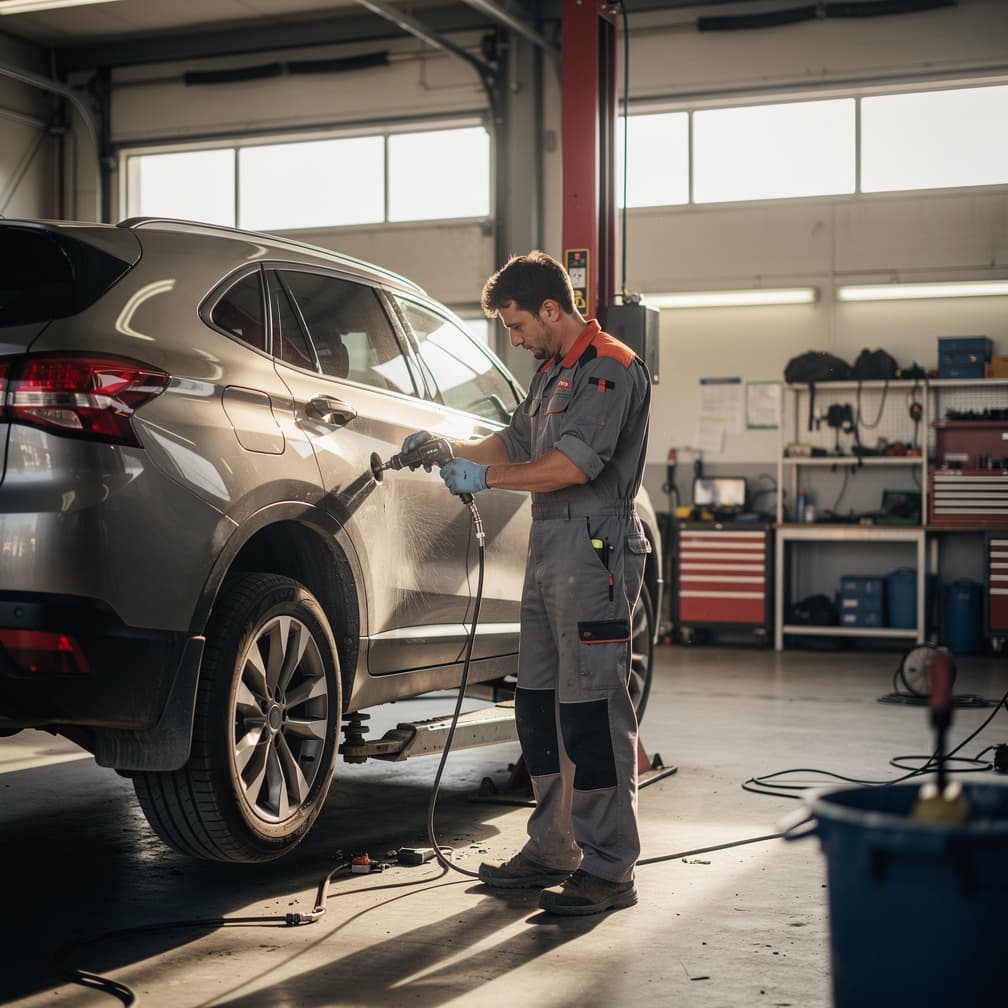

A customer's crossover can sit in your bay for three weeks, stripped to bare metal, and it belongs to someone else the entire time. Auto body shop insurance in Washington answers for that stretch: the vehicle dented during storage, the booth fire that stops every job on the floor, the visitor who slips crossing the bay toward your estimator's desk. Your lifts and spray equipment carry their own exposure, because a dead compressor idles technicians and pushes delivery dates back. District of Columbia has about 24,000 businesses, and any fleet account or dealer among them can demand proof of coverage before releasing work to a shop. The certificate is the easy part. The harder question is whether the limits behind it match what a bad week in your building would actually cost. Compare what participating carriers quote against that figure.
What Makes Washington Different
Waiver of subrogation shows up in repair contracts and confuses more owners than any other clause. It asks your insurer to give up its right to recover from the party you signed with. Insurers can allow it by endorsement, refuse it, or charge for it, depending on the policy. Signing first and asking later is how a shop learns its wording does not match its promises. A body shop in Washington handling work for a rental operator may meet the clause on every order. The clause costs nothing to read and can cost a claim to ignore. The DC Department of Insurance, Securities and Banking publishes consumer guidance on commercial policy terms, which is worth a look before signing. Bring the exact clause to participating carriers and ask each whether it will endorse it.
Local Risk Factors in Washington
Before the wet season arrives, find out in writing whether your policy treats rising water as a covered cause of loss. Most standard forms do not, and the morning your parts room is ankle deep is a poor time to learn it. Practical steps cost nothing: raise stock off the floor, keep chargers and battery banks on shelves, and decide which cars would need moving first. That last question earns its keep when a shop in Washington holds customer cars, because a vehicle moved to higher ground is a claim that never happens. Commercial Property may respond to wind-driven rain through a torn roof while leaving ground water out entirely, and the distinction decides plenty of claims. Confirm the details with the DC Department of Insurance, Securities and Banking before you buy.
What Coverage Does an Auto Body Shop in Washington Need?
General Liability
Landlords, dealers, and fleet accounts ask for this one by name before they release work or hand over keys. It can help cover a visitor hurt in your reception area or lot, damage you cause to property that is not yours, and the legal defense behind either. Injuries to your own technicians sit somewhere else entirely, and so does damage to the panel you are repairing.
Example: A customer steps around a parts cart in the walkway, catches a heel on a floor drain, and breaks a wrist; General Liability may respond to the medical claim and the defense that follows it.
Commercial Property
Rising water is typically outside this form, and so is ordinary wear, which catches owners off guard more than anything else in the policy. What it could help cover is the building, the booth, the parts room, and the contents inside them after fire, storm, or a break-in. Customer vehicles in your custody follow their own limit, so ask about that one separately.
Example: Fire starts in the spray booth after closing and smoke reaches the mixing room and the office; Commercial Property is generally the line quoted for the building and contents behind a loss like that.
Workers Compensation
A technician tears a shoulder freeing a seized panel, and the medical bills and missed wages become a payroll question rather than a liability one. This line is rated against payroll by job classification, and it typically handles work-related injury and illness for people you employ. It does not answer for a customer hurt in the same building. Requirements vary by state.
Example: A grinder kicks back and opens a technician's forearm two hours before a promised delivery; Workers Compensation could help cover the treatment and the wages lost while that arm heals.
Tools & Equipment (Inland Marine)
Where a property policy watches the building, this line follows the gear that makes the work possible: welders, spray guns, dent pullers, and the equipment that moves between bays or leaves in a technician's truck. It is priced off the schedule you file, so anything unlisted is usually anything unpaid. Wear and mechanical breakdown are commonly left out.
Example: A tool chest and two welders vanish from a locked bay in Washington overnight, and the schedule collapses by mid-morning; Inland Marine is the line usually quoted against a theft like that.
How Much Does Auto Body Shop Insurance Cost in Washington?
Auto Body Shop Insurance is a bundle of separate policies, priced separately. The ranges below are typical figures for Washington for each line, except workers compensation, which is rated per $100 of payroll; a quote prices each one against your own operations.
| Coverage | Typical range | What moves your price |
|---|---|---|
| General Liability Insurance | $130 - $450 per month | Industry and risk classification, annual revenue, number of employees |
| Commercial Property Insurance | $200 - $800 per month | Building value and construction type, roof age and condition, fire protection class |
| Workers Compensation Insurance | $0.75 - $2.74 per $100 of payroll | Employee classification codes, total annual payroll, experience modification rate |
| Inland Marine Insurance | $30 - $120 per month | Total insured value of the scheduled property, type and age of the equipment, where it is stored and how far it travels |
Prices shown are general estimates, not guaranteed rates or quotes. Your actual premium will depend on the insurer, coverage selected, business details, location, claims history, and other underwriting factors. Learn about our pricing methodology.
What Are the Insurance Requirements for an Auto Body Shop in Washington?
Workers' comp is generally required once you have your first employee. District of Columbia generally requires employers to carry workers' compensation at that point. Common exemptions include sole proprietors. Confirm current thresholds with your state's workers' compensation agency before you hire.
Flood damage is typically excluded from standard policies. Standard commercial property and builders-risk-type policies typically exclude flood damage. Flood exposure varies address by address, so check your premises in FEMA's Flood Map Service Center before deciding; if you sit in a mapped flood zone, a separate policy through the National Flood Insurance Program is the usual starting point.
Where to verify licensing and coverage rules. The DC Department of Insurance, Securities and Banking publishes consumer guidance and current insurance requirements for District of Columbia businesses. When a contract or lease demands specific wording, the DC Department of Insurance, Securities and Banking's guidance is the authoritative place to check.
Get Your Auto Body Shop Quote in Washington
Compare rates from multiple carriers. Free quotes, no obligation.
Operating in Washington
- Parts arriving damaged or late leave a stripped car sitting in a bay for days, and a torn-down vehicle in storage is pure exposure with no revenue attached to it.
- About 11 auto body shops operate in District of Columbia, which is also the number of owners bidding for the same technicians, so an injury claim costs you a scarce person and not only money.
- A lift failure with a car in the air is the incident nobody plans for, and it can reach your equipment, your customer's vehicle, and a technician in the same second.
- Estimators walk customers across the shop floor, so the same aisle that moves parts and panels also moves people who have never worn safety glasses in their lives.
How to Buy: Advice for Washington Owners
Start with the loss that would actually close your doors. For most shops that is a fire in or around the paint booth, which can reach the building, the mixing room, the equipment, and the cars waiting on the floor in one event. Commercial Property is the line usually quoted against that scenario, and the values you report decide what a settlement can look like. Ask what the policy treats as scheduled equipment, because a frame rack and a booth are not office furniture. Ask separately what happens to income while you rebuild, since a shop in Washington still owes its customers their cars during the months it has no bays. Check the DC Department of Insurance, Securities and Banking's guidance before deciding how much of that risk to keep. Then put identical facts in front of several participating carriers and compare what comes back.
FAQ
Auto Body Shop Insurance in Washington: FAQ
Usually, and it moves the first slice of every loss back onto you. That trade is sound when the cash is there on the day a booth stops working and unsound when it is not. Theft and vandalism losses tend to be frequent rather than enormous, so a low deductible on them can cost you at renewal instead. Decide which losses you would simply absorb, then price both settings and compare.
A per-occurrence limit is the most a policy may pay for one event, such as a single customer hurt in your waiting area. The aggregate is the ceiling for the entire policy term across every event. A shop that has already spent most of its aggregate on earlier claims has less left for the next one, even though the per-occurrence number never moved. Ask where you stand at renewal rather than after a loss.
Often it does not. Damage to the very item you are working on is commonly excluded, because insurers treat the quality of your work as your responsibility rather than a chance event. Damage to the rest of the vehicle can be a different question entirely. This is the exclusion that ends the most arguments in a body shop, so ask a carrier to show you exactly where the line sits.
That depends on the carrier, and it is worth asking before you buy rather than the week an account demands one. Some issue certificates the same day through a portal, while others route the request through a service team. Adding an additional insured is an endorsement and can carry a fee. A dealer in Washington can hold cars back until the paperwork lands, so the answer outweighs most price differences.
Renting does not move the exposure. Your equipment, your inventory, the cars in your care, and the people working around them are still yours, and the building owner's policy is written for the building owner. The lease will likely require your own coverage and name limits for it. A tenant in Washington should also ask who insures the improvements they paid for, because that clause strands more owners than any other.
Yes. Insurers ask for several years of loss history, and one bad stretch can price a small shop out of the market it works in. That is why a low deductible on frequent small claims is expensive twice: once at the deductible and again at the next renewal. Ask participating carriers in District of Columbia how they weight prior claims, because the weighting differs and can outweigh every other quote difference.
Sources
- 1.U.S. Census Bureau, County Business Patterns (2022), District of Columbia(District of Columbia has about 24,000 business establishments.)
- 2.U.S. Census Bureau, County Business Patterns (2023), District of Columbia(District of Columbia has about 11 businesses in this trade's category (NAICS group 811121).)
- 3.DC Department of Insurance, Securities and Banking(DC Department of Insurance, Securities and Banking publishes consumer guidance for insurance buyers.)
- 4.FEMA / FloodSmart(Flood coverage is typically purchased separately; FEMA administers the National Flood Insurance Program.)


