







































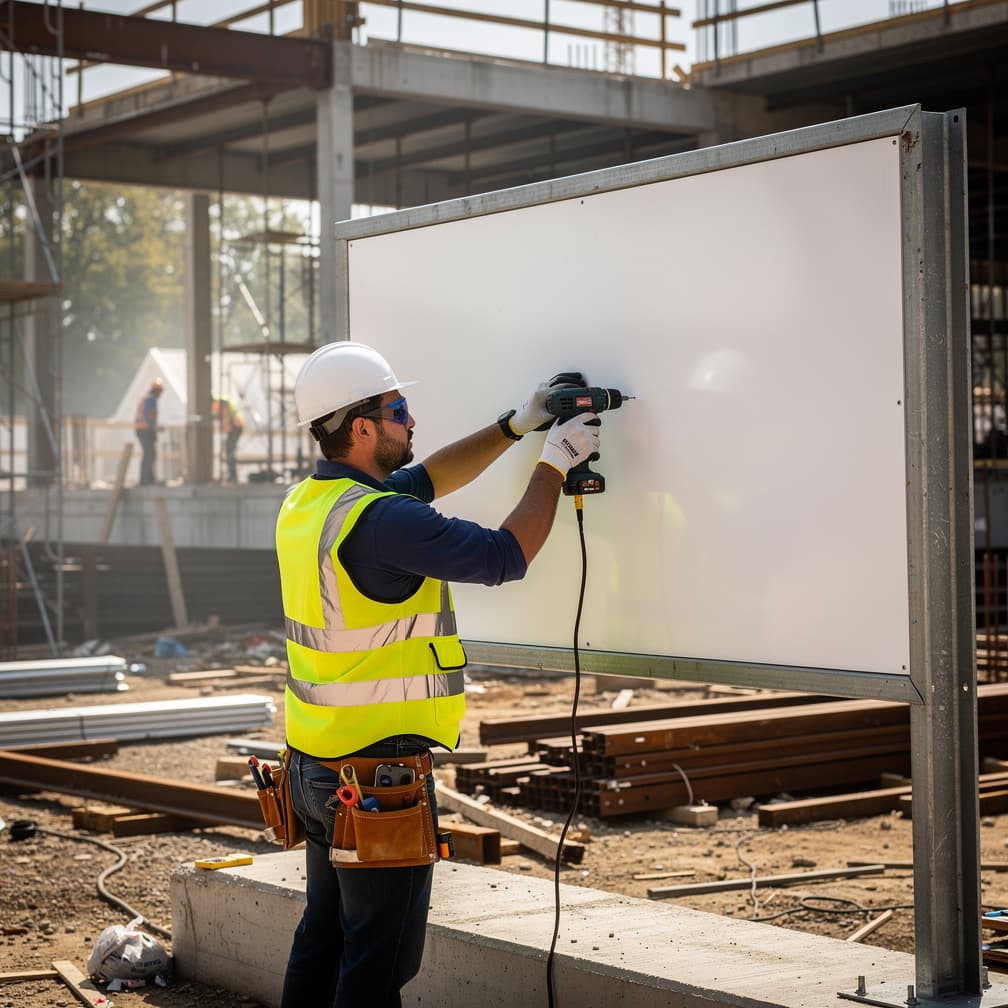

As a sign installation contractor in Atlanta, your exposure starts when the lift leaves the yard and does not end when the last bolt is torqued. Dense markets extend it further, since a job on a leased storefront can put three companies' names on one certificate. Sign installation contractor insurance in Atlanta has to satisfy the party who hired you and the parties who merely own the building. Those are different demands, and they show up as different limits and different endorsement wording. A contract you skim in a hurry can commit you to both at once. The habit that saves the most money is reading the insurance section before the price section, every time. What follows breaks each line down for sign work and shows the published range behind it.
What Makes Atlanta Different
Contracts in a crowded market get longer, and the insurance exhibit is where the length hides. A national tenant's standard form can demand additional-insured status, waivers, and primary wording all at once. Those three phrases are filler to nobody; each one changes what your policy is asked to do. A certificate proving you have coverage says nothing about whether the endorsement wording matches the exhibit. The gap tends to surface after a claim, when a building owner tenders the defense to you. If a landlord in Atlanta rejects your certificate, the job stops until the endorsement is issued. Carriers in Georgia price those endorsements differently, so the same request can move a quote. Read the exhibit before you bid, because the wording is priced into the job either way.
Local Risk Factors in Atlanta
Debris is the part nobody plans for. After a severe storm, a sign that partly failed is more dangerous than one that came down completely, and the customer wants it handled today. Your crew ends up on a lift beside compromised structure, which is exactly the setup that produces injury claims and dropped material. Slow down and document, because photographs taken before you touch anything decide who owns the damage later. General Liability is generally the line that comes into play if a removal damages the building further in Atlanta. Ask what a carrier in Georgia expects you to record on emergency calls, then build the routine before you need it.
What Coverage Does a Sign Installation Contractor in Atlanta Need?
General Liability
Landlords, general contractors, and franchise facility teams ask for this one by name before a lift ever touches their property. It can respond when your work damages a customer's building or injures somebody nearby, and completed-operations wording extends that reach to failures showing up after you leave. Damage to the sign itself, caused by your own faulty work, is typically excluded.
Example: A channel letter slips during a second-story mount and cracks the storefront glass below; general liability can help cover the window, the cleanup, and the claim the tenant files afterward.
Workers Compensation
Injuries to your own crew sit outside General Liability, and that gap is what this line fills. A fall from a lift, a shoulder torn lifting a panel, or heat illness on a roof deck may be handled here, including medical bills and a portion of lost wages. Requirements vary by state, and the Georgia Office of Insurance and Safety Fire Commissioner publishes the current requirements for employers in Georgia.
Example: A groundman steadying a pylon panel takes the weight wrong and tears a shoulder; workers compensation is generally where the surgery and the missed weeks get sorted out.
Commercial Auto
Trucks, trailers, and the lift towed behind them are business vehicles, and personal auto policies commonly exclude business use altogether. This line rates on what you drive, how far, and who is behind the wheel. It might answer for damage you cause in a parking lot as well as damage to your own vehicle. Tools riding inside are a separate question worth asking about.
Example: Backing a bucket truck into a tight lot in Atlanta, your crew catches a parked sedan's fender; commercial auto is typically the line that settles that repair.
Commercial Property
Everything the other lines ignore lives here: the shop, the fabrication equipment, the vinyl and substrate on the racks, and finished panels waiting on an install date. Fire, theft, and named storm perils are the usual causes of loss. Flood is typically excluded and priced separately, and tools away from the premises often fall outside this form as well.
Example: Somebody cuts the lock on your yard overnight, and the ladders, hardware, and two pallets of substrate are gone by morning; commercial property may pick up the replacement cost.
How Much Does Sign Installation Contractor Insurance Cost in Atlanta?
Sign Installation Contractor Insurance is a bundle of separate policies, priced separately. The ranges below are typical figures for Atlanta for each line, except workers compensation, which is rated per $100 of payroll; a quote prices each one against your own operations.
| Coverage | Typical range | What moves your price |
|---|---|---|
| General Liability Insurance | $230 - $750 per month | Industry and risk classification, annual revenue, number of employees |
| Workers Compensation Insurance | $0.75 - $2.74 per $100 of payroll | Employee classification codes, total annual payroll, experience modification rate |
| Commercial Auto Insurance | $370 - $1,025 per month | Fleet size and vehicle types, driver records and experience, coverage limits and deductibles |
| Commercial Property Insurance | $120 - $470 per month | Building value and construction type, roof age and condition, fire protection class |
Prices shown are general estimates, not guaranteed rates or quotes. Your actual premium will depend on the insurer, coverage selected, business details, location, claims history, and other underwriting factors. Learn about our pricing methodology.
What Are the Insurance Requirements for a Sign Installation Contractor in Atlanta?
Workers' comp is generally required once you have 3 or more employees. Georgia generally requires employers to carry workers' compensation at that point. Common exemptions include sole proprietors, partners, and corporate officers. Confirm current thresholds with your state's workers' compensation agency before you hire.
State auto liability minimums apply to business vehicles. Georgia's minimum auto liability limits are $25,000/$50,000/$25,000 (bodily injury per person / per accident / property damage). Contracts and lenders often require more than the state floor.
Flood damage is typically excluded from standard policies. Standard commercial property and builders-risk-type policies typically exclude flood damage. Flood exposure varies address by address, so check your premises in FEMA's Flood Map Service Center before deciding; if you sit in a mapped flood zone, a separate policy through the National Flood Insurance Program is the usual starting point.
Where to verify licensing and coverage rules. The Georgia Office of Insurance and Safety Fire Commissioner publishes consumer guidance and current insurance requirements for Georgia businesses. When a contract or lease demands specific wording, the Georgia Office of Insurance and Safety Fire Commissioner's guidance is the authoritative place to check.
Get Your Sign Installation Contractor Quote in Atlanta
Compare rates from multiple carriers. Free quotes, no obligation.
Operating in Atlanta
- Signs get fabricated before they get installed, so a storm delay leaves finished panels sitting in an Atlanta yard or a trailer where theft and hail can find them.
- Drops tend to happen during the lift rather than the mount: a panel is heaviest and least controlled in the seconds it leaves the truck bed.
- A storefront install in Atlanta puts your crew directly over a public sidewalk, which turns pedestrian control into an insurance decision rather than a courtesy.
- Electrical hookups extend your exposure past the day you leave, because a connection blamed for a failure months later is still your connection.
How to Buy: Advice for Atlanta Owners
Gather the paperwork before you gather quotes, because an underwriter's questions are the same everywhere: annual payroll by role, annual revenue, a list of every vehicle and trailer, the height you regularly work at, whether you do the electrical hookup, and three years of loss runs. Missing answers get replaced with conservative assumptions, and conservative assumptions cost money. Have the equipment list ready too, since the lift is likely the most expensive thing you own. That file lets General Liability and Commercial Auto get priced on facts rather than guesses. The Georgia Office of Insurance and Safety Fire Commissioner publishes the current requirements for the insurance sold in Georgia, which is worth a look before you hand anyone your data. Send one clean packet to participating carriers through CPK and let the comparison in Atlanta be apples to apples.
FAQ
Sign Installation Contractor Insurance in Atlanta: FAQ
Yes, and many do. The certificate is often a condition of the work order itself, so a lapsed or missing one can stall an install that is already scheduled and crewed. Track renewal dates and keep a list of everyone who needs to be named on it. Getting an endorsement issued takes days you may not have during install week.
Annual payroll split by role, annual revenue, a list of vehicles and trailers, a description of the work including typical mounting height and whether you handle electrical connections, and three years of loss runs if you have them. Participating carriers in Georgia fill missing information with conservative assumptions. The more precise your file, the less anyone has to guess, and guesses tend to cost you.
Typically no. Standard property forms generally exclude flood, and coverage for it is written separately through a federal program or a surplus carrier. That matters if you keep panels, vinyl, or electrical components at ground level. Commercial Property may respond to other water losses, such as a burst pipe, so ask which cause of loss you are actually buying.
It depends on why it failed. Completed-operations coverage under General Liability may respond to damage or injury caused by finished work, including an electrical connection that gives out later. Damage to the sign itself from your own faulty work is commonly excluded, since a policy is not a warranty on your craftsmanship. That distinction decides whether the repair comes out of your pocket.
Not automatically. A Commercial Property policy usually concentrates on what sits at your shop, and tools away from the premises can fall outside it unless the form or an endorsement addresses them. Ask specifically about equipment in transit and at a jobsite, since a sign crew's tools spend most of their life in neither spot. Keep serial numbers and photographs either way.
Two ceilings apply at once. The per-occurrence figure caps what a policy may pay on a single claim; the aggregate caps everything paid across the whole term. A sign shop with one bad fall and two cracked storefronts can burn through the aggregate while the per-occurrence number still looks healthy. Watch both, because the renewal after a year like that is a different conversation.
Sources
- 1.Georgia Office of Insurance and Safety Fire Commissioner(Georgia Office of Insurance and Safety Fire Commissioner publishes consumer guidance for insurance buyers.)
- 2.FEMA / FloodSmart(Flood coverage is typically purchased separately; FEMA administers the National Flood Insurance Program.)


