







































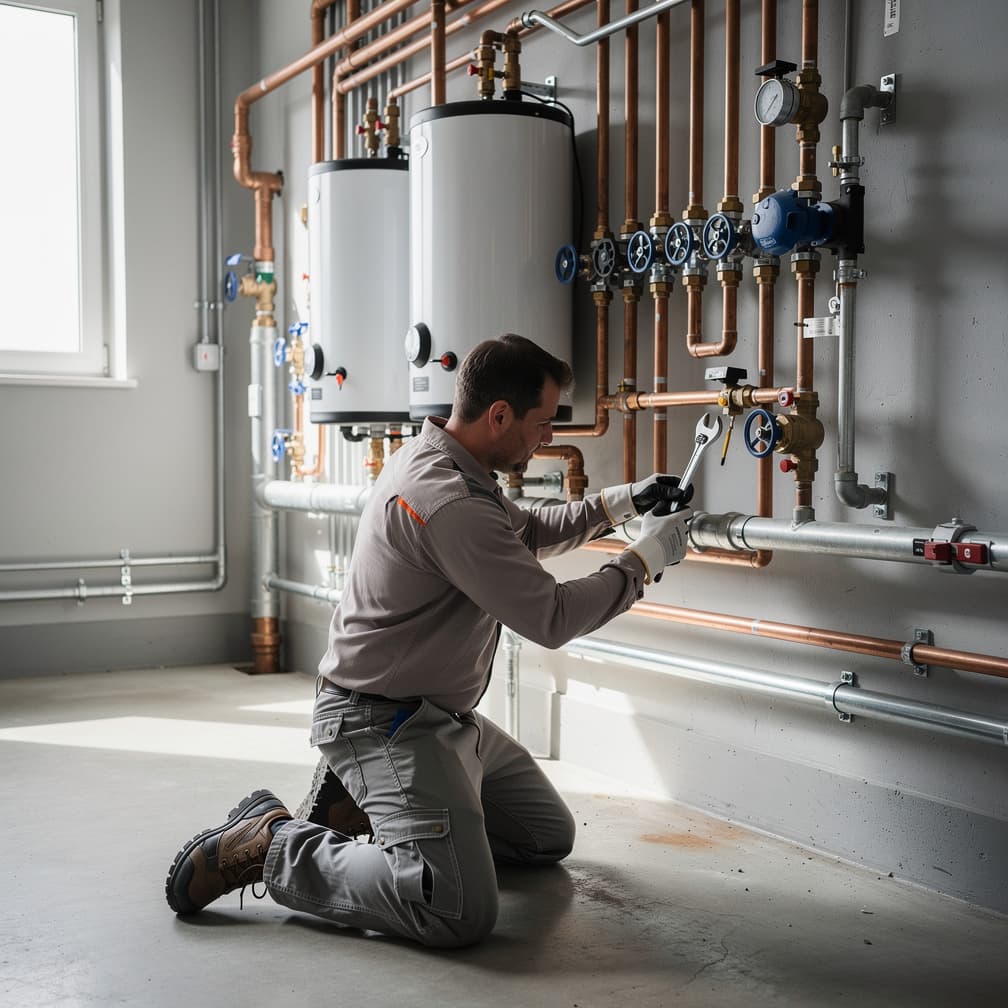

As a plumber in Columbus, you carry the risk of every fitting you have ever tightened, long after the invoice cleared. Finished work is where this trade's claims live: the joint that held for a year, then let go behind drywall while the owner was away. Plumbing insurance in Columbus is mostly an argument about that tail, and about who pays to open the wall and put it back. General Liability commonly picks up damage your completed work causes to other property, while the cost of redoing your own defective work typically sits outside it. That distinction surprises people at the worst possible time. Knowing where the line falls tells you what to price into a job and what to insure. The sections below lay out the coverages, the published ranges, and the questions worth putting to a carrier.
What Makes Columbus Different
Bad weather in a spread-out market makes the drive dangerous well before the job does. Ice, mud, and a loaded trailer turn the trip to a call into the riskiest part of a plumber's day. Vehicle claims tend to be the largest ones this trade sees, because other people are wrapped up in them. A storm that keeps you off the road for days also stacks the calls, and stacked calls get rushed. Rushed emergency work in an unfamiliar building is how a small repair becomes a property damage file. Getting stranded far from home leaves tools sitting in a truck overnight in a place nobody is watching. That is a theft question and an equipment schedule question, and both belong in the quote. Ask how Georgia weather patterns land in your rating before you sign anything in Columbus.
Local Risk Factors in Columbus
Severe storms rearrange a plumbing week more often than they wreck a plumbing shop. Power goes, sump pumps quit, and calls stack up faster than a two-truck operation can answer them. The risk lives in the catch-up: tired crews, unfamiliar basements, and standing water around panels somebody else installed badly. Workers Compensation is the line that answers when a helper is hurt in that stretch, though how it applies depends on where you work and who sits on the payroll. The other half is the tornado that takes your own building, which is a property question rather than a liability one. Look hard at what a total loss of a Columbus shop and yard would mean for the crew's next month in Georgia.
What Coverage Does a Plumbing in Columbus Need?
General Liability
Landlords, general contractors, and property managers ask for this one by name before your first day on site. It typically answers third-party claims: warped flooring under a failed connection, a tenant who slips on water in a hallway, a ceiling that lets go two floors below. Redoing your own defective joint generally sits outside it.
Example: A shutoff valve fails overnight after a routine swap and the kitchen below is ruined; General Liability can help cover the restoration bill and the claim that arrives behind it.
Workers Compensation
An apprentice pinned by a water heater on a basement stair is what this line exists for. Medical care and lost wages for an injured employee are typically its job, and general contractors often want proof or a waiver before anyone walks onto a site. Rules differ by state, and a helper paid on a 1099 may still count.
Example: A helper strains his back pulling a cast iron section out of a crawl space and misses six weeks of work; Workers Compensation may pick up the treatment and part of the lost pay.
Commercial Auto
A personal auto policy typically steps back the moment a van is used for the business, and that gap is what this line fills. Vehicles, trailers, and the people driving them are what it rates on, and injury claims from an accident tend to be the largest ones a plumbing shop ever sees. Damage to your own truck is usually a separate choice.
Example: A loaded van rear-ends a car while merging on the way to a call in Columbus; Commercial Auto is generally where the other driver's injuries and your truck's repairs both get sorted out.
Tools & Equipment (Inland Marine)
Tools live in a truck, and a policy written on a building does not follow them out there. A hydro jetter, a camera reel, press tools, and the fittings behind the seat are typically scheduled here, with theft from a locked vehicle the claim this trade files most often. Items above a set value usually have to be listed individually.
Example: A trailer is cut loose from a job site overnight with a jetter still strapped down; a scheduled Inland Marine claim could put that equipment back on the road inside a week.
Commercial Umbrella
Where a general contractor's requirement runs past what your base policy carries, this is the less expensive way to reach the number. It sits above liability and auto, coming into play when one loss, a flooded floor or a bad intersection, exhausts the underlying limit. It cannot repair a coverage the policy beneath it never had.
Example: Water from a burst riser reaches four units and a retail tenant, and the demands outrun the base limit; a Commercial Umbrella might absorb what is left once the underlying policy is spent.
How Much Does Plumbing Insurance Cost in Columbus?
Plumbing Insurance is a bundle of separate policies, priced separately. The ranges below are typical figures for Columbus for each line, except workers compensation, which is rated per $100 of payroll; a quote prices each one against your own operations.
| Coverage | Typical range | What moves your price |
|---|---|---|
| General Liability Insurance | $120 - $370 per month | Industry and risk classification, annual revenue, number of employees |
| Workers Compensation Insurance | $0.75 - $2.74 per $100 of payroll | Employee classification codes, total annual payroll, experience modification rate |
| Commercial Auto Insurance | $230 - $650 per month | Fleet size and vehicle types, driver records and experience, coverage limits and deductibles |
| Inland Marine Insurance | $35 - $130 per month | Total insured value of the scheduled property, type and age of the equipment, where it is stored and how far it travels |
| Commercial Umbrella Insurance | $70 - $230 per month | Umbrella limit requested, limits carried on the underlying policies, loss history on those underlying policies |
Prices shown are general estimates, not guaranteed rates or quotes. Your actual premium will depend on the insurer, coverage selected, business details, location, claims history, and other underwriting factors. Learn about our pricing methodology.
What Are the Insurance Requirements for a Plumbing in Columbus?
Workers' comp is generally required once you have 3 or more employees. Georgia generally requires employers to carry workers' compensation at that point. Common exemptions include sole proprietors, partners, and corporate officers. Confirm current thresholds with your state's workers' compensation agency before you hire.
State auto liability minimums apply to business vehicles. Georgia's minimum auto liability limits are $25,000/$50,000/$25,000 (bodily injury per person / per accident / property damage). Contracts and lenders often require more than the state floor.
Where to verify licensing and coverage rules. The Georgia Office of Insurance and Safety Fire Commissioner publishes consumer guidance and current insurance requirements for Georgia businesses. When a contract or lease demands specific wording, the Georgia Office of Insurance and Safety Fire Commissioner's guidance is the authoritative place to check.
Get Your Plumbing Quote in Columbus
Compare rates from multiple carriers. Free quotes, no obligation.
Operating in Columbus
- Your customer's insurer can come looking months later through subrogation, and the thing that saves you is the photograph you took before touching the fitting.
- A Georgia shop can serve customers across county lines all week, and the miles between calls are an exposure the quote should already account for.
- Emergency calls come at night, in the rain, into Columbus basements you have never seen before, and the rushed version of a repair is the one that shows up later as a claim.
- Water heaters are heavy, awkward, and usually down a flight of stairs; the strained back is a payroll problem and the gouged stair rail is somebody else's property.
How to Buy: Advice for Columbus Owners
Payroll is the honest starting point for anything involving employees, and it is also where owners get creative. Report what you actually pay, by role, because Workers Compensation is rated on payroll and reconciled at audit, and the audit always wins. An apprentice, a licensed tech, and an office manager carry different rates, so lumping them together costs money in one direction or the other. General Liability sits beside it and answers for the customer's property, never for your own crew's injuries. If you use subs, keep their certificates, since an uninsured sub can land on your policy as though they were staff. Ask what happens to the price when payroll grows mid-year, and whether the policy adjusts or waits. Ask how a crawl space injury claim gets handled in Georgia, because that is the one this trade actually files. With a real payroll picture, participating carriers can quote Columbus work off the same page and you can compare terms instead of assumptions.
FAQ
Plumbing Insurance in Columbus: FAQ
Generally not. Correcting your own defective work is usually treated as a cost of doing business, while the damage that work does to other property is where liability coverage tends to come in. That line decides whether you file or simply go back and fix it. Ask a carrier to show you the exclusion in the form instead of describing it on the phone.
Ask while you are shopping, because the answer differs by carrier and by whether the request needs an endorsement or just a plain certificate. A standard certificate is routine; additional insured wording, a waiver of subrogation, or a limit change takes longer. Renewal is where people get caught, since a lapsed document reads exactly like no coverage. Keep a list of everyone holding yours for Columbus work.
A one-person shop gets asked for the same certificate a twenty-van company gets asked for, because a property manager's form does not scale down to fit you. The van, the tools, and the water damage exposure all exist whether or not anyone else is on the payroll. What changes is the price, not the requirement. A Georgia sole operator should also ask what happens if a helper starts mid-year.
Any commercial customer will ask for proof before you touch a valve, and plenty of landlords and general contractors will not open a door without it. Whether any of it is mandatory depends on where you work and on whether anyone is on your payroll. The Georgia Office of Insurance and Safety Fire Commissioner publishes the current requirements for contractor coverage obligations. The practical answer is simpler: with no certificate, the work that pays on terms is closed to you.
Price moves on payroll, revenue, the kind of work you take, and your claims history. A shop doing repipes and water heater swaps inside finished homes is priced differently than one cleaning drains. Limits matter as well, since a higher limit costs more in a straight line. The cost table on this page shows published ranges by line, and your own Columbus number comes out of the answers on the application.
Damage your work does to someone else's property is the classic General Liability claim, and the flooring, the cabinets, and the ceiling below are usually the expensive part of it. Repairing your own faulty joint generally sits outside that, because a policy is not a warranty on workmanship. The split catches plumbers out constantly. Ask how completed operations are worded before you need the answer.
Sources
- 1.Georgia Office of Insurance and Safety Fire Commissioner(Georgia Office of Insurance and Safety Fire Commissioner publishes consumer guidance for insurance buyers.)


