







































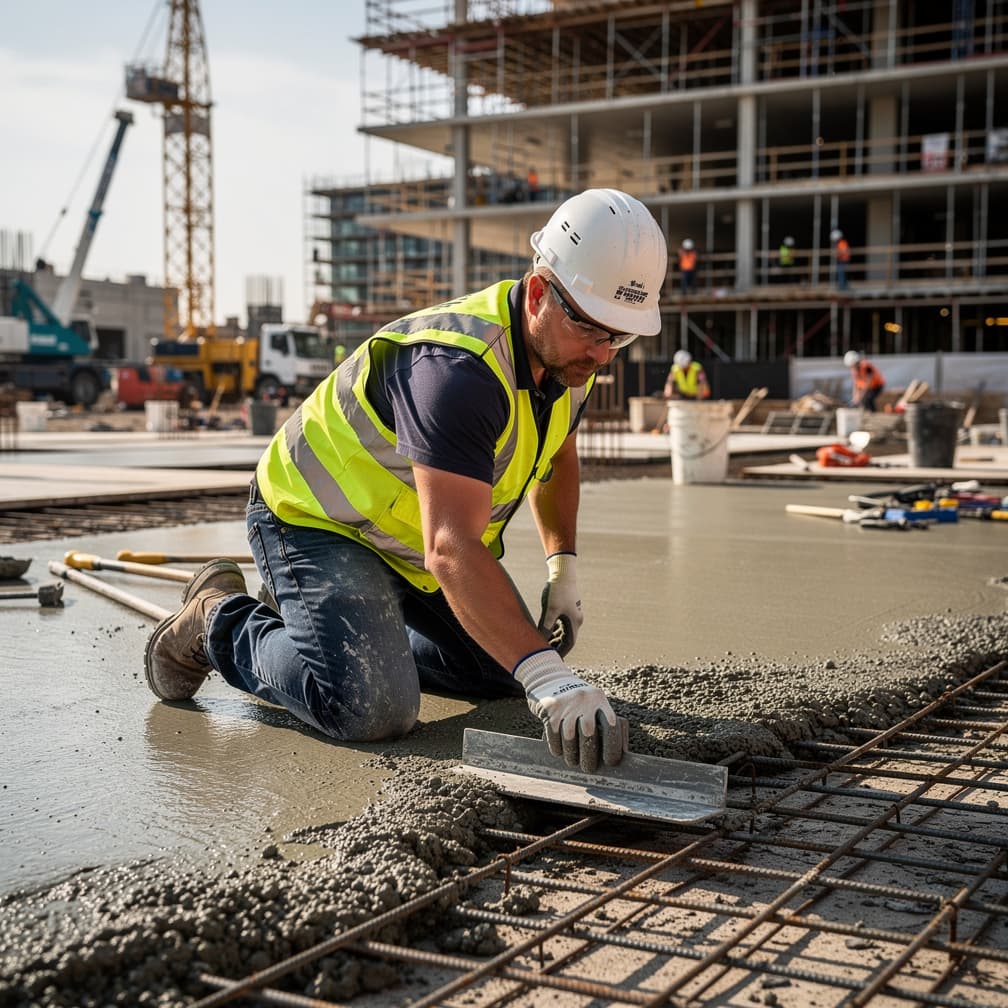

As a concrete contractor in Aurora, you are responsible for a surface long after the last trowel leaves it. A slab that settles, a sidewalk that heaves, a driveway that cracks along a saw line: each can come back as a property damage claim years after payment cleared. Concrete contractor insurance in Aurora is largely a bet on that tail, and the buying decision follows from it. Day-of exposures are easier to picture, of course, since a passerby on wet concrete or a worker hurt moving forms is an immediate problem. The tail is what owners underprice. Read the ranges below with completed work in mind, then compare quotes from participating carriers on limits, not on the monthly figure alone.
What Makes Aurora Different
Anyone who lets you onto a site can require proof, and the requirement scales with the site. A homeowner might accept your word; a builder wants a certificate; a public job wants more again. You cannot pick which of those you meet, since the work comes from all three directions. That is the argument for buying to the strictest contract you actually sign rather than the average one. Limits set for the average job leave you scrambling the week the big one lands in Aurora. Scrambling means a midterm change, and midterm changes are rarely priced in your favor. Set the baseline once and let smaller jobs sit comfortably underneath it for the rest of the term. Bring your worst subcontract to participating carriers in Illinois and quote against that document.
Local Risk Factors in Aurora
Tornado and severe storm cells give a concrete crew minutes rather than hours, and everything on an open pad in Aurora is loose material to a wind like that. Forms, plywood, stacked rebar, and a screed left across the slab all travel. What they hit becomes the claim: a neighbor's siding, a parked car, a passerby who never expected construction debris in the air. General Liability is typically the line for that third-party damage, while your own smashed equipment is a separate question answered by what you scheduled. Straight-line winds in Illinois do the same work as a funnel and get taken less seriously by everyone until the cleanup starts.
What Coverage Does a Concrete Contractor in Aurora Need?
General Liability
Builders and property owners ask for this one by name before a truck reaches the pad. It is the line that might answer when a visitor slips on a curing slab, or when moving forms and equipment take out a fence, an irrigation line, or the curbing beside your work. Redoing your own cracked slab typically sits outside it.
Example: A homeowner walks out to admire a fresh driveway, steps onto the edge before it cures, and lands hard; General Liability can help cover the injury claim and the defense that follows it.
Workers Compensation
Finishing, cutting, and lifting are where a concrete crew gets hurt, and this line is rated for exactly that, priced per $100 of payroll. Medical care and lost wages for an injured employee are what it is meant to address. Owners and subcontractors get treated differently, and thresholds vary from state to state.
Example: A finisher lifts a form panel wrong during a slab pour and cannot work for a month; Workers Compensation is generally intended to take the medical bills and part of the missing wages.
Commercial Auto
Personal policies commonly exclude business use, which can leave the truck hauling mix, forms, and a loaded trailer unprotected at the worst possible moment. This line gets rated on the vehicles, the towing, the mileage, and the drivers, and it may respond when your truck injures someone or damages property on the road.
Example: A trailer of forms comes loose on the drive between two pours in Aurora and clips the car behind it; Commercial Auto is where those injury and repair demands would land.
Tools & Equipment (Inland Marine)
Tools and mobile equipment spend more hours in transit or parked at a jobsite than under anyone's eye. Scheduled values then decide what a theft or a loss is worth: the mixer, the trowel machine, the saws, the vibrators. Rented equipment is often handled separately, and anything left off the schedule usually stays off the payment.
Example: A trailer is emptied overnight at an open jobsite and the saws and trowel machine are gone by first light; scheduled equipment coverage could make the replacement a matter of days rather than months.
Commercial Umbrella
When a subcontract names a limit higher than your underlying policy carries, this is usually the cheaper way to reach the number. It sits above General Liability or the auto limit and follows those terms, so an exclusion underneath stays an exclusion. It is built for the rare large claim rather than the routine one.
Example: A multi-vehicle accident on the way to a pour produces injury demands well past the underlying auto limit; an umbrella layer might pick up what sits above it, subject to the terms.
How Much Does Concrete Contractor Insurance Cost in Aurora?
Concrete Contractor Insurance is a bundle of separate policies, priced separately. The ranges below are typical figures for Aurora for each line, except workers compensation, which is rated per $100 of payroll; a quote prices each one against your own operations.
| Coverage | Typical range | What moves your price |
|---|---|---|
| General Liability Insurance | $210 - $625 per month | Industry and risk classification, annual revenue, number of employees |
| Workers Compensation Insurance | $0.75 - $2.74 per $100 of payroll | Employee classification codes, total annual payroll, experience modification rate |
| Commercial Auto Insurance | $240 - $750 per month | Fleet size and vehicle types, driver records and experience, coverage limits and deductibles |
| Inland Marine Insurance | $40 - $160 per month | Total insured value of the scheduled property, type and age of the equipment, where it is stored and how far it travels |
| Commercial Umbrella Insurance | $80 - $270 per month | Umbrella limit requested, limits carried on the underlying policies, loss history on those underlying policies |
Prices shown are general estimates, not guaranteed rates or quotes. Your actual premium will depend on the insurer, coverage selected, business details, location, claims history, and other underwriting factors. Learn about our pricing methodology.
What Are the Insurance Requirements for a Concrete Contractor in Aurora?
Workers' comp is generally required once you have your first employee. Illinois generally requires employers to carry workers' compensation at that point. Common exemptions include sole proprietors, partners, and corporate officers owning all stock. Confirm current thresholds with your state's workers' compensation agency before you hire.
State auto liability minimums apply to business vehicles. Illinois's minimum auto liability limits are $25,000/$50,000/$20,000 (bodily injury per person / per accident / property damage). Contracts and lenders often require more than the state floor.
Where to verify licensing and coverage rules. The Illinois Department of Insurance publishes consumer guidance and current insurance requirements for Illinois businesses. When a contract or lease demands specific wording, the Illinois Department of Insurance's guidance is the authoritative place to check.
Get Your Concrete Contractor Quote in Aurora
Compare rates from multiple carriers. Free quotes, no obligation.
Operating in Aurora
- Every additional insured request is a separate endorsement, and the wording a builder demands in Illinois can differ from whatever your last contract was willing to accept.
- Rain on a green slab in Aurora ruins a finish that looked acceptable an hour earlier, and whether that loss is yours or the owner's gets decided by the contract you signed.
- Concrete work is heavy from the first shovel to the last trowel, which is why back, knee, and shoulder claims sit at the top of most crews' loss runs.
- A crew spread across Kane County spends more hours on the road than on the pad, and the vehicle exposure grows with every mile of that drive between projects.
How to Buy: Advice for Aurora Owners
The truck is where the largest single claim on a concrete job usually comes from, so start the quote there. Commercial Auto gets rated on the vehicles, the miles, the drivers, and what you tow, and a mixer behind a loaded trailer is no commuting risk. Pull motor vehicle records for everyone who drives, including the finisher who moves a truck once a week. One bad record can move the whole schedule's price, and learning that at renewal is worse than learning it now. A Commercial Umbrella usually sits above the auto limit, which is exactly where contracts tend to push you anyway. The Illinois Department of Insurance publishes consumer guidance on commercial vehicle coverage. Give participating carriers in Illinois the same driver list and compare what comes back.
FAQ
Concrete Contractor Insurance in Aurora: FAQ
Yes, in two directions. Their payroll can land in your Workers Compensation audit if you cannot produce their certificate, and their mistakes can arrive as a claim against you, because the owner hired you rather than them. Collect the certificate before they start, ask to be named as an additional insured on it, and keep the copy with the job file. A crack argument years later begins in that folder.
Payroll leads, because the hands finishing, cutting, and lifting carry the injuries. Then come the vehicles and how far they haul, the value of the equipment riding on the trailer, the limits your contracts demand, the deductible you pick, and your claims history. Work type matters as well, since a highway pour and a backyard patio are different exposures. Two contractors in Aurora can quote differently on payroll alone.
General contractors, property owners, property managers, and permit desks all can, and each may want different wording on the page. A builder in Aurora can require additional insured status and a waiver of subrogation before your truck reaches the pad. Homeowners rarely ask, which makes it easy to let a policy drift out of date between commercial jobs. The certificate is proof; the limits behind it are what a claim tests.
Usually not. Redoing your own defective work is treated as workmanship in most liability forms, which makes it a warranty question rather than a coverage one. What changes the answer is what the failed slab damaged next: a garage floor, a fence, irrigation lines, or a parked vehicle. That resulting property damage is where General Liability may come into play, subject to the form and its exclusions.
It can be both. A visitor in Aurora who steps onto curing concrete and falls is a third-party injury, the classic General Liability scenario, and the policy is intended to take the medical demand and the defense that follows. Your side of it is the deductible and, next term, the loss history. Barricades and a written warning to the owner cut the odds and help the file if it happens anyway.
It extends your policy to name the builder as an insured for claims arising out of your work, which is why the contract demands it. That takes an endorsement, not a checkbox, so it has to be requested and issued. Primary and noncontributory language often rides alongside, pushing your policy ahead of everybody else's. Both can affect how a submission gets priced, so raise them before you bind rather than after.
Sources
- 1.Illinois Department of Insurance(Illinois Department of Insurance publishes consumer guidance for insurance buyers.)


