







































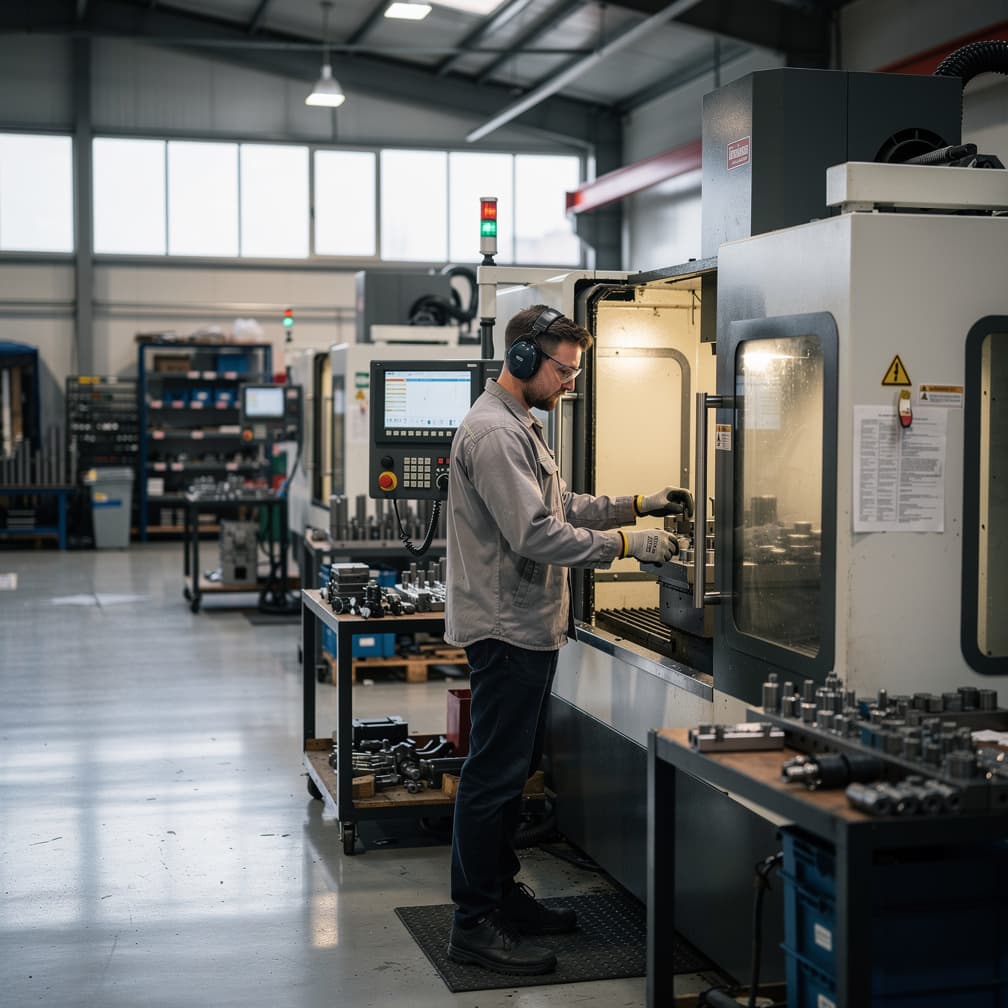

As a machine shop in Chicago, the hand injury is the claim you remember. Chips, deburring blades, tumblers, and a fixture heavier than the person lifting it put your crew closer to an emergency room than almost any desk trade. Workers Compensation is the line built for that moment, and the rules about who has to carry it vary from state to state, so nothing here substitutes for what applies where you cut. Its cost tracks payroll, which means the bill grows the day you staff a second shift. Machine shop insurance in Chicago turns into a payroll question once the crew passes a few people. Get the payroll right and most of the quote follows from it.
What Makes Chicago Different
Wages set your workers compensation bill, and a tight labor market lifts wages whether the budget planned for it or not. Because that line rates against payroll, the raise you gave to keep a machinist quietly raises the premium at audit. Nobody budgets for the true-up, and the invoice lands after the money is already out the door. A shop in Chicago competing for skilled hands should assume the comp line grows alongside the paychecks. Estimate payroll honestly at the start of the term rather than low, because a lowball estimate only defers the bill. Participating carriers in Illinois true up the same way, so shopping does not make that arithmetic disappear. What shopping can move is the class code, the experience modifier, and whether anyone gives credit for guarding and training. Ask each quote which of those three it actually looked at.
Local Risk Factors in Chicago
Before the storm season, walk the building and look at it the way an adjuster will: roof age, door tracks, skylights, and whatever is stacked against an outside wall. Storm claims turn on maintenance as much as on wind, since deterioration is generally excluded while sudden damage is not. Photograph the roof now so the argument later stays short. Keep the drawings, the offsets, and your certificate somewhere that does not depend on the shop having power. A shop in Chicago that can prove its condition before the storm spends the following month on production instead of on a claim file, wherever in Illinois it sits.
What Coverage Does a Machine Shop in Chicago Need?
General Liability
Buyers, landlords, and staffing agencies all ask for this one by name before work starts. It generally answers third-party claims: a delivery driver hurt in your aisle, a customer's property damaged, or a machined part that fails in service and takes something with it. Injuries to your own crew sit elsewhere, and it has nothing to say about your machines.
Example: A quality inspector walks your aisle, catches a foot on a coolant hose, and breaks a wrist. The medical bills and the suit behind them are the sort of third-party claim this line is meant to take on.
Commercial Property
Fire, storm, vandalism, and theft are the causes of loss it usually names, applied to the building, the machines bolted inside it, and the material sitting between operations. Wear, rust, and mechanical breakdown generally fall outside, and so does flood. The limit matters more than the premium here, since a limit set off a tax assessment rarely rebuilds a shop.
Example: A fire starting in a chip pan closes the shop for two months. Rebuilding the structure and replacing the machines standing under it is the loss this coverage is generally written to meet.
Workers Compensation
Hands, eyes, and backs work close to moving steel every hour of a shift, and this is the line built for the moment one of them loses. It typically handles medical treatment and part of the lost wages for your own employees. Rules on who has to carry it vary across Illinois, and buyers demand proof regardless. Cost tracks payroll rather than headcount.
Example: A machinist reaches in to clear a chip nest and the hand takes stitches and six weeks off the floor. Treatment and a share of the missing pay are what this coverage typically picks up.
Tools & Equipment (Inland Marine)
Commercial Property stops at an address, and this line follows the things that will not. Gauges, fixtures, indicators, and a job box parked at a customer's plant can be covered in transit or off site, depending on how they were scheduled. It is rated from the list you hand over, which is why a stale schedule is the usual reason a claim disappoints.
Example: A tote of fixtures and a micrometer set vanish from a customer's dock overnight in Chicago. Scheduled tooling is exactly what this line is intended to answer for.
Commercial Umbrella
Purchase orders ask for limits no small shop would pick on its own, and this is how those numbers get met. It sits above the underlying liability limits and generally comes into play only once they are used up. It typically raises the ceiling rather than widening what the form addresses, so a gap in the base stays a gap above it too.
Example: A part fails inside a customer's assembly and the claim runs past the underlying limit before the lawyers have finished arguing. The layer above is what would be left to respond.
How Much Does Machine Shop Insurance Cost in Chicago?
Machine Shop Insurance is a bundle of separate policies, priced separately. The ranges below are typical figures for Chicago for each line, except workers compensation, which is rated per $100 of payroll; a quote prices each one against your own operations.
| Coverage | Typical range | What moves your price |
|---|---|---|
| General Liability Insurance | $140 - $420 per month | Industry and risk classification, annual revenue, number of employees |
| Commercial Property Insurance | $200 - $675 per month | Building value and construction type, roof age and condition, fire protection class |
| Workers Compensation Insurance | $0.75 - $2.74 per $100 of payroll | Employee classification codes, total annual payroll, experience modification rate |
| Inland Marine Insurance | $40 - $160 per month | Total insured value of the scheduled property, type and age of the equipment, where it is stored and how far it travels |
| Commercial Umbrella Insurance | $80 - $250 per month | Umbrella limit requested, limits carried on the underlying policies, loss history on those underlying policies |
Prices shown are general estimates, not guaranteed rates or quotes. Your actual premium will depend on the insurer, coverage selected, business details, location, claims history, and other underwriting factors. Learn about our pricing methodology.
What Are the Insurance Requirements for a Machine Shop in Chicago?
Workers' comp is generally required once you have your first employee. Illinois generally requires employers to carry workers' compensation at that point. Common exemptions include sole proprietors, partners, and corporate officers owning all stock. Confirm current thresholds with your state's workers' compensation agency before you hire.
Flood damage is typically excluded from standard policies. Standard commercial property and builders-risk-type policies typically exclude flood damage. Flood exposure varies address by address, so check your premises in FEMA's Flood Map Service Center before deciding; if you sit in a mapped flood zone, a separate policy through the National Flood Insurance Program is the usual starting point.
Where to verify licensing and coverage rules. The Illinois Department of Insurance publishes consumer guidance and current insurance requirements for Illinois businesses. When a contract or lease demands specific wording, the Illinois Department of Insurance's guidance is the authoritative place to check.
Get Your Machine Shop Quote in Chicago
Compare rates from multiple carriers. Free quotes, no obligation.
Operating in Chicago
- Parts leave for heat treat or plating and come back a week later. While they sit on somebody else's dock they are still your problem, and still your customer's due date.
- One machine usually carries a third of the schedule, and losing it does not damage the building at all. Downtime is the loss no adjuster ever photographs.
- A landlord in Cook County can hold the keys until a certificate names both them and their lender, which puts your move-in date inside a carrier's turnaround rather than your own.
- Oily rags, chip pans, and a drum of coolant make a shop fire ordinary rather than exotic. A fire in Chicago also puts the marshal's report straight into your claim file.
How to Buy: Advice for Chicago Owners
Start from the loss that would actually end the business, then buy back toward the small stuff. For a shop that loss is rarely a slip in the office; it is a fire or a breakdown that stops production for a season, or a part failing in service that drags a customer's whole assembly into the claim. Commercial Property with a limit set from a real rebuild figure can answer the first. The second lives on the completed operations side of General Liability, where the endorsement wording decides whether work you finished last year still counts. Ask every quote to state both in writing. Check the Illinois Department of Insurance's guidance before deciding what a policy in Illinois ought to include. Then hand identical limits to participating carriers and let them compete on one picture.
FAQ
Machine Shop Insurance in Chicago: FAQ
Payroll split by job type, last year's receipts, a schedule of machines with values, and loss runs covering the past several years. Add the largest contract you work under, since its limits and naming demands shape the policy quoted for a shop in Chicago. Shops that hand all of that over get priced once. Shops that estimate get priced twice, and the second number arrives at audit.
You can, and the premium generally drops quickly, which is why quotes sometimes do it without pointing it out. The saving disappears the first year two small losses land together, so choose the number against cash you could lose without borrowing. Hold it constant across every submission you compare, or you are looking at different policies wearing the same name.
It sits above them. A Commercial Umbrella generally attaches over the underlying limits and responds once those are exhausted, which is why fixing a thin base first usually costs less than layering over it. Buyers demanding umbrella limits are asking about the total, not the structure. If the underlying limit does not meet the attachment point, the layer above can have nothing to sit on.
No, and that is deliberate. Wear, gradual deterioration, and rust are maintenance rather than sudden accidental events, so forms exclude them regardless of how expensive the repair gets. The distinction matters after water damage, since corrosion creeping across ways and tables over weeks reads differently from the storm that let the water in. Document the event and the date, because the timeline is what gets argued.
Often yes, and the contract usually says so in language nobody reads twice. Castings, forgings, and bar stock owned by somebody else still burn or walk out the same as yours, and their value can exceed the machine beside them. Property of others is handled by specific wording rather than assumed, so a shop in Chicago should confirm the form addresses it before a break-in makes the question urgent.
It depends on the staffing agreement, which decides whose employee they are for insurance purposes. The agency generally carries workers compensation on its own people, though the contract may push some of that risk back to you along with an endorsement requirement. Read it the way you read a purchase order in Illinois, then confirm the arrangement once a year rather than assuming it survived the last renewal.
Sources
- 1.Illinois Department of Insurance(Illinois Department of Insurance publishes consumer guidance for insurance buyers.)
- 2.FEMA / FloodSmart(Flood coverage is typically purchased separately; FEMA administers the National Flood Insurance Program.)


