







































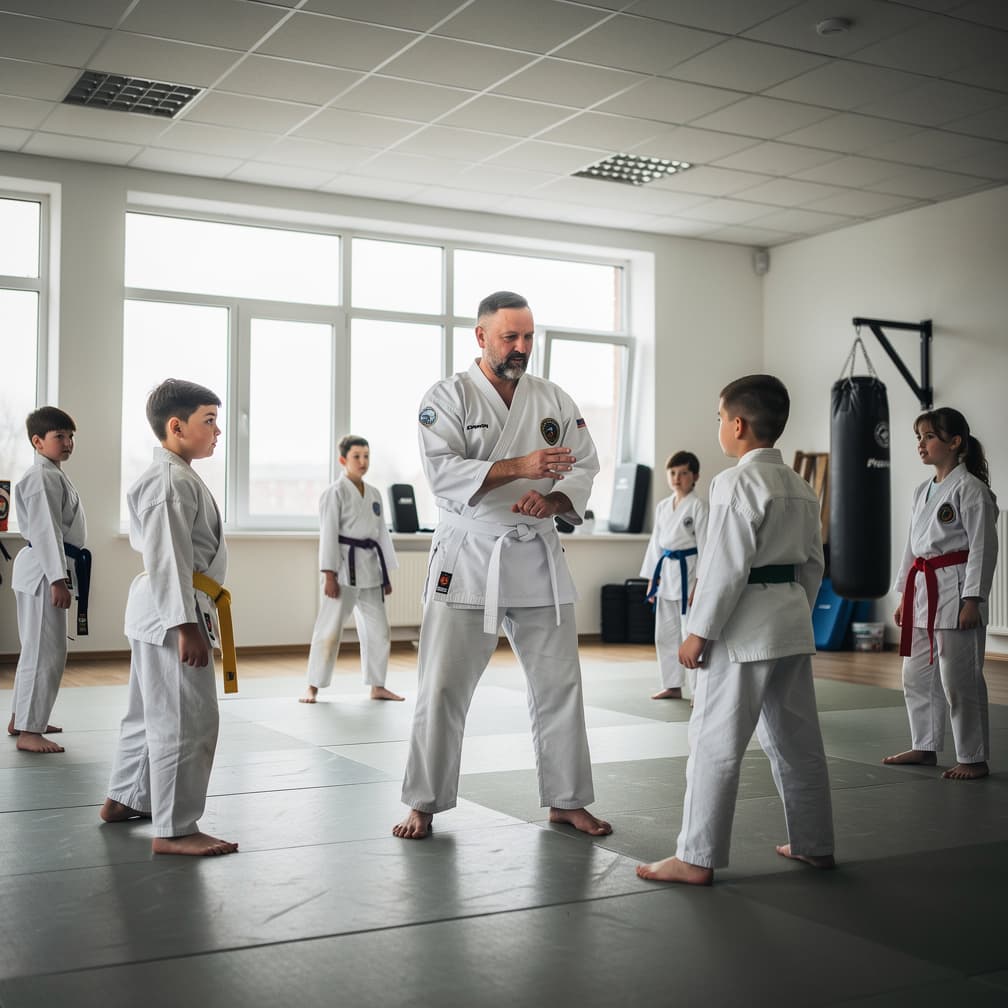

As a martial arts studio in Kansas City, you owe a duty of care every time a coach pairs two students for a round, and that duty follows you into the lobby, the locker area, and the gear bags stacked by the door. Martial arts studio insurance in Kansas City is the financial answer to that duty. Waivers get signed, filed, and argued anyway, and a parent who signed for a nine-year-old can revisit that signature years later. Meanwhile the building runs its own claims: a burst line over the mats, a break-in that takes the sound system, glass at the storefront after a bad night. Payroll drives one half of the price and the room drives the other. Bring your lease and your schedule to the sections below.
What Makes Kansas City Different
Fewer students in the room does not automatically mean a smaller premium for a Kansas City studio. Rating leans on payroll, on the mat area you occupy, and on whether live contact runs weekly. A school with thirty students and full sparring can rate above one with a hundred doing forms. That surprises owners who assume headcount is the number underwriters care about most. The other quiet driver is how you pay instructors, because contractors and employees sit in different columns. A payroll audit later can reclassify people and hand you a bill you never budgeted for. Getting that right at the quote costs nothing; getting it wrong at the audit costs the difference. Ask how the carrier defines an instructor before you assume your headcount answers the question in Kansas City.
Local Risk Factors in Kansas City
Before storm season, walk the room and write down what would have to be replaced if the roof opened for ten minutes. Mats, pads, bags, mirrors, the sound system, and anything bolted overhead: that list becomes your property limit, and it runs larger than owners guess. A Kansas City studio insuring the room at a number picked at opening is insuring a room it no longer has. Sudden storm damage is generally what Commercial Property is written around, though wear and tear on those same mats is not. Update the list yearly and keep a copy that survives the building, because Kansas weather does not schedule itself.
What Coverage Does a Martial Arts Studio in Kansas City Need?
General Liability
Landlords, host gyms, and event organizers ask about this line by name before they hand over keys or floor time. It generally sits behind third-party injury and property damage claims tied to your studio: a student hurt during a live round, a parent who slips near the entry, a bag stand that tips onto a child. Damage to your own mats and mirrors is a property question instead.
Example: A parent walks in from a wet lot, goes down on the entry tile, and breaks a wrist while class runs behind her; general liability limits are typically what the resulting claim gets paid from.
Professional Liability
Where General Liability answers for the fall in the lobby, this line answers for the coaching itself. Allegations that an instructor paired a beginner against an advanced student, pushed a technique past someone's level, or supervised a round badly all land here. It typically responds to claims about instruction, advice, and supervision rather than to a slip on your floor.
Example: A student is told to spar up a level, tears a knee, and the family's demand letter blames the coach's judgment rather than the mats; professional liability is generally the line that answers.
Commercial Property
Wear and tear on mats is excluded, and so is rising water from outside the building, which is worth knowing before you assume the room is handled. What this line generally covers instead is sudden loss to what you own: mats, mirrors, hanging bags, racks, pads, the sound system, and whatever tenant improvements your Kansas City lease calls yours.
Example: A rooftop unit lets go over a weekend and drips onto forty mat panels; commercial property may pick up the replacement, subject to the deductible you chose at binding.
Workers Compensation
An instructor tears an achilles demonstrating a throw and a cleaner slips on a wet floor at closing. Both are employees hurt at work, and this is the line built around that moment. It is rated on payroll, so how you classify coaches matters as much as how many of them you have. Student injuries are a liability question, not this one.
Example: A coach lands badly during a demonstration in Kansas City and needs surgery plus three months off the mats; workers compensation can typically take on the medical bills and part of the lost wages.
How Much Does Martial Arts Studio Insurance Cost in Kansas City?
Martial Arts Studio Insurance is a bundle of separate policies, priced separately. The ranges below are typical figures for Kansas City for each line, except workers compensation, which is rated per $100 of payroll; a quote prices each one against your own operations.
| Coverage | Typical range | What moves your price |
|---|---|---|
| General Liability Insurance | $150 - $470 per month | Industry and risk classification, annual revenue, number of employees |
| Professional Liability Insurance | $70 - $240 per month | The services you actually perform, annual revenue or billed fees, limit and retention selected |
| Commercial Property Insurance | $65 - $230 per month | Building value and construction type, roof age and condition, fire protection class |
| Workers Compensation Insurance | $0.75 - $2.74 per $100 of payroll | Employee classification codes, total annual payroll, experience modification rate |
Prices shown are general estimates, not guaranteed rates or quotes. Your actual premium will depend on the insurer, coverage selected, business details, location, claims history, and other underwriting factors. Learn about our pricing methodology.
What Are the Insurance Requirements for a Martial Arts Studio in Kansas City?
Workers' comp is generally required once you have your first employee. Kansas generally requires employers to carry workers' compensation at that point. Common exemptions include sole proprietors, partners, and members of LLCs. Confirm current thresholds with your state's workers' compensation agency before you hire.
Where to verify licensing and coverage rules. The Kansas Insurance Department publishes consumer guidance and current insurance requirements for Kansas businesses. When a contract or lease demands specific wording, the Kansas Insurance Department's guidance is the authoritative place to check.
Get Your Martial Arts Studio Quote in Kansas City
Compare rates from multiple carriers. Free quotes, no obligation.
Operating in Kansas City
- Equipment invoices arrive over years and the loss arrives in one night, which is why the property limit a Kansas City owner set at opening is usually wrong by year three.
- Sound systems, card readers, and cameras run off the same circuit, and a surge can take the whole front desk with no visible damage to anything at all.
- A property manager in Kansas City can hold a lease renewal until your current certificate is on file, so a missed payment can cost you the room long before it costs you a claim.
- Mats absorb water and rarely recover, which turns a slow leak above the training floor into a full replacement rather than a repair.
How to Buy: Advice for Kansas City Owners
Waivers are worth doing well and worth not overestimating. A parent signs on behalf of a child, and how far that signature reaches is a question answered differently from place to place. Use current forms, get them signed before the first class rather than during it, and keep them where you can find them under pressure. General Liability limits, not the waiver, are what stand behind a defense when the signature gets challenged. Professional Liability sits behind the separate allegation that the instruction itself was negligent. Rules on all of this vary by state, and checking the Kansas Insurance Department's guidance before deciding is time well spent. With the paperwork and the limits settled, comparing quotes from participating carriers on CPK for your Kansas City studio is the last step, not the first.
FAQ
Martial Arts Studio Insurance in Kansas City: FAQ
A waiver is a defense, and defenses still get litigated. A parent who signed on behalf of a child can challenge how far that signature reaches, and answering the challenge costs money either way. General Liability limits are generally what stand behind defense costs and any settlement. Keep current forms, signed before the first class rather than during it, and treat them as one layer instead of the whole answer.
An injury during a live round is the classic General Liability scenario: a third party gets hurt on your Kansas City premises during your activity, and the family brings a claim. If the allegation shifts to how the class was taught or how the pairing was made, Professional Liability generally sits behind that instead. The two often get argued together. Which one answers depends on what the demand letter actually alleges.
Naming someone as an additional insured can extend your policy's defense to them for claims arising out of your operations. A landlord asks because an injury on your mats can name the building owner too. The certificate is only evidence; the endorsement is what actually adds them. Ask whether yours is blanket or charged per request, and pull the wording from the lease before you buy anything.
Usually, though it belongs on the application. Drop-in adults who train hard without a relationship to the school are a different exposure than enrolled students, and underwriters price it that way. Describe how you check waivers, whether a coach supervises, and whether visitors spar. A quote built on a description that leaves out open mat can be argued at the claim, which is the wrong moment for that argument.
Expect questions about annual payroll by role, student count, mat square footage, whether minors train, whether live sparring runs, and what equipment you own. Keep your invoices and instructor roster within reach. Vague answers produce vague quotes that cannot be set against each other honestly. The more precisely you describe the room, the more the numbers coming back mean something for a Kansas City studio.
Rising water from outside the building typically sits beyond a standard property form, which is why flood gets priced as its own decision. Foam mats absorb water and rarely recover, so the gap bites harder here than it would in an office. A pipe bursting above the training floor is a different event and is often treated differently. Ask which is which before assuming the room is handled.
Sources
- 1.Kansas Insurance Department(Kansas Insurance Department publishes consumer guidance for insurance buyers.)


