







































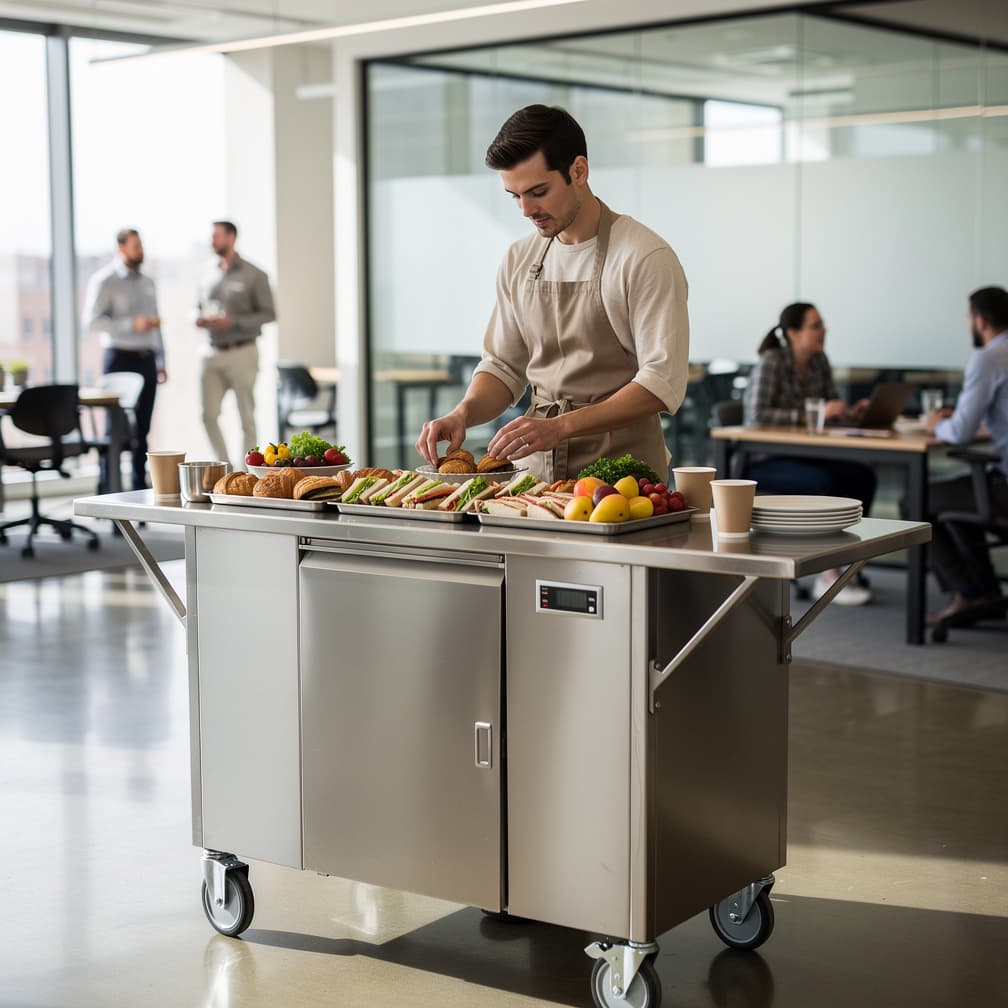

As a food cart in Bangor, you rent your risk from whoever owns the pavement under you. That is the odd part of the trade: the exposure that can end you belongs to a stranger's body or a stranger's property, and the cart itself is nearly a side note. Food cart insurance in Bangor starts there and works outward to the griddle, the generator, and the tow vehicle. Get the liability limit right and the rest is arithmetic about replacement values. Get it wrong and the equipment schedule will not save you. The sections below set out what carts commonly carry, what the published ranges are, and which losses sit outside a policy, so you can compare quotes on the parts that decide the outcome.
What Makes Bangor Different
Weather in a thin market removes the whole week rather than a shift. When a county has three events worth working and rain takes one, you lost a third of the month, not a weekend. That arithmetic is why carts in small markets feel weather harder than the storm damage alone suggests. Physical damage is the part a policy tends to speak to: a bent canopy frame, water into a control panel, a cart flipped in a gust. The lost booking usually stays with you. Ask a property manager in Bangor what happens to your slot when the weather calls it off, because contracts differ and nobody volunteers the answer. In Penobscot County, the replacement date may be the next season. Build the year around that risk rather than expecting to insure it away.
Local Risk Factors in Bangor
Decide in the fall what winter looks like for the cart, because the choice is cheaper then. Heated storage, drained lines, and a documented shutdown cost you a weekend. A split tank, a corroded burner, and a season that opens two weeks late cost a great deal more than a weekend. Policies frequently carry conditions about maintaining heat or draining systems, and a cart parked in an unheated yard in Bangor can fall outside them without anyone saying so out loud. Ice adds a second problem: a customer who slips on a frozen patch beside your window is a liability claim regardless of who salted the walk in Maine. Both problems get handled before the first freeze, never during it.
What Coverage Does a Food Cart in Bangor Need?
General Liability
Venues, landlords, and permit offices ask for this one by name, and it answers to strangers rather than to anything you own. A burn at the window, a slip beside the queue, a canopy into somebody's parked car: General Liability can help cover the injury claim and the defense that follows, subject to your limits. Damage to the cart itself sits somewhere else entirely.
Example: A customer reaches across for a drink, catches the edge of the griddle shelf, and burns a forearm badly enough for stitches; the medical bill and the demand letter behind it may fall to General Liability.
Commercial Property
Flood is out, gradual wear is out, and mechanical breakdown usually is too, which leaves the losses that actually close a cart: theft from a storage lot, storm damage to a canopy or hood, vandalism overnight. Commercial Property is generally written around the cart, the griddle, the generator, and the inventory, and it typically expects those items scheduled at honest values.
Example: The cart is gone from the yard by morning, chain cut, cooler and gear with it; where the build was documented and the equipment scheduled, Commercial Property is the line that would be asked to answer.
Commercial Auto
Everything else on this page stops at the curb; this one starts there. Once a cart travels behind a vehicle, or supplies ride in one, the trip counts as business use, and personal auto forms commonly exclude exactly that. Commercial Auto is generally the line for the vehicle, the trailer, and the cart in transit. Parked and serving is a separate question.
Example: Wet road, a short stop, and the driver behind you does not stop at all; the cart is folded and the day's stock with it, a loss that generally belongs to Commercial Auto rather than to any property form in Bangor.
Business Owners Policy
One contract instead of two. A Business Owners Policy bundles the liability side and the property side, which for a single cart with a clean equipment list is often simpler to buy and simpler to prove to a venue that wants paperwork. The tow vehicle is not included, and flood stays outside it.
Example: A gust puts your canopy through a parked windshield and rips the frame in the same second; both halves of that afternoon, the stranger's glass and your own equipment, may be handled under one Business Owners Policy.
How Much Does Food Cart Insurance Cost in Bangor?
Food Cart Insurance is a bundle of separate policies, priced separately. The ranges below are typical figures for Bangor for each line; a quote prices each one against your own operations.
| Coverage | Typical range | What moves your price |
|---|---|---|
| General Liability Insurance | $45 - $150 per month | Industry and risk classification, annual revenue, number of employees |
| Commercial Property Insurance | $40 - $160 per month | Building value and construction type, roof age and condition, fire protection class |
| Commercial Auto Insurance | $130 - $380 per month | Fleet size and vehicle types, driver records and experience, coverage limits and deductibles |
| Business Owners Policy Insurance | $70 - $210 per month | Annual revenue and industry class, building and contents values, square footage and building age |
Prices shown are general estimates, not guaranteed rates or quotes. Your actual premium will depend on the insurer, coverage selected, business details, location, claims history, and other underwriting factors. Learn about our pricing methodology.
What Are the Insurance Requirements for a Food Cart in Bangor?
Workers' comp is generally required once you have your first employee. Maine generally requires employers to carry workers' compensation at that point. Common exemptions include sole proprietors and partners. Confirm current thresholds with your state's workers' compensation agency before you hire.
State auto liability minimums apply to business vehicles. Maine's minimum auto liability limits are $50,000/$100,000/$25,000 (bodily injury per person / per accident / property damage). Contracts and lenders often require more than the state floor.
Flood damage is typically excluded from standard policies. Standard commercial property and builders-risk-type policies typically exclude flood damage. Flood exposure varies address by address, so check your premises in FEMA's Flood Map Service Center before deciding; if you sit in a mapped flood zone, a separate policy through the National Flood Insurance Program is the usual starting point.
Where to verify licensing and coverage rules. The Maine Bureau of Insurance publishes consumer guidance and current insurance requirements for Maine businesses. When a contract or lease demands specific wording, the Maine Bureau of Insurance's guidance is the authoritative place to check.
Get Your Food Cart Quote in Bangor
Compare rates from multiple carriers. Free quotes, no obligation.
Operating in Bangor
- Booking forms arrive with an insurance exhibit stapled to the back, and that exhibit, not the fee or the hours, is the part that decides whether you can work the date.
- Storage is where the overnight risk lives. An open yard, a driveway, and a rented bay in Bangor price differently, and an underwriter asks about it every single time.
- A canopy in a gust becomes a projectile. Damage to somebody else's car or storefront from your own equipment is a liability question with your name on the file.
- Sidewalks belong to somebody. Whoever owns the ground under a cart in Bangor can set insurance terms before you ever open the window, and permits do not override them.
How to Buy: Advice for Bangor Owners
Start with the toughest agreement you have signed, or the one you want to sign next. The insurance exhibit in a market or venue contract names limits, additional insured wording, and sometimes a waiver, and those terms decide what you buy far more than your own comfort does. Bring that page into a quote conversation in Bangor instead of describing it from memory. General Liability is where most of those requirements land, since the parties asking care about strangers getting hurt near your window. Commercial Property comes next if the cart, the griddle, and a full load of inventory would be painful to replace at once. The Maine Bureau of Insurance publishes consumer guidance on what proof of coverage should show. Once the requirement is written down, comparing quotes from participating carriers through CPK becomes a matter of matching identical limits across every option.
FAQ
Food Cart Insurance in Bangor: FAQ
Yes, and the figure is theirs to pick. A lease or a pitch agreement can name a per-occurrence limit, require additional insured status, and add waiver or notice terms, and in practice none of it is negotiable. If a landlord in Bangor sets a floor above what you carry, the policy is what moves. Read the insurance exhibit before signing, because that page is the real specification for what you buy.
A deductible is the slice of every loss you keep for yourself. If a generator is worth less than the deductible you chose, no claim is worth filing and you absorb the whole thing. Carts tend to have exactly that kind of loss: gear, a cooler, a canopy, inventory. A high deductible lowers the monthly figure and quietly moves the small, likely losses back onto you. Quote the same coverage at two deductible levels in Bangor and read both.
Usually within the territory the policy names, though the details matter and travel raises questions nobody asks until a claim arrives. A cart that works events across Maine should say so at quoting instead of describing a single pitch. The bigger friction is often paperwork, since each new venue may want its own name on the certificate. Ask about the territory and the endorsement process in the same conversation.
A stranger burned at your window is a third-party injury claim, and General Liability is generally the line meant for it, subject to limits and the policy's own terms. What it may not touch is damage to your own cart from the same flare-up, which sits on the property side. Insurers may also ask about suppression equipment and setup distance, so mention what you run. Intentional acts stay excluded everywhere.
Four things move a quote more than anything else: what the cart and its equipment would cost to replace, how many people stand near it during a shift, whether a vehicle tows it, and your claims history. Limits and deductibles are the dials you get to choose. Menu and hours matter far less than owners expect. A guessed replacement value is the most common reason a quote changes after you accept it.
That is a third-party injury, which is the core of General Liability. It can help cover the medical claim and the legal defense if the person sues, subject to your limits and the policy's terms. It does nothing for your own cart or your own injuries. Wet pavement, a spill beside the queue, and a cord across a walkway all land in the same bucket, which is why the limit a venue demands is usually the limit worth carrying.
Sources
- 1.Maine Bureau of Insurance(Maine Bureau of Insurance publishes consumer guidance for insurance buyers.)
- 2.FEMA / FloodSmart(Flood coverage is typically purchased separately; FEMA administers the National Flood Insurance Program.)


