







































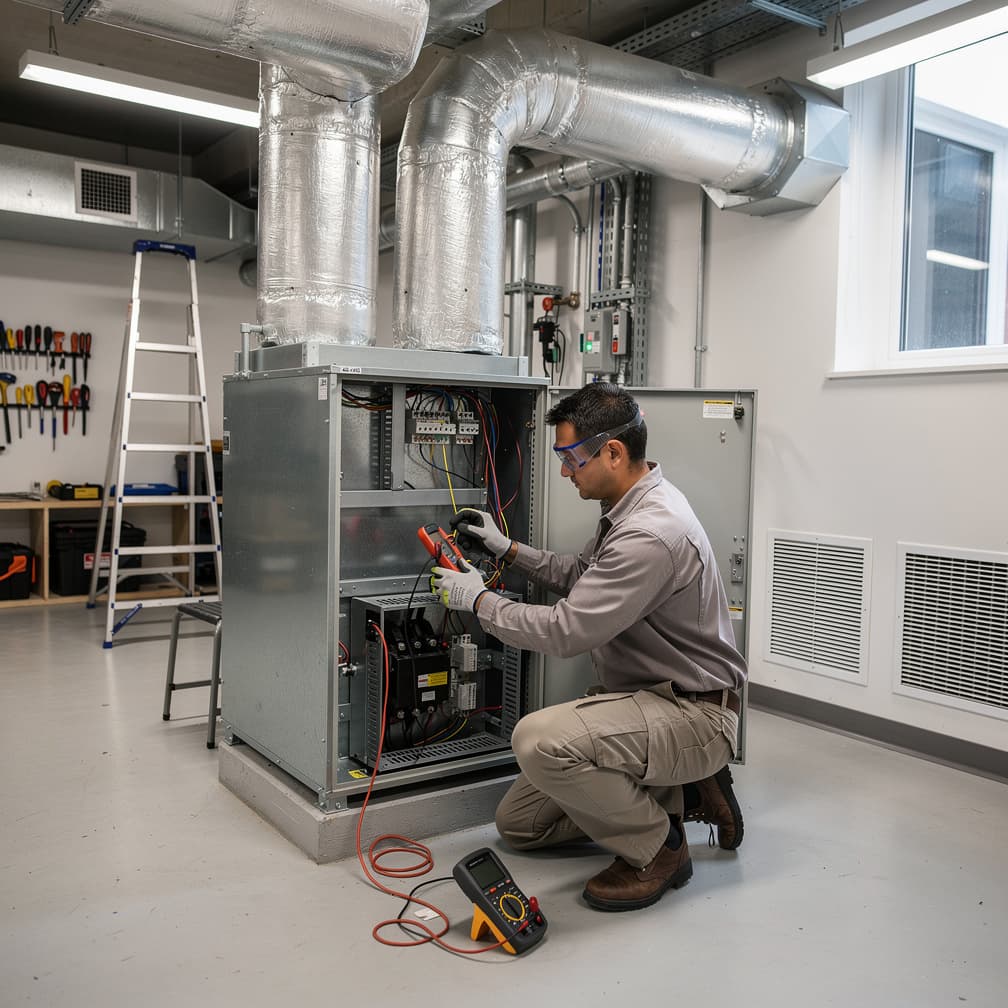

Carbon monoxide turns a routine furnace repair into the worst call of a career. A cracked heat exchanger you signed off on, a flue you reconnected, a combustion test you ran in a hurry: the allegation is bodily injury, and it names the last person who touched the equipment. That exposure is why HVAC technician insurance in Ann Arbor is worth more than a checkbox at a permit counter. Defense costs start the day a letter arrives, long before anyone decides whether you did anything wrong. Some forms can pay that defense inside the limit, which quietly shrinks the money left for a settlement. Ask which way your form is written before you compare two quotes that look identical on price. The rest of this page lays out what participating carriers in Michigan want to see.
What Makes Ann Arbor Different
Distance is the defining feature of a thin market, and distance shows up in your auto exposure. An hour of driving between calls is an hour of risk that no ladder safety talk ever touches. Radius of operation is a question every commercial vehicle quote asks, and the honest answer sets the rate. Understating it is not a savings plan; it is a coverage argument waiting for a wreck to happen. Fewer nearby competitors can mean you take jobs outside your comfort zone to keep the calendar full. Refrigeration, boilers, and light commercial controls are not the same risk as a residential changeout. Tell every participating carrier in Michigan what you actually work on, including the parts you do twice yearly. A quote in Ann Arbor built on a narrow description of your work is a quote that unravels at claim time.
Local Risk Factors in Ann Arbor
A stack of emergency calls after a storm looks like a good week and prices like a bad one. Rushed changeouts, rooftop work in wind, and a helper you hired last month are the ingredients of a claim that surfaces six months later as water in a ceiling. Completed operations is the part of a liability form that deals with work you have already finished and left, and General Liability is usually where that argument lands. Whether damage to your own installation is included is a wording question, and forms differ on it. The storm damage to the building is not your claim. The work you do afterward is, so ask how the form reads before Washtenaw County has its next bad night and an Ann Arbor customer calls.
What Coverage Does an HVAC Technician in Ann Arbor Need?
General Liability
Third-party injury and property damage arising out of your work is what this line is written for: a customer who slips near your equipment, a ceiling ruined by a condensate line you installed, a claim that lands months after the job closed. Damage to your own workmanship is commonly excluded, and property managers usually demand this policy by name before you start.
Example: A drain pan you replaced overflows into the finished basement below, and the homeowner's insurer sends a demand letter with photographs attached. A liability form may answer for the restoration work, subject to its exclusions.
Workers Compensation
Your helper falls off a ladder at a rooftop unit and the medical bills start the same afternoon. This is the system that generally handles those costs and the lost wages behind them, and it operates separately from the liability policy. Rules vary by state, and uninsured subcontractors are commonly counted as your payroll at audit.
Example: A technician overheats in an attic during a heat run and spends two days in a clinic. The employer's coverage is typically what handles the treatment and the wages missed, depending on the state's rules.
Commercial Auto
Personal auto policies typically exclude the business use you do all day, which is the gap this line fills. It is meant for the vans and trucks you drive between calls, the helpers who drive them, and the liability when one of them causes an accident. Cargo in the back is usually a separate question.
Example: Your van rear-ends a car at a light while loaded with a new condenser and a full parts run. The commercial vehicle policy is generally what deals with the other driver's damage and injuries.
Tools & Equipment (Inland Marine)
Gauges, recovery machines, vacuum pumps, torch sets, and the ladder rack are the assets this trade actually loses, and they live in a van rather than at an address. Coverage here generally follows the item between jobs, subject to per-item limits and the values you declare. Wear and tear and mechanical breakdown are commonly excluded.
Example: A locked van in Ann Arbor is broken into overnight and the recovery machine, two gauge sets, and a vacuum pump are gone before the first call. The scheduled equipment might be replaced under this line, depending on the limits you chose.
Commercial Umbrella
A vendor agreement asking for higher limits than your primary carries is the usual reason a shop buys excess capacity. It sits above the liability and auto policies underneath it and generally follows their terms, which means an exclusion below stays an exclusion above. It does not broaden what those policies already say.
Example: One flooded floor of an Ann Arbor building produces claims from the owner, the tenant, and the tenant's insurer, and the primary limit runs out first. Excess capacity above it could pick up what remains, subject to the underlying terms.
How Much Does HVAC Technician Insurance Cost in Ann Arbor?
HVAC Technician Insurance is a bundle of separate policies, priced separately. The ranges below are typical figures for Ann Arbor for each line, except workers compensation, which is rated per $100 of payroll; a quote prices each one against your own operations.
| Coverage | Typical range | What moves your price |
|---|---|---|
| General Liability Insurance | $100 - $340 per month | Industry and risk classification, annual revenue, number of employees |
| Workers Compensation Insurance | $0.75 - $2.74 per $100 of payroll | Employee classification codes, total annual payroll, experience modification rate |
| Commercial Auto Insurance | $260 - $725 per month | Fleet size and vehicle types, driver records and experience, coverage limits and deductibles |
| Inland Marine Insurance | $20 - $90 per month | Total insured value of the scheduled property, type and age of the equipment, where it is stored and how far it travels |
| Commercial Umbrella Insurance | $65 - $220 per month | Umbrella limit requested, limits carried on the underlying policies, loss history on those underlying policies |
Prices shown are general estimates, not guaranteed rates or quotes. Your actual premium will depend on the insurer, coverage selected, business details, location, claims history, and other underwriting factors. Learn about our pricing methodology.
What Are the Insurance Requirements for an HVAC Technician in Ann Arbor?
Workers' comp is generally required once you have your first employee. Michigan generally requires employers to carry workers' compensation at that point. Common exemptions include sole proprietors, partners, and corporate officers. Confirm current thresholds with your state's workers' compensation agency before you hire.
State auto liability minimums apply to business vehicles. Michigan's minimum auto liability limits are $50,000/$100,000/$10,000 (bodily injury per person / per accident / property damage). Contracts and lenders often require more than the state floor.
Where to verify licensing and coverage rules. The Michigan Department of Insurance and Financial Services publishes consumer guidance and current insurance requirements for Michigan businesses. When a contract or lease demands specific wording, the Michigan Department of Insurance and Financial Services's guidance is the authoritative place to check.
Get Your HVAC Technician Quote in Ann Arbor
Compare rates from multiple carriers. Free quotes, no obligation.
Operating in Ann Arbor
- A van at fault in a wreck while carrying a helper creates two claims at once, one for the other driver and one for your own employee.
- Brazing near dry framing is a fire exposure the customer's carrier remembers long after you have forgotten the job existed.
- Rooftop access agreements in Ann Arbor can require you to name the building owner on your policy before the roof hatch gets unlocked.
- Older equipment with a cracked heat exchanger puts you in the middle of a carbon monoxide conversation whether or not you touched that part.
How to Buy: Advice for Ann Arbor Owners
Read the exclusions before the price. Faulty workmanship language, damage to your own work, wear and tear, and pollution wording all shape what a General Liability policy does after a bad install. Refrigerant and combustion byproducts can raise pollution questions that standard forms treat unevenly. Ask, in writing, how the form handles carbon monoxide allegations, because that is the claim this trade fears most. Ask whether defense costs sit inside the limit or outside it, since the answer changes what the limit is worth. Check the Michigan Department of Insurance and Financial Services's guidance before deciding which structure you want. A Commercial Umbrella follows the primary's terms in many cases, so a gap below usually stays a gap above. Bring those questions to CPK and compare participating carriers in Ann Arbor on answers rather than on the monthly figure.
FAQ
HVAC Technician Insurance in Ann Arbor: FAQ
It depends on the form and on what is alleged. Bodily injury claims tied to combustion byproducts can raise pollution wording that policies treat unevenly, so the exclusion page matters more than the price page. Ask in writing how the form handles carbon monoxide allegations before you bind. Ask also whether defense sits inside or outside the limit, since these claims cost money long before fault is settled.
The per-occurrence limit is the most a policy might pay for one event, like one flooded ceiling. The aggregate is what every claim in one policy year has to share between them. A bad year of completed-operations claims can erode the aggregate quietly, and the limit a contract requires is usually the per-occurrence number. Ask a participating carrier in Michigan what your aggregate looks like after two claims, not after none.
Yes, and it is routine. When a homeowner's carrier pays for water damage it believes your install caused, it can pursue you for what it paid out. That is called subrogation, and it arrives as a letter with photographs and a number at the bottom. Your liability policy is what turns that letter into your carrier's problem instead of yours. Waivers of subrogation in a contract change the direction of the same idea.
Turnaround depends on the carrier and the agent servicing the policy, so nobody can promise a timeframe. What you can control is having the policy in force before you need the document, and knowing the exact entity name, address, and wording the holder wants. A certificate with the wrong name gets rejected as often as one that arrives late. Ask what the holder's exhibit requires and send it once, correctly.
It depends on what you sign. A vendor agreement asking for limits above your primary is the usual reason, and Commercial Umbrella capacity above an existing policy is often cheaper than raising the primary to match. It generally follows the terms underneath it, so an exclusion below stays an exclusion above. If nobody asks for high limits, the case is about severity: one bad water loss in a large home.
Usually not. Flood is typically excluded from standard property forms and priced separately, and rising water damaging a building is the owner's problem to file. Your equipment inside that building is a different question, and tools coverage can respond to some water losses while excluding flood entirely. Read the wording before the season, because reading it afterward has never changed anyone's outcome.
Sources
- 1.Michigan Department of Insurance and Financial Services(Michigan Department of Insurance and Financial Services publishes consumer guidance for insurance buyers.)


