







































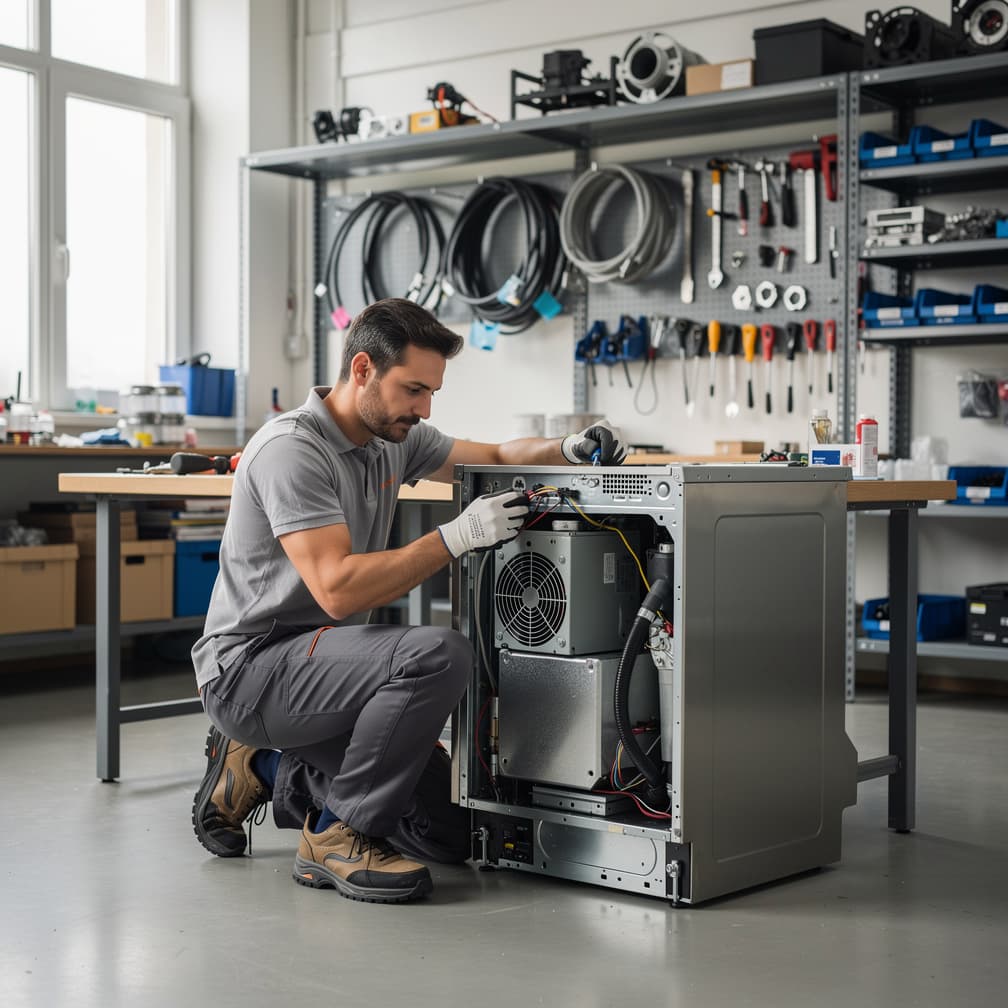

A dryer tips off its pedestal during a pull-out and gouges the plank floor on the way down. The scratch was never on your invoice, and the homeowner still expects you to make it right. Moments like that are why appliance repair insurance in Minneapolis gets bought before the next call is booked. Diagnosis, disassembly, reassembly: each step puts your hands on property that belongs to somebody else, in a room you did not build. In a county with about 40,500 businesses, plenty of your calls end at commercial sites where the customer has a claims process and a legal department rather than a shrug. That is a lot of counterparties who can put a demand letter in front of you. This page walks through which line answers which loss, and where the honest gaps sit.
What Makes Minneapolis Different
About 16 appliance repair businesses work in Hennepin County, which mostly tells you how quickly a customer can replace you. Density means the second call goes to somebody else, and it also means your name sits on review pages beside theirs. A damage complaint you settle out of pocket is cheaper than the review, right up until the amount stops being small. That is the moment owners discover what their limit actually is. Competitive markets also push shops toward warranty and service contract work, where the counterparty writes the insurance terms. Volume work brings volume exposure: more entries, more floors, more chances that one visit turns expensive. The rate you quote gets squeezed while the risk you carry does not. Pricing your policy against that reality is the only honest way to do it.
Local Risk Factors in Minneapolis
Tornado watches empty a schedule faster than any other weather, and a shop in Minneapolis can lose a full day of billable calls to a warning that never touches ground. Debris and wind damage afterward create the opposite problem: more calls than a two-technician outfit can absorb, all at once. Vans parked at customer homes take limbs and hail while your technician is inside. Physical damage to a service vehicle from wind or falling debris may fall under the comprehensive part of a Commercial Auto policy, subject to the deductible. The tools inside it are a separate schedule and a separate question. Ask participating carriers in Minnesota how each form treats property riding in a vehicle.
What Coverage Does an Appliance Repair in Minneapolis Need?
General Liability
Property managers, landlords, and warranty networks ask for this one by name before they let a technician through the door. It is generally the line for damage you cause at a customer's site and for injuries to people who do not work for you. Damage to the appliance you were working on is commonly excluded, which surprises owners.
Example: A hand truck clips a cabinet door while a washer comes out of a tight laundry closet, splitting the panel and the trim beside it. Repairs to that cabinetry might fall to the policy, subject to the deductible.
Commercial Auto
Every parts run, service call, and equipment haul is business use of a vehicle, and personal auto forms commonly exclude exactly that. This line is meant for the vans and trucks that carry your technicians, subject to who is listed as a driver. The meters and pullers inside are usually scheduled somewhere else.
Example: A van heading to a supplier for a compressor rear-ends a stopped car at a light. The other driver's repairs, the injury claim, and the damage to your van could all run through this policy, up to the limit.
Professional Liability
Sometimes nothing gets broken and the customer is still furious: the unit failed again a week later, and they say the diagnosis was wrong. That argument is about your work rather than about property, which is where General Liability usually stops and this line typically begins. Deliberate misconduct stays outside it.
Example: A customer says a misdiagnosed control board led to three visits and a freezer of spoiled food, then sends a demand letter naming the last technician. Defense costs for that dispute may be picked up here.
Tools & Equipment (Inland Marine)
Tools do not sit still in this trade. Diagnostic meters, vacuum pumps, specialty pullers, and part carriers ride between homes every day, and a building policy generally stops at the door while a vehicle policy generally stops at the tools. This line is written for property that travels, rated on a schedule you keep current. Wear and mechanical breakdown are usually outside it.
Example: A locked van in Minneapolis is broken into overnight and the diagnostic gear inside walks, taking three days of scheduled calls with it. Replacement of the scheduled equipment can be within reach, depending on the list you filed.
How Much Does Appliance Repair Insurance Cost in Minneapolis?
Appliance Repair Insurance is a bundle of separate policies, priced separately. The ranges below are typical figures for Minneapolis for each line; a quote prices each one against your own operations.
| Coverage | Typical range | What moves your price |
|---|---|---|
| General Liability Insurance | $60 - $190 per month | Industry and risk classification, annual revenue, number of employees |
| Commercial Auto Insurance | $210 - $500 per month | Fleet size and vehicle types, driver records and experience, coverage limits and deductibles |
| Professional Liability Insurance | $60 - $180 per month | The services you actually perform, annual revenue or billed fees, limit and retention selected |
| Inland Marine Insurance | $20 - $90 per month | Total insured value of the scheduled property, type and age of the equipment, where it is stored and how far it travels |
Prices shown are general estimates, not guaranteed rates or quotes. Your actual premium will depend on the insurer, coverage selected, business details, location, claims history, and other underwriting factors. Learn about our pricing methodology.
What Are the Insurance Requirements for an Appliance Repair in Minneapolis?
Workers' comp is generally required once you have your first employee. Minnesota generally requires employers to carry workers' compensation at that point. Common exemptions include sole proprietors, partners, and officers of closely held corporations. Confirm current thresholds with your state's workers' compensation agency before you hire.
State auto liability minimums apply to business vehicles. Minnesota's minimum auto liability limits are $30,000/$60,000/$10,000 (bodily injury per person / per accident / property damage). Contracts and lenders often require more than the state floor.
Where to verify licensing and coverage rules. The Minnesota Department of Commerce publishes consumer guidance and current insurance requirements for Minnesota businesses. When a contract or lease demands specific wording, the Minnesota Department of Commerce's guidance is the authoritative place to check.
Get Your Appliance Repair Quote in Minneapolis
Compare rates from multiple carriers. Free quotes, no obligation.
Operating in Minneapolis
- A homeowner in Minneapolis may accept a discount on the next visit after a scratched floor. A management company opens a file, notifies its insurer, and expects a claim number from you.
- Warranty network dispatches arrive with an insurance page attached to the service agreement, written to a national template. The limits on that page become your specification whether or not the account is worth the limits.
- The appliance you were sent to fix is usually treated differently from the room around it. That distinction decides more claims in this trade than any argument about who was careless.
- Parts runs put a technician in traffic in the middle of a workday, and that trip is business use of a vehicle. Participating carriers in Minnesota write that exclusion into the form, and it surfaces after the accident, never before.
How to Buy: Advice for Minneapolis Owners
Exclusions decide claims, and they are the last thing anybody reads. Wear and tear is excluded everywhere, which matters in a trade where the machine was already failing when you arrived. Damage to the appliance you were working on is treated differently than damage to the room around it, and the difference is a specific exclusion rather than an opinion. Intentional acts are out. Flood sits outside a standard property form entirely. Ask each participating carrier to point at the exclusion that would apply to your last three complaints, and read the actual language rather than the summary. General Liability and Professional Liability draw that boundary in different places, and knowing where is worth more than a small premium difference. The Minnesota Department of Commerce publishes consumer guidance on reading policy exclusions. Compare what is excluded in Minneapolis the same way you compare what is priced.
FAQ
Appliance Repair Insurance in Minneapolis: FAQ
Payroll, annual revenue, a vehicle list with drivers, an equipment schedule with current values, your entity name exactly as registered in Minnesota, and five years of loss runs. Guessing on payroll or receipts produces a number that changes at audit. The equipment list is the one owners skip, and it is also the one that decides whether a stolen-tools claim actually helps. Assemble the page once and send the identical version to every carrier you compare.
Per-occurrence is what one event can draw. Aggregate is what the whole policy year can draw. One flooded kitchen can use most of a per-occurrence limit; three moderate claims in a busy year can use the aggregate and leave the fourth on you. Ask whether defense costs sit inside the limit or outside it, because inside-the-limit defense makes the number smaller than it looks on a certificate.
Flood sits outside a standard property form, and that is true almost everywhere. Coverage for rising water is written and priced separately, commonly through the federal program or a surplus market policy. Water that comes from a supply line you reassembled is a different question with a different answer. Ask participating carriers in Minnesota which of your forms treats which kind of water, because owners routinely assume one document handles both.
It proves a policy existed on the day the certificate printed. It does not prove scope, it does not prove the endorsement your contract asked for, and it does not survive a cancellation. A property manager in Minneapolis can reject a certificate for a legal entity name that differs by one word. Keep renewal dates somewhere you can reach from a driveway, because a lapse shows up as a scheduling problem first.
That depends entirely on the carrier, and it is worth asking before you buy rather than after. Nobody controls a carrier's turnaround, so treat responsiveness as part of the comparison and not an afterthought. Keep your entity name, your policy numbers, and your renewal dates in one place your dispatcher can reach. An account lost over a document nobody could produce is the most avoidable loss in this trade.
Service agreements from warranty companies and manufacturers commonly carry an insurance page with limits, endorsements, and sometimes a waiver of subrogation. That page is written to a national template and does not soften for a small shop. Waiving subrogation gives up your insurer's right to pursue whoever actually caused a loss, and participating carriers in Minnesota price that differently. Read the page before you sign, because it becomes your specification.
Sources
- 1.U.S. Census Bureau, County Business Patterns (2022), Hennepin County(Hennepin County has about 40,500 business establishments.)
- 2.U.S. Census Bureau, County Business Patterns (2023), Hennepin County(Hennepin County has about 16 businesses in this trade's category (NAICS group 811412).)
- 3.Minnesota Department of Commerce(Minnesota Department of Commerce publishes consumer guidance for insurance buyers.)


