







































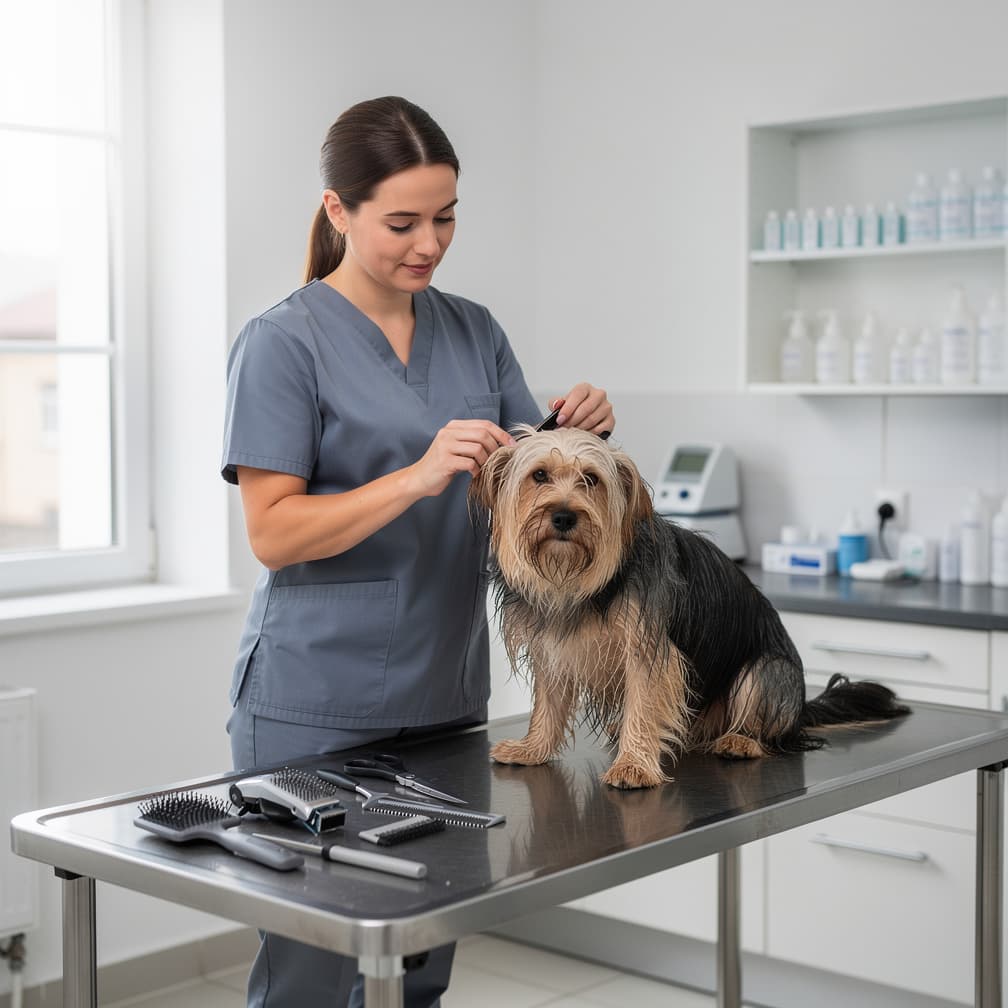

A nervous dog twists on the table during a nail trim, and the vet bill that follows arrives with a demand letter attached. Pet grooming insurance in Minneapolis exists for that hour: the nick that needs stitches, the bite that lands on a groomer's forearm, the wet floor by the drying station. Grooming is hands-on work with animals that did not agree to be there, and claims start in the seconds when an animal decides it has had enough. Paperwork matters as much as care. A landlord, a franchise agreement, or a payroll figure can each force a specific line onto your policy before you open the doors. The sections below lay out what groomers commonly carry in Minnesota, what the published ranges look like, and where the gaps sit, so you can compare quotes without guessing.
What Makes Minneapolis Different
Grooming inside a pet store, a veterinary clinic, or a big-box concession puts someone else's risk manager in charge of your paperwork. Those hosts hand down limit requirements, additional-insured wording, and sometimes a waiver of subrogation, and they do not negotiate. A shop in Minneapolis that adds one corporate account can find its insurance rewritten to satisfy that account alone. The demand is not about your safety record; it is about the host's own contract with its insurer. Ask for the insurance exhibit before you sign the concession agreement, rather than after the ink dries. Then price the policy that exhibit describes instead of the one you had in mind. Crowded retail markets in Minnesota run on these exhibits because chains standardize them across every location. A quote that wins on price and fails the exhibit costs you the account.
Local Risk Factors in Minneapolis
A canceled weekend is what most storms actually cost a grooming shop, and weekend slots do not reschedule into an already full midweek. Owners who keep an appointment during a warning arrive tense, dogs read that, and a nervous animal on a table is exactly where handling claims begin. That is the risk nobody itemizes: the storm creates the conditions, and the injury looks like an ordinary bad handoff. Photograph and document as usual, because the weather is not a defense. On the property side, a shop in Minneapolis should ask how a quote treats an equipment loss caused by a surge versus one caused by age. That distinction settles more small claims across Hennepin County than the storm itself does.
What Coverage Does a Pet Grooming in Minneapolis Need?
General Liability
Landlords, host clinics, and corporate accounts ask for this one by name. It is the line typically aimed at people rather than pets: the client who slips on a wet floor at pickup, the person bitten in your waiting area, the damage you cause to somebody else's property. Injury to an animal in your care is often excluded and usually needs separate wording, so ask.
Example: A client leans over the desk to sign, slips on water tracked from the tub room, and lands hard; General Liability can help cover the medical bills and the claim that follows.
Professional Liability
Nobody was hurt and the owner is still furious: the coat came off too short, the shave down was never authorized, a sore is blamed on your blade. Those complaints are about the service rather than an injury, and General Liability generally leaves them alone. Professional Liability is the line meant for that argument, and it often funds the defense even when a claim goes nowhere.
Example: An owner books a full groom before a show, returns to a coat clipped shorter than agreed, and demands compensation; Professional Liability might answer the claim and the lawyer's bill.
Commercial Property
Tubs, hydraulic tables, high-velocity dryers, clipper sets, and the product on the shelf are the money in a grooming shop, and they all sit in one room. This line is intended for that room: fire, theft, vandalism, and sudden water from inside the building. Flood is typically excluded and bought separately, and wear on an aging dryer motor is treated as maintenance.
Example: A break-in overnight empties the clipper drawer and takes both dryers from a salon in Minneapolis; Commercial Property may respond up to the values you scheduled, which is why the inventory matters.
Workers Compensation
A bite to a client and a bite to your bather travel down different roads. This is the employee road: medical care and lost wages when a groomer is hurt lifting a ninety-pound dog, scratched on the table, or injured on a wet floor at work. Rules on who must carry it vary by state and headcount. Rating runs per hundred dollars of payroll rather than as a flat monthly figure.
Example: A bather reaches into a tub, takes a bite that needs stitches, and misses a week of shifts; Workers Compensation is generally intended to handle the medical care and the lost wages.
How Much Does Pet Grooming Insurance Cost in Minneapolis?
Pet Grooming Insurance is a bundle of separate policies, priced separately. The ranges below are typical figures for Minneapolis for each line, except workers compensation, which is rated per $100 of payroll; a quote prices each one against your own operations.
| Coverage | Typical range | What moves your price |
|---|---|---|
| General Liability Insurance | $50 - $150 per month | Industry and risk classification, annual revenue, number of employees |
| Professional Liability Insurance | $45 - $140 per month | The services you actually perform, annual revenue or billed fees, limit and retention selected |
| Commercial Property Insurance | $85 - $280 per month | Building value and construction type, roof age and condition, fire protection class |
| Workers Compensation Insurance | $0.75 - $2.74 per $100 of payroll | Employee classification codes, total annual payroll, experience modification rate |
Prices shown are general estimates, not guaranteed rates or quotes. Your actual premium will depend on the insurer, coverage selected, business details, location, claims history, and other underwriting factors. Learn about our pricing methodology.
What Are the Insurance Requirements for a Pet Grooming in Minneapolis?
Workers' comp is generally required once you have your first employee. Minnesota generally requires employers to carry workers' compensation at that point. Common exemptions include sole proprietors, partners, and officers of closely held corporations. Confirm current thresholds with your state's workers' compensation agency before you hire.
Flood damage is typically excluded from standard policies. Standard commercial property and builders-risk-type policies typically exclude flood damage. Flood exposure varies address by address, so check your premises in FEMA's Flood Map Service Center before deciding; if you sit in a mapped flood zone, a separate policy through the National Flood Insurance Program is the usual starting point.
Where to verify licensing and coverage rules. The Minnesota Department of Commerce publishes consumer guidance and current insurance requirements for Minnesota businesses. When a contract or lease demands specific wording, the Minnesota Department of Commerce's guidance is the authoritative place to check.
Get Your Pet Grooming Quote in Minneapolis
Compare rates from multiple carriers. Free quotes, no obligation.
Operating in Minneapolis
- High-velocity dryers and hydraulic tables cost more than the room they sit in, so a property schedule copied from a generic checklist tends to understate a Minneapolis salon by a wide margin.
- The dog already in the tub does not care that the power is out, and a shop without hot water or dryers cannot finish work it has already taken money for.
- A bather bitten while lifting a large dog is an on-the-job injury, which puts the claim on the payroll side of your insurance rather than the client side.
- Corporate accounts and host clinics tend to hand down insurance exhibits written for every location in the chain, so a two-table shop in Minneapolis gets the same limit requirement as a warehouse.
How to Buy: Advice for Minneapolis Owners
Let the people who can sue you set your floor. A landlord names a limit, a host clinic names a limit, a corporate account names a limit, and your policy has to satisfy the highest of them. Buying under that ceiling saves a few dollars and fails the one document that mattered. Buying far over it wastes money, unless you handle large or reactive dogs, where severity argues for headroom. General Liability is the line those documents name almost every time. Professional Liability rarely appears in a lease, which is why it gets skipped and then needed. The Minnesota Department of Commerce publishes consumer guidance on liability limits if you want the mechanics first. Write down every limit anyone has ever demanded of you, then compare quotes from participating carriers in Minnesota through CPK at the highest one.
FAQ
Pet Grooming Insurance in Minneapolis: FAQ
Most commercial landlords ask for proof of coverage before they hand over keys, and the lease usually names a minimum limit and asks to be added as an additional insured. That request is contractual rather than legal, so the numbers vary from building to building. Get the clause in writing, then buy to it. A policy that cannot produce the certificate the lease describes will not get you the space.
Price moves on a handful of inputs: payroll if you have employees, annual revenue, the value of your equipment, the limits you choose, and your claims history. A solo groomer with one table prices differently from a three-station shop with a lease. Published ranges are statewide starting points, and a quote for your own shop in Minnesota may land anywhere across them. Bring accurate figures, because an estimate corrected later reprices the whole year.
Not automatically. Many General Liability forms exclude damage to property in your care, custody, or control, and an animal you are handling is legally property. Some carriers add that exposure back by endorsement; others handle it through a different form entirely. Ask the specific question before you buy, because this is the claim a grooming shop is most likely to see and the one where wording decides the outcome.
Adding a party as an additional insured can extend your policy's defense and response to that party for claims arising out of your work. A landlord wants it so a slip in your doorway is argued against your policy first. The certificate you send is proof the endorsement exists, not the endorsement itself. Ask your carrier to confirm the actual form was added, and keep a copy of it.
A fall on your premises is a third-party bodily injury claim, and General Liability is the line usually built for it. Wet floors are the specific hazard in grooming, since water travels from the tub room to the entry on paws and shoes. Mats and signage cut the frequency, not the severity. Ask whether medical payments coverage is included, because a small no-fault payment early can end a claim that would otherwise grow.
Expect questions about payroll by role, annual revenue, animal volume, whether you accept aggressive or large dogs, your equipment values, your building or lease, and any claims in the last five years. Two quotes built from different guesses are not comparable, so write your figures down once and use the same set everywhere. Estimates get corrected at audit, and corrections arrive as a bill.
Sources
- 1.Minnesota Department of Commerce(Minnesota Department of Commerce publishes consumer guidance for insurance buyers.)
- 2.FEMA / FloodSmart(Flood coverage is typically purchased separately; FEMA administers the National Flood Insurance Program.)


