







































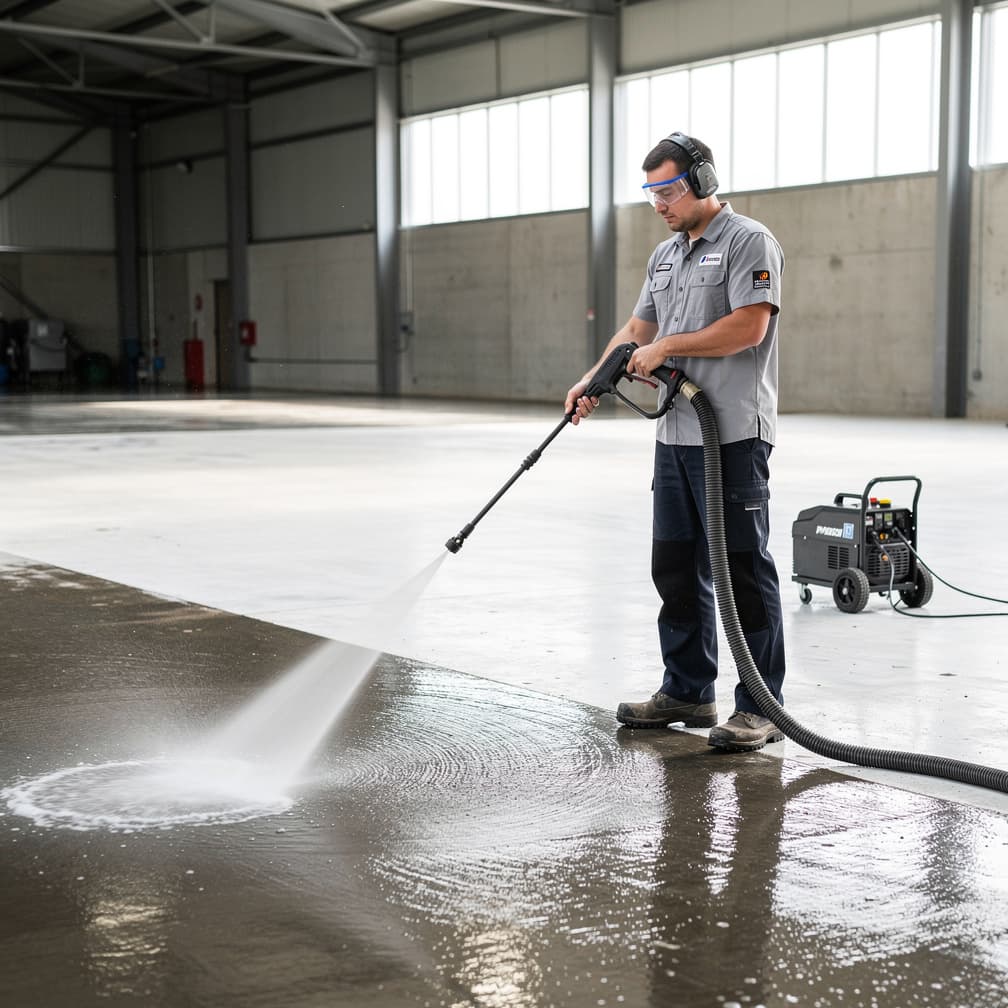

About 40,500 businesses operate in Hennepin County, and every one of them is a possible counterparty who can put a certificate requirement in front of you. That is what changes the picture in a dense market: the buyer is rarely the person paying you. A management company signs, a tenant complains, and a building owner sits behind both with contract language nobody read aloud. Pressure washing insurance in Minneapolis has to satisfy that chain, not your own comfort level. Additional insured wording is where the chain shows up, and it is never automatic. Bids get pulled over a missing endorsement more often than over price. Check what your contracts actually demand before you shop, because the wrong policy is cheap for exactly one week.
What Makes Minneapolis Different
Competition sets your price ceiling, and your price ceiling quietly sets what coverage you think you can afford. About 45 pressure washing businesses in Hennepin County chase the same commercial routes with the same equipment list. Underbidding to win those routes squeezes the exact budget line that would fund a higher limit. That is a real trade-off, and it belongs in the bid rather than in a rationalization afterward. A crowded market also means the client has a replacement lined up the day you damage something. Your leverage in a damage dispute is thin, so the policy does the negotiating instead of you. Pricing coverage into the bid in Minneapolis beats treating it as a fee to dodge later. Compare quotes on identical limits; a cheaper number against a lower limit is not a comparison.
Local Risk Factors in Minneapolis
Before a storm season starts, look at where your equipment sleeps. A trailer in an open lot, a pump on a tailgate, and a tank strapped under a tarp are all outdoor assets in a hail and wind event. The claim question is not only what was damaged but where it sat, since equipment wording distinguishes a fixed premises from transit and a job site from a yard. Your clients have the same problem, which is why the phone rings hard once a cell passes: gutters, roofs, and lots all need washing at once. Take that work at your normal pace. The Minnesota Department of Commerce publishes consumer guidance on business coverage worth reading before you rely on a rumor in Minnesota.
What Coverage Does a Pressure Washing in Minneapolis Need?
General Liability
Third-party damage is the whole story here: the client's etched concrete, the neighbor's overspray-dusted car, the tenant who slips on an entry you just rinsed. Landlords and property managers demand this line before a work order releases. It typically will not answer for damage to the exact surface you were hired to clean, which is the exclusion worth asking about.
Example: A wand lingers a beat too long and a customer's stamped patio comes back swirled and permanent; the repair bill and the argument behind it are what General Liability may take on.
Commercial Auto
Your truck hauls a trailer, a tank, and everything that earns money, which is why personal auto policies commonly exclude the trip entirely. This line is meant for business vehicle use: collisions between jobs, damage to the truck, and liability when a loaded trailer is involved. Hired and non-owned wording matters when a helper drives their own car for supplies.
Example: A helper backs the trailer into a bollard at a strip center and clips a parked sedan on the way out; Commercial Auto is generally the line that picks up the vehicle damage.
Tools & Equipment (Inland Marine)
Pumps, hoses, reels, wands, tanks, and surface cleaners rarely sit still, and that movement is exactly what a standard property form handles poorly. Inland Marine is intended for gear in transit and at job sites, including theft from a locked trailer. Wear, mechanical breakdown, and a pump left full through a freeze usually fall outside it.
Example: The trailer is emptied overnight at a yard and the surface cleaner, two reels, and a spare pump are gone by first light; equipment coverage might fund the replacement.
Workers Compensation
Employees get hurt in ways your clients never see: a hot-water burn, a fall from a ladder at second-story siding, a back that gives out under a hose reel. This line is rated per $100 of payroll and is intended for medical costs and lost wages after a work injury. Requirements vary by state, so check the Minnesota Department of Commerce's guidance before deciding.
Example: A helper slips on a wet loading dock and fractures a wrist halfway through a soft-wash job; the medical bills and part of the lost pay are what Workers Compensation is meant to handle.
How Much Does Pressure Washing Insurance Cost in Minneapolis?
Pressure Washing Insurance is a bundle of separate policies, priced separately. The ranges below are typical figures for Minneapolis for each line, except workers compensation, which is rated per $100 of payroll; a quote prices each one against your own operations.
| Coverage | Typical range | What moves your price |
|---|---|---|
| General Liability Insurance | $85 - $250 per month | Industry and risk classification, annual revenue, number of employees |
| Commercial Auto Insurance | $210 - $500 per month | Fleet size and vehicle types, driver records and experience, coverage limits and deductibles |
| Inland Marine Insurance | $20 - $80 per month | Total insured value of the scheduled property, type and age of the equipment, where it is stored and how far it travels |
| Workers Compensation Insurance | $0.75 - $2.74 per $100 of payroll | Employee classification codes, total annual payroll, experience modification rate |
Prices shown are general estimates, not guaranteed rates or quotes. Your actual premium will depend on the insurer, coverage selected, business details, location, claims history, and other underwriting factors. Learn about our pricing methodology.
What Are the Insurance Requirements for a Pressure Washing in Minneapolis?
Workers' comp is generally required once you have your first employee. Minnesota generally requires employers to carry workers' compensation at that point. Common exemptions include sole proprietors, partners, and officers of closely held corporations. Confirm current thresholds with your state's workers' compensation agency before you hire.
State auto liability minimums apply to business vehicles. Minnesota's minimum auto liability limits are $30,000/$60,000/$10,000 (bodily injury per person / per accident / property damage). Contracts and lenders often require more than the state floor.
Where to verify licensing and coverage rules. The Minnesota Department of Commerce publishes consumer guidance and current insurance requirements for Minnesota businesses. When a contract or lease demands specific wording, the Minnesota Department of Commerce's guidance is the authoritative place to check.
Get Your Pressure Washing Quote in Minneapolis
Compare rates from multiple carriers. Free quotes, no obligation.
Operating in Minneapolis
- A general contractor can put you on a Minneapolis site under their insurance exhibit, which means the project sets your limits and endorsements, and your preferences stop mattering that day.
- Hot surfaces flash chemicals off faster, so crews reapply, dwell times drift, and painted siding starts giving up its finish, which is the quiet way a wash becomes a repair bill.
- Every helper you put on a wand changes your payroll figure, and payroll is the number Workers Compensation is rated on and then audited against later.
- Carriers in Minnesota take different positions on the same described work, which is why a single quote tells you a price and not whether the price is reasonable.
How to Buy: Advice for Minneapolis Owners
Ask what is not covered before you ask what it costs. Wear and tear on your own pumps is not an Inland Marine claim; sudden theft from a locked trailer usually is, subject to how the policy defines the location. Damage to the very surface you were cleaning may fall under a care, custody, and control exclusion, which is the gap owners are most surprised by on a General Liability policy. Pollution and runoff wording deserves its own question, since detergent that reaches a storm drain is not the same as detergent that reaches a lawn. Get each answer in writing rather than over the phone. The Minnesota Department of Commerce publishes consumer guidance on reading policy exclusions, which is a better use of an evening than another price comparison. Then compare quotes from participating carriers in Minnesota knowing what each one leaves out.
FAQ
Pressure Washing Insurance in Minneapolis: FAQ
Revenue, payroll by role, years in business, your loss history, a vehicle and driver list, and an equipment inventory. Then the details that actually move the price: which surfaces you agree to work on, whether you go above one story, what chemicals you use, and where the trailer sits overnight. Vague answers produce vague policies. Send the same package to every participating carrier in Minnesota so the quotes stay comparable.
That is the claim General Liability exists for, and it is the most common one in this trade. A wet surface you created, a person who never hired you, and an injury is textbook third-party bodily injury. Whether a claim gets paid turns on the facts and the policy wording, not on whether you set a cone out, though the cone helps your defense. Defense costs can start before anyone decides fault.
Only if the retention is money you can produce on the day of a loss. Raising it lowers the premium and moves the first slice of every claim onto your books, which is a financing decision rather than a saving. Run it against a real scene: a repaint on a neighbor's car, a stolen surface cleaner, a blown window seal. If funding that yourself would stop work, the lower deductible is the cheaper option.
Usually before, because the insurance page is often a condition of signing rather than a formality afterward. A property manager can require the certificate, the endorsements, and the exact limit wording on file before the work order releases. Buying under that deadline means taking whatever arrives fastest, which is how owners end up with limits they never chose. Start the quotes while the contract is still a conversation.
Generally not, and assuming otherwise is expensive twice. An uninsured sub's mistake can come back at you as the hiring party, and at audit that sub is commonly reclassified as your payroll, which raises the premium after the fact. Collect a certificate from every sub before they touch a job and keep it on file. Ask any participating carrier in Minnesota how it treats uninsured subs before you build a crew that way.
Because the file differs, not the map. Payroll, revenue, claims history, the surfaces described, the heights worked, the vehicles listed, and the chemicals used all sit in a submission, and two owners with the same truck can describe very different businesses. Underwriting appetite differs between participating carriers too, so one submission lands in several different places. That is the whole reason comparing quotes is worth an afternoon.
Sources
- 1.U.S. Census Bureau, County Business Patterns (2022), Hennepin County(Hennepin County has about 40,500 business establishments.)
- 2.U.S. Census Bureau, County Business Patterns (2023), Hennepin County(Hennepin County has about 45 businesses in this trade's category (NAICS group 561790).)
- 3.Minnesota Department of Commerce(Minnesota Department of Commerce publishes consumer guidance for insurance buyers.)


