







































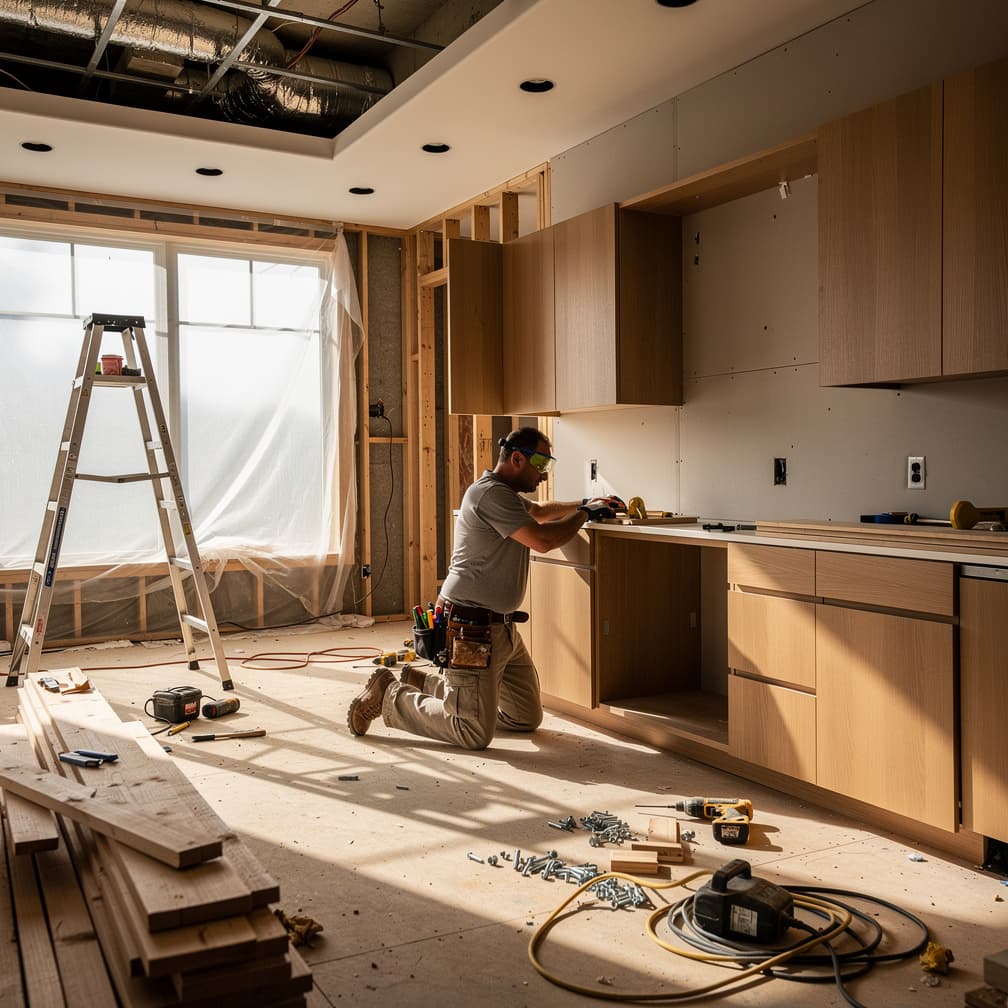

As a cabinet installer in St. Louis, you may be the only shop for a long stretch doing true custom work, and that changes both who hires you and how far you drive. Long hauls keep your tools on the road, and the road is where theft and damage actually happen. Cabinet installer insurance in St. Louis is only useful if it follows the van out of St. Louis city and onto a job you took because it paid well. Coverage territory, radius, and where the equipment sits overnight are the questions that decide whether it does. Being the only option also means a dispute cannot be walked away from cleanly, because you will see that client again. Sort the paperwork before the season fills up, since nobody shops a policy well in the middle of an install.
What Makes St. Louis Different
Word travels fast where the same handful of builders hire the same handful of finish crews. The proof they ask for is still a certificate, even when the relationship goes back many years. Long trust does not remove the requirement, because the builder answers to an owner and a lender. If a homeowner in St. Louis hires you directly, nobody may ask you for anything at all. That silence is the trap: the person least likely to ask is the one most likely to sue. A direct client sees your work every day and notices the door that never quite closed. Coverage bought for the builder's file still has to answer for the kitchen nobody ever inspected. Match the policy to the jobs you actually take around St. Louis city, not to the file it satisfies.
Local Risk Factors in St. Louis
Tornado and severe storm damage tends to reach a cabinet installer sideways in St. Louis: the house you were about to work in is suddenly unbuildable, and the job disappears for months. Debris and downed lines close roads, so even undamaged jobs stall. Material staged inside a damaged home can be a total loss while the structure still stands, because wet particleboard swells and stays swelled. Inland Marine can help cover material and tools away from your shop, subject to the perils the form actually names. Read what it says about property left in the open or under a tarp, since that is where a claim gets denied. Carriers in Missouri differ on that point more than they differ on price.
What Coverage Does a Cabinet Installer in St. Louis Need?
General Liability
Builders, property managers, and homeowners ask for proof of this line before a crew comes through the door. It could help cover injury to other people and damage you cause to property that is not yours, subject to what the form excludes. Damage to the cabinets you were installing, and the cost of redoing work that was simply done badly, typically sit outside it.
Example: A dolly loaded with wall boxes clips a finished stair nose on the way into a St. Louis kitchen, and the homeowner wants the whole run of trim replaced. That repair is the sort of claim this line may pick up.
Workers Compensation
Employee injuries sit here rather than on a liability form: a strain from lifting a tall pantry, a hand caught between a cabinet and a wall, heat illness inside a house with no cooling. It is rated on payroll, so the number moves the week you hire. Builders commonly demand proof before anyone badges onto a site, and rules on when it is mandatory vary by state.
Example: Your helper steadies a wall unit, the cleat gives, and the cabinet comes down on his wrist. Medical bills and the wages lost while it heals are what this line is generally meant to address.
Commercial Auto
A personal policy commonly stops applying the moment a van is used for the business, and cabinet work keeps a van loaded and moving every day. This line is written for the vehicles you drive to job sites, and it may respond to injury or damage you cause with them, subject to the drivers and vehicles actually listed on it.
Example: You back into a client's parked car while unloading a run in a tight driveway. Repairs to that car, and any injury claim that follows, are what the auto line is meant to answer.
Tools & Equipment (Inland Marine)
Tools never stay in one place in this trade: a track saw rides to three houses in a week and a cabinet jack lives in the van. This line is built for equipment and material away from a fixed location, and it might help cover theft or damage while they travel. Forms often narrow theft from an unattended vehicle, and some cap what any single item may collect.
Example: A window gets popped in a St. Louis driveway overnight, and the saw, the laser, and a bin of hardware are gone by morning. Replacing that kit is the loss this line typically speaks to.
Commercial Umbrella
When a builder demands a limit higher than your General Liability carries, this is usually how you reach it for less than raising the primary. It sits above the underlying policies and can respond once their limits are exhausted, subject to the terms of both. It does not broaden anything the underlying form already excludes.
Example: Water from a sink base spreads through a finished floor and into the unit below, and the primary limit runs out while three trades argue over fault. An umbrella could carry what is left.
How Much Does Cabinet Installer Insurance Cost in St. Louis?
Cabinet Installer Insurance is a bundle of separate policies, priced separately. The ranges below are typical figures for St. Louis for each line, except workers compensation, which is rated per $100 of payroll; a quote prices each one against your own operations.
| Coverage | Typical range | What moves your price |
|---|---|---|
| General Liability Insurance | $100 - $300 per month | Industry and risk classification, annual revenue, number of employees |
| Workers Compensation Insurance | $0.75 - $2.74 per $100 of payroll | Employee classification codes, total annual payroll, experience modification rate |
| Commercial Auto Insurance | $180 - $525 per month | Fleet size and vehicle types, driver records and experience, coverage limits and deductibles |
| Inland Marine Insurance | $30 - $110 per month | Total insured value of the scheduled property, type and age of the equipment, where it is stored and how far it travels |
| Commercial Umbrella Insurance | $60 - $200 per month | Umbrella limit requested, limits carried on the underlying policies, loss history on those underlying policies |
Prices shown are general estimates, not guaranteed rates or quotes. Your actual premium will depend on the insurer, coverage selected, business details, location, claims history, and other underwriting factors. Learn about our pricing methodology.
What Are the Insurance Requirements for a Cabinet Installer in St. Louis?
Workers' comp is generally required once you have 5 or more employees. Missouri generally requires employers to carry workers' compensation at that point. Common exemptions include sole proprietors, partners, and farm workers. Confirm current thresholds with your state's workers' compensation agency before you hire.
State auto liability minimums apply to business vehicles. Missouri's minimum auto liability limits are $25,000/$50,000/$25,000 (bodily injury per person / per accident / property damage). Contracts and lenders often require more than the state floor.
Where to verify licensing and coverage rules. The Missouri Department of Commerce and Insurance publishes consumer guidance and current insurance requirements for Missouri businesses. When a contract or lease demands specific wording, the Missouri Department of Commerce and Insurance's guidance is the authoritative place to check.
Get Your Cabinet Installer Quote in St. Louis
Compare rates from multiple carriers. Free quotes, no obligation.
Operating in St. Louis
- Cabinets get delivered days before you install them, and they sit in a garage or an unfinished room the whole time. Whose loss that is when something crushes a box depends on the contract, not on who paid the supplier.
- Homeowners stay in the house while you work, which means kids, pets, and a customer walking through a hallway full of cords and stacked doors. Injury claims start there far more often than on a ladder.
- Your van is the shop for most of the day, and a smash and grab in a driveway in St. Louis can take a week of production with it.
- Countertops are templated off the cabinets you set, so a run that is out of level pushes a fabrication bill onto somebody. That argument becomes a claim the moment the fabricator refuses to eat it.
How to Buy: Advice for St. Louis Owners
Quotes are only comparable when the submission behind them is identical. Send every carrier the same payroll figure, the same revenue split, the same vehicle list, and the same equipment schedule, or you are comparing three different businesses. Ask each to quote General Liability at the limit your contracts require rather than at a house default. If you run a crew, ask for Workers Compensation on the same class codes, since a misclassified installer changes everything downstream. Note what each quote excludes, not only what it includes, because the exclusions are where the real differences hide. The Missouri Department of Commerce and Insurance publishes consumer guidance on reading commercial policies, which helps when the wording gets dense. Comparing quotes from participating carriers is straightforward once every proposal answers the same question about your St. Louis operation.
FAQ
Cabinet Installer Insurance in St. Louis: FAQ
Expect questions about payroll, annual revenue, how the work splits between new construction and occupied homes, your vehicles and drivers, your equipment list, and your losses over the past few years. Subcontractor certificates matter too, since uncertified subs can be counted into your payroll at audit. Gather all of it once and every carrier ends up quoting the same St. Louis business instead of guessing at three different ones.
One incident has its own ceiling, and the policy term carries a separate, larger one above it. The difference bites an installer because a single water claim under a sink base can swallow a big share of the term ceiling, leaving thin room for the scratched floor that surfaces two months later. Defense costs may chew into both numbers, depending on how the form is written, so ask whether defense sits inside the limit.
That depends on what failed and who touched it. If a plumber's connection let go, the argument belongs to the plumber, though General Liability may still fund your defense while fault gets sorted out. If the damage traces back to your installation, the ruined floor and drywall raise a different question than rebuilding the cabinet itself. Report it early either way, because late notice can jeopardize a claim you wanted to make.
The deductible is the slice of a loss that stays on your side before any policy money moves, and on most commercial forms it applies per claim rather than once a year. Raising it lowers the premium and moves risk onto your slowest month. Two scratched floors in one year behind a high deductible can cost more than a lower deductible would have. Pick the number against your cash, not your optimism.
Coverage usually follows the work rather than a county line, but the application asks where you operate and how far you travel, and those answers feed your rating. If your jobs regularly run outside St. Louis city, say so at quote time rather than at claim time. A policy rated on a radius you do not actually drive can create an argument nobody wants during a loss.
A certificate shows a policy existed on the day it was issued. It is not the policy, it does not amend the policy, and it cannot tell a builder whether an exclusion applies to the job. Clients still demand one before releasing a draw, so keep the list of who holds yours current. When the policy renews, send fresh copies out that same week and save yourself a stalled payment.
Sources
- 1.Missouri Department of Commerce and Insurance(Missouri Department of Commerce and Insurance publishes consumer guidance for insurance buyers.)


