







































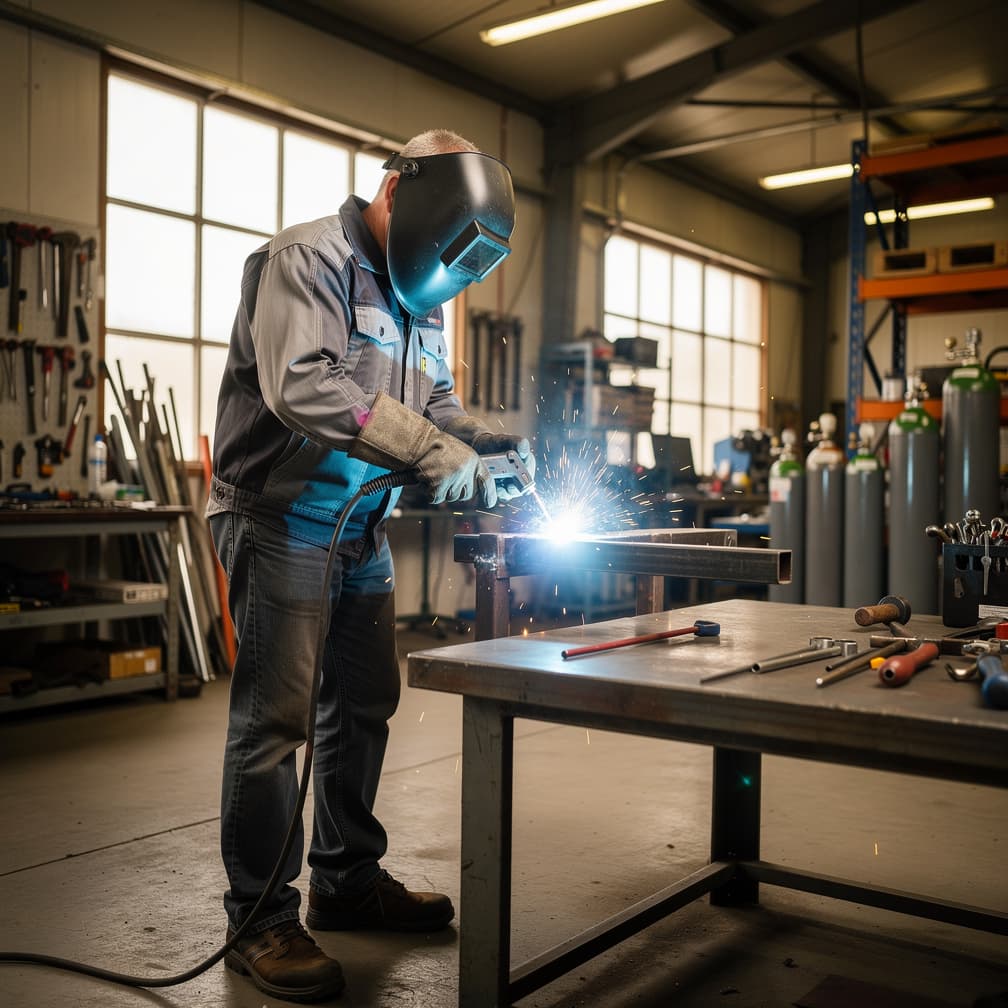

Premiums in a thin market are driven less by competition and more by what it costs to fix things when nobody nearby can. Welding business insurance in St. Louis carries that math: a claim needing a specialty repair vendor or a rented machine can stall while parts travel. Commercial Property for a welding shop is quoted from $65 a month at the low end, and construction type and fire protection move it fast. Distance to a hydrant and to a staffed station is a rating factor whether or not anyone tells you. Your loss history follows you past St. Louis city lines when you bid work in the next town over. A thin bench of competitors does not mean fewer certificates: the owner hiring you still wants paper before the gate opens. Read the drivers below, then compare quotes with your real payroll and equipment list in hand.
What Makes St. Louis Different
Handshake work still ends in paperwork the moment a bank, an insurer, or a corporate customer joins the conversation. A farm, a fabrication shop, or a municipal yard can each demand a certificate before your first cut, whatever the relationship. If a customer in St. Louis answers to a lender or a parent company, their requirements arrive intact from somewhere else. Thin markets do not soften those templates; they mean fewer people nearby who can explain them to you. The obligation also outlives the job, since many owners ask that certificates stay in force through a warranty period. Missing that detail turns a finished handrail into an open argument about who insured the repair. Keep proof of coverage on file with every recurring customer and refresh it at renewal without being chased. Jobs rarely stall over price; they stall over a document nobody updated, and that holds anywhere in Missouri.
Local Risk Factors in St. Louis
Before the season turns, decide what happens to the shop if the roof opens at midnight. Tarps, pallets raised off the floor, and a written list of what sits where are cheap and useful. Severe storms also cut power for days, and a welding business without power is a payroll expense with no revenue attached. Income coverage generally ties to physical damage at your own address, so an outage caused by damage down the road may not trigger it. Ask that question specifically, because owners in Missouri tend to learn the answer during the outage rather than before it. Utility interruption is sometimes available by endorsement, and St. Louis customers cannot pay you for work you could not perform.
What Coverage Does a Welding Business in St. Louis Need?
General Liability
General contractors, landlords, and plant managers ask for this one by name before hot work starts. It is the line generally meant for third-party trouble: a fire in a building you do not own, a visitor hurt at the shop door, a customer's wall scorched during an install. What it typically excludes is the cost of redoing your own defective weld.
Example: A spark drops behind a wall panel during a handrail install and the framing smolders until an alarm trips at midnight; the repair bill and the owner's claim may fall to General Liability.
Workers Compensation
Burns, arc flash to the eyes, crushed fingers, and heat illness are the injuries a welding payroll produces, and this coverage is intended for the medical bills and lost wages that follow. Pricing runs off payroll by class code rather than revenue. It does nothing for damage to a customer's property, and requirements vary by state.
Example: A helper lifts stock that came off the table minutes earlier and burns his hand through the glove; the treatment and the missed shifts are what Workers Compensation is typically there for.
Commercial Property
Your own bay is the blind spot: a landlord's policy is written for the building, and your benches, machines, stock, and installed improvements sit outside it. This line is intended for those, along with finished work waiting on pickup. Flood is typically excluded and priced separately, and reported values drift as the yard fills.
Example: A storm peels panels off the shop roof and rain soaks two welders and a rack of stock overnight; Commercial Property can help cover the building and the contents, subject to the deductible.
Tools & Equipment (Inland Marine)
Equipment refuses to stay put in this trade, so a policy tied to one address can leave the truck out. This coverage follows machines, leads, and hoods between the shop, the road, and a temporary site, and theft is the claim welding businesses actually file. Terms often differ for gear in transit versus gear left overnight, and mechanical breakdown is usually excluded.
Example: A trailer is cut open at a St. Louis job site overnight and two machines are gone before the crew arrives; Inland Marine terms usually decide whether that loss gets paid or absorbed.
How Much Does Welding Business Insurance Cost in St. Louis?
Welding Business Insurance is a bundle of separate policies, priced separately. The ranges below are typical figures for St. Louis for each line, except workers compensation, which is rated per $100 of payroll; a quote prices each one against your own operations.
| Coverage | Typical range | What moves your price |
|---|---|---|
| General Liability Insurance | $180 - $550 per month | Industry and risk classification, annual revenue, number of employees |
| Workers Compensation Insurance | $0.75 - $2.74 per $100 of payroll | Employee classification codes, total annual payroll, experience modification rate |
| Commercial Property Insurance | $140 - $450 per month | Building value and construction type, roof age and condition, fire protection class |
| Inland Marine Insurance | $45 - $180 per month | Total insured value of the scheduled property, type and age of the equipment, where it is stored and how far it travels |
Prices shown are general estimates, not guaranteed rates or quotes. Your actual premium will depend on the insurer, coverage selected, business details, location, claims history, and other underwriting factors. Learn about our pricing methodology.
What Are the Insurance Requirements for a Welding Business in St. Louis?
Workers' comp is generally required once you have 5 or more employees. Missouri generally requires employers to carry workers' compensation at that point. Common exemptions include sole proprietors, partners, and farm workers. Confirm current thresholds with your state's workers' compensation agency before you hire.
Flood damage is typically excluded from standard policies. Standard commercial property and builders-risk-type policies typically exclude flood damage. Flood exposure varies address by address, so check your premises in FEMA's Flood Map Service Center before deciding; if you sit in a mapped flood zone, a separate policy through the National Flood Insurance Program is the usual starting point.
Where to verify licensing and coverage rules. The Missouri Department of Commerce and Insurance publishes consumer guidance and current insurance requirements for Missouri businesses. When a contract or lease demands specific wording, the Missouri Department of Commerce and Insurance's guidance is the authoritative place to check.
Get Your Welding Business Quote in St. Louis
Compare rates from multiple carriers. Free quotes, no obligation.
Operating in St. Louis
- Jobs across St. Louis city mean equipment sleeps where you left it, and a policy written around one fixed shop address can treat that gear differently than you assumed.
- Welding on a customer's own machine puts their property in your hands, and that is the loss owners assume a policy handles until somebody reads the care and custody wording.
- An apprentice with a bad habit is a payroll problem and an insurance problem, since burns and eye injuries drive the claims that follow your loss runs for years.
- A general contractor in St. Louis can demand thirty days of cancellation notice on the certificate, and a policy that cannot support that language quietly costs you the job.
How to Buy: Advice for St. Louis Owners
Equipment is what welding businesses actually claim on, and it is the coverage owners describe most casually. Write the schedule properly: machine, model, serial number, replacement cost, and where each item sleeps at night. Inland Marine is meant for property that moves, and terms often differ for gear in transit, at a temporary site, or in your own bay. Read those three cases separately, since a theft from a job trailer and a theft from your shop can fall to different lines. Commercial Property may be the one that answers when the loss happens at your own address, so learn where the boundary sits. Ask what a claim needs as proof, and take the photographs now rather than after the loss. Guidance from the Missouri Department of Commerce and Insurance is a reasonable starting point on coverage terms. Then compare quotes from participating carriers in St. Louis with the same schedule attached to every one.
FAQ
Welding Business Insurance in St. Louis: FAQ
An additional insured is a party added to your policy by endorsement so your coverage can answer when a claim names them alongside you. Owners and general contractors ask for it because they would rather your insurer handle a fire that started at your station than their own. A certificate listing them proves little on its own; the endorsement behind it does the work. Ask which endorsement form a quote includes before you accept it.
Generally no. Policies commonly exclude the cost of repairing your own defective work, treating it as a business expense rather than an insurable accident. What can differ is the damage that failed weld causes to other property or to people, which is usually where liability coverage enters. That line surprises owners, so read the your-work exclusion before assuming a cracked joint falls inside the policy.
Keep a current certificate on file and a list of who holds it. A new site usually wants the certificate holder named, the additional-insured endorsement attached, and specific limits shown. Send the contract's insurance exhibit to whoever issues the paperwork instead of describing it over the phone, since wording gets rejected over small details. A general contractor in St. Louis city can hold your crew at the gate over a certificate that reads wrong, so start the request well before mobilization.
Per-occurrence is the most a policy may pay for one claim; aggregate is the ceiling for the whole policy year. A welding shop with a single fire rarely notices the difference. A shop with a fire, a slip claim at the shop door, and a damaged customer structure in one year can find the annual number gone before renewal. Every customer holding your certificate shares that same aggregate, which is why the yearly figure deserves a look.
Flood is the standard exception. Property policies typically exclude flood damage, and coverage for rising water is usually bought separately through a flood program. Wind and hail are treated differently and may sit inside a property policy, subject to their own deductible. If your bay sits in a flood-prone part of Missouri, ask about the separate policy before a wet season, since new flood coverage often carries a waiting period.
That is a specific question worth asking out loud, because a liability policy commonly limits or excludes damage to property in your care, custody, or control. If you weld on a machine and ruin it, the claim may fall in that gap unless the policy is written to address it. Welding businesses live in exactly that gap, so ask how work performed on a customer's own property is treated.
Sources
- 1.Missouri Department of Commerce and Insurance(Missouri Department of Commerce and Insurance publishes consumer guidance for insurance buyers.)
- 2.FEMA / FloodSmart(Flood coverage is typically purchased separately; FEMA administers the National Flood Insurance Program.)


