







































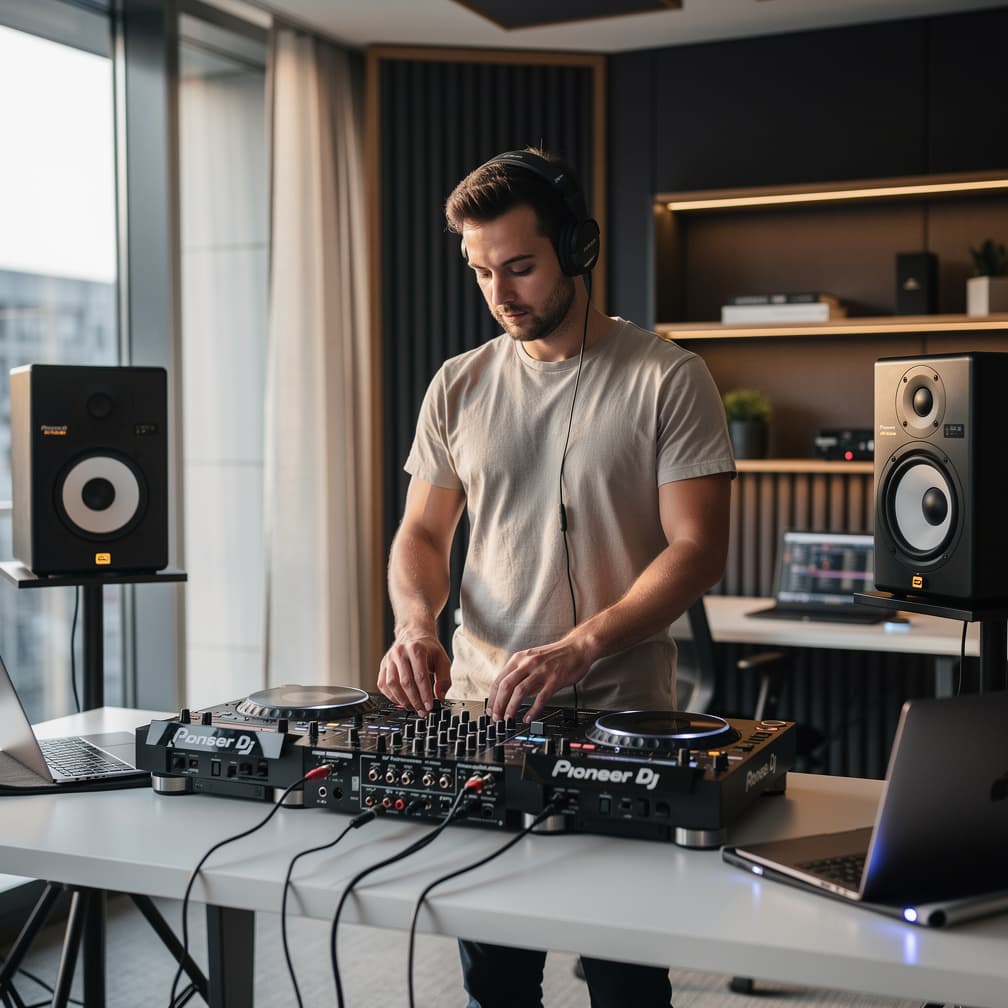

About 40 disc jockeys operate in Douglas County, and the number matters less than one fact hiding inside it: the good weekend dates are finite and everyone wants the same ones. DJ insurance in Omaha does not win you a date, but the lack of it can cost you one, since a venue can refuse load-in over a missing certificate and there is no appeal on the day of an event. The rest of this trade is stubbornly physical. Speakers travel, cables cross floors, gear sits unattended between soundcheck and doors. Those are the losses that actually get claimed, in a crowded market or an empty one. Read what disc jockeys commonly carry, look at the published ranges, and compare participating carriers before the calendar fills.
What Makes Omaha Different
Heat, wind, and rain each break a different part of the setup, and none of them announce themselves. Wind takes the light stand, rain takes the mixer, heat takes the amplifier in the middle of a set. The common thread is that your workplace has no roof and no control over conditions. A tent is not a building, and a policy written for a building can read that difference strictly. Ask how your gear is treated when it sits outside under temporary cover for a day in Omaha. Ask again about the hours before and after the event, when the rig waits in a vehicle. Those gaps are where owners discover what their coverage assumed about storage and use. Closing them is a conversation to have with participating carriers in Nebraska before a booking, never after.
Local Risk Factors in Omaha
Before storm season, walk your own setup and ask what falls first. Tall stands, unweighted truss, and a canopy that was rented for shade are the parts that make a severe storm expensive rather than merely wet. Damage that follows from a setup coming apart can turn into a third-party claim if a guest is standing nearby, which is a different problem from your ruined amplifier. General Liability might answer the injured guest depending on the circumstances; your own gear is a separate conversation entirely. Weight the stands, watch the sky, and know which policy answers which half before a date in Omaha makes you find out. A warning that covers Douglas County may mean nothing at the venue you are standing in.
What Coverage Does a DJ in Omaha Need?
General Liability
A guest who trips over a cable and lands hard is the claim a venue has in mind when it asks for proof. General Liability is commonly written for third-party bodily injury and property damage arising out of your work, with legal defense usually included. It generally does nothing for your own speakers, and damage to the room you are working in can fall under a care, custody, or control exclusion.
Example: A cable ramp shifts during a reception and a guest goes down between the booth and the bar; General Liability might answer the medical bills and the lawyer who calls two months later.
Commercial Property
Gear riding in a vehicle is exactly what this line is not built around. Commercial Property generally attaches to a fixed address, and it can help with equipment damaged or stolen at the storage unit, studio, or office where the rig lives between events. Flood is usually carved out, and property standing in someone else's ballroom often sits outside it too.
Example: A storage unit in Omaha is broken into overnight and two subwoofers and a lighting bar are gone; commercial property could respond to the loss at that address.
Tools & Equipment (Inland Marine)
Gear that moves is the whole problem this line exists for. Inland Marine typically follows listed equipment rather than an address, so speakers, controllers, and lighting can be addressed while in a vehicle, at a venue, or in storage. Wear and tear, mechanical breakdown, and gradual damage are commonly excluded, and an item missing from the schedule is generally missing from the claim.
Example: A road case tips off a loading ramp and the mixer inside stops powering on; inland marine may pick up the replacement, subject to your schedule and your deductible.
Business Owners Policy
Buying two forms is not the only route. A Business Owners Policy commonly packages liability with property on a single form and can be cheaper than the parts, which is why it suits owners who want one renewal date. The catch for a DJ is how it treats property away from a premises, since a rig that lives in a vehicle may need equipment coverage added on top.
Example: A booking in Omaha ends with a scraped ballroom wall and a stolen light stand on the same night; a Business Owners Policy might handle both, depending on how the property terms read.
How Much Does DJ Insurance Cost in Omaha?
DJ Insurance is a bundle of separate policies, priced separately. The ranges below are typical figures for Omaha for each line; a quote prices each one against your own operations.
| Coverage | Typical range | What moves your price |
|---|---|---|
| General Liability Insurance | $50 - $140 per month | Industry and risk classification, annual revenue, number of employees |
| Commercial Property Insurance | $50 - $160 per month | Building value and construction type, roof age and condition, fire protection class |
| Inland Marine Insurance | $20 - $80 per month | Total insured value of the scheduled property, type and age of the equipment, where it is stored and how far it travels |
| Business Owners Policy Insurance | $65 - $190 per month | Annual revenue and industry class, building and contents values, square footage and building age |
Prices shown are general estimates, not guaranteed rates or quotes. Your actual premium will depend on the insurer, coverage selected, business details, location, claims history, and other underwriting factors. Learn about our pricing methodology.
What Are the Insurance Requirements for a DJ in Omaha?
Workers' comp is generally required once you have your first employee. Nebraska generally requires employers to carry workers' compensation at that point. Common exemptions include sole proprietors, partners, and some agricultural workers. Confirm current thresholds with your state's workers' compensation agency before you hire.
Flood damage is typically excluded from standard policies. Standard commercial property and builders-risk-type policies typically exclude flood damage. Flood exposure varies address by address, so check your premises in FEMA's Flood Map Service Center before deciding; if you sit in a mapped flood zone, a separate policy through the National Flood Insurance Program is the usual starting point.
Where to verify licensing and coverage rules. The Nebraska Department of Insurance publishes consumer guidance and current insurance requirements for Nebraska businesses. When a contract or lease demands specific wording, the Nebraska Department of Insurance's guidance is the authoritative place to check.
Get Your DJ Quote in Omaha
Compare rates from multiple carriers. Free quotes, no obligation.
Operating in Omaha
- Setup happens on floors you did not choose, and a stand on a soft surface tips in a way it never does in a rehearsal space.
- Insurance requirements arrive with the contract rather than the conversation, so an Omaha booking you accepted by text can still carry a clause you never read.
- Additional insured wording is an endorsement that has to be requested, and discovering that the afternoon before an event is the standard way to learn it.
- The nearest shop that repairs a powered speaker may be a long drive from Omaha, which turns a small failure into a canceled booking rather than an inconvenience.
How to Buy: Advice for Omaha Owners
Write down the worst night you can imagine and price against that. It usually looks like this: a guest hurt near the booth, a scraped ballroom wall, and a case missing from the vehicle, all before midnight. General Liability may answer the first two in different ways, and the wall can run into a care, custody, or control exclusion that surprises you. Inland Marine could answer the third if the case was listed. Nothing answers the booking you had to cancel. Knowing which of those four you are actually buying down is the whole exercise, and it takes ten minutes. Check the Nebraska Department of Insurance's guidance before deciding what a standard policy is expected to include. Then bring that list of four to participating carriers and make them answer it in Omaha terms.
FAQ
DJ Insurance in Omaha: FAQ
Property in transit is exactly what Inland Marine exists to address, and it typically follows the listed equipment rather than a building. A standard Commercial Property form is generally written around a fixed location, so gear in a vehicle can fall outside it. The distinction matters for this trade more than most, because the rig spends its life between addresses. List every item with a current replacement value; unlisted gear is usually unlisted at claim time too.
A venue can require additional insured status as a condition of the booking, and many do. It gives the venue standing under your policy for claims arising out of your work, which is why coordinators ask for it. It is an endorsement, not a checkbox on a certificate, and it usually has to be requested from the insurer. Ask for it when you buy rather than the week of an event, since adding it late takes time you may not have.
Possibly, and the two numbers on your policy decide it. The per-occurrence limit is the ceiling for one injured guest; the annual aggregate is the ceiling for every claim in the policy period combined. A heavy wedding season stacks dates, and stacked dates stack chances, so the aggregate is the figure a busy DJ can genuinely run out of. Once it is gone the policy is generally spent until renewal. Read both before you decide a limit is enough.
Personal policies commonly exclude property used for business, and a rig that earns money is business property in most wordings. The exclusion tends to surface at claim time rather than at purchase, which is the worst moment to discover it. Equipment used for paid events generally belongs on a commercial form written for it. Read your personal policy's business property language before assuming the speakers in the garage are handled.
That depends on the insurer and how you bought the policy, and nobody on this page controls the answer. What you can control is asking the question before you buy: can you generate a certificate yourself, at night, for a venue in Omaha you just booked? Some setups make it instant and some route it through a person who works business hours. Coordinators rarely give notice, so the answer matters more than it sounds.
Theft from a vehicle is one of the most common losses in this trade, and equipment coverage can respond depending on the wording. Conditions matter: whether the vehicle was locked, whether the gear was visible, and whether the loss was reported promptly all tend to appear in the policy. Some forms limit theft from an unattended vehicle specifically. Read that condition before the night that ends at two in the morning, not after it.
Sources
- 1.U.S. Census Bureau, County Business Patterns (2023), Douglas County(Douglas County has about 40 businesses in this trade's category (NAICS group 711510).)
- 2.Nebraska Department of Insurance(Nebraska Department of Insurance publishes consumer guidance for insurance buyers.)
- 3.FEMA / FloodSmart(Flood coverage is typically purchased separately; FEMA administers the National Flood Insurance Program.)


