







































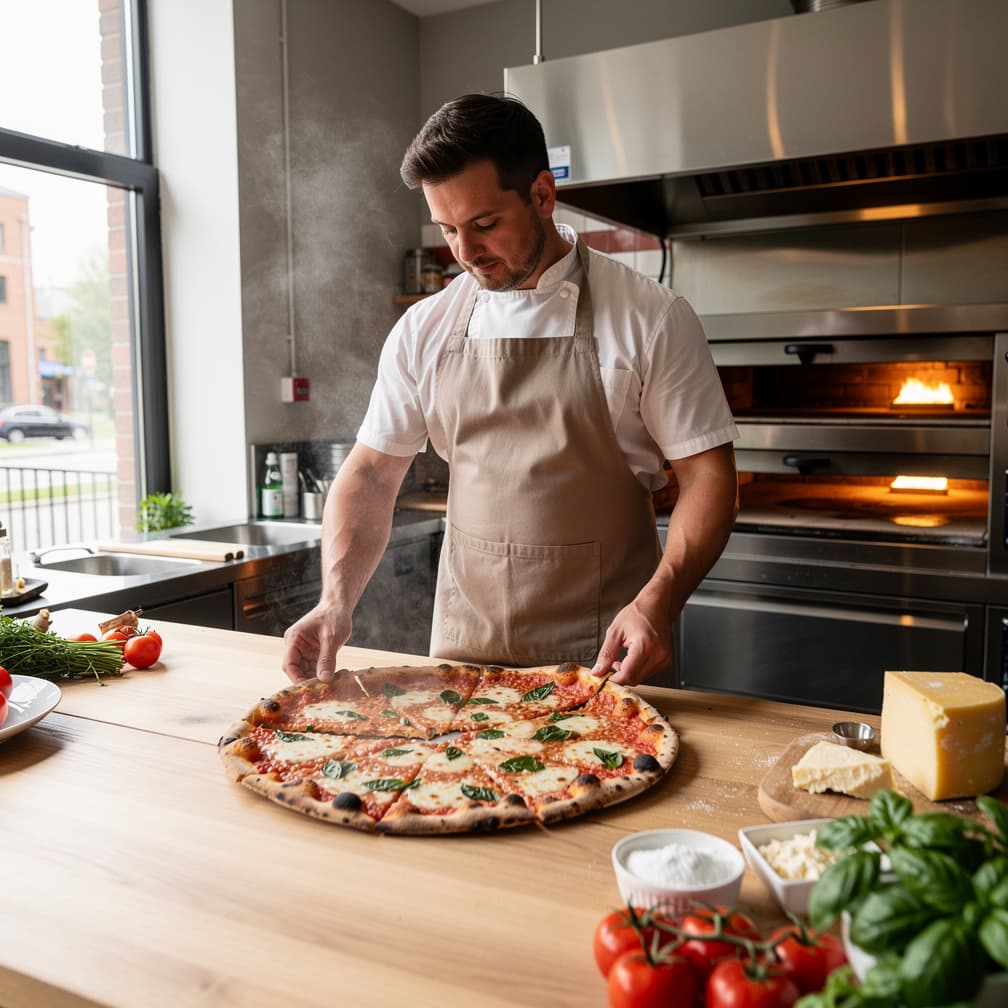

Grease collects in the hood over a long service, and a single flare-up can take the oven, the ceiling, and a week of orders with it. The expensive part is rarely the equipment. A dark kitchen in Manchester still owes rent, payroll, and the invoice for dough that never got used, which is the gap pizza shop insurance in Manchester exists to close. Your lease already names who repairs what and who carries which limit, so read it before you shop. Commercial Property is usually the first line an owner tests, and the deductible comes off your side of the loss before anything moves. Ask what it would take to reopen the line, then work backward to a limit that matches. Everything below starts from that question.
What Makes Manchester Different
Every delivery mile you add is a priced exposure, and the radius on your website is a rating fact. Vehicle count, driver ages, and how far a run goes all move the auto number, sometimes a lot. Owners underestimate this because the car looks cheap and the claim does not. Two shops with identical kitchens and different delivery radii are not the same submission to an underwriter. Decide what your delivery footprint in Manchester really is before you describe it, then describe it accurately. Shrinking the radius is a legitimate way to cut cost, and it is a business decision rather than a paperwork one. Ask each carrier in New Hampshire what a quote looks like at your current radius and at a tighter one. Numbers make that trade-off visible in a way opinions do not.
Local Risk Factors in Manchester
Before the first hard freeze, walk the building with a wrench and a plan. Know where the main shutoff is, know which lines run through an unheated wall, and know who on your crew can kill the water in the middle of the night. That knowledge is the difference between a mop and a rebuild. Roof loads, ice dams, and a parking lot nobody salted are the other three items on that walk, and each of them is a claim in a different section of the form. A Manchester shop that writes the plan down has something to show an adjuster and something to hand a new manager. Ask each carrier in New Hampshire what the policy expects you to do when the shop is closed for a stretch.
What Coverage Does a Pizza Shop in Manchester Need?
General Liability
Landlords, catering clients, and delivery platforms all ask to see this one before they do business with you. It is the line that generally answers a customer's bodily injury or property damage claim: a slip near the pickup counter, a burn from a hot box, a spill across a dining room table. Employee injuries and vehicle accidents sit outside it.
Example: A customer carries a hot pizza past a toddler, the box tips, and a burn claim follows the same week. General Liability might answer the medical demand and the defense costs, subject to your limit.
Commercial Property
Ovens, the hood, the walk-in, the register, the tenant improvements you paid for, and the stock in the cooler are the money inside your four walls. This line can help cover sudden damage to them from fire, storm, theft, or vandalism, subject to your deductible. Flood typically sits outside it, and equipment that simply wears out usually does too.
Example: A fryer flare-up scorches the hood and the ceiling, and the kitchen closes for two weeks of repairs. Commercial Property could respond to the equipment and the building damage, depending on your valuation basis.
Commercial Auto
Personal auto policies commonly exclude driving for pay, which is the hole every delivery shop drives through. This line is meant for the vehicles the shop owns and the drivers it lists, and it could respond when one of them causes injury or damage on a run. Drivers using their own cars are a separate arrangement worth asking about by name.
Example: A driver in Manchester runs a light with four orders in the back and clips a parked car. Commercial Auto may pick up the third-party damage and the liability that follows, once the deductible is met.
Workers Compensation
Where General Liability stops at the customer, this line starts with your crew. Burns, cuts, slips on a greased floor, and a back strain lifting dough are the claims a kitchen actually files, and it could help cover medical costs, a portion of lost wages, and rehabilitation. Rules and thresholds vary by state, so confirm what applies to you.
Example: A new hire reaches into a deck oven without a mitt and burns a forearm badly enough for stitches and a week off. Workers Compensation is typically built to handle the medical bill and part of the lost wages.
How Much Does Pizza Shop Insurance Cost in Manchester?
Pizza Shop Insurance is a bundle of separate policies, priced separately. The ranges below are typical figures for Manchester for each line, except workers compensation, which is rated per $100 of payroll; a quote prices each one against your own operations.
| Coverage | Typical range | What moves your price |
|---|---|---|
| General Liability Insurance | $85 - $250 per month | Industry and risk classification, annual revenue, number of employees |
| Commercial Property Insurance | $150 - $470 per month | Building value and construction type, roof age and condition, fire protection class |
| Commercial Auto Insurance | $230 - $650 per month | Fleet size and vehicle types, driver records and experience, coverage limits and deductibles |
| Workers Compensation Insurance | $0.75 - $2.74 per $100 of payroll | Employee classification codes, total annual payroll, experience modification rate |
Prices shown are general estimates, not guaranteed rates or quotes. Your actual premium will depend on the insurer, coverage selected, business details, location, claims history, and other underwriting factors. Learn about our pricing methodology.
What Are the Insurance Requirements for a Pizza Shop in Manchester?
Workers' comp is generally required once you have your first employee. New Hampshire generally requires employers to carry workers' compensation at that point. Common exemptions include sole proprietors, partners, and LLC members. Confirm current thresholds with your state's workers' compensation agency before you hire.
State auto liability minimums apply to business vehicles. New Hampshire's minimum auto liability limits are $25,000/$50,000/$25,000 (bodily injury per person / per accident / property damage). Contracts and lenders often require more than the state floor.
Flood damage is typically excluded from standard policies. Standard commercial property and builders-risk-type policies typically exclude flood damage. Flood exposure varies address by address, so check your premises in FEMA's Flood Map Service Center before deciding; if you sit in a mapped flood zone, a separate policy through the National Flood Insurance Program is the usual starting point.
Where to verify licensing and coverage rules. The New Hampshire Insurance Department publishes consumer guidance and current insurance requirements for New Hampshire businesses. When a contract or lease demands specific wording, the New Hampshire Insurance Department's guidance is the authoritative place to check.
Get Your Pizza Shop Quote in Manchester
Compare rates from multiple carriers. Free quotes, no obligation.
Operating in Manchester
- Hood cleaning sits on a schedule somebody has to keep, and the receipt is the proof. An underwriter who asks for it and gets nothing has learned something about your shop before quoting a single line.
- A landlord can hold the keys to a Manchester storefront until the certificate names the right party with the right wording. That is a wait measured in days, and rent usually starts anyway.
- Delivery drivers use their own cars in most small shops, and a Manchester shop still owns the exposure when one of them rear-ends someone on a run.
- The busiest hour is when the mop bucket sits out, the counter fills, and a spill goes unnoticed. Claims in this trade follow foot traffic more than bad luck.
How to Buy: Advice for Manchester Owners
Certificates are a process, not a document, and the process is what you should shop for. Ask each carrier how a certificate gets issued, who can request one, how fast an additional-insured endorsement can be added, and whether the wording is blanket or scheduled. A blanket form saves you a call every time a catering client or a delivery platform onboards; a scheduled form means a call each time. Keep a running list of every holder your Manchester shop has, with renewal dates beside them, because switching carriers means reissuing all of them at once. General Liability is usually the line named on those requests, and Commercial Property shows up when a lessor wants a loss payee on the oven. The New Hampshire Insurance Department publishes consumer guidance on certificates of insurance and what they do and do not prove. Compare participating carriers on that service reality as well as on price, since one of them you live with daily.
FAQ
Pizza Shop Insurance in Manchester: FAQ
Payroll by role, annual sales, square footage, seating count, delivery radius, a vehicle list with drivers, an equipment schedule with model numbers, and five years of loss runs. Missing pieces become estimates, and estimates get corrected at audit, usually in the carrier's favor. Getting the loss runs from a prior insurer takes longer than owners plan, so start there. Identical inputs to every carrier quoting your Manchester shop is the only way a comparison means anything.
It can, and onboarding often stalls until the wording matches its template. An additional-insured endorsement is coverage; the certificate is only the receipt. Blanket wording adds parties automatically as contracts require it, while a scheduled form means calling your carrier each time. Ask which one a quote includes before you sign, since the difference is invisible at purchase and constant afterward. A Manchester shop with several platform contracts feels that difference weekly.
Rarely, and assuming so is how shops end up personally exposed. Personal auto forms commonly exclude business use, which means a denial on the driver's side can land the demand on yours. Hired and non-owned auto coverage exists for exactly that arrangement, and each carrier treats it differently. Run motor vehicle records before hiring, keep them current, and ask in writing what your policy expects from the driver's own limits.
It starts with a call, a claim number, and an adjuster who has never seen your kitchen. What you can show decides the rest: dated photos, model numbers, purchase records, hood cleaning receipts, and payroll. Commercial Property may respond to the building damage and the equipment, subject to your deductible and valuation basis. Whether it rebuilds at replacement cost or actual cash value is a wording choice you made at purchase, not after.
Only if you can write that check during your worst month. A higher deductible pulls the premium down and moves the small losses onto you, which works right up until two of them land in one quarter. Look at cash on hand, not at the average year. Ask carriers quoting your Manchester shop for two deductible levels so the trade-off arrives as a number rather than a feeling.
Indirectly. Hillsborough County has about 11,000 businesses, and a market that size tends to bring professionalized landlords and contract templates naming higher limits than a small landlord would. Rating still keys off your payroll, sales, vehicles, and claims history. The market mostly changes what your counterparties demand, and what they demand can change the limit you end up buying.
Sources
- 1.U.S. Census Bureau, County Business Patterns (2022), Hillsborough County(Hillsborough County has about 11,000 business establishments.)
- 2.New Hampshire Insurance Department(New Hampshire Insurance Department publishes consumer guidance for insurance buyers.)
- 3.FEMA / FloodSmart(Flood coverage is typically purchased separately; FEMA administers the National Flood Insurance Program.)


