







































Updated July 16, 2026

Roofing Insurance in New Jersey
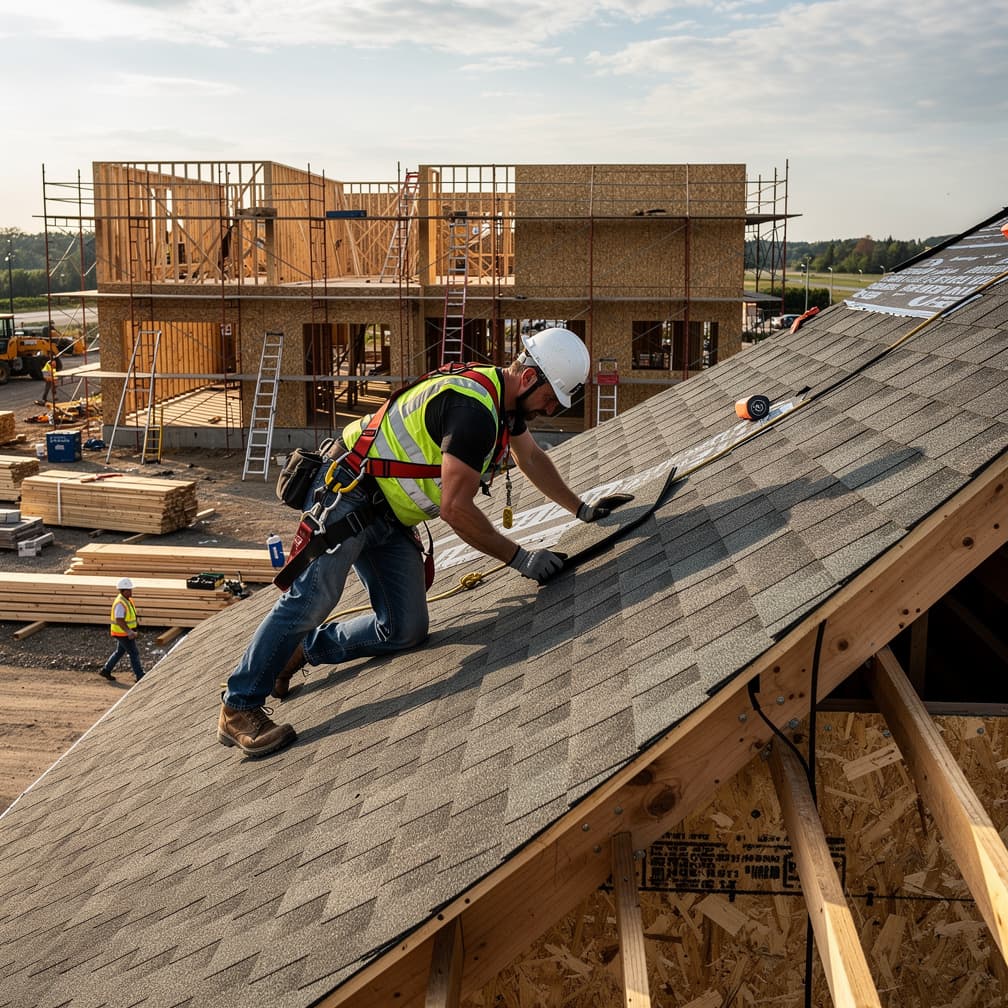
Roofing crews in New Jersey work in a market shaped by hurricane exposure, flooding, Nor'easters, and a dense mix of residential and commercial jobs. A roofing insurance quote here usually has to do more than check a box on a contract. It needs to fit how your crews move between towns, stage materials on active jobsites, and protect customers when weather turns quickly. In a state where workers' compensation is required for businesses with one or more employees and many landlords ask for proof of general liability, the quote process often starts with certificates, limits, and jobsite details.
If you run a small roofing firm, use subcontractors, or keep tools and mobile property in trucks or trailers, the right policy structure can help you line up with lease terms, jobsite requirements, and vehicle rules before work begins. New Jersey roofing insurance averages $252 to $1,007 per month. With roughly 1,100 roofing businesses operating across the state and annual revenues spanning $250K to $2.5M, coverage needs vary sharply from one operation to the next. That revenue spread tells you a two-person crew and a twenty-person operation will walk away with very different policies.
Climate Risk Profile
Natural Disaster Risk in New Jersey
Understanding climate-related risks helps determine appropriate insurance coverage levels.
Hurricane
High
Flooding
High
Nor'easter
High
Severe Storm
Moderate
Expected Annual Loss from Natural Hazards
$1.6B
estimated economic loss per year across New Jersey
Source: FEMA National Risk Index
Risk Factors for Roofing Businesses in New Jersey
- New Jersey hurricane exposure can create roofing liability, property damage, and catastrophic claims when high winds or debris affect active jobsites.
- Flooding and Nor'easter conditions can interrupt roofing work, damage tools, mobile property, and contractors equipment, and increase the chance of third-party claims on site.
- Severe storm conditions across New Jersey can lead to slip and fall incidents, customer injury, and legal defense costs when a roof replacement is underway.
- Dense commercial corridors in New Jersey can raise the impact of vehicle accident, hired auto, and non-owned auto exposures for crews moving between jobs.
- Active jobsite conditions in New Jersey can increase bodily injury risk, especially where materials, ladders, and equipment are staged near customers or other trades.
How New Jersey compares with the national baseline
Uninsured drivers
14.9% vs 11.6% baseline
About 14.9% of New Jersey drivers are estimated to be uninsured, above the 11.6% average across states.
Fatal crashes per 100 million miles
0.84 vs 1.33 baseline
New Jersey sees about 0.84 fatal crashes per 100 million miles driven, below the national average of 1.33.
Property crime per 100,000 residents
1,510 vs 2,200 baseline
Property crime in New Jersey runs below the national average, at 1,510 vs 2,200 incidents per 100,000 residents.
Blue bar: New Jersey. Gray line: national baseline.
How Much Does Roofing Insurance Cost in New Jersey?
Roofing Insurance is a bundle of separate policies, priced separately. The ranges below are typical figures for New Jersey for each line, except workers compensation, which is rated per $100 of payroll; a quote prices each one against your own operations.
| Coverage | Typical range | What moves your price |
|---|---|---|
| General Liability Insurance | $460 - $1,475 per month | Industry and risk classification, annual revenue, number of employees |
| Workers Compensation Insurance | $0.75 - $2.74 per $100 of payroll | Employee classification codes, total annual payroll, experience modification rate |
| Commercial Auto Insurance | $390 - $1,250 per month | Fleet size and vehicle types, driver records and experience, coverage limits and deductibles |
| Inland Marine Insurance | $55 - $230 per month | Total insured value of the scheduled property, type and age of the equipment, where it is stored and how far it travels |
| Commercial Umbrella Insurance | $140 - $550 per month | Umbrella limit requested, limits carried on the underlying policies, loss history on those underlying policies |
Prices shown are general estimates, not guaranteed rates or quotes. Your actual premium will depend on the insurer, coverage selected, business details, location, claims history, and other underwriting factors. Learn about our pricing methodology.
What New Jersey Requires for Roofing Insurance
Non-compliance can result in fines, loss of contracts, and personal liability:
- Workers' compensation is required in New Jersey for businesses with 1+ employees, with exemptions for sole proprietors and partners.
- Commercial auto minimum liability in New Jersey is $35,000/$70,000/$25,000 (raised effective January 1, 2026), so roofing businesses with vehicles should confirm limits before jobs begin.
- Most commercial leases in New Jersey require proof of general liability coverage, which can affect how quickly a roofing contractor can secure space or renew it.
- Roofing businesses should be prepared to show certificates of insurance before starting work, especially for general liability, workers' compensation, and commercial auto.
- If you use subcontractors, job sites may ask how coverage is structured so liability, workplace injury, and equipment protection are clearly documented.
- Because New Jersey insurance requirements can vary by landlord, municipality, and contract, policy limits and endorsements should be checked against each job's certificate request.
| Requirement | What New Jersey law says |
|---|---|
| Auto liability minimums | $35,000/$70,000/$25,000 (bodily injury per person / per accident / property damage). These floors apply to personal and business vehicles alike; lenders and contracts often require more. |
| Workers compensation | Generally required once you have your first employee. Some roles are exempt, so confirm current thresholds before you hire. |
| Where to verify | New Jersey Department of Banking and Insurance publishes current requirements, consumer guides, and license lookups. |
Get Your Roofing Insurance Quote in New Jersey
Compare rates from multiple carriers. Free quotes, no obligation.
Common Claims for Roofing Businesses in New Jersey
A wind-driven storm in coastal New Jersey dislodges materials from a roof replacement, leading to property damage and a third-party claim from a neighboring business.
A customer or visitor slips near a staging area during a roofing project, which can trigger a slip and fall claim with legal defense and possible settlement costs.
A crew's tools and mobile property are damaged while traveling between jobs, delaying work and raising replacement concerns for equipment in transit.
Preparing for Your Roofing Insurance Quote in New Jersey
Your business name, locations you serve in New Jersey, and whether you operate as a solo roofer, crew-based contractor, or subcontractor-heavy operation.
Crew count, payroll, and whether you have one or more employees so workers' compensation needs can be reviewed correctly.
Vehicle details, including owned, hired auto, and non-owned auto use, plus any trailers, trucks, or vans tied to roofing work.
A list of tools and mobile property you want included, along with any certificate or limit requirements from landlords or job sites.
Coverage Considerations in New Jersey
- General liability insurance can help cover third-party injuries and property damage that arise on active roofing sites, including slip and fall incidents and advertising injury claims.
- Workers' compensation insurance should be ready for New Jersey crews with one or more employees, addressing workplace injuries, medical costs, and rehabilitation within the policy structure.
- Inland marine insurance can help protect your tools and mobile property when materials move between trucks, trailers, and job locations.
- Umbrella coverage may be worth reviewing for larger projects where underlying policies need extra protection against catastrophic claims and lawsuits.
What Happens Without Proper Coverage?
Roofing claims do not always come from dramatic accidents. Many start with routine production pressure: a crew rushes to dry in before weather changes, debris shifts during cleanup, materials are staged where customers still need access, or a driver backs a trailer in a tight space and damages someone else’s property. Without the right coverage in place, a normal workday problem can turn into a direct hit to cash flow, contract relationships, and your ability to keep jobs moving.
The uncomfortable part is how the exposures stack. Water intrusion after a failed dry-in does not stay a property problem; it becomes a dispute about workmanship, a strained relationship with the general contractor who recommended you, and sometimes a withheld payment on the whole project. A hurt crew member is more than a claim: the schedule slips, other workers absorb overtime, and the customer waiting on completion starts calling. Claims in this trade rarely stay in one lane, which is why the policies need to work as a set rather than as purchases made one renewal at a time.
Proof of coverage is also a ticket to work. General contractors, property managers, and public bids treat certificates, limits, and workers compensation documentation as a gate, and a rejected packet can cost you a job you already priced. Before you renew or bid the next project, check your certificates, limits, vehicle schedule, payroll, and subcontractor paperwork so a gap shows up in a file check instead of after a claim.
Recommended Coverage for Roofing Businesses
Based on the risks and requirements above, roofing businesses need these coverage types in New Jersey:

General Liability
Essential coverage for every business, protect against third-party bodily injury, property damage, and advertising claims.

Workers Compensation
Help cover your employees' medical expenses and lost wages for work-related injuries and illnesses.

Commercial Auto
Protect your business vehicles and drivers with comprehensive commercial auto coverage.

Inland Marine
Protect tools, equipment, and goods in transit or stored at locations away from your primary premises.

Commercial Umbrella
Extend your liability limits beyond your primary policies for extra protection against catastrophic claims.
Roofing Insurance by City in New Jersey
Insurance needs and pricing for roofing businesses can vary across New Jersey. Find coverage information for your city:
Insurance Tips for Roofing Owners
Separate your payroll and job duties carefully before quoting, because office staff, sales staff, working supervisors, and field crews create different workers compensation considerations.
List every vehicle your company uses for estimates, material runs, crew transport, and towing, so your commercial auto quote matches daily operations instead of a partial schedule.
Ask how tools, ladders, compressors, and other mobile equipment are covered while stored in trucks, trailers, and temporary jobsites, not only at your main location.
Compare liability limits against the requirements in your customer contracts and subcontract agreements, especially if you work for general contractors or commercial property owners.
If you use subcontractors during busy seasons or storm response, tighten your certificate collection process and understand how uninsured subs could affect your claim exposure.
Bring sample contracts to the quote conversation so you can check additional insured, waiver, and higher-limit requests before signing work that changes your risk.
Revisit your coverage whenever your operation shifts from residential replacements into commercial repairs, service work, or emergency tarping, because the exposure pattern changes with the workflow.
FAQ
Frequently Asked Questions About Roofing Insurance in New Jersey
A quote can be built around general liability, workers' compensation, commercial auto, inland marine, and umbrella coverage. For roofers, the quote usually focuses on third-party claims, property damage, and tool protection that come up during active projects.
Roofing insurance cost varies based on crew size, payroll, vehicle use, jobsite exposure, subcontractor setup, and the limits you choose. The final price depends on the details in your application.
Many commercial leases ask for proof of general liability coverage, and job sites often request certificates before work starts. Clients may also want to see workers' compensation, commercial auto, and evidence that your policy limits match the contract terms they expect you to meet.
Most roofing businesses in New Jersey start by reviewing liability, workers comp, and equipment protection. Depending on how you work, you may also want to add umbrella coverage for larger claims that exceed your underlying policy limits.
Have your business details, crew count, payroll, vehicle list, subcontractor use, job types, and equipment inventory ready.
General liability, workers compensation, commercial auto, and inland marine form the base, with a commercial umbrella added as contracts get larger or loss potential climbs past primary limits. Which policy leads depends on whether certificates, crew size, or mobile equipment is your biggest pressure point.
Because the work itself is the hazard: height, ladders, bundles, and repetitive lifting in changing weather. Most states also require it once you have employees. Match payroll and job duties accurately by role and account for any subcontracted labor so the policy reflects how your field operation actually runs.
That is what it is designed for: third-party property damage or bodily injury tied to your jobsite operations, subject to the policy terms. Make sure the quote describes your real mix of work, because a policy written around repairs only can complicate a claim that arises on a full replacement.
Updated July 16, 2026