







































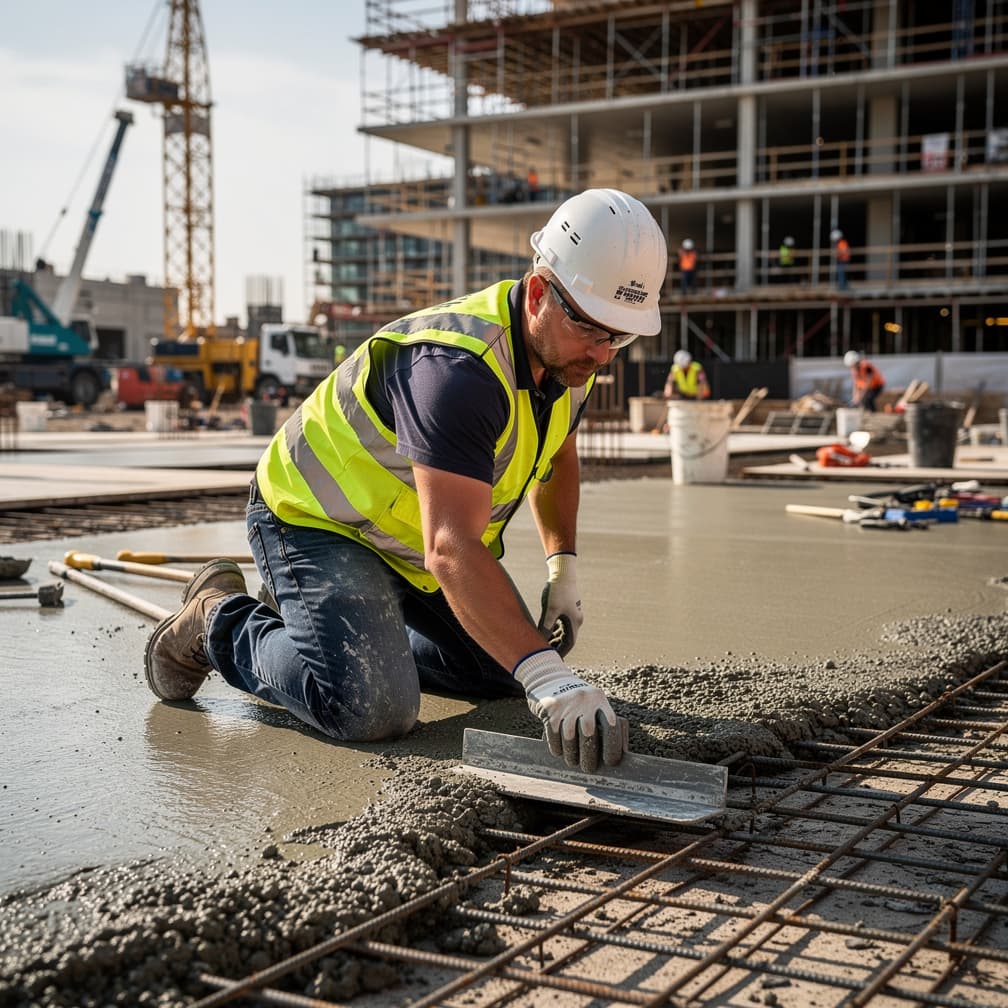

A fresh pour stays soft long enough for a curious homeowner to walk out and look at it, and the fall that follows becomes your problem rather than theirs. Concrete contractor insurance in Buffalo is built around those moments: the slip on a curing slab, the finisher hurt lifting a screed, the trailer that comes loose between jobs. Most of the paper you sign before a pour already tells you which limits to buy, though the certificate never explains why. The harder question arrives two years later, when a driveway settles and cracks and the owner wants the whole thing torn out. Completed work disputes take longer and cost more than almost anything that happens on pour day. What follows lays out what concrete crews commonly carry, what the published ranges look like, and where New York rules come into it.
What Makes Buffalo Different
Wind and rain move forms, and moved forms move the work you thought was finished. Rebar left standing through a storm becomes a hazard to anyone walking past your open site. A neighbor's fence takes the plywood that used to be your formwork, and that is a claim. Securing a site before a storm week takes an hour, and an adjuster will ask whether you did. Photographs of a secured site have settled more arguments than any policy wording ever has. Weather delay itself is rarely an insured loss, which is worth confirming with participating carriers in New York. General Liability sits on the third-party side of that line, so the fence is where it might respond. Know which side of the line each loss falls on before you compare quotes in Buffalo.
Local Risk Factors in Buffalo
Before you bid a job on low ground in Buffalo, look at how water leaves the site, because that answer decides what a storm costs you. A flooded pad means pumping, drying, regrading, and a schedule you cannot recover, and none of that is a claim. Flood is excluded from standard property coverage and gets bought separately, often through the federal program, so it is a decision rather than an oversight. Tools and equipment carried on a schedule may be handled differently, and the form language about water is where the difference lives. Ask a participating carrier in New York how a submerged trailer gets treated, then get that answer in writing before you need it.
What Coverage Does a Concrete Contractor in Buffalo Need?
General Liability
Builders and property owners ask for this one by name before a truck reaches the pad. It is the line that might answer when a visitor slips on a curing slab, or when moving forms and equipment take out a fence, an irrigation line, or the curbing beside your work. Redoing your own cracked slab typically sits outside it.
Example: A homeowner walks out to admire a fresh driveway, steps onto the edge before it cures, and lands hard; General Liability can help cover the injury claim and the defense that follows it.
Workers Compensation
Finishing, cutting, and lifting are where a concrete crew gets hurt, and this line is rated for exactly that, priced per $100 of payroll. Medical care and lost wages for an injured employee are what it is meant to address. Owners and subcontractors get treated differently, and thresholds vary from state to state.
Example: A finisher lifts a form panel wrong during a slab pour and cannot work for a month; Workers Compensation is generally intended to take the medical bills and part of the missing wages.
Commercial Auto
Personal policies commonly exclude business use, which can leave the truck hauling mix, forms, and a loaded trailer unprotected at the worst possible moment. This line gets rated on the vehicles, the towing, the mileage, and the drivers, and it may respond when your truck injures someone or damages property on the road.
Example: A trailer of forms comes loose on the drive between two pours in Buffalo and clips the car behind it; Commercial Auto is where those injury and repair demands would land.
Tools & Equipment (Inland Marine)
Tools and mobile equipment spend more hours in transit or parked at a jobsite than under anyone's eye. Scheduled values then decide what a theft or a loss is worth: the mixer, the trowel machine, the saws, the vibrators. Rented equipment is often handled separately, and anything left off the schedule usually stays off the payment.
Example: A trailer is emptied overnight at an open jobsite and the saws and trowel machine are gone by first light; scheduled equipment coverage could make the replacement a matter of days rather than months.
Commercial Umbrella
When a subcontract names a limit higher than your underlying policy carries, this is usually the cheaper way to reach the number. It sits above General Liability or the auto limit and follows those terms, so an exclusion underneath stays an exclusion. It is built for the rare large claim rather than the routine one.
Example: A multi-vehicle accident on the way to a pour produces injury demands well past the underlying auto limit; an umbrella layer might pick up what sits above it, subject to the terms.
How Much Does Concrete Contractor Insurance Cost in Buffalo?
Concrete Contractor Insurance is a bundle of separate policies, priced separately. The ranges below are typical figures for Buffalo for each line, except workers compensation, which is rated per $100 of payroll; a quote prices each one against your own operations.
| Coverage | Typical range | What moves your price |
|---|---|---|
| General Liability Insurance | $290 - $875 per month | Industry and risk classification, annual revenue, number of employees |
| Workers Compensation Insurance | $0.75 - $2.74 per $100 of payroll | Employee classification codes, total annual payroll, experience modification rate |
| Commercial Auto Insurance | $300 - $900 per month | Fleet size and vehicle types, driver records and experience, coverage limits and deductibles |
| Inland Marine Insurance | $65 - $270 per month | Total insured value of the scheduled property, type and age of the equipment, where it is stored and how far it travels |
| Commercial Umbrella Insurance | $110 - $370 per month | Umbrella limit requested, limits carried on the underlying policies, loss history on those underlying policies |
Prices shown are general estimates, not guaranteed rates or quotes. Your actual premium will depend on the insurer, coverage selected, business details, location, claims history, and other underwriting factors. Learn about our pricing methodology.
What Are the Insurance Requirements for a Concrete Contractor in Buffalo?
Workers' comp is generally required once you have your first employee. New York generally requires employers to carry workers' compensation at that point. Common exemptions include sole proprietors of one-person businesses and some ministers and clergy. Confirm current thresholds with your state's workers' compensation agency before you hire.
State auto liability minimums apply to business vehicles. New York's minimum auto liability limits are $25,000/$50,000/$10,000 (bodily injury per person / per accident / property damage). Contracts and lenders often require more than the state floor.
Where to verify licensing and coverage rules. The New York State Department of Financial Services publishes consumer guidance and current insurance requirements for New York businesses. When a contract or lease demands specific wording, the New York State Department of Financial Services's guidance is the authoritative place to check.
Get Your Concrete Contractor Quote in Buffalo
Compare rates from multiple carriers. Free quotes, no obligation.
Operating in Buffalo
- About 84 concrete contractors work in Erie County, so a builder who opens your file and finds an expired certificate already has somebody else's number sitting in the same folder.
- A homeowner's fence, sprinkler heads, and lawn all sit inside the swing radius of your equipment, and every one of them gets billed to you when a skid steer clips it.
- Pumping concrete over a wall or a roofline in Buffalo puts your hose above property nobody quoted on, and a blowout or a drip lands on finished surfaces below it.
- Cold snaps and heat waves both push pours into conditions the schedule picked rather than the crew, and the cure defects argued about months later started on exactly those days.
How to Buy: Advice for Buffalo Owners
Certificates travel further than your crew does, and they get read by people who have no reason to call you first. Set up the ones you use most before the season loads up: the builder, the property manager, the permit desk. Ask a participating carrier how certificate requests are handled and how additional insured status gets added to General Liability, since that endorsement is what most site rules turn on. Find out whether the same holder has to appear on a Commercial Umbrella as well. Keep copies of expired certificates for finished jobs, because a cracked slab argument arrives long after the folder closes. Check the New York State Department of Financial Services's guidance before deciding what proof to keep. Then compare what participating carriers in New York can endorse, not only what they charge.
FAQ
Concrete Contractor Insurance in Buffalo: FAQ
Payroll leads, because the hands finishing, cutting, and lifting carry the injuries. Then come the vehicles and how far they haul, the value of the equipment riding on the trailer, the limits your contracts demand, the deductible you pick, and your claims history. Work type matters as well, since a highway pour and a backyard patio are different exposures. Two contractors in Buffalo can quote differently on payroll alone.
General contractors, property owners, property managers, and permit desks all can, and each may want different wording on the page. A builder in Buffalo can require additional insured status and a waiver of subrogation before your truck reaches the pad. Homeowners rarely ask, which makes it easy to let a policy drift out of date between commercial jobs. The certificate is proof; the limits behind it are what a claim tests.
Usually not. Redoing your own defective work is treated as workmanship in most liability forms, which makes it a warranty question rather than a coverage one. What changes the answer is what the failed slab damaged next: a garage floor, a fence, irrigation lines, or a parked vehicle. That resulting property damage is where General Liability may come into play, subject to the form and its exclusions.
It can be both. A visitor in Buffalo who steps onto curing concrete and falls is a third-party injury, the classic General Liability scenario, and the policy is intended to take the medical demand and the defense that follows. Your side of it is the deductible and, next term, the loss history. Barricades and a written warning to the owner cut the odds and help the file if it happens anyway.
It extends your policy to name the builder as an insured for claims arising out of your work, which is why the contract demands it. That takes an endorsement, not a checkbox, so it has to be requested and issued. Primary and noncontributory language often rides alongside, pushing your policy ahead of everybody else's. Both can affect how a submission gets priced, so raise them before you bind rather than after.
That scenario is what Inland Marine is meant for: tools, mobile equipment, and contractors equipment away from a fixed location. Whether a theft from an open trailer qualifies depends on the schedule, the values you listed, and any locked-vehicle conditions in the form. Rented equipment is often handled separately, so ask about it specifically. Anything left off the schedule generally gets left out of the payment.
Sources
- 1.U.S. Census Bureau, County Business Patterns (2023), Erie County(Erie County has about 84 businesses in this trade's category (NAICS group 238110).)
- 2.New York State Department of Financial Services(New York State Department of Financial Services publishes consumer guidance for insurance buyers.)


