







































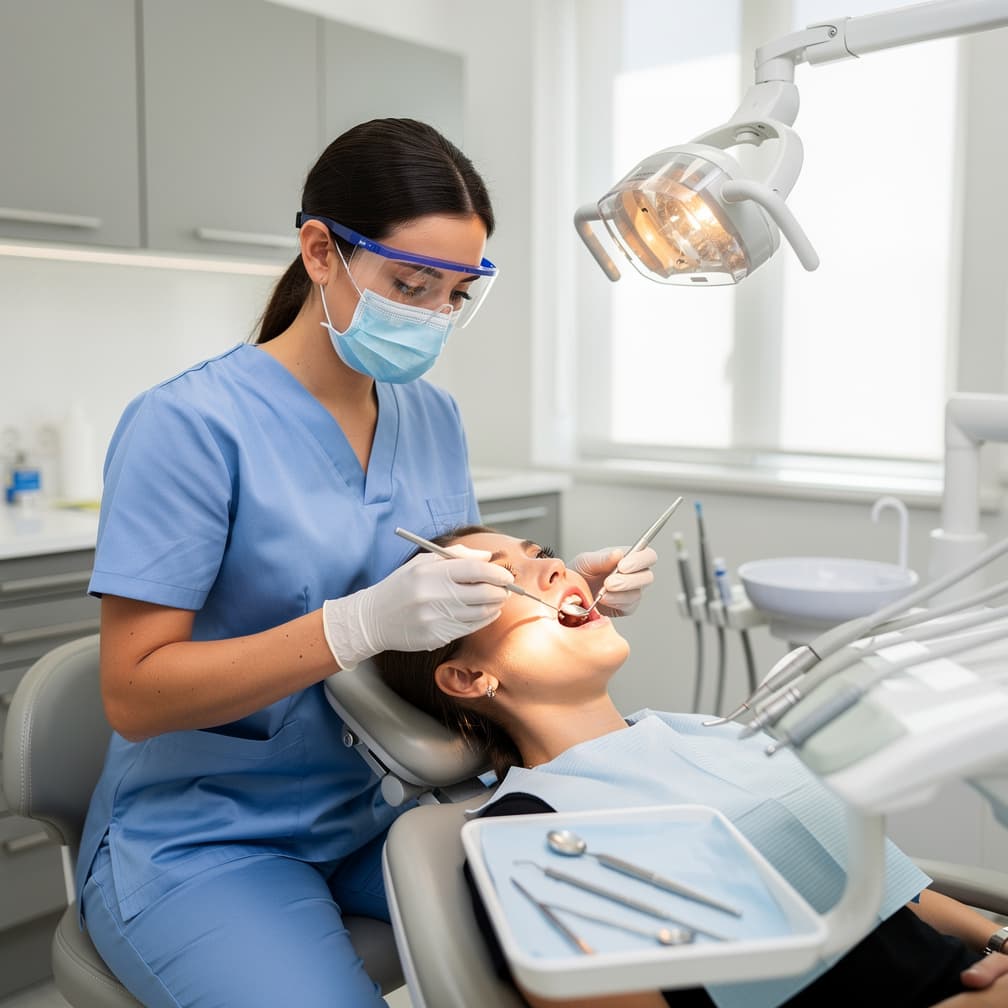

As a dental practice in New York, you carry three kinds of risk at once: what happens in the chair, what happens in the waiting room, and what happens on the server. A treatment allegation, a fall, and a records breach travel through different parts of a policy and get handled by different adjusters. Dental practice insurance in New York is the shorthand for that whole stack, and the stack is where owners lose track. Many owners find out which piece they skipped on the day a demand letter arrives. Payroll for hygienists and assistants drives one part of the cost; the equipment in your operatories drives another. Read the ranges below with your own staff list open, then compare quotes on identical limits rather than on price alone.
What Makes New York Different
Wages set the floor under one line of your policy, and nothing you do at the front desk changes that. In a market with about 61,500 businesses, hygienist and assistant pay climbs because every employer is hiring from the same short list. Your payroll base climbs with it, and the workers compensation premium gets calculated on that base at audit. You can hold headcount flat and still owe more at year end than the estimate said you would. Rent and build-out costs move the property side the same way, since replacing an operatory costs what local trades charge. A New York practice budgeting last year's premium against this year's payroll is budgeting a shortfall. Ask for the audit rules on every quote and find out when the true-up actually lands. The surprise is rarely the rate; the surprise is the base it gets applied to.
Local Risk Factors in New York
Hurricane closures arrive with notice and cost you anyway: the office boards up, the week's schedule empties, and staff are still owed while nobody sits in a chair. When wind finds the roof of a medical suite, water follows it down into the operatories, and imaging equipment tolerates neither. Commercial Property may respond to the wind damage and to what the wind let in, though storm surge arriving from outside the building is treated as flood and typically sits outside that form. That distinction settles more dental claims than any limit does, and it is worth reading before a season opens in New York. Ask which peril your deductible attaches to as well, since a named storm can carry a percentage deductible rather than a flat one, and on a rebuilt Kings County suite the difference is not small.
What Coverage Does a Dental Practice in New York Need?
Professional Liability
A patient alleges the treatment plan was wrong, the consent was never explained, or a finding on an image went unnoticed. That allegation is what Professional Liability exists for, and the form typically carries defense costs alongside any settlement. Ordinary premises injuries sit outside it, and so does anything a policy treats as intentional conduct.
Example: A crown fails and the patient's counsel argues the tooth underneath was never properly assessed; Professional Liability may answer the defense costs and whatever settles the file.
General Liability
Landlords and plan networks ask for General Liability by name before they hand over keys or list you on a panel. It is the third-party line: a patient who slips at the front desk, a visitor hurt by a toppling display, damage your practice does to someone else's property. Harm arising from treatment belongs on Professional Liability instead.
Example: A patient catches a heel on a lifting floor tile in the waiting room and fractures a wrist; the medical bills and the demand behind them are what General Liability is generally there to absorb.
Commercial Property
Flood is typically outside this form, and so is a compressor that simply wore out. What sits inside is sudden damage to the things a practice runs on: chairs, imaging units, sterilizers, cabinetry, and the build-out you funded rather than the landlord. Commercial Property gets rated on those values, so an outdated equipment list quietly underinsures the office.
Example: A storm opens the roof above two operatories in New York and rain reaches the cabinetry and a sensor overnight; Commercial Property might carry the repairs and the replacements.
Cyber Liability
Patient records, billing data, and the software running your schedule are the assets at stake here. Cyber Liability commonly addresses forensic work, patient notification, and the legal costs after a breach or a ransomware lockout, and some forms reach the income lost while systems are down. Social engineering, the wire sent to an impersonator, often needs its own endorsement.
Example: A staff member opens an attachment and the scheduling and imaging systems lock before a full day of appointments; Cyber Liability can help cover the response and the patients who need telling.
Workers Compensation
Where the liability lines answer to patients and third parties, this one answers to your own people: the hygienist with a needlestick, the assistant with a repetitive strain complaint, the front desk worker who slips on the same wet mat a patient does. Requirements vary by state, and the New York State Department of Financial Services publishes the current requirements for employers.
Example: A hygienist catches a stick during a cleaning and needs testing and follow-up visits; Workers Compensation is the line that typically picks up the medical care and the missed shifts.
How Much Does Dental Practice Insurance Cost in New York?
Dental Practice Insurance is a bundle of separate policies, priced separately. The ranges below are typical figures for New York for each line, except workers compensation, which is rated per $100 of payroll; a quote prices each one against your own operations.
| Coverage | Typical range | What moves your price |
|---|---|---|
| Professional Liability Insurance | $270 - $975 per month | The services you actually perform, annual revenue or billed fees, limit and retention selected |
| General Liability Insurance | $75 - $290 per month | Industry and risk classification, annual revenue, number of employees |
| Commercial Property Insurance | $180 - $650 per month | Building value and construction type, roof age and condition, fire protection class |
| Cyber Liability Insurance | $85 - $380 per month | Records held and how sensitive they are, annual revenue and industry, multi-factor authentication and backup practices |
| Workers Compensation Insurance | $0.75 - $2.74 per $100 of payroll | Employee classification codes, total annual payroll, experience modification rate |
Prices shown are general estimates, not guaranteed rates or quotes. Your actual premium will depend on the insurer, coverage selected, business details, location, claims history, and other underwriting factors. Learn about our pricing methodology.
What Are the Insurance Requirements for a Dental Practice in New York?
Workers' comp is generally required once you have your first employee. New York generally requires employers to carry workers' compensation at that point. Common exemptions include sole proprietors of one-person businesses and some ministers and clergy. Confirm current thresholds with your state's workers' compensation agency before you hire.
Flood damage is typically excluded from standard policies. Standard commercial property and builders-risk-type policies typically exclude flood. Given New York's coastal flood exposure, a separate flood policy is worth pricing; FEMA's National Flood Insurance Program is the usual starting point.
Where to verify licensing and coverage rules. The New York State Department of Financial Services publishes consumer guidance and current insurance requirements for New York businesses. When a contract or lease demands specific wording, the New York State Department of Financial Services's guidance is the authoritative place to check.
Get Your Dental Practice Quote in New York
Compare rates from multiple carriers. Free quotes, no obligation.
Operating in New York
- Your scheduling software knows who is coming in tomorrow, so a ransomware lockout means the front desk calls patients from memory and loses a week it never gets back.
- Equipment lessors want to be named on the policy before they finance a chair, and a New York practice waiting on that endorsement is waiting on the delivery too.
- A patient complaint usually arrives as a letter rather than a lawsuit, and many forms want notice of the circumstance before anything is filed. Sitting on it for a month hands the carrier a defense.
- Wet entry mats and a lobby full of people who came in from the rain make reception the busiest injury surface you own, and the maintenance log is what an adjuster reads afterward.
How to Buy: Advice for New York Owners
Bundling is convenient and it hides things. One monthly total for a dental office can wrap General Liability, property, and a cyber endorsement into a figure impossible to compare against anything. Ask for the split before you ask for the total, and make each carrier show the same lines at the same limits. Look at what the property piece assumes about your build-out and your equipment values, because that line is the one most often quoted on stale numbers. Read the deductible per line rather than as one figure, since a low premium often hides a deductible that eats every small claim. A quote for a New York practice built on last year's payroll and last year's equipment list describes a different office. The New York State Department of Financial Services publishes consumer guidance on comparing business policies. Take the split rather than the total to every participating carrier, and buy the structure you understand.
FAQ
Dental Practice Insurance in New York: FAQ
It happens, and more often after they leave than while they are there. The practice entity is commonly named alongside the treating dentist, which is why the entity's own limits matter. If the policy is claims-made, work done on your watch is still your file when a demand lands years later, so ask what happens to prior acts before anyone resigns.
It is rated per hundred dollars of payroll rather than as a flat monthly fee, so the figure moves with your roster and with the classification code assigned to each role. A hygienist, an assistant, and an office manager are not rated alike. Estimates get trued up at audit against what you actually paid, so an office that guesses low pays the difference later.
It shows a policy existed on the day it was issued, and little more. A certificate is a snapshot rather than a contract, and it cannot amend the policy behind it. If a landlord wants additional insured status or a waiver of subrogation, those have to be endorsed onto the policy itself. A line typed onto the certificate does not create them, so ask for the endorsement.
Landlords and property managers before a lease, plan networks during credentialing, equipment lessors before financing, and sometimes a staffing agency placing temporary hygienists. Each wants different wording, and one document rarely satisfies all of them. A practice in New York should keep a list of every holder and send the replacement to all of them at renewal, because nobody sends a reminder.
Standard property forms typically exclude flood, meaning water arriving from outside the building. That gets priced as its own decision, and a ground floor dental suite is exactly the layout where the gap bites, since a compressor, a vacuum pump, and cabinetry all sit low. Water escaping from a pipe inside your own suite is usually a separate question with a separate answer.
Wear and tear is typically excluded, so age by itself is not a covered cause. Equipment breakdown coverage is a separate conversation and might answer a sudden mechanical or electrical failure, though not a part that simply reached the end of its life. The days you cannot treat patients are a third question again, governed by business income terms rather than the property limit.
Sources
- 1.U.S. Census Bureau, County Business Patterns (2022), Kings County(Kings County has about 61,500 business establishments.)
- 2.New York State Department of Financial Services(New York State Department of Financial Services publishes consumer guidance for insurance buyers.)
- 3.FEMA / FloodSmart(Flood coverage is typically purchased separately; FEMA administers the National Flood Insurance Program.)


