







































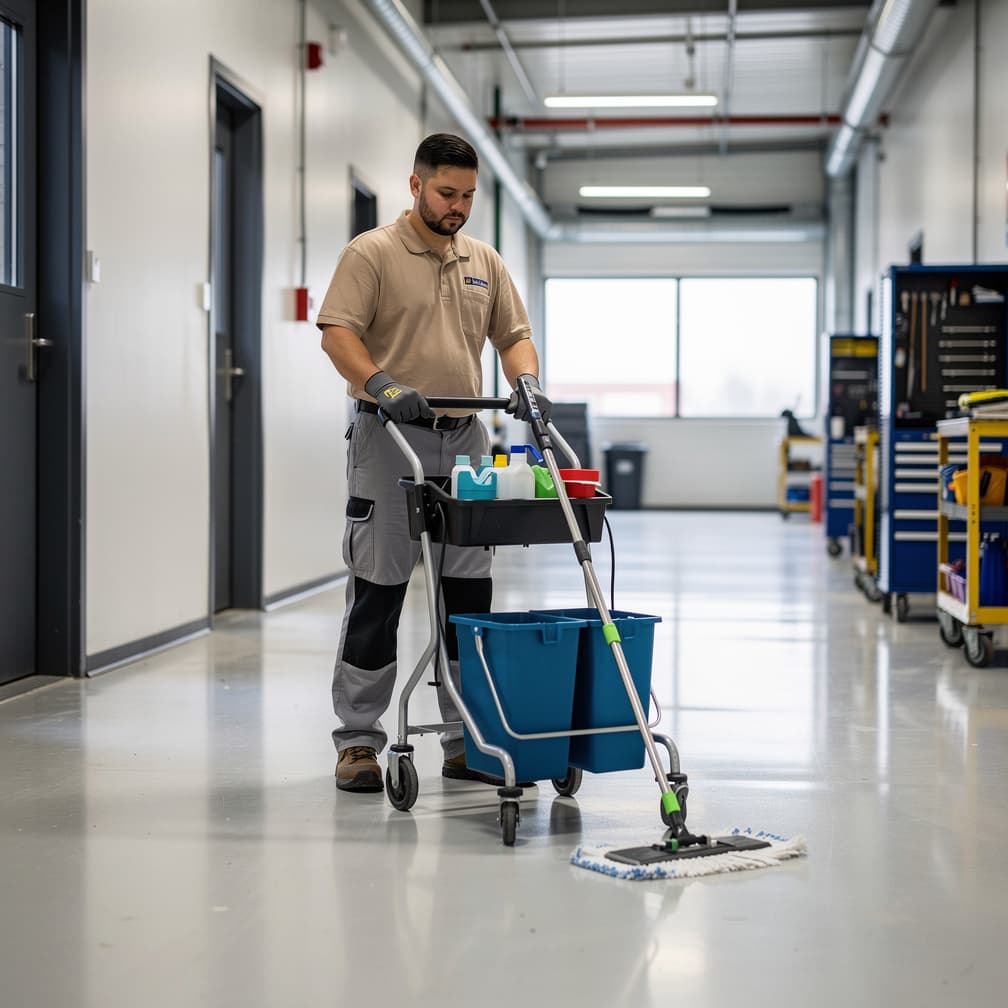

A wet floor sign tips over, and ten minutes later a visitor is on the tile with a broken wrist. Janitorial service insurance in New York exists for that moment, and for the cracked lobby glass, the scratched conference table, the wallet nobody can explain. Your crew works inside other people's buildings, often while those businesses are still running, so the person who gets hurt is rarely your employee. That single fact makes the liability question sharper for cleaning work than for trades that get an empty site and a locked door. Kings County has about 61,500 businesses, and any of them can ask for proof of coverage before handing over a key. The sections below walk through what cleaning contractors usually carry, what the published ranges look like, and where the honest gaps sit.
What Makes New York Different
Additional insured wording is the clause that quietly turns your policy into somebody else's backstop. In a metro market, one portfolio manager can control dozens of the doors you bid in New York. Reject their wording once and you can lose the whole portfolio instead of a single building. A certificate that says additional insured without the endorsement attached fails the first real test. That test arrives after a loss, when a claims department reads the form and not the summary. Ask a participating carrier in New York for the actual endorsement, then read what it names. Waivers of subrogation, notice of cancellation, and primary wording are the other three that stall bids. Each one is priceable, and the moment to price it is before you sign anything.
Local Risk Factors in New York
Plan the shutdown before a season does it for you: where do the machines go, and who moves them? Equipment left in a client's ground floor closet is equipment a New York crew does not control once a building is locked down. Storing it higher and drier costs nothing; discovering the gap afterward is expensive. Ask what a policy for a Kings County operation does with property away from your own premises, since that limit is often far smaller than the one at your address. A business owners policy can bundle the question, though the away-from-premises sub-limit is the number that settles it. Get that figure in writing before anyone boards a window.
What Coverage Does a Janitorial Service in New York Need?
General Liability
Landlords, property managers, and facility directors ask for this one by name before your crew gets access to a building. It is aimed at bodily injury and property damage your cleaning operations cause to other people: a visitor down on a wet floor, a client's glass panel cracked by a cart. Damage to the surface you were working on, and theft by an employee, typically sit outside it.
Example: A cleaner mops a lobby, a delivery driver walks through before the floor dries, and a wrecked knee becomes a demand letter; general liability may respond to the claim and the defense.
Commercial Property
Flood typically sits outside the standard form, which matters when your machines live at floor level. What the form does address is the fleet and supply side of the business: buffers, extractors, vacuums, ladders, and stock at the address you declare. Equipment kept in client closets or a vehicle usually falls under a much smaller limit, so ask where that line sits before you buy.
Example: A break-in at your storage unit clears out two scrubbers and a pallet of supplies overnight; commercial property can help cover replacement, though the values you declared decide the size of the check.
Workers Compensation
A cleaner slips off a step stool while changing a light diffuser and cannot work for weeks. This is the line built for that: medical costs and lost wages for your own employees, quoted against payroll rather than as a flat monthly figure. Requirements vary by state, and client contracts frequently ask for proof of it whatever the state rules happen to say.
Example: Two crew members walk a ride-on scrubber down a loading dock ramp and one wrenches a shoulder badly; workers compensation is generally where the medical bills and the lost time end up.
Business Owners Policy
Where general liability and commercial property are two contracts, this is one: a package built for smaller cleaning operations, with a single bill and a single certificate. Property caps and eligibility rules are the trade-off, and the aggregate limit is shared across everything inside. Read what the package does with equipment away from your premises before assuming it matches a standalone form.
Example: A fire in the supply room wrecks machines and injures a tenant in the New York unit next door; a business owners policy can help with both halves, subject to the limits inside the package.
How Much Does Janitorial Service Insurance Cost in New York?
Janitorial Service Insurance is a bundle of separate policies, priced separately. The ranges below are typical figures for New York for each line, except workers compensation, which is rated per $100 of payroll; a quote prices each one against your own operations.
| Coverage | Typical range | What moves your price |
|---|---|---|
| General Liability Insurance | $110 - $320 per month | Industry and risk classification, annual revenue, number of employees |
| Commercial Property Insurance | $80 - $260 per month | Building value and construction type, roof age and condition, fire protection class |
| Workers Compensation Insurance | $0.75 - $2.74 per $100 of payroll | Employee classification codes, total annual payroll, experience modification rate |
| Business Owners Policy Insurance | $140 - $390 per month | Annual revenue and industry class, building and contents values, square footage and building age |
Prices shown are general estimates, not guaranteed rates or quotes. Your actual premium will depend on the insurer, coverage selected, business details, location, claims history, and other underwriting factors. Learn about our pricing methodology.
What Are the Insurance Requirements for a Janitorial Service in New York?
Workers' comp is generally required once you have your first employee. New York generally requires employers to carry workers' compensation at that point. Common exemptions include sole proprietors of one-person businesses and some ministers and clergy. Confirm current thresholds with your state's workers' compensation agency before you hire.
Flood damage is typically excluded from standard policies. Standard commercial property and builders-risk-type policies typically exclude flood. Given New York's coastal flood exposure, a separate flood policy is worth pricing; FEMA's National Flood Insurance Program is the usual starting point.
Where to verify licensing and coverage rules. The New York State Department of Financial Services publishes consumer guidance and current insurance requirements for New York businesses. When a contract or lease demands specific wording, the New York State Department of Financial Services's guidance is the authoritative place to check.
Get Your Janitorial Service Quote in New York
Compare rates from multiple carriers. Free quotes, no obligation.
Operating in New York
- Clients want their exact legal entity on the certificate, and the name on the building is usually not it. One wrong line sends the document back and pushes your start date.
- You bill for cleaning space somebody else occupies, so when a New York client closes for repairs your revenue stops even though nothing of yours was touched.
- Restroom and spill cleanup puts your crew in contact with whatever is on the floor. An exposure incident starts as a payroll and reporting question long before it becomes a claim.
- The first post-construction job you accept is a different insurance class from the offices you already clean, and a carrier may decline to follow you there without notice.
How to Buy: Advice for New York Owners
Subcontracted crews are the gap owners discover late. If you send another company into a client building, their insurance and yours both matter, and the client will ask about both. Collect certificates from every sub before their first shift, and check the limits against your own contract. An uninsured sub can end up as your claim, and a carrier may treat their payroll as yours at audit. Workers Compensation audits catch exactly this, and the bill arrives after the work is finished. General Liability wording can also exclude work you do not perform directly, so read that section carefully. Check the New York State Department of Financial Services's guidance before deciding how to treat subcontractor payroll. Then bring the whole picture, subs included, to participating carriers in New York so nothing surprises you later.
FAQ
Janitorial Service Insurance in New York: FAQ
Nobody can quote it from the trade name alone. Cost follows payroll, the services you perform, your claims history, and the limits your contracts demand. A crew that strips and refinishes floors rates differently from one wiping desks. Workers compensation is quoted against payroll rather than as a flat figure, so headcount moves it every time you add a shift. The published ranges for cleaning work sit in the cost table further down this page.
That depends on wording most owners never read. General liability is aimed at damage to property you do not own, though damage to the very thing you were working on can land in an exclusion instead. A floor you were refinishing is the classic argument. Ask a carrier in New York how they treat damage to your own work, and get the answer before the invoice arrives.
Usually not on the liability side. General liability is built around bodily injury and property damage arising from your operations, and theft by an employee typically sits outside it. Some carriers offer a crime or employee dishonesty endorsement, and the limits there are often small. If a client raises the question during a bid, learn what your policy would really do before you promise anything.
It is an endorsement that extends your liability policy to another party, usually the building owner or the management company. They want it so a claim arising from your cleaning lands on your carrier instead of theirs. A certificate that mentions additional insured without the endorsement attached may not hold up when a claims department reads the file. Ask for the endorsement itself, not the summary.
That is a carrier question, and it is worth asking before you buy rather than after. Some issue certificates the same day through a portal you control; others take days and route the request through a service desk. Cleaning is bid in volume, so slow issuing costs contracts. If a New York property manager sets a start date within the week, a slow certificate can lose the job outright.
Yes, and they do it routinely. The contract sets the floor, and your policy either meets it or you do not get the work. Reading that clause before you sign is the only way to price the job honestly, since raising a limit partway through a term is slower and sometimes dearer than buying it at renewal. Ask what the step up costs before assuming it is unaffordable.
Sources
- 1.U.S. Census Bureau, County Business Patterns (2022), Kings County(Kings County has about 61,500 business establishments.)
- 2.New York State Department of Financial Services(New York State Department of Financial Services publishes consumer guidance for insurance buyers.)
- 3.FEMA / FloodSmart(Flood coverage is typically purchased separately; FEMA administers the National Flood Insurance Program.)


