







































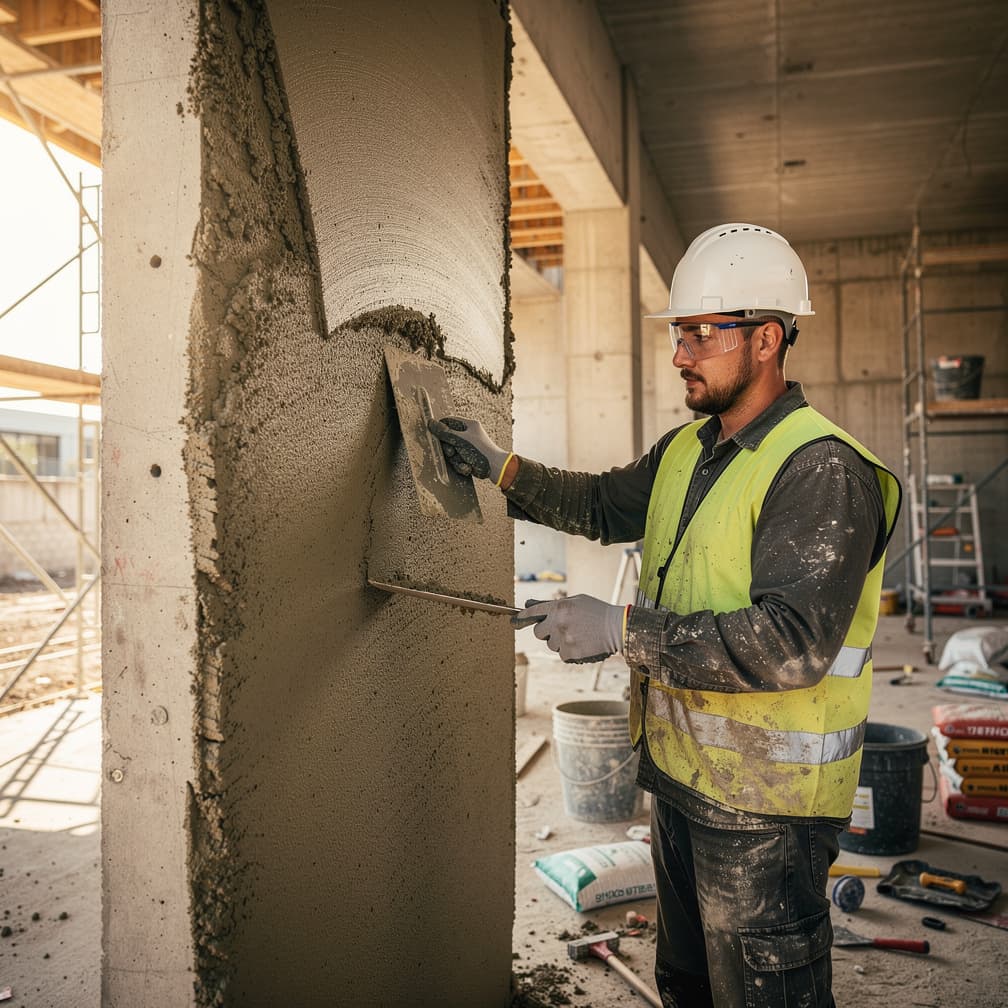

Kings County counts about 61,500 businesses, and every one of them sits inside walls somebody had to finish. That is the demand side of your trade, and it is also the claim side, because the more finished buildings you work on, the more of your day happens next to somebody else's property. Stucco repair on an occupied building puts scaffold over an entrance, wet material near a walkway, and a hopper gun within drift range of glass. The exposures behind plastering and stucco contractor insurance in New York come from that adjacency rather than from the mixing. A quote asks about it in plain terms: how much of your work is repair, and how often the public walks past your staging. Answer honestly, because the inspection after a claim tests the answer. Then compare participating carriers on the same set of facts.
What Makes New York Different
Layered work is what a big market really means for a plastering and stucco business. Your crew sits on a builder's schedule, behind a framer, ahead of a painter, boxed in by a crane window. Delay flows downhill in that arrangement, and the trade holding the schedule when it slips absorbs the argument. A stucco crew is often that trade, because the coats cure on their own clock and nobody else's. So the exposure in New York is less about one dramatic loss and more about many small collisions with other trades. Damage to a neighbor trade's finished work is the most common of those, and it gets charged back fast. Ask how your policy treats damage you cause to work another trade already completed and signed off. Participating carriers in New York do not all draw that boundary in the same place.
Local Risk Factors in New York
Hurricane season rearranges a plastering and stucco calendar before it damages a single wall. Sites board up, elevations slide to the far side of the storm, and the crew still shows up on payroll. Fresh stucco is vulnerable while it cures, and a wall that takes wind-driven rain at the wrong hour can become a full redo. Commercial Property may respond to storm damage to your yard, your shop, and the gear inside them, often subject to a separate windstorm deductible. What it typically does not treat as damage is the week of lost production, and that week is frequently the bigger number. Ask what your deductible looks like when a loss gets named a windstorm rather than ordinary damage in New York, then weigh that against what a bad season costs a business in New York.
What Coverage Does a Plastering & Stucco Contractor in New York Need?
General Liability
Builders, property managers, and permit counters ask for this one by name before a crew mobilizes. It can help cover third-party injury and the damage your work does to somebody else's property: a cracked window, a neighbor's siding under drifted spray, a homeowner who slips on wet material. Redoing your own defective stucco is typically excluded, and that boundary is where most disputes in this trade live.
Example: A gust carries hopper spray across a driveway and onto two parked cars during a finish coat. The repair bills land inside a week, and General Liability may pick them up once your deductible clears.
Workers Compensation
A general contractor rarely lets an uninsured crew onto a site, and who must carry this varies by state. For your own employees it could respond to medical costs and lost wages after a scaffold fall, a heat illness, or a lime burn. It generally does nothing for an injured homeowner or a passerby, since that is a liability question instead.
Example: A plasterer steps off the second lift and lands wrong, and the shoulder needs surgery and four months away. Workers' Compensation is generally the line that handles the medical bills and part of the lost wages.
Commercial Auto
Personal auto forms commonly exclude the pickup the moment it is towing a mixer to a jobsite, which is where this line begins. It could respond when your truck or trailer damages another vehicle or somebody's property, and it rates on drivers, radius, and what you haul. Leaving a driver off the schedule is the omission that turns a wreck into a bill you fund alone.
Example: The hitch lets go on a grade and a loaded mixer rolls into the car behind you on a New York run. Commercial Auto could take the other driver's damage, subject to the limits on your schedule.
Commercial Property
Pumps, hoppers, scaffold sections, hand tools, and pallets of bagged mix are what this line is meant to sit on, along with the yard or shop holding them. Theft, fire, and storm damage are the usual triggers. Flood typically falls outside it and gets priced separately, and gear left at a jobsite may need its own extension.
Example: A trailer gets cut open overnight at the yard, and the pump, two hoses, and a rack of scaffold are gone by dawn. With the equipment scheduled, Commercial Property might fund the replacement rather than your next draw.
How Much Does Plastering & Stucco Contractor Insurance Cost in New York?
Plastering & Stucco Contractor Insurance is a bundle of separate policies, priced separately. The ranges below are typical figures for New York for each line, except workers compensation, which is rated per $100 of payroll; a quote prices each one against your own operations.
| Coverage | Typical range | What moves your price |
|---|---|---|
| General Liability Insurance | $390 - $1,275 per month | Industry and risk classification, annual revenue, number of employees |
| Workers Compensation Insurance | $0.75 - $2.74 per $100 of payroll | Employee classification codes, total annual payroll, experience modification rate |
| Commercial Auto Insurance | $330 - $1,025 per month | Fleet size and vehicle types, driver records and experience, coverage limits and deductibles |
| Commercial Property Insurance | $110 - $470 per month | Building value and construction type, roof age and condition, fire protection class |
Prices shown are general estimates, not guaranteed rates or quotes. Your actual premium will depend on the insurer, coverage selected, business details, location, claims history, and other underwriting factors. Learn about our pricing methodology.
What Are the Insurance Requirements for a Plastering & Stucco Contractor in New York?
Workers' comp is generally required once you have your first employee. New York generally requires employers to carry workers' compensation at that point. Common exemptions include sole proprietors of one-person businesses and some ministers and clergy. Confirm current thresholds with your state's workers' compensation agency before you hire.
State auto liability minimums apply to business vehicles. New York's minimum auto liability limits are $25,000/$50,000/$10,000 (bodily injury per person / per accident / property damage). Contracts and lenders often require more than the state floor.
Flood damage is typically excluded from standard policies. Standard commercial property and builders-risk-type policies typically exclude flood. Given New York's coastal flood exposure, a separate flood policy is worth pricing; FEMA's National Flood Insurance Program is the usual starting point.
Where to verify licensing and coverage rules. The New York State Department of Financial Services publishes consumer guidance and current insurance requirements for New York businesses. When a contract or lease demands specific wording, the New York State Department of Financial Services's guidance is the authoritative place to check.
Get Your Plastering & Stucco Contractor Quote in New York
Compare rates from multiple carriers. Free quotes, no obligation.
Operating in New York
- Every stucco wall depends on the framer's flashing and the window installer's flanges, both buried under your coats. When water shows, the first call comes to you because your finish is the only part anyone can see.
- Compressors, hoppers, and hand tools live in a truck bed overnight more often than anybody admits. Gear in transit and gear at rest get treated differently, so ask where the protection stops.
- Hiring day labor for a big pour is ordinary, and an auditor can count that cash as payroll a year later. Keeping a certificate from anyone you pay is the least glamorous paperwork in Kings County, and the most useful.
- A finish coat can craze in a hot dry stretch or set wrong in a cold snap, and the wall reads as your defect either way. Documenting conditions on the day of placement is worth the two minutes.
How to Buy: Advice for New York Owners
Put your expiration date somewhere you cannot ignore it, then work backward a full month. A lapse is mainly a work stoppage: badges stop, portals reject, and a property manager in New York can pull your access. Renewal is also the only moment you hold real leverage, so spend it fixing whatever annoyed you all year. Ask about General Liability wording that survives completed operations, and ask whether your Commercial Auto radius still matches reality. Bring an updated equipment schedule, because insuring last year's gear is a slow way to lose a claim. The New York State Department of Financial Services publishes consumer guidance on policy renewal and cancellation, including your notice rights. Then run the renewal past participating carriers instead of accepting the first offer that lands.
FAQ
Plastering & Stucco Contractor Insurance in New York: FAQ
That depends on the form. Some property coverage stops at your yard, and gear left at a jobsite or locked in a trailer needs a specific extension. Pumps, hoses, mixers, and scaffold sections are all portable and all easy to resell. Ask exactly where your equipment is insured, and get the answer out of the policy rather than out of a conversation.
That is third-party property damage, and General Liability is the line that commonly answers for it. The repair gets settled while your crew is still on the wall, which is why these claims feel routine. Frequency matters, though, because a run of small claims shows up in your loss runs and follows you through renewals. Sometimes paying a minor one directly costs less over three years than reporting it.
No. A certificate is a snapshot saying a policy existed on the day somebody issued it. It grants nothing and changes nothing, which is why an owner in New York who catches a stale one remembers the name printed on it. The endorsement is the document that actually grants rights to another party. Keep both, and reissue the certificate whenever the policy changes.
Payroll rather than revenue drives the biggest line, so a season with more field hours moves the number even when billings hold steady. Claims history is the other lever, and one open moisture file can travel with you through several renewals. Higher limits demanded by a new contract cost real money too. Ask participating carriers in New York to show the classes and rates they used.
Generally not by itself. Property forms are built around physical damage to property you own, and a lost week is not damage. Business interruption thinking usually starts with a covered damage event before anything else. Your subcontract, rather than your policy, decides whether a weather delay buys you time or costs you money. Read the delay clause before the season starts.
Start from what your contracts demand, since the strictest exhibit you sign sets your floor. Then look at the largest elevation you work on and ask what a full strip and recoat would cost once remediation is attached. The aggregate matters as much as the per occurrence number, because one wall can produce several claimants. A limit that clears your worst contract is easier to bid with in New York.
Sources
- 1.U.S. Census Bureau, County Business Patterns (2022), Kings County(Kings County has about 61,500 business establishments.)
- 2.New York State Department of Financial Services(New York State Department of Financial Services publishes consumer guidance for insurance buyers.)
- 3.FEMA / FloodSmart(Flood coverage is typically purchased separately; FEMA administers the National Flood Insurance Program.)


