







































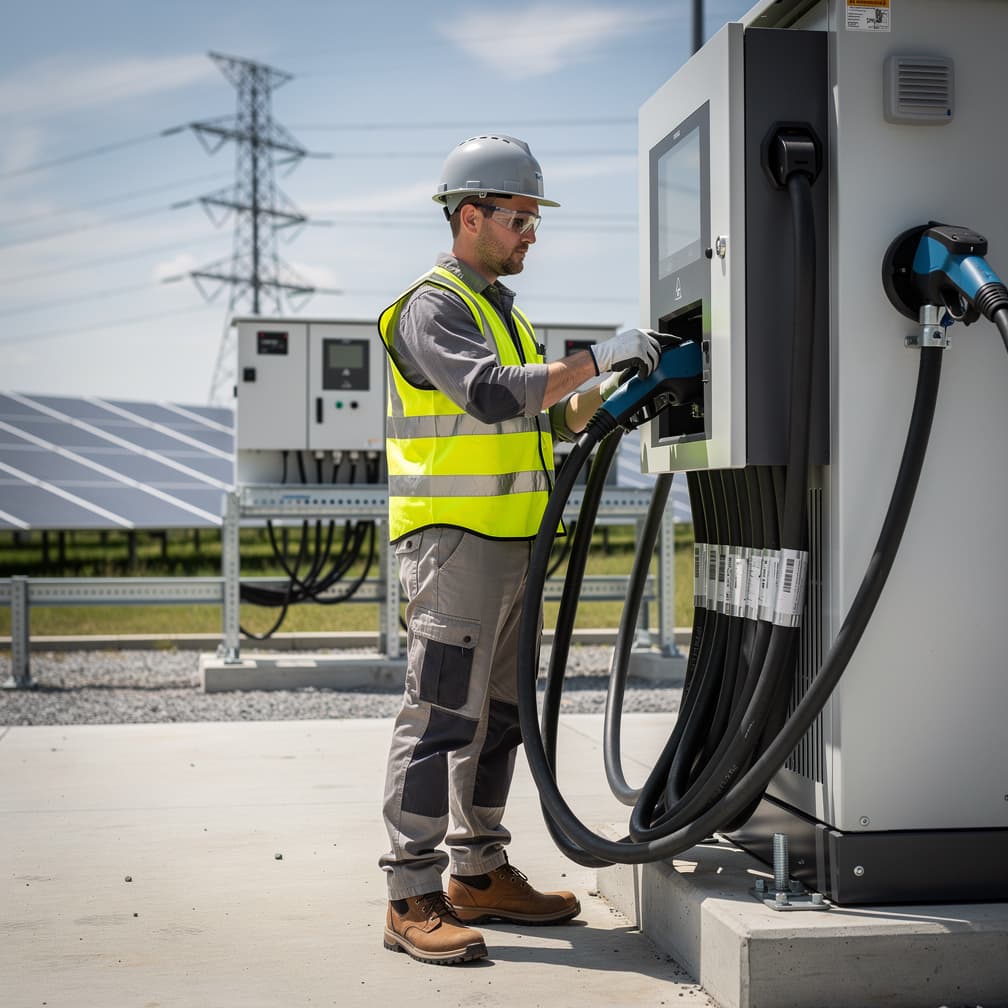

As an EV charging installer in Cary, you sign for other people's buildings before you ever touch a breaker. The garage slab, the tenant's finish, the service equipment on the wall: all of it belongs to someone whose contract already tells you what proof to produce. EV charging installer insurance in Cary is the promise behind that proof, and the certificate is only a receipt for it. Property managers hold the schedule, and a lapsed policy can stall an install whose hardware is already staged on site. The exposures behind the paper are simple to name: the hole you cut, the person walking past your work zone, the van, the recommendation you put in writing. Each one prices differently, and the questions worth asking before you buy start below.
What Makes Cary Different
Dense counties do not hand you more work so much as more counterparties on each job. Wake County has about 33,000 businesses, and one garage retrofit there can involve an owner, a manager, a tenant, and a utility contractor. Every one of those parties has a contract, a lawyer, and a reason to name somebody else when a charger fails. Claims in a crowded market rarely stay two-sided, and the party you never met can be the one who files. Your limit gets tested by the total of everyone's losses, not by the size of the invoice you sent. An aggregate that looked generous against one job looks thin against four claimants arguing over one bad install. Ask how that aggregate resets and what a single occurrence means when several parties file over the same wall. The question costs nothing while you are quoting and decides everything afterward.
Local Risk Factors in Cary
A week of canceled installs is the first cost, long before anyone talks about property. Roads close, garages pump out, and the jobs booked across Wake County slide into a backlog you work off with overtime. Your gear is the exposure that travels: a trencher parked in a low lot, a van left overnight, cases of hardware staged on a floor that turned into a pond. Inland Marine may respond to equipment losses, though water is a peril worth asking about specifically rather than assuming. Ask whoever quotes your policy in North Carolina where flooding sits on the equipment form, and what a staged-materials loss looks like before an owner has formally accepted the hardware.
What Coverage Does an EV Charging Installer in Cary Need?
General Liability
Property owners and general contractors ask for this line by name before they let a crew into a garage. It can help cover third-party bodily injury and damage to a customer's building when an install goes wrong. What it typically will not do is pay to redo the faulty part of your own work.
Example: A core bit finds a hidden sprinkler branch, and water runs down two finished levels before anybody shuts it off. The owner's repair invoice may fall to this line, subject to your limit.
Workers Compensation
An apprentice pulling wire in a hot panel is the exposure this line exists for. Medical costs and lost wages after a workplace injury are generally what it responds to, and the price follows payroll rather than how many chargers you set. Who must carry it varies by state.
Example: A helper carrying a wall unit down an icy ramp tears a shoulder, and the surgery costs more than the job billed. Benefits here might pick up the treatment and part of the missed pay.
Commercial Auto
Personal auto policies generally exclude the business use behind a loaded work van, and that gap is what this line fills. It may respond to damage and injuries from a crash while a crew travels between installs, while comprehensive is the piece that answers for theft, hail, and falling debris. Ask about hired and non-owned exposure separately.
Example: A van running between two Cary sites rear-ends a sedan at a light, and the other driver files for injuries months later. The liability limits here are what such a claim gets measured against.
Professional Liability
Damage and injury sit on other lines; advice sits here. Load calculations, layout decisions, equipment selection, and the capacity you promised an owner are professional work, and a claim that your recommendation was wrong could fall to this coverage. Intentional acts and problems you knew about and ignored are typically outside it.
Example: You specify a charger the existing service cannot support, the panel trips repeatedly, and a tenant loses a stall for weeks. A dispute over that recommendation might land here instead of on the liability form.
Tools & Equipment (Inland Marine)
Benders, meters, cordless kits, and the compact trencher on your trailer spend their working lives away from any fixed address, which is why a building's property form does not follow them. This coverage is intended for tools and equipment in transit, in the van, or staged at a site. Wear and tear is typically excluded.
Example: A locked van left overnight at a Cary job is emptied by morning, taking two battery kits and a bender with it. Replacement values scheduled in advance are generally what settles a claim like that.
How Much Does EV Charging Installer Insurance Cost in Cary?
EV Charging Installer Insurance is a bundle of separate policies, priced separately. The ranges below are typical figures for Cary for each line, except workers compensation, which is rated per $100 of payroll; a quote prices each one against your own operations.
| Coverage | Typical range | What moves your price |
|---|---|---|
| General Liability Insurance | $150 - $480 per month | Industry and risk classification, annual revenue, number of employees |
| Workers Compensation Insurance | $0.75 - $2.74 per $100 of payroll | Employee classification codes, total annual payroll, experience modification rate |
| Commercial Auto Insurance | $230 - $625 per month | Fleet size and vehicle types, driver records and experience, coverage limits and deductibles |
| Professional Liability Insurance | $80 - $260 per month | The services you actually perform, annual revenue or billed fees, limit and retention selected |
| Inland Marine Insurance | $35 - $120 per month | Total insured value of the scheduled property, type and age of the equipment, where it is stored and how far it travels |
Prices shown are general estimates, not guaranteed rates or quotes. Your actual premium will depend on the insurer, coverage selected, business details, location, claims history, and other underwriting factors. Learn about our pricing methodology.
What Are the Insurance Requirements for an EV Charging Installer in Cary?
Workers' comp is generally required once you have 3 or more employees. North Carolina generally requires employers to carry workers' compensation at that point. Common exemptions include sole proprietors, partners, and LLC members. Confirm current thresholds with your state's workers' compensation agency before you hire.
State auto liability minimums apply to business vehicles. North Carolina's minimum auto liability limits are $50,000/$100,000/$50,000 (bodily injury per person / per accident / property damage). Contracts and lenders often require more than the state floor.
Where to verify licensing and coverage rules. The North Carolina Department of Insurance publishes consumer guidance and current insurance requirements for North Carolina businesses. When a contract or lease demands specific wording, the North Carolina Department of Insurance's guidance is the authoritative place to check.
Get Your EV Charging Installer Quote in Cary
Compare rates from multiple carriers. Free quotes, no obligation.
Operating in Cary
- Renewal dates rarely line up with project schedules, and a policy that expires mid-install can freeze a job that is otherwise finished and ready to energize.
- Property managers hold gate access and elevator time, and a crew arriving without a current certificate on file can lose both for the day. The install waits until the paperwork moves.
- Copper, cordless kits, and mount hardware staged overnight on an open site are the easiest things on the job to carry away. Theft becomes a scheduling problem before it becomes a claim.
- A homeowner's finished garage has no tolerance for a wrong core: one cut through drywall, tile, or a hidden line turns a two-hour install into a repair nobody priced into the bid.
How to Buy: Advice for Cary Owners
Nobody buys coverage for the day they buy it. Picture the worst plausible week instead: a helper hurt at a live panel, a van rolled on the way to a second site, and a customer's garage wall opened up and left wet. Each of those lands on a different policy, and the one you skipped is reliably the one that shows up. Workers Compensation, Commercial Auto, and General Liability each answer a piece of that week, which is why they usually get bought together. Price the package rather than the pieces, since the lowest single line often hides the widest gap in North Carolina. Then compare package quotes from participating carriers in Cary instead of shopping one line at a time.
FAQ
EV Charging Installer Insurance in Cary: FAQ
Ask whoever handles your policy for a certificate naming the exact parties from the contract, and send the insurance exhibit along so the wording matches. Additional insured or waiver of subrogation language arrives through endorsements, and participating carriers in North Carolina issue those on their own forms. Requesting them when you bind, rather than the week work starts, is what keeps a crew off the sidewalk.
An undersized service that trips, or forces a customer to rebuild a panel, is an advice problem rather than a damage problem, and General Liability is generally built around damage. Professional Liability is intended for claims tied to your recommendations, layouts, and planning decisions. An installer who quotes loads and specifies equipment is doing professional work, whether the invoice describes it that way or not.
Not automatically. A sub carrying nothing of their own can end up rated onto your payroll at audit and can leave a liability claim resting entirely on your file. Collect a certificate before they break ground, check that their limits meet the contract you signed, and ask to be named as additional insured on their policy. Keep the paperwork as long as yours can be audited.
Payroll, revenue, a vehicle list with drivers, an equipment schedule with values, your split between residential and commercial work, and any claims from recent years. Design or consulting work belongs in that picture too. Estimates get verified later at audit, so accuracy now avoids a bill after the money is spent. The same facts feed every submission you make in Wake County, which is what makes quotes comparable.
Standard property and equipment forms typically exclude flood, and that gap usually gets filled through a separate program rather than an endorsement. Water from a burst pipe inside a building is a different peril and may be treated differently from rising water outside it. If hardware sits staged in a Cary garage before an owner accepts it, ask who carries the risk during that window.
Prior claims are among the strongest inputs on a quote, and an open file with a reserve on it can follow you through more than one renewal. Quick reporting and photographs matter for that reason: an incident documented the day it happened usually closes faster than one reconstructed later. Participating carriers weigh identical history differently, which is why gathering more than one quote is worth the hour.
Sources
- 1.U.S. Census Bureau, County Business Patterns (2022), Wake County(Wake County has about 33,000 business establishments.)
- 2.North Carolina Department of Insurance(North Carolina Department of Insurance publishes consumer guidance for insurance buyers.)


