







































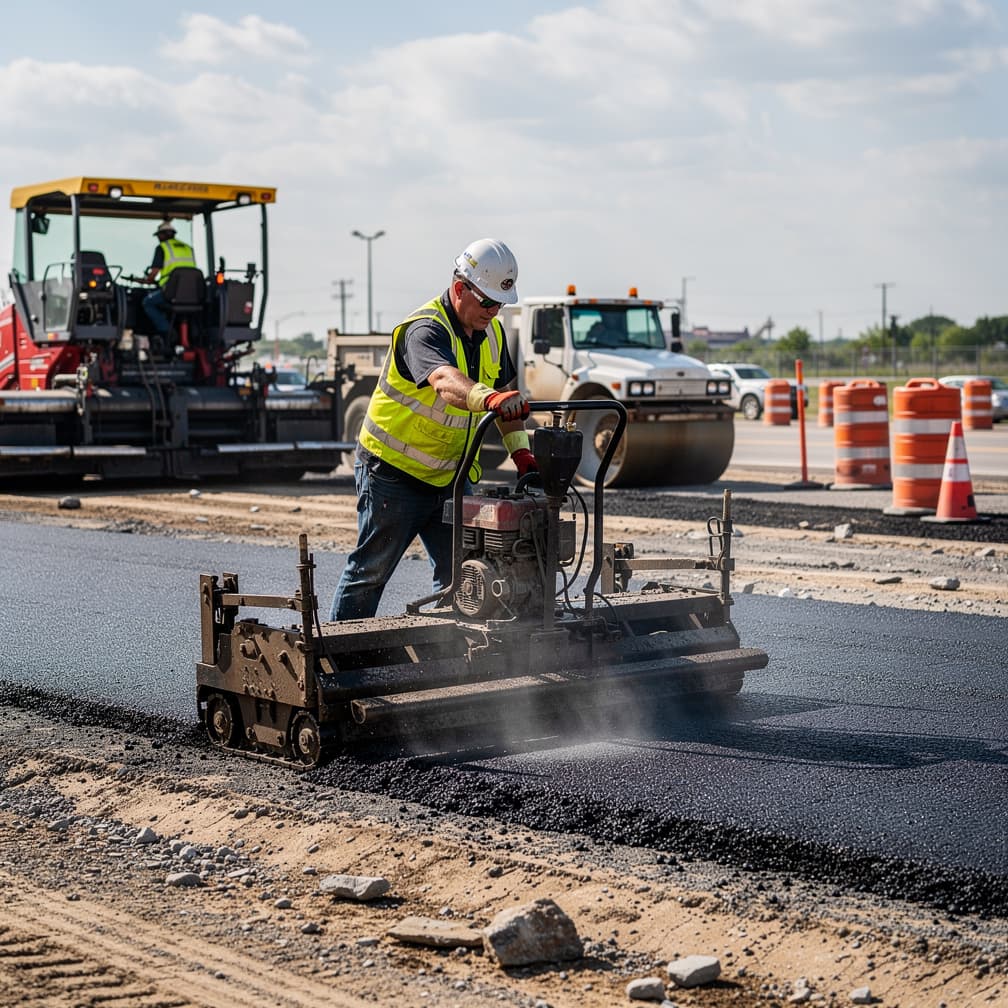

About $352,000 is the median home value in Charlotte, and the drives behind those houses are steady work for a paving crew. Homeowner jobs change the risk picture, though: you are working feet from a garage door, a landscape bed, and a car that was parked there this morning. Paving and asphalt contractor insurance in Charlotte has to answer for that kind of close-range property damage as readily as for a highway shoulder job. Residential customers rarely demand certificates, so the discipline has to come from you. They do call an attorney when a new drive cracks or drains toward a foundation. Damage to somebody else's property and rework on your own mat are different animals, and only one of them usually finds a policy. Knowing which is which before you bid is the point of what follows.
What Makes Charlotte Different
Payroll is the engine under a paving premium, because Workers' Compensation is rated on it and liability tracks it closely. Add crew members to keep up with demand across Mecklenburg County and the premium moves before the first invoice clears. Class codes matter as much as the dollars, since paving work and office work are priced nothing alike. Misclassifying a foreman who spends half his week on the mat is exactly the error an audit finds. Vehicles are the second engine, and a dense Charlotte schedule means more units, more drivers, and more annual miles. Loss history sits behind both, quietly multiplying or discounting everything else on the submission. None of those levers respond to shopping alone, which is why the paperwork is where savings live. Fix the inputs first, then compare what the market returns on identical exposures.
Local Risk Factors in Charlotte
Flooding can put a paving jobsite out of commission long before anyone reaches for a policy. Water fills excavation, undermines a fresh base, and leaves a lot that has to be rebuilt rather than finished. Machines parked in the low corner of a yard in Charlotte are the loss that stings, because a drowned engine is an expensive week. Standard property forms typically exclude flood, and coverage for rising water is generally bought and priced on its own. Trucks caught in high water sit somewhere else again: Commercial Auto with physical damage might answer, depending on the form and on what got wet. Ask which of your assets sit inside which form before the first bad forecast in North Carolina, because the answers rarely match intuition.
What Coverage Does a Paving & Asphalt Contractor in Charlotte Need?
General Liability
Owners, general contractors, and landlords ask for this one by name before a crew mobilizes, and the certificate usually has to show it. It generally responds to bodily injury and property damage your work does to other people: a clipped storefront apron, a visitor who trips at an open site. Damage to your own mat, and the cost of redoing it, typically sits outside.
Example: A compactor nudges a bollard into a client's glass entry while the crew finishes a Charlotte apron. The repair bill and the complaint that follows are the kind of loss this line may take on.
Workers Compensation
Hot mix, moving rollers, and live traffic put a paving crew within reach of a serious injury every working day. This line is meant for employee injuries: medical treatment and a share of lost wages after someone gets hurt on the job. Liability forms typically exclude those claims, and what employers must carry varies from state to state.
Example: A screed operator takes a burn through a glove reaching across fresh mat, and treatment runs into weeks of follow-up visits. Medical costs and part of the missed pay could fall here.
Commercial Auto
A personal auto policy usually walks away the moment a vehicle is used for the business, which is where this line starts. Trucks, dumps, and the trailers hauling rollers between jobs get rated on units, drivers, and how far they run. Injury and damage to others in an at-fault wreck are the core of it; the machine riding on the trailer is generally handled elsewhere.
Example: A loaded trailer clips a parked sedan while backing into a tight Charlotte lot, and the other driver reports an injury the next morning. Costs on their side are what this coverage is intended to meet.
Commercial Umbrella
Where the underlying limits stop, this one is designed to keep going, sitting above General Liability and Commercial Auto rather than replacing either. Contracts on larger paving jobs often demand limits the base program cannot show on a certificate. It typically inherits the exclusions beneath it, so a gap downstairs stays a gap upstairs.
Example: A multi-vehicle wreck involving a paving truck exhausts the auto limit before the medical bills are even counted. Whatever is left of the claim may find its way here, subject to the terms.
How Much Does Paving & Asphalt Contractor Insurance Cost in Charlotte?
Paving & Asphalt Contractor Insurance is a bundle of separate policies, priced separately. The ranges below are typical figures for Charlotte for each line, except workers compensation, which is rated per $100 of payroll; a quote prices each one against your own operations.
| Coverage | Typical range | What moves your price |
|---|---|---|
| General Liability Insurance | $250 - $825 per month | Industry and risk classification, annual revenue, number of employees |
| Workers Compensation Insurance | $0.75 - $2.74 per $100 of payroll | Employee classification codes, total annual payroll, experience modification rate |
| Commercial Auto Insurance | $550 - $1,575 per month | Fleet size and vehicle types, driver records and experience, coverage limits and deductibles |
| Commercial Umbrella Insurance | $110 - $420 per month | Umbrella limit requested, limits carried on the underlying policies, loss history on those underlying policies |
Prices shown are general estimates, not guaranteed rates or quotes. Your actual premium will depend on the insurer, coverage selected, business details, location, claims history, and other underwriting factors. Learn about our pricing methodology.
What Are the Insurance Requirements for a Paving & Asphalt Contractor in Charlotte?
Workers' comp is generally required once you have 3 or more employees. North Carolina generally requires employers to carry workers' compensation at that point. Common exemptions include sole proprietors, partners, and LLC members. Confirm current thresholds with your state's workers' compensation agency before you hire.
State auto liability minimums apply to business vehicles. North Carolina's minimum auto liability limits are $50,000/$100,000/$50,000 (bodily injury per person / per accident / property damage). Contracts and lenders often require more than the state floor.
Where to verify licensing and coverage rules. The North Carolina Department of Insurance publishes consumer guidance and current insurance requirements for North Carolina businesses. When a contract or lease demands specific wording, the North Carolina Department of Insurance's guidance is the authoritative place to check.
Get Your Paving & Asphalt Contractor Quote in Charlotte
Compare rates from multiple carriers. Free quotes, no obligation.
Operating in Charlotte
- Old work never leaves. A lot you paved three seasons ago in Charlotte is still sitting there, still failing on its own schedule, and still able to produce a complaint against the business today.
- Subcontracted crews you never carried on payroll can be charged back to you at audit when their certificates are missing, which turns a cheap sub into an expensive one months after the job closed.
- Municipal and school work in Mecklenburg County arrives with bid documents, insurance exhibits, and sometimes a bond requirement, none of which scale down because the job happens to be small.
- About 111 paving and asphalt contractors operate in Mecklenburg County, so the same general contractors keep seeing the same short list of bidders, and how you handled your last claim travels with you.
How to Buy: Advice for Charlotte Owners
Ask what a quote assumed before you set it beside another one, because two numbers built on different assumptions are not comparable. Class codes, radius, limits, deductibles, and whether hired autos are included can each move the price on their own. A cheap Commercial Auto quote that assumed a fifty-mile radius stops being cheap when the crew drives across Mecklenburg County for the job. General Liability quoted on last year's revenue is telling you about last year, not about the season ahead. Write the assumptions down beside each offer and the real comparison takes five minutes. Skipping that step is how owners buy on premium and discover the difference during a claim. Line the offers up on identical exposures, then let participating carriers in North Carolina compete on the same terms.
FAQ
Paving & Asphalt Contractor Insurance in Charlotte: FAQ
Only if you can absorb the first slice of several losses in one season. Paving generates frequent small property damage on Charlotte lots and drives, and each one gets funded by you before anything else responds. A steep deductible suits rare, large losses better than frequent, small ones. Ask for two deductible levels quoted side by side so the tradeoff arrives as a number rather than a feeling.
Most owners and general contractors will not let a crew mobilize without a certificate on file, and the request usually arrives attached to the contract. The document names limits and often names the client as an additional insured. That is a contractual demand rather than a legal one, so it shifts from client to client. General Liability is the line those requests tend to center on. Settle it before the bid, because coverage bought under deadline pressure costs more and fits worse.
Nobody can price a paving business off the trade name alone. The number follows payroll, revenue, the vehicle list, equipment values, the limits your contracts demand, and five years of loss history. A three-truck outfit in Charlotte laying residential drives and a three-truck outfit running highway shoulder work land in very different places. Published ranges give you a starting point; your own number comes from those inputs, so make them accurate before you shop.
Usually not. Redoing your own defective work is a workmanship question, and policies generally treat it as a cost of doing business rather than an insured loss. What may respond is damage your faulty work does to somebody else's property, such as water that undermines a neighboring structure. That distinction decides how much you hold back for callbacks. Price rework into the bid and treat the policy as protection against the bigger, third-party half of the problem.
Anyone with leverage: the owner of the lot, the general contractor above you, the landlord of your yard, sometimes a lender. Additional insured status is granted by endorsement, and the wording matters as much as the name. Blanket wording can handle everyone your contracts require, while per-project endorsements get issued one at a time and slow the paperwork down. Ask which one your General Liability carries before a Charlotte client asks you for it.
It is rated per $100 of payroll, at a rate tied to the class code describing the work. Time on the mat and time in the office are not priced alike, so the split between them matters. The premium starts as an estimate and gets trued up at audit against what you actually paid out. Keeping payroll records by class code through the season is the surest way to control the final number.
Sources
- 1.U.S. Census Bureau, County Business Patterns (2023), Mecklenburg County(Mecklenburg County has about 111 businesses in this trade's category (NAICS group 238990).)
- 2.U.S. Census Bureau, ACS 5-Year Estimates (2023), table B25077(The median home value in Charlotte is about $352,000.)
- 3.North Carolina Department of Insurance(North Carolina Department of Insurance publishes consumer guidance for insurance buyers.)


