







































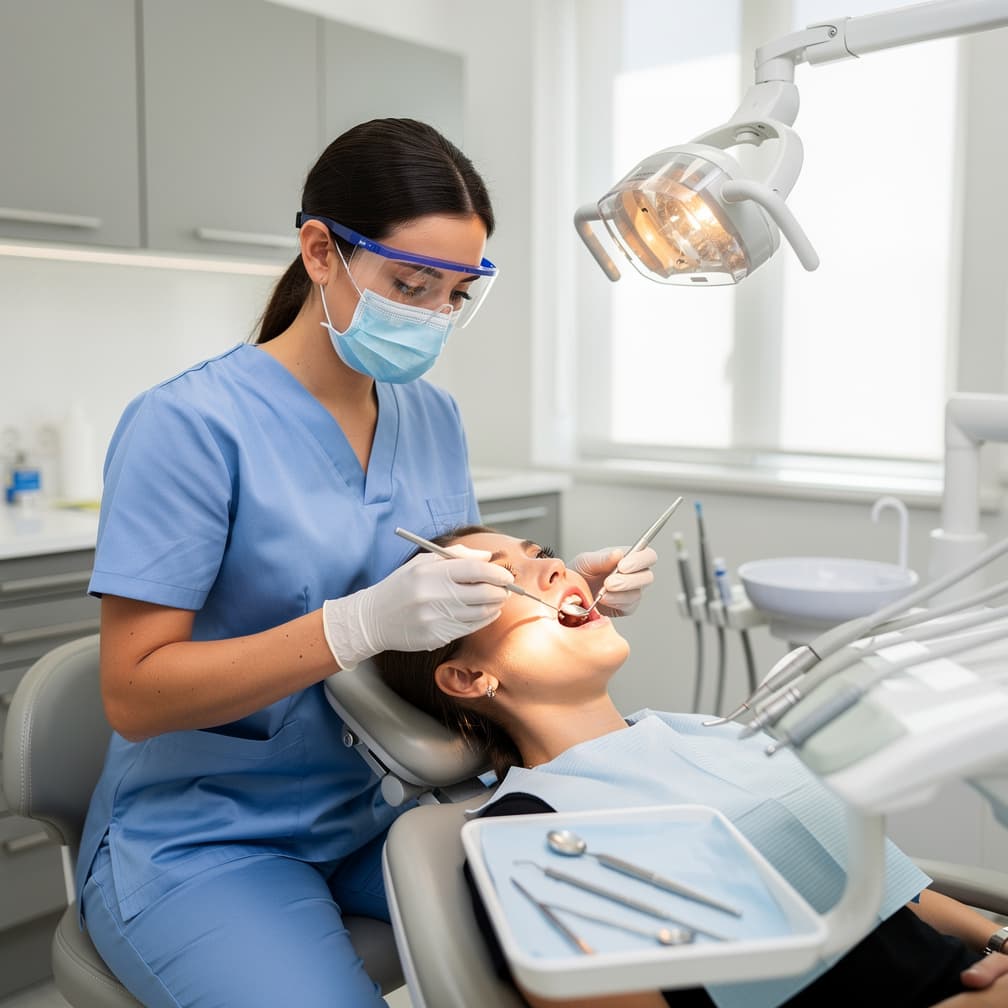

As a dental practice in Durham, you carry three kinds of risk at once: what happens in the chair, what happens in the waiting room, and what happens on the server. A treatment allegation, a fall, and a records breach travel through different parts of a policy and get handled by different adjusters. Dental practice insurance in Durham is the shorthand for that whole stack, and the stack is where owners lose track. Many owners find out which piece they skipped on the day a demand letter arrives. Payroll for hygienists and assistants drives one part of the cost; the equipment in your operatories drives another. Read the ranges below with your own staff list open, then compare quotes on identical limits rather than on price alone.
What Makes Durham Different
Water finds a dental suite through the ceiling more often than through the front door. The office above yours has plumbing, and a storm week is when tired plumbing decides to fail. Your operatories sit under it, and cabinetry, sensors, and a compressor do not dry out well. Fault turns into an argument between two policies and two tenants while your chairs stay empty. A thin market makes it worse, since the restoration crew serving Durham County may already be booked when you call. Meanwhile every canceled patient is revenue you do not recover, and the recall list keeps growing. Ask what a policy says about damage that starts in someone else's space, because that answer is rarely obvious. A Durham practice should know it before the ceiling explains it.
Local Risk Factors in Durham
Flood water does not have to reach the chairs to close a dental office. An inch across a ground floor suite finds the compressor, the vacuum pump, and the cabinetry first, and every operatory runs on those. Sterilization stops, the schedule empties, and the drying alone takes days a practice in Durham cannot rebook. The gap is the part owners miss: standard commercial property forms typically exclude flood, so water arriving from outside the building gets priced as its own decision rather than bundled in. Ask whether your suite sits in a mapped flood area in Durham County, ask what a policy would treat as a covered water event, and get the answer in writing while the question is still theoretical.
What Coverage Does a Dental Practice in Durham Need?
Professional Liability
A patient alleges the treatment plan was wrong, the consent was never explained, or a finding on an image went unnoticed. That allegation is what Professional Liability exists for, and the form typically carries defense costs alongside any settlement. Ordinary premises injuries sit outside it, and so does anything a policy treats as intentional conduct.
Example: A crown fails and the patient's counsel argues the tooth underneath was never properly assessed; Professional Liability may answer the defense costs and whatever settles the file.
General Liability
Landlords and plan networks ask for General Liability by name before they hand over keys or list you on a panel. It is the third-party line: a patient who slips at the front desk, a visitor hurt by a toppling display, damage your practice does to someone else's property. Harm arising from treatment belongs on Professional Liability instead.
Example: A patient catches a heel on a lifting floor tile in the waiting room and fractures a wrist; the medical bills and the demand behind them are what General Liability is generally there to absorb.
Commercial Property
Flood is typically outside this form, and so is a compressor that simply wore out. What sits inside is sudden damage to the things a practice runs on: chairs, imaging units, sterilizers, cabinetry, and the build-out you funded rather than the landlord. Commercial Property gets rated on those values, so an outdated equipment list quietly underinsures the office.
Example: A storm opens the roof above two operatories in Durham and rain reaches the cabinetry and a sensor overnight; Commercial Property might carry the repairs and the replacements.
Cyber Liability
Patient records, billing data, and the software running your schedule are the assets at stake here. Cyber Liability commonly addresses forensic work, patient notification, and the legal costs after a breach or a ransomware lockout, and some forms reach the income lost while systems are down. Social engineering, the wire sent to an impersonator, often needs its own endorsement.
Example: A staff member opens an attachment and the scheduling and imaging systems lock before a full day of appointments; Cyber Liability can help cover the response and the patients who need telling.
Workers Compensation
Where the liability lines answer to patients and third parties, this one answers to your own people: the hygienist with a needlestick, the assistant with a repetitive strain complaint, the front desk worker who slips on the same wet mat a patient does. Requirements vary by state, and the North Carolina Department of Insurance publishes the current requirements for employers.
Example: A hygienist catches a stick during a cleaning and needs testing and follow-up visits; Workers Compensation is the line that typically picks up the medical care and the missed shifts.
How Much Does Dental Practice Insurance Cost in Durham?
Dental Practice Insurance is a bundle of separate policies, priced separately. The ranges below are typical figures for Durham for each line, except workers compensation, which is rated per $100 of payroll; a quote prices each one against your own operations.
| Coverage | Typical range | What moves your price |
|---|---|---|
| Professional Liability Insurance | $140 - $480 per month | The services you actually perform, annual revenue or billed fees, limit and retention selected |
| General Liability Insurance | $40 - $160 per month | Industry and risk classification, annual revenue, number of employees |
| Commercial Property Insurance | $90 - $360 per month | Building value and construction type, roof age and condition, fire protection class |
| Cyber Liability Insurance | $40 - $190 per month | Records held and how sensitive they are, annual revenue and industry, multi-factor authentication and backup practices |
| Workers Compensation Insurance | $0.75 - $2.74 per $100 of payroll | Employee classification codes, total annual payroll, experience modification rate |
Prices shown are general estimates, not guaranteed rates or quotes. Your actual premium will depend on the insurer, coverage selected, business details, location, claims history, and other underwriting factors. Learn about our pricing methodology.
What Are the Insurance Requirements for a Dental Practice in Durham?
Workers' comp is generally required once you have 3 or more employees. North Carolina generally requires employers to carry workers' compensation at that point. Common exemptions include sole proprietors, partners, and LLC members. Confirm current thresholds with your state's workers' compensation agency before you hire.
Flood damage is typically excluded from standard policies. Standard commercial property and builders-risk-type policies typically exclude flood damage. Flood exposure varies address by address, so check your premises in FEMA's Flood Map Service Center before deciding; if you sit in a mapped flood zone, a separate policy through the National Flood Insurance Program is the usual starting point.
Where to verify licensing and coverage rules. The North Carolina Department of Insurance publishes consumer guidance and current insurance requirements for North Carolina businesses. When a contract or lease demands specific wording, the North Carolina Department of Insurance's guidance is the authoritative place to check.
Get Your Dental Practice Quote in Durham
Compare rates from multiple carriers. Free quotes, no obligation.
Operating in Durham
- Payroll estimated in month one gets trued up at audit, so a Durham office that added an assistant midyear owes the difference at year end rather than at signup.
- Temporary hygienists arrive through agencies, and whose policy answers for them is settled in a contract nobody printed, usually discovered on the day one of them gets hurt.
- Old charts a Durham office keeps for no particular reason still count as records, and the record count is one of the inputs a cyber quote gets rated against.
- A build-out you paid for in Durham sits on your policy as tenant improvements rather than on the landlord's schedule, and owners routinely assume the opposite until a claim corrects them.
How to Buy: Advice for Durham Owners
Limits are the decision; premium is the consequence. A per-occurrence limit is what one claim can reach, and the aggregate is the ceiling for a whole policy year across every claim. A dental office that meets a settlement demand and a slip in the same twelve months learns that difference from the wrong side. Deductibles work the other way: a higher one lowers the premium and moves the first slice of every loss back onto you. Decide what a bad year looks like for a practice in Durham, then buy the limit that survives it and the deductible you can actually write a check for. Professional Liability is where that math gets real, since a treatment allegation is the claim with the longest tail. The North Carolina Department of Insurance publishes consumer guidance on how policy limits work if the terms are unfamiliar. With the structure fixed, compare quotes from participating carriers and let only the price move.
FAQ
Dental Practice Insurance in Durham: FAQ
Annual revenue, payroll broken out by role, an equipment list with values, your procedure mix, a patient record count, and your claims history. Add the build-out cost if you funded it, since tenant improvements belong on the property side. A Durham office that brings all of that gets numbers it can compare; an office that estimates gets numbers that move at audit.
An occurrence form generally answers for work done while it was in force, whenever the claim shows up. A claims-made form answers only if the policy is in force when the claim is made, and it carries a retroactive date setting how far back it reaches. For a dental office, where a treatment allegation can surface years later, that difference decides whether switching carriers quietly erases your history.
Damage starting in someone else's space is one of the messier claims a dental suite sees, because two policies and two tenants argue over fault while your chairs sit empty. Your own property coverage may answer for your equipment and improvements regardless, and your carrier can pursue the other party afterward. A practice in Durham County may still wait behind everyone else for a restoration crew.
Deductibles, documented backup and safety practices, accurate payroll classification, and a clean claims history all move the number, and none of them require surrendering a limit. Cutting the limit is the one lever that looks like savings and is not, because a settlement demand does not shrink to fit your policy. Compare quotes at identical limits first, then decide what a higher deductible is worth.
Landlords routinely ask for proof before keys change hands, and the insurance exhibit in a lease often names limits, additional insured status, and a waiver of subrogation. Get that exhibit quoted before you sign, because a policy that cannot issue the wording a landlord in Durham demands is a policy you end up replacing in month one.
A third-party injury on your premises, such as a slip on a wet entry mat, is what General Liability typically responds to. A claim alleging harm from the treatment itself belongs on Professional Liability instead, and that trips up owners regularly. The dividing line is not where the patient was standing; it is what they say went wrong.
Sources
- 1.North Carolina Department of Insurance(North Carolina Department of Insurance publishes consumer guidance for insurance buyers.)
- 2.FEMA / FloodSmart(Flood coverage is typically purchased separately; FEMA administers the National Flood Insurance Program.)


