







































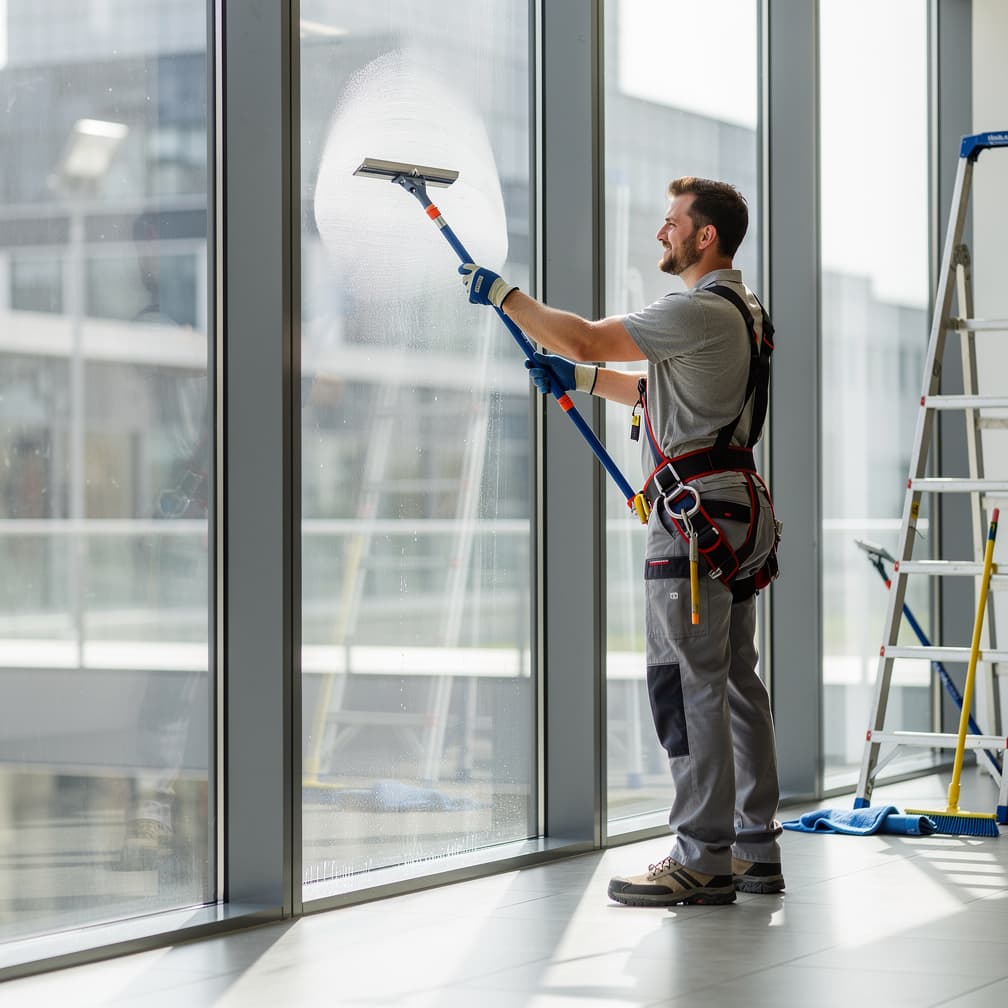

The lowest window cleaning quote in a crowded market often buys exactly the limits that lose you the contract. Window cleaning service insurance in Cleveland gets priced against what the buildings you want ask for, and in a dense county those asks climb fast. About 31,500 businesses sit in Cuyahoga County, and buildings with the most glass tend to carry the strictest vendor requirements wherever they stand. General liability at a low limit can quote from $35 a month, and it can also be exactly what a property manager rejects. Higher limits cost real money, and they are what put you on an approved vendor list. Read on for the lines window cleaners carry, the published ranges, and the questions worth asking before you compare.
What Makes Cleveland Different
Big glass and big buildings mean a claim can involve three companies before anyone opens a policy. In a dense county, ownership, management, and tenancy are usually different parties with different lawyers. Each can be named on your certificate, and carriers in Ohio price extra endorsements differently. When someone falls at an entry, all three point at the vendor who left the floor wet. Your limits get tested by how many parties have standing, not by the size of the pane. Commercial leases behind a Cleveland tower get drafted by specialists who write insurance exhibits daily. Reading one lease teaches you the pattern, and the pattern is what your policy has to satisfy. Buy for the building you want next year, not the one you already clean.
Local Risk Factors in Cleveland
Severe storms in Cleveland damage a window cleaning service in minutes and its schedule for weeks. Wind takes ladders off racks, flips extension poles into cars, and turns a routine setup into a hazard a crew cannot control. Equipment that gets loose becomes a third party claim, and General Liability may respond when your ladder ends up through somebody's windshield, subject to the limit and the deductible. What follows a tornado is a glass economy: broken panes everywhere, glaziers booked solid, and clients in Cleveland who want frames cleaned the day the plywood comes off. Working fast beside damaged structures raises your own injury risk, and that lands on the payroll side of your program rather than the liability side.
What Coverage Does a Window Cleaning Service in Cleveland Need?
General Liability
A dropped scraper that finds a shoulder, a hose that trips a customer, a pole that scars a neighbor's siding: these are the third party claims General Liability is generally built to answer, along with the defense costs behind them. It typically does not reach your own tools, and damage to the very pane you were cleaning can land inside a care, custody, and control exclusion.
Example: A pedestrian walking under a second story ladder in Cleveland is struck by a falling squeegee and needs stitches; General Liability can help cover the injury claim and the lawyer who arrives with it.
Workers Compensation
Once you put somebody on payroll, this is the line clients, landlords, and state rules expect to see. Workers Compensation is meant for your own crew's injuries: a fall from a ladder, a shoulder worn out by repetitive work, heat sickness on a summer job. It is quoted per hundred dollars of payroll and generally does not respond to anyone who is not your employee.
Example: A window cleaner slips off the third rung and breaks a wrist on a routine storefront call; Workers Compensation could respond to the medical bills and to part of the lost wages.
Commercial Auto
Personal auto forms commonly exclude business use, which leaves a van full of poles, ladders, and tanks outside the only coverage many new owners assume they have. Commercial Auto is designed for that vehicle, for the employees driving it between accounts, and for the harm it can do to other cars and people. Comprehensive coverage on it might reach theft or storm damage, subject to your deductible.
Example: A crew van loaded with extension poles rear-ends a sedan on the way to a morning route; Commercial Auto is generally where the repair bill and the injury claim both get sorted out.
Commercial Umbrella
Your primary lines each stop at their own limit, and a serious claim does not. Commercial Umbrella sits above them and starts where they end, which is the usual way a window cleaning service reaches the limit a large contract names, often for less than raising the primary to the same place. It follows the underlying forms, so it inherits their exclusions rather than filling a gap they left.
Example: A ladder falls in a lobby in Cleveland and injures three people at once, exhausting the primary limit mid-settlement; a Commercial Umbrella might carry the remainder, subject to its own terms.
How Much Does Window Cleaning Service Insurance Cost in Cleveland?
Window Cleaning Service Insurance is a bundle of separate policies, priced separately. The ranges below are typical figures for Cleveland for each line, except workers compensation, which is set by the state fund; a quote prices each one against your own operations.
| Coverage | Typical range | What moves your price |
|---|---|---|
| General Liability Insurance | $90 - $300 per month | Industry and risk classification, annual revenue, number of employees |
| Workers Compensation Insurance | Set by the state fund | Employee classification codes, total annual payroll, experience modification rate |
| Commercial Auto Insurance | $170 - $470 per month | Fleet size and vehicle types, driver records and experience, coverage limits and deductibles |
| Commercial Umbrella Insurance | $55 - $170 per month | Umbrella limit requested, limits carried on the underlying policies, loss history on those underlying policies |
Prices shown are general estimates, not guaranteed rates or quotes. Your actual premium will depend on the insurer, coverage selected, business details, location, claims history, and other underwriting factors. Learn about our pricing methodology.
What Are the Insurance Requirements for a Window Cleaning Service in Cleveland?
Workers' comp is generally required once you have your first employee, through the state fund. Ohio runs workers' compensation through a state fund: employers buy coverage from the Ohio Bureau of Workers' Compensation (BWC), not from private carriers. Common exemptions include sole proprietors, partners, and LLC members. Confirm current requirements directly with the fund before you hire.
State auto liability minimums apply to business vehicles. Ohio's minimum auto liability limits are $25,000/$50,000/$25,000 (bodily injury per person / per accident / property damage). Contracts and lenders often require more than the state floor.
Where to verify licensing and coverage rules. The Ohio Department of Insurance publishes consumer guidance and current insurance requirements for Ohio businesses. When a contract or lease demands specific wording, the Ohio Department of Insurance's guidance is the authoritative place to check.
Get Your Window Cleaning Service Quote in Cleveland
Compare rates from multiple carriers. Free quotes, no obligation.
Operating in Cleveland
- The helper you pay for two days a month still appears in a payroll audit at year end, and an unreported one turns a clean renewal into a bill you never planned for.
- A tenant can demand your certificate even when the landlord already holds one, because their lease makes them responsible for their own vendors. Expect to issue the same document twice for one Cleveland building.
- Recurring contracts get renewed quietly and cancelled the same way. A vendor in Cleveland dropped for expired paperwork rarely gets told why; the route simply stops appearing on the schedule.
- A pane that cracks under your scraper is a different claim from a pane your pole clips on the way past. The first can run into a care, custody, and control exclusion; the second usually does not.
How to Buy: Advice for Cleveland Owners
Gather your worst realistic day before you gather quotes. For a window cleaning service in Cleveland, that day is a dropped tool landing on a person, not a scratched pane, and the injury claim behind it is what General Liability exists to answer. Price the limit against that scenario rather than against the monthly figure. Next comes the crew, since anyone working at height turns into a Workers Compensation question the moment you have payroll, and audits find unreported help reliably. The van sits behind both, because a collision claim can arrive larger than anything a ladder produces. The Ohio Department of Insurance publishes consumer guidance on employer coverage obligations. Once you know which of those could actually end the business, compare quotes from participating carriers through CPK on those limits and let the small stuff sort itself out.
FAQ
Window Cleaning Service Insurance in Cleveland: FAQ
That one is trickier than it looks. Damage to the property you are working on can fall under a care, custody, and control exclusion, meaning a liability policy might not respond to the pane itself even while it responds to everything around it. Ask about that exact scenario on every quote, because the answer moves with the form and it is the loss window cleaners actually have.
Because they want confirmation that someone else pays if your work injures a visitor or damages the building. The certificate shows a policy exists on that date at those limits. It is not the policy and it grants nothing by itself, but it is the document a security desk or vendor portal checks, and nothing on file usually means no access.
Generally not. Liability coverage aims at harm you do to other people and their property, so your own equipment sits outside it. Tools stolen from a van or snapped on a job are a separate conversation, and small operators often carry that risk themselves without realizing they chose to. Ask each quote where your equipment lands before assuming it is included.
Start from your contracts rather than a rule of thumb. If a Cleveland client names a limit, that number is your floor, and buying under it puts you on the job with paperwork that reads compliant and a policy that is not. Past that, the limit answers the worst realistic day, which in this trade is usually an injury below a ladder. Commercial Umbrella is often how a required number gets reached without rebuilding the primary.
The per occurrence figure is the most available for one incident; the aggregate is the ceiling on everything in a policy year. A route touching dozens of buildings has plenty of chances to stack small claims, and three modest ones can eat an aggregate quietly. The fourth client then discovers there is nothing left. Ask how the aggregate restores rather than only what the per occurrence number says.
No, and it is worth being blunt about that. Days lost to weather are a scheduling problem rather than an insured loss, because nothing of yours was damaged. What coverage can address is the wind driven incident: a pole that gets away and hits a car, a ladder that goes through a storefront. That is a liability claim; the rained out week stays a rained out week.
Sources
- 1.U.S. Census Bureau, County Business Patterns (2022), Cuyahoga County(Cuyahoga County has about 31,500 business establishments.)
- 2.Ohio Department of Insurance(Ohio Department of Insurance publishes consumer guidance for insurance buyers.)


