







































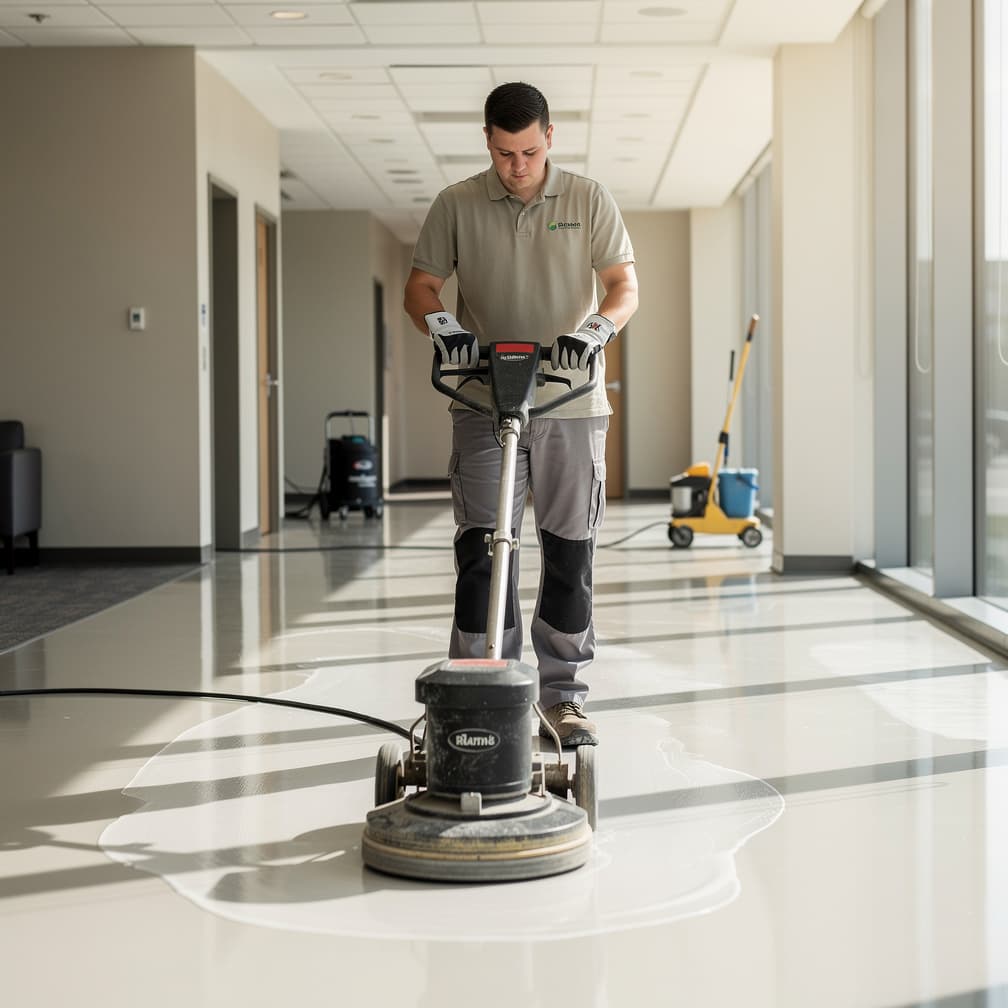

As a floor waxing service in Dayton, you work after hours in buildings you do not control, on surfaces you did not install. A client hands over a key and a deadline, and the risk transfers to you somewhere inside that handoff. Floor waxing service insurance in Dayton exists for the hour between the last coat and the first person who walks on it. That hour is when a slip becomes a lawsuit and a spilled drum of finish becomes somebody else's flooring bill. Your contract already decided who pays, and vendor agreements push it back onto the vendor. Check whether the limit you carry matches the limit you promised in writing. A mismatch there shows up on the worst possible day.
What Makes Dayton Different
Deductibles decide how much of a small loss you absorb before anything responds at all. Most floor damage claims are small, which means most of them land inside your deductible anyway. Setting it high lowers the monthly number and raises the size of the loss you eat. Setting it low does the reverse, and small claims filed often can push your renewal upward. Neither choice is wrong; the wrong move is picking one without knowing your own loss pattern. Count last year's out-of-pocket floor repairs before you shop Dayton coverage, and then choose deliberately. A number chosen for the quote sheet rather than the business is a number that hurts. Bring that history to participating carriers in Ohio and let it argue on your behalf.
Local Risk Factors in Dayton
A shop roof opened by wind puts every machine you own at risk in a single night. Burnishers and auto-scrubbers do not survive water and debris, and replacing them is not a purchase a small crew absorbs between jobs. The job booked in Dayton still needs doing, and the account will call somebody else if you cannot arrive with equipment. A Business Owners Policy may help cover both the building damage and the contents, though the equipment schedule inside it has to actually list what you own. A machine bought last spring and never added is a machine nobody is going to replace. Check the schedule in Montgomery County against the shop floor, not against your memory.
What Coverage Does a Floor Waxing Service in Dayton Need?
General Liability
Property managers name this line on every vendor certificate they hand out, and for a floor waxing crew the reason is a visitor who falls on a hallway you just finished. It may respond to third-party injury and to damage you cause to a client's walls, fixtures, or adjacent carpet. Damage to the floor you were actually working on is commonly excluded.
Example: A tenant crosses a lobby before the finish has cured, goes down, and files a claim through the building. Defense and settlement costs might fall to your liability limits, depending on how the form reads.
Commercial Property
Rising water sits outside this form, which surprises owners who assume water is water. What it might help cover is your shop and what fills it: burnishers, auto-scrubbers, drums of finish, and pads, against causes like fire, theft, and a burst pipe. Equipment kept in a trailer or a client's closet can fall outside a basic form, so where machines sleep belongs on the application.
Example: Someone cuts the lock on your shop overnight and two burnishers are gone before the first job of the morning. Replacement of the scheduled equipment could be addressed, less your deductible.
Workers Compensation
Payroll is the rating basis here, and the exposure is a crew that lifts heavy machines, hauls drums, and works on wet surfaces after hours. It is intended to handle medical costs and lost wages when a helper is hurt on the job. Thresholds vary by state, and many contracts demand proof whatever the threshold happens to say.
Example: A helper carrying a burnisher down a stairwell slips on a damp landing and tears a shoulder. Medical bills and time away from work would typically be handled through this line.
Business Owners Policy
Where General Liability answers for other people and Commercial Property answers for your own things, this packages both into one form, which usually means one certificate and one renewal for a small crew. It is generally meant for smaller operations, and the property limits inside it deserve a hard read against your real equipment list. Employee injuries stay outside it.
Example: A pipe bursts above the shop in Dayton overnight, soaking pads, stock, and an auto-scrubber, while a client separately claims a gouged door frame. One policy might pick up both, up to the limits you chose.
How Much Does Floor Waxing Service Insurance Cost in Dayton?
Floor Waxing Service Insurance is a bundle of separate policies, priced separately. The ranges below are typical figures for Dayton for each line, except workers compensation, which is set by the state fund; a quote prices each one against your own operations.
| Coverage | Typical range | What moves your price |
|---|---|---|
| General Liability Insurance | $65 - $200 per month | Industry and risk classification, annual revenue, number of employees |
| Commercial Property Insurance | $45 - $130 per month | Building value and construction type, roof age and condition, fire protection class |
| Workers Compensation Insurance | Set by the state fund | Employee classification codes, total annual payroll, experience modification rate |
| Business Owners Policy Insurance | $80 - $240 per month | Annual revenue and industry class, building and contents values, square footage and building age |
Prices shown are general estimates, not guaranteed rates or quotes. Your actual premium will depend on the insurer, coverage selected, business details, location, claims history, and other underwriting factors. Learn about our pricing methodology.
What Are the Insurance Requirements for a Floor Waxing Service in Dayton?
Workers' comp is generally required once you have your first employee, through the state fund. Ohio runs workers' compensation through a state fund: employers buy coverage from the Ohio Bureau of Workers' Compensation (BWC), not from private carriers. Common exemptions include sole proprietors, partners, and LLC members. Confirm current requirements directly with the fund before you hire.
Flood damage is typically excluded from standard policies. Standard commercial property and builders-risk-type policies typically exclude flood damage. Flood exposure varies address by address, so check your premises in FEMA's Flood Map Service Center before deciding; if you sit in a mapped flood zone, a separate policy through the National Flood Insurance Program is the usual starting point.
Where to verify licensing and coverage rules. The Ohio Department of Insurance publishes consumer guidance and current insurance requirements for Ohio businesses. When a contract or lease demands specific wording, the Ohio Department of Insurance's guidance is the authoritative place to check.
Get Your Floor Waxing Service Quote in Dayton
Compare rates from multiple carriers. Free quotes, no obligation.
Operating in Dayton
- Bidding against a lower price tempts you to shave the insurance line, because it is the one item on the sheet that no client checks until the day it finally matters.
- A property manager can refuse you the door code until a certificate naming the right entity is on file, so a lapse lasting a single week in Dayton can cost you a full night of billable work.
- Buffers walk sideways whenever the operator's eyes stay on the pad, which is why gouged baseboards and dented door frames generate more small claims for this trade than anything the wax itself touches.
- Work in occupied buildings happens after the tenants leave, so the people who slip on your finish are strangers who never signed anything with you. An injury to a Dayton tenant still begins with the building's own incident report.
How to Buy: Advice for Dayton Owners
Timing beats price on this decision. Buy before the first contract is signed, because a service agreement can commit you to limits and endorsements no policy you already own will deliver. Buy before the season fills, because an endorsement request in the middle of a busy stretch takes days you do not have. Buy before you hire, because Workers Compensation should exist the day a helper first lifts a machine, not the week afterward. General Liability can often be bound quickly; changes to it cannot. Requirements vary by state, so check the Ohio Department of Insurance's guidance before deciding what your Dayton work needs in place. When you are ready, CPK compares quotes from participating carriers on your calendar rather than on a renewal notice's.
FAQ
Floor Waxing Service Insurance in Dayton: FAQ
It depends heavily on where they were sitting. Commercial Property can respond to theft from your own premises, while equipment left in a trailer, a storage unit, or a client's closet can fall outside a basic form. Ask that question specifically before you buy, naming the actual places your machines sleep across Montgomery County. A stolen burnisher stops the next morning's job whether or not anything responds.
It bundles liability with coverage for your own property, which suits many small operations and produces one certificate instead of two. What it will not do is stretch to employee injuries, which sit with workers compensation, and the property limits inside a packaged policy deserve a careful read against your actual equipment list. Bundling buys convenience, and convenience is not the same as completeness.
That is third-party property damage, and General Liability could respond depending on the wording and the exclusions in your form. The argument is usually about scope: a building will price the whole run rather than the stained yard, because dye lots stop matching over time. Your deductible comes off your side of the number. Photograph the area before you start, every single time.
Yes, and it is in your interest to. After-hours work in occupied space is a different exposure from an empty warehouse, and an underwriter in Ohio pricing a guess prices for the worst case. A submission that describes the real work honestly gets a real number. It also avoids the far worse conversation where a claim arrives and the application described a different business.
Generally not by a standard property form. Flood is written and priced separately in most cases, which catches owners who assume water is water. Storm damage arriving through a damaged roof gets treated differently from water rising into the building, and that distinction decides who pays. If your machines and chemical stock sit anywhere near that risk in Montgomery County, ask about it before the season turns rather than after.
Once a policy is bound, a certificate is usually quick. Endorsements are the slow part: additional insured wording or a waiver of subrogation is a change to the policy, and carriers differ on how fast they issue one. Start the week you win the Dayton account, not the night before the first coat goes down. A job that stalls on paperwork still costs you the crew's hours.
Sources
- 1.Ohio Department of Insurance(Ohio Department of Insurance publishes consumer guidance for insurance buyers.)
- 2.FEMA / FloodSmart(Flood coverage is typically purchased separately; FEMA administers the National Flood Insurance Program.)


