







































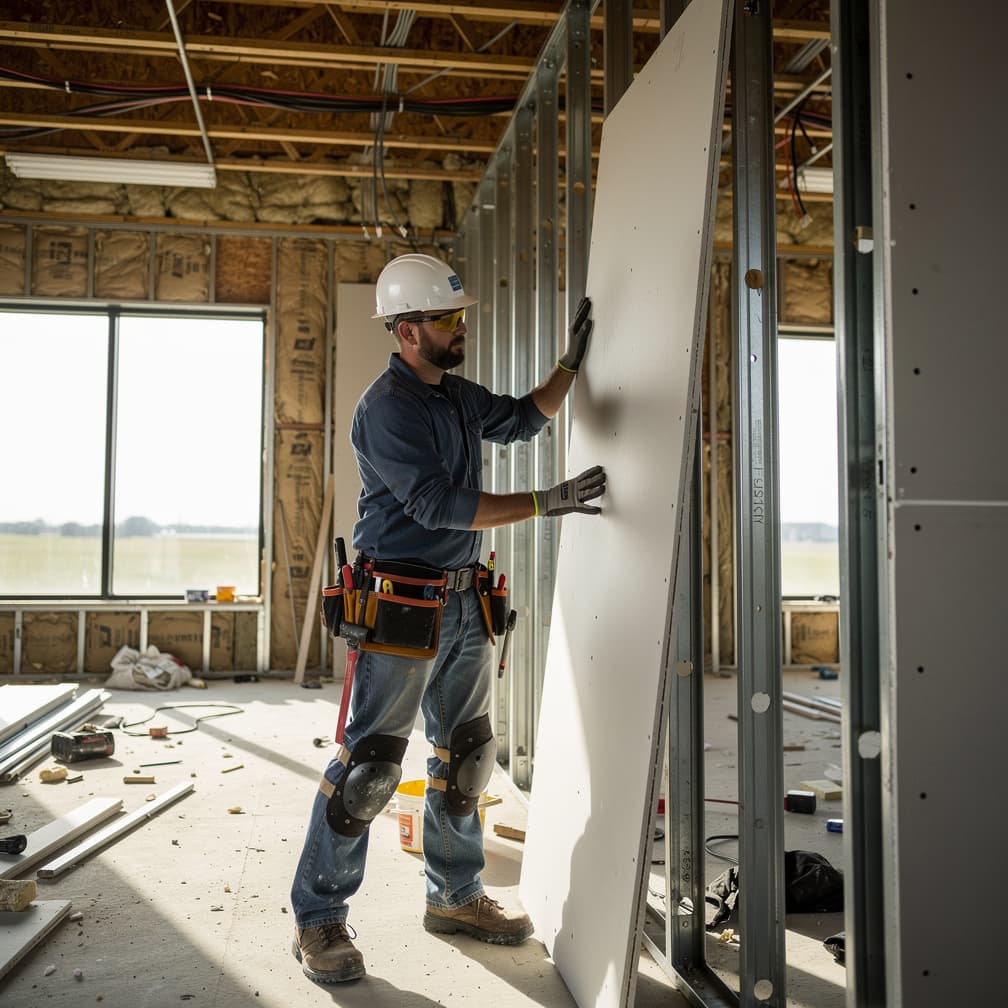

Philadelphia County has about 30,000 businesses, and a drywall crew ends up working inside a good number of them before the paint goes on. Each owner, general contractor and property manager sets its own insurance terms, and a dense market multiplies the number of separate contracts that can name you. Drywall contractor insurance in Philadelphia therefore gets bought against the strictest certificate you are likely to see, never the average one. The exposures do not change with the market: dust in an occupied suite, a cutout that clips a sprinkler line, a lift left overnight on a staging floor. What changes is how fast a superintendent can replace you when your paperwork lapses. Read the limits and the additional insured wording before you read the premium.
What Makes Philadelphia Different
Classification is where drywall pricing gets decided, and it happens before anyone looks at your safety record. Payroll gets slotted into a class, and the class carries the rate that multiplies everything after it. Misclassified payroll is a slow leak: it can undercharge you for a year, then correct itself at audit. An audit bill in the middle of a busy season is nobody's idea of a good surprise. With about 20 drywall contractors in Philadelphia County, an underwriter has deep comparison data on how this trade gets hurt. That data, rather than your opinion of your crew, sets the starting point for the Philadelphia quote you see. What you control is the accuracy of the numbers you hand over and the deductible you accept. Give them clean figures, since a quote built on a guess is only a bill deferred.
Local Risk Factors in Philadelphia
A flooded building becomes drywall work, and that is the strange part of this trade: the disaster that stops you also feeds you. Before the rebuild starts, though, your own property is the exposure. Sheets staged on a subfloor, buckets of compound, a lift plugged in at ground level, a truck parked low: all of it can be underwater while nobody is on site. Commercial Auto can be the line that matters for a vehicle caught in rising water, depending on the comprehensive terms you bought. What a standard property form does with flood is usually nothing at all, which is why the federal program sits alongside it. If a Philadelphia job regularly takes you onto low ground in Pennsylvania, ask where your material and vehicles actually sit in that structure.
What Coverage Does a Drywall Contractor in Philadelphia Need?
General Liability
Builders, property managers and homeowners ask for this one by name before you unload a cart. General Liability is meant for the harm your work does to other people and their property: the visitor who trips on a cord, the gouged floor, the window cracked by a sheet on the turn. Correcting your own taping generally sits outside it.
Example: A finished stair tread splinters as a sheet comes around the landing in Philadelphia, and the homeowner wants it replaced before the walkthrough; General Liability may take the repair and the argument that follows.
Workers Compensation
Stilts, overhead lifting and a hundred sheets a day are what this line gets priced against. Workers' Compensation typically handles medical care and lost wages when an employee is hurt on the job, and it is rated per $100 of payroll rather than as a flat monthly figure. It does nothing for a helper who carries no coverage of their own, which is why certificates get collected first.
Example: A taper steps off stilts wrong and tears a shoulder mid-shift; Workers' Compensation is generally where the treatment and the missed weeks get handled.
Commercial Auto
Your coverage for the wall stops at the curb. Commercial Auto is intended for the truck and trailer that haul board, compound, lifts and ladders between jobs, and it prices vehicles, drivers, radius and use. Personal auto policies commonly exclude business use, so hauling material for pay usually needs this instead. Cargo riding inside is often a separate conversation.
Example: A trailer of sheets gets clipped merging onto a ramp and half the load is scrap; Commercial Auto could answer for the truck, with the cargo question depending on how it was scheduled.
Tools & Equipment (Inland Marine)
A lift left overnight on a staging floor you do not own is the gap this line exists to close. Inland Marine is built for mobile property: the lift, the stilts, the lasers, the screw guns, the compressor, and material in transit. What you recover typically tracks the values you declared. Wear, rust and gear you never listed generally stay yours.
Example: Somebody cuts the lock on a box truck parked overnight for a Philadelphia job and the screw guns and the laser go with it; Inland Marine might cover the replacements, subject to your schedule and deductible.
How Much Does Drywall Contractor Insurance Cost in Philadelphia?
Drywall Contractor Insurance is a bundle of separate policies, priced separately. The ranges below are typical figures for Philadelphia for each line, except workers compensation, which is rated per $100 of payroll; a quote prices each one against your own operations.
| Coverage | Typical range | What moves your price |
|---|---|---|
| General Liability Insurance | $160 - $500 per month | Industry and risk classification, annual revenue, number of employees |
| Workers Compensation Insurance | $0.75 - $2.74 per $100 of payroll | Employee classification codes, total annual payroll, experience modification rate |
| Commercial Auto Insurance | $250 - $700 per month | Fleet size and vehicle types, driver records and experience, coverage limits and deductibles |
| Inland Marine Insurance | $40 - $160 per month | Total insured value of the scheduled property, type and age of the equipment, where it is stored and how far it travels |
Prices shown are general estimates, not guaranteed rates or quotes. Your actual premium will depend on the insurer, coverage selected, business details, location, claims history, and other underwriting factors. Learn about our pricing methodology.
What Are the Insurance Requirements for a Drywall Contractor in Philadelphia?
Workers' comp is generally required once you have your first employee. Pennsylvania generally requires employers to carry workers' compensation at that point. Common exemptions include sole proprietors, general partners, and some agricultural workers. Confirm current thresholds with your state's workers' compensation agency before you hire.
State auto liability minimums apply to business vehicles. Pennsylvania's minimum auto liability limits are $15,000/$30,000/$5,000 (bodily injury per person / per accident / property damage). Contracts and lenders often require more than the state floor.
Where to verify licensing and coverage rules. The Pennsylvania Insurance Department publishes consumer guidance and current insurance requirements for Pennsylvania businesses. When a contract or lease demands specific wording, the Pennsylvania Insurance Department's guidance is the authoritative place to check.
Get Your Drywall Contractor Quote in Philadelphia
Compare rates from multiple carriers. Free quotes, no obligation.
Operating in Philadelphia
- A trailer of board and compound is cargo, and a shifted load that cracks half the sheets is a loss before the first screw ever goes in.
- Certificates get rejected over a misspelled entity name more often than over missing coverage, and a rejected certificate can cost a small job its entire margin.
- Payroll estimates made in a slow season get trued up at audit after a busy one, which is how a good year turns into an unexpected bill.
- General contractors in a thin market compare notes, so one disputed seam in Philadelphia can quietly cost you the next three bids across Philadelphia County.
How to Buy: Advice for Philadelphia Owners
Timing beats shopping. Buy before the contract is signed, because an exhibit you already agreed to is a requirement you now have to meet at whatever price exists that week. Renewal is the moment to add limit cheaply; the week before a start date is the moment you pay for urgency. If you are adding a truck or a lift, tell the carrier when it arrives instead of letting the audit find it. Workers' Compensation follows payroll in real time, so a seasonal crew and a flat estimate rarely end well. Commercial Auto follows drivers, and a new driver on an old policy is a conversation to have early. The Pennsylvania Insurance Department publishes consumer guidance on mid-term policy changes and audits. Give yourself a few weeks before a Philadelphia start date to compare quotes from participating carriers rather than accepting whatever clears the deadline.
FAQ
Drywall Contractor Insurance in Philadelphia: FAQ
Whenever the policy renews, whenever a limit or an entity name changes, and whenever a new party asks to be named. Many builders want a fresh one per project, so an annual document may not clear a new site. Treat it as a running list rather than a one-time errand, because a lapse in Philadelphia can idle a crew that had work waiting. Requests get rejected over spelling surprisingly often.
Nearly every builder answers that question inside the subcontract. Proof of coverage is usually required before you are allowed on site, and a start date in Philadelphia can slip while a certificate gets sorted out. The party hiring you sets the terms, so read the insurance exhibit attached to your agreement rather than assuming a universal rule exists. General Liability is the line those exhibits name most often.
Payroll comes first, since the people on the wall carry the risk. Vehicles come next, because a loaded truck and trailer are the largest thing you move each day. Then the equipment values you declare, and behind all of it your claims history. Work mix matters too, as occupied remodels read differently to an underwriter than open shells. Limits and deductibles move the final number, and those parts you choose yourself.
Whoever owns or controls the space you are about to work inside. That can be a general contractor, a building owner, a property manager, an association, or a lender standing behind a renovation. A property manager in Philadelphia County can hold your site access until the document names the right entity. Getting that entity name exactly right matters more than crews expect, because a rejected certificate costs days.
It means your policy extends certain rights to the party who hired you, so a claim against them may be handled under your coverage instead of theirs. The certificate alone does not create that status. An endorsement does, and the endorsement wording decides how far it reaches. Blanket forms pick up whoever your contract requires; scheduled forms name parties one at a time. Ask which one you actually hold.
Usually not the rework itself. The cost of correcting your own workmanship is the classic gap, and General Liability tends to look instead at damage resulting from the work, such as ruined flooring under a failed seam. Labor and material to refinish your own joints generally sit on your side of the line. Read the form language, because this varies, and price that risk into the bid.
Sources
- 1.U.S. Census Bureau, County Business Patterns (2022), Philadelphia County(Philadelphia County has about 30,000 business establishments.)
- 2.U.S. Census Bureau, County Business Patterns (2023), Philadelphia County(Philadelphia County has about 20 businesses in this trade's category (NAICS group 238310).)
- 3.Pennsylvania Insurance Department(Pennsylvania Insurance Department publishes consumer guidance for insurance buyers.)


