







































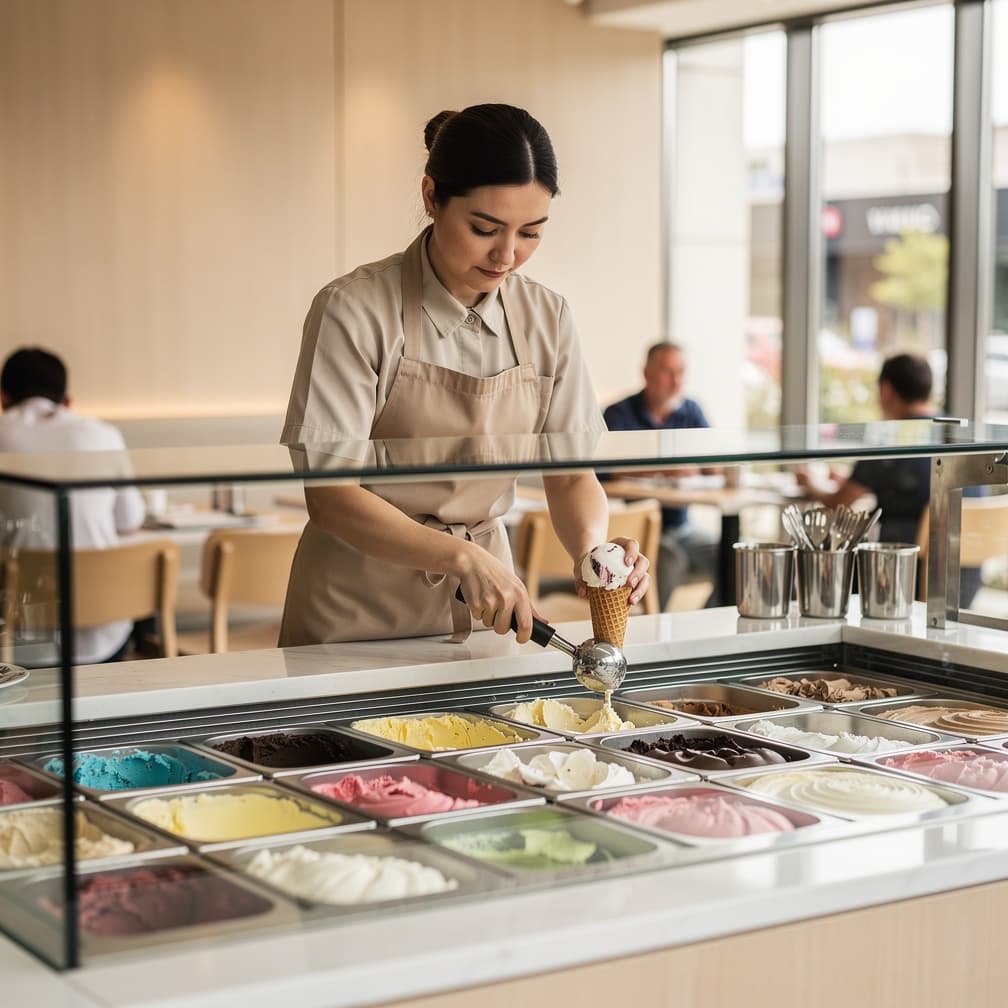

As an ice cream shop in Pittsburgh, you carry more value in frozen inventory than the storefront next door keeps on its shelves, and it can be worthless in six hours. That exposure is the one owners under-insure most, because it looks like stock and behaves like cash. Ice cream shop insurance in Pittsburgh should be read for its spoilage terms first: what counts as spoilage, what triggers it, and how long the power has to be out. The customer side is more familiar and no less expensive, since one slip near the counter can generate legal fees for a year. Payroll and claims history set most of the price. Make each quote spell out its spoilage trigger before you compare anything else.
What Makes Pittsburgh Different
Deductibles are where a Pittsburgh owner quietly trades premium for risk, and frozen stock sharpens that trade. A spoilage loss is often modest in dollars and easy to repeat, the worst shape for a high deductible. Two power failures in one summer can both fall under the deductible and cost you the inventory twice. Property deductibles and liability deductibles are separate numbers, and a quote may move only one of them. In a crowded market, restoration vendors price to demand, so a cleanup bill can run higher than expected. That pushes the real cost of a small loss above the number you assumed when choosing a deductible. Run the arithmetic on two bad events rather than one before accepting a higher deductible in Pittsburgh. The premium you save on paper rarely survives its first contact with a second claim.
Local Risk Factors in Pittsburgh
Flooding reaches an ice cream shop at the worst possible level: the floor, where the walk-in compressor, the electrical panel, and the display cases all sit. Water coming in under a storefront door in Pittsburgh can cut power to the freezers before it damages anything else, and the stock goes first. Cleanup after floodwater runs slower than after a burst pipe, because contamination rules govern anything that touched a food surface. Standard commercial property forms typically exclude flood, which surprises owners reading the policy for the first time after a storm in Pennsylvania. Flood coverage gets priced and bought separately, so it is a decision rather than an assumption. Check what your form actually says before the season when Allegheny County sees water.
What Coverage Does an Ice Cream Shop in Pittsburgh Need?
General Liability
Landlords, event organizers, and lenders ask for this one by name before they hand over keys, a booth, or a loan. It can help with third-party bodily injury, damage you cause to someone else's property, and advertising injury claims tied to how you promote the shop. Injuries to your own staff sit outside it and belong on a different line entirely.
Example: A child slips on a melted drip beside the condiment station and the family's lawyer sends a letter two months later; general liability may respond to the defense and any settlement.
Commercial Property
Flood and gradual wear sit outside this form, which is worth knowing before you lean on it. What remains is your side of the building: display cases, soft-serve machines, the walk-in, signage, and the improvements you paid to install. Frozen stock usually falls under a sublimit of its own, and that number deserves a slow look.
Example: Storm-driven debris breaks the storefront glass of a shop in Pittsburgh and rain reaches the cases overnight; commercial property is generally intended to help with the repairs and the fixtures behind them.
Business Owners Policy
Where liability and property are usually bought as two decisions, this one packages them into a single form, often at a better price for a counter this size. The bundle can also carry interruption terms for a closure caused by covered damage. Its sublimits, on frozen stock above all, are where it either fits your shop or does not.
Example: A compressor quits from a covered cause and the counter stays shut four days while a technician is found; a business owners policy could help with the spoiled product and the income lost.
Workers Compensation
Employee injuries are what this line exists for: a wrist caught in a mixer, a burn from a hot fudge well, a fall on a floor that never stays dry through a rush. Medical costs and a share of lost wages are typically what it addresses. Rules on who must carry it vary by state, and it prices against payroll rather than revenue.
Example: A part-time scooper slips carrying a tub out of the walk-in and misses three weeks of shifts; workers compensation is meant to pick up the treatment and part of those wages.
How Much Does Ice Cream Shop Insurance Cost in Pittsburgh?
Ice Cream Shop Insurance is a bundle of separate policies, priced separately. The ranges below are typical figures for Pittsburgh for each line, except workers compensation, which is rated per $100 of payroll; a quote prices each one against your own operations.
| Coverage | Typical range | What moves your price |
|---|---|---|
| General Liability Insurance | $65 - $180 per month | Industry and risk classification, annual revenue, number of employees |
| Commercial Property Insurance | $85 - $290 per month | Building value and construction type, roof age and condition, fire protection class |
| Business Owners Policy Insurance | $110 - $340 per month | Annual revenue and industry class, building and contents values, square footage and building age |
| Workers Compensation Insurance | $0.75 - $2.74 per $100 of payroll | Employee classification codes, total annual payroll, experience modification rate |
Prices shown are general estimates, not guaranteed rates or quotes. Your actual premium will depend on the insurer, coverage selected, business details, location, claims history, and other underwriting factors. Learn about our pricing methodology.
What Are the Insurance Requirements for an Ice Cream Shop in Pittsburgh?
Workers' comp is generally required once you have your first employee. Pennsylvania generally requires employers to carry workers' compensation at that point. Common exemptions include sole proprietors, general partners, and some agricultural workers. Confirm current thresholds with your state's workers' compensation agency before you hire.
Flood damage is typically excluded from standard policies. Standard commercial property and builders-risk-type policies typically exclude flood damage. Flood exposure varies address by address, so check your premises in FEMA's Flood Map Service Center before deciding; if you sit in a mapped flood zone, a separate policy through the National Flood Insurance Program is the usual starting point.
Where to verify licensing and coverage rules. The Pennsylvania Insurance Department publishes consumer guidance and current insurance requirements for Pennsylvania businesses. When a contract or lease demands specific wording, the Pennsylvania Insurance Department's guidance is the authoritative place to check.
Get Your Ice Cream Shop Quote in Pittsburgh
Compare rates from multiple carriers. Free quotes, no obligation.
Operating in Pittsburgh
- About 360 ice cream shops share Allegheny County, and after a regional outage every one of them calls the same restoration vendors on the same morning.
- A Pittsburgh summer schedule can double your headcount for twelve weeks, and payroll reported at winter levels gets corrected at the year-end audit rather than forgiven.
- Cash in the till usually sits under a small sublimit on a property form, so a break-in that takes the drawer and the display glass produces two very different recoveries.
- A power failure that starts on a utility line outside your Pittsburgh building may fall outside a property form entirely unless utility service interruption was added by endorsement.
How to Buy: Advice for Pittsburgh Owners
Walk your shop with a notepad and price everything that plugs in. Soft-serve machines, batch freezers, display cases, the walk-in, and the counter mixers are the assets a quote needs listed, with model and age. Compressors over a decade old change how an underwriter reads the risk, and equipment breakdown terms are worth asking about by name. Commercial Property is the line those items sit under, though the stock inside the freezer often carries its own separate limit. A Business Owners Policy can bundle the same equipment with your liability cover, and the sublimits inside decide what the stock is worth. Photograph the serial plates while you are there, because a claim moves faster when the paperwork already exists. The Pennsylvania Insurance Department publishes consumer guidance on documenting a commercial property loss. With the list finished, CPK puts participating carriers side by side on the same Pittsburgh equipment schedule.
FAQ
Ice Cream Shop Insurance in Pittsburgh: FAQ
A Business Owners Policy bundles liability and property into one form, which usually suits a counter this size. It does not carry employee-injury coverage, and it does not guarantee a stock limit large enough for a full freezer. The sublimits inside the bundle are where your real answer lives. Read the spoilage limit, the equipment breakdown terms, and the interruption waiting period before assuming the bundle is complete.
Annual revenue, payroll broken out by job, square footage for your Pittsburgh location, an equipment list with ages, the value of stock at full inventory, and loss runs from the last five years. Guessed payroll gets corrected at audit, which turns a low quote into a bill you did not plan for. Photographs of the walk-in and the service area help underwriters who cannot visit in person.
Generally not. Property forms respond to sudden and accidental damage and typically exclude wear, tear, and gradual deterioration, which is exactly how an old compressor dies. Equipment breakdown terms can change that answer for a mechanical failure, and they are worth requesting by name. Either way, a maintenance record is what separates a sudden failure from a neglected one in an adjuster's file.
Rarely. A landlord's policy usually answers for the building shell, while the fixtures, equipment, and improvements you installed remain yours to insure. Tenant improvements and betterments is the phrase to look for on your own quote, and for a shop with a full build-out it is often the largest number on the schedule. A Pittsburgh lease normally spells the split out; get it in writing before both sides assume the other one has it.
Bodily injury claims tied to food are usually handled under the products and completed operations part of General Liability, which sits inside the policy most shops already carry. It can help with defense and any settlement, though deliberate mislabeling is a different matter and is typically excluded. Ingredient lists, allergen signage, and staff training are what keep the claim from starting at all.
Vandalism and theft are commonly named perils on a commercial property form, so broken glass, damaged signage, and a stolen till may fall inside it. What tends to be limited is cash itself, which usually sits under a small sublimit. If your Pittsburgh shop keeps an outdoor setup, ask whether property in the open is scheduled, because it frequently is not.
Sources
- 1.U.S. Census Bureau, County Business Patterns (2023), Allegheny County(Allegheny County has about 360 businesses in this trade's category (NAICS group 722515).)
- 2.Pennsylvania Insurance Department(Pennsylvania Insurance Department publishes consumer guidance for insurance buyers.)
- 3.FEMA / FloodSmart(Flood coverage is typically purchased separately; FEMA administers the National Flood Insurance Program.)


