







































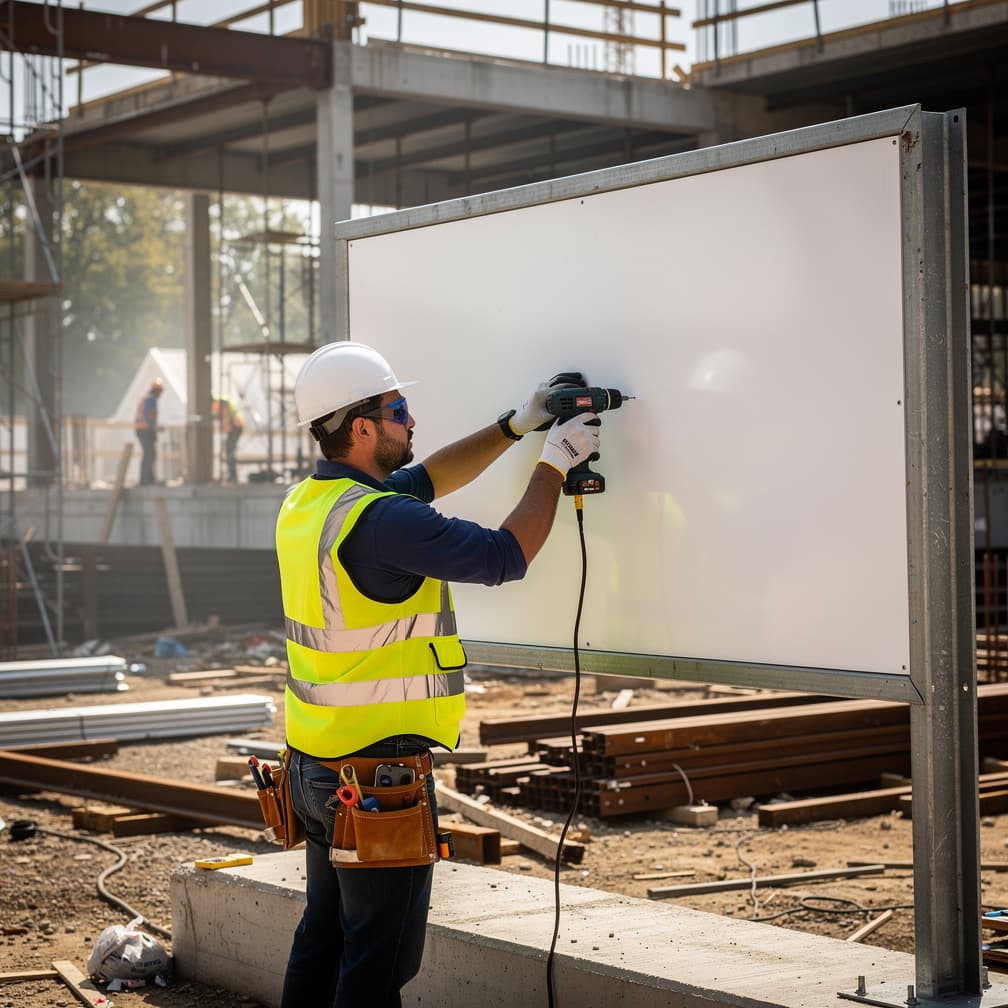

Anchor bolts driven into an unknown wall are a guess until the sign hangs on them, and a guess that fails damages somebody else's facade. Dense markets stack the parties on top of that risk: Dallas County has about 70,500 businesses, and a landlord, a tenant, and a general contractor can all end up on one claim file. Sign installation contractor insurance in Grand Prairie ends up answering to every one of them, including parties who never signed your work order. So the additional-insured wording on a certificate matters as much as the monthly premium does. Limits get tested by the building you mounted to, and buildings are expensive. The sections ahead break down what each line handles for sign work and what it quietly leaves out, so the gaps get priced by you rather than by a contract.
What Makes Grand Prairie Different
Competition in a large market shows up in your policy long before it shows in your pricing. Bigger clients bring bigger insurance requirements, and the requirements are the real barrier to entry. A shop carrying minimum limits simply cannot bid the work a facility team is putting out. So the limit becomes a sales tool, which is a strange thing to say about insurance. It is also why underinsured crews stay stuck on the small jobs by default. Raising a limit with a participating carrier in Texas usually costs far less per dollar than the first dollar of coverage did. Ask what the next tier of work in Grand Prairie requires before you renew at last year's numbers. The bid list you actually want is the one your certificate already qualifies you for.
Local Risk Factors in Grand Prairie
Tornadoes and severe storms hit a sign contractor from two directions at once. The first is your own yard, where panels, hardware, and a trailer can be scattered or crushed in minutes. The second is your client list, since every sign that came down is a service call, and the calls all arrive together. Working at height on a wall that just took a beating is a different job than the one you bid last month. Commercial Property can respond to storm damage at your premises in Grand Prairie, subject to the perils your form names and the deductible you picked. Ask what it says about property in the open, which is where a sign yard in Texas lives.
What Coverage Does a Sign Installation Contractor in Grand Prairie Need?
General Liability
Landlords, general contractors, and franchise facility teams ask for this one by name before a lift ever touches their property. It could respond when your work damages a customer's building or injures somebody nearby, and completed-operations wording extends that reach to failures showing up after you leave. Damage to the sign itself, caused by your own faulty work, is typically excluded.
Example: A channel letter slips during a second-story mount and cracks the storefront glass below; general liability can help cover the window, the cleanup, and the claim the tenant files afterward.
Workers Compensation
Injuries to your own crew sit outside General Liability, and that gap is what this line fills. A fall from a lift, a shoulder torn lifting a panel, or heat illness on a roof deck may be handled here, including medical bills and a portion of lost wages. Requirements vary by state, and the Texas Department of Insurance publishes the current requirements for employers in Texas.
Example: A groundman steadying a pylon panel takes the weight wrong and tears a shoulder; workers compensation is generally where the surgery and the missed weeks get sorted out.
Commercial Auto
Trucks, trailers, and the lift towed behind them are business vehicles, and personal auto policies commonly exclude business use altogether. This line rates on what you drive, how far, and who is behind the wheel. It might answer for damage you cause in a parking lot as well as damage to your own vehicle. Tools riding inside are a separate question worth asking about.
Example: Backing a bucket truck into a tight lot in Grand Prairie, your crew catches a parked sedan's fender; commercial auto is typically the line that settles that repair.
Commercial Property
Everything the other lines ignore lives here: the shop, the fabrication equipment, the vinyl and substrate on the racks, and finished panels waiting on an install date. Fire, theft, and named storm perils are the usual causes of loss. Flood is typically excluded and priced separately, and tools away from the premises often fall outside this form as well.
Example: Somebody cuts the lock on your yard overnight, and the ladders, hardware, and two pallets of substrate are gone by morning; commercial property may pick up the replacement cost.
How Much Does Sign Installation Contractor Insurance Cost in Grand Prairie?
Sign Installation Contractor Insurance is a bundle of separate policies, priced separately. The ranges below are typical figures for Grand Prairie for each line, except workers compensation, which is rated per $100 of payroll; a quote prices each one against your own operations.
| Coverage | Typical range | What moves your price |
|---|---|---|
| General Liability Insurance | $230 - $750 per month | Industry and risk classification, annual revenue, number of employees |
| Workers Compensation Insurance | $0.75 - $2.74 per $100 of payroll | Employee classification codes, total annual payroll, experience modification rate |
| Commercial Auto Insurance | $390 - $1,075 per month | Fleet size and vehicle types, driver records and experience, coverage limits and deductibles |
| Commercial Property Insurance | $140 - $490 per month | Building value and construction type, roof age and condition, fire protection class |
Prices shown are general estimates, not guaranteed rates or quotes. Your actual premium will depend on the insurer, coverage selected, business details, location, claims history, and other underwriting factors.
What Are the Insurance Requirements for a Sign Installation Contractor in Grand Prairie?
Workers' comp is not mandatory for most private employers here. Texas leaves workers' compensation optional for most private employers. Skipping it leaves injury costs on you, and many clients and general contractors still demand proof of it by contract — check the Texas Department of Insurance's guidance before deciding.
State auto liability minimums apply to business vehicles. Texas's minimum auto liability limits are $30,000/$60,000/$25,000 (bodily injury per person / per accident / property damage). Contracts and lenders often require more than the state floor.
Flood damage is typically excluded from standard policies. Standard commercial property and builders-risk-type policies typically exclude flood damage. Flood exposure varies address by address, so check your premises in FEMA's Flood Map Service Center before deciding; if you sit in a mapped flood zone, a separate policy through the National Flood Insurance Program is the usual starting point.
Where to verify licensing and coverage rules. The Texas Department of Insurance publishes consumer guidance and current insurance requirements for Texas businesses. When a contract or lease demands specific wording, the Texas Department of Insurance's guidance is the authoritative place to check.
Get Your Sign Installation Contractor Quote in Grand Prairie
Compare rates from multiple carriers. Free quotes, no obligation.
Operating in Grand Prairie
- Anchor conditions inside a wall stay unknown until you drill, and nobody hands you the drawings for a building you did not construct.
- Work in Dallas County can cross into a neighboring one before lunch, which puts more of your day on a highway than on a ladder.
- Deposits get spent on materials, so a job cancelled after fabrication leaves you holding a custom panel that nobody else will ever want.
- A client's opening date is the real deadline, and every delay you did not cause still arrives on your invoice as a complaint.
How to Buy: Advice for Grand Prairie Owners
Two numbers decide how a policy performs, and neither of them is the premium. The limit is what the policy can reach on your worst day; the deductible is what you fund before it reaches anything at all. Sign work argues for a limit well above the price of your average job, because the facade you mount to is worth more than the sign on it. Per-occurrence and aggregate are separate ceilings, and a bad year can exhaust the aggregate on General Liability while the per-occurrence figure still looks generous. Deductibles on Commercial Property are the place to take risk deliberately, since tools and materials are replaceable. Check the Texas Department of Insurance's guidance before deciding how much of a loss you want to own in Texas. Ask participating carriers to quote two limit options side by side rather than one.
FAQ
Sign Installation Contractor Insurance in Grand Prairie: FAQ
Typically no. Standard property forms generally exclude flood, and coverage for it is written separately through a federal program or a surplus carrier. That matters if you keep panels, vinyl, or electrical components at ground level. Commercial Property can respond to other water losses, such as a burst pipe, so ask which cause of loss you are actually buying.
It depends on why it failed. Completed-operations coverage under General Liability can respond to damage or injury caused by finished work, including an electrical connection that gives out later. Damage to the sign itself from your own faulty work is commonly excluded, since a policy is not a warranty on your craftsmanship. That distinction decides whether the repair comes out of your pocket.
Not automatically. A Commercial Property policy usually concentrates on what sits at your shop, and tools away from the premises can fall outside it unless the form or an endorsement addresses them. Ask specifically about equipment in transit and at a jobsite, since a sign crew's tools spend most of their life in neither spot. Keep serial numbers and photographs either way.
Two ceilings apply at once. The per-occurrence figure caps what a policy may pay on a single claim; the aggregate caps everything paid across the whole term. A sign shop with one bad fall and two cracked storefronts can burn through the aggregate while the per-occurrence number still looks healthy. Watch both, because the renewal after a year like that is a different conversation.
The deductible is the part of a loss you fund before the policy participates at all. Choosing a higher one lowers the premium and moves risk back onto you, which is a fair trade for replaceable tools and a poor one for a total shop loss. Picture a realistic claim, then pick the number you could write a check for tomorrow.
Usually yes, though territory and radius both show up on the application, and a wide operating radius gets rated. If most installs sit an hour or more from the shop, say so, because a carrier that priced you as a local operation may look at a highway claim differently. Describing the real footprint costs less than arguing about it afterward.
Sources
- 1.U.S. Census Bureau, County Business Patterns (2022), Dallas County(Dallas County has about 70,500 business establishments.)
- 2.Texas Department of Insurance(Texas Department of Insurance publishes consumer guidance for insurance buyers.)
- 3.FEMA / FloodSmart(Flood coverage is typically purchased separately; FEMA administers the National Flood Insurance Program.)


