







































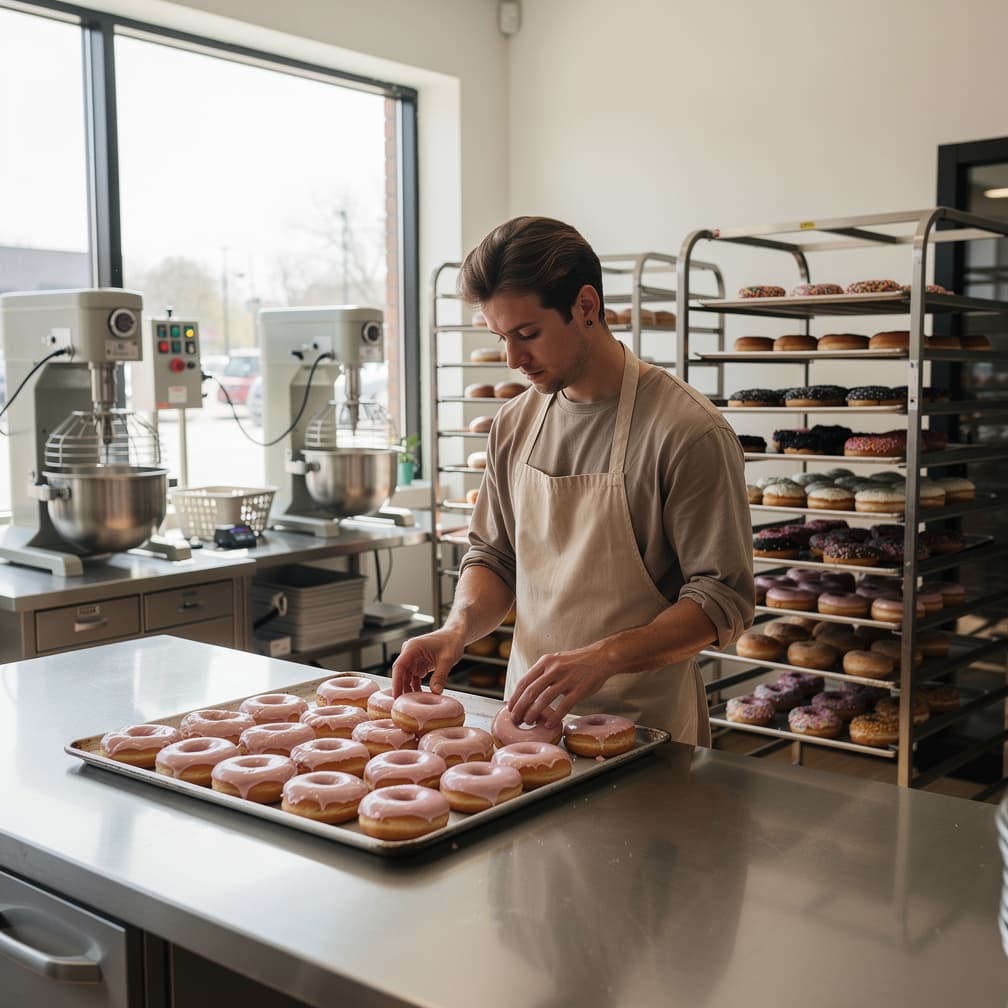

Refrigeration failing overnight is a quiet disaster: the cream filling, the dairy, and the prepped dough all go in the trash before the first customer knocks. Spoiled stock is only half of it, since a shop that cannot bake cannot sell, and the register stays at zero while a compressor gets replaced. Shopping donut shop insurance in Odessa without asking about equipment breakdown and lost income leaves that whole scenario on your side of the ledger. Fryers, proofers, and walk-in coolers age on their own schedule and rarely fail at a convenient hour. The value of what sits in your kitchen usually sets the property side of a quote. Read on for where the standard forms stop and what participating carriers in Texas price differently.
What Makes Odessa Different
A quote for a two-person window and a quote for a full production kitchen barely resemble each other. Equipment values do most of that work: fryers, proofers, sheeters, mixers, and refrigeration add up quickly. Underinsure them and you save a little every month until the month you actually claim. Replacement cost and actual cash value are different promises, and the cheaper one ages your equipment. Ask which basis a quote uses before you compare two numbers that look similar. A shop in Odessa with older equipment can face a real gap between payout and purchase price. Loss history matters too, and a small operation feels each claim more sharply at renewal. Fewer claims and an accurate equipment list are the two levers that move a Texas renewal your way.
Local Risk Factors in Odessa
Tornado and severe storm damage lands unevenly: the shop across the street loses a roof and yours loses the sign, the awning, and the rooftop condenser. That last one is the expensive line, because a shop without refrigeration is closed no matter how good the front counter looks. Commercial Property may respond to the structure, the equipment, and the stock, subject to your deductible and the valuation basis you picked. Debris cleanup and code upgrades during a rebuild carry their own limits that are easy to overlook. If a storm cuts across Odessa, the parts of a claim that stall are usually the ones nobody priced: a signage sublimit and the wait for a replacement rooftop unit somewhere in Texas.
What Coverage Does a Donut Shop in Odessa Need?
General Liability
Landlords, wholesale buyers, and permit desks all ask for this one by name, and it is the line that faces the far side of your counter. It can help cover bodily injury and property damage claims a third party brings against the shop, along with legal defense, subject to your limits. Injuries to your own staff belong somewhere else entirely.
Example: A customer carrying a coffee and a dozen box slips on glaze near the counter and fractures a wrist. The demand letter shows up four months later, and General Liability may pick up defense and settlement inside your limit.
Commercial Property
Rising water, ordinary wear, and a compressor that simply died are the usual exclusions; most of what else can wreck the shop is what this line exists for. Fryers, cases, fixtures, the fit-out you paid for, and the stock in the back can all be scheduled on it, valued at replacement cost or at depreciated value. That choice matters more than the premium does.
Example: A grease fire in the hood takes out the exhaust system, the fryer bank, and the ceiling over the production line. Commercial Property is the line built to answer for the rebuild and the ruined equipment, subject to your deductible and valuation basis.
Workers Compensation
A baker pulls a tray from the oven and catches the hot rack instead, and by mid-shift you are paying for an urgent care visit and an hour nobody worked. This is the line built for injuries on the clock, rated on payroll rather than on how careful the crew is. It generally addresses medical treatment and part of lost wages, and rules on who must carry it vary by state.
Example: Hot oil splashes when a basket goes in too fast, and a new hire spends the week at a burn clinic instead of on the line. Workers Compensation can carry the treatment and a share of the wages while the arm heals.
Business Owners Policy
Buying the liability side and the property side separately works fine; a Business Owners Policy stacks them into one form, with one renewal and one conversation. For a shop in Odessa it is the usual starting point. The trade-off is sublimits: cash, signage, and spoiled stock often sit under quiet caps, and mechanical breakdown may have to be added on.
Example: A break-in empties the register, cracks the storefront glass, and wrecks the display case in one night. The package may answer for the glass and the fixtures under a single claim number, while the cash tends to sit under its own small cap.
How Much Does Donut Shop Insurance Cost in Odessa?
Donut Shop Insurance is a bundle of separate policies, priced separately. The ranges below are typical figures for Odessa for each line, except workers compensation, which is rated per $100 of payroll; a quote prices each one against your own operations.
| Coverage | Typical range | What moves your price |
|---|---|---|
| General Liability Insurance | $70 - $200 per month | Industry and risk classification, annual revenue, number of employees |
| Commercial Property Insurance | $120 - $360 per month | Building value and construction type, roof age and condition, fire protection class |
| Workers Compensation Insurance | $0.75 - $2.74 per $100 of payroll | Employee classification codes, total annual payroll, experience modification rate |
| Business Owners Policy Insurance | $150 - $380 per month | Annual revenue and industry class, building and contents values, square footage and building age |
Prices shown are general estimates, not guaranteed rates or quotes. Your actual premium will depend on the insurer, coverage selected, business details, location, claims history, and other underwriting factors.
What Are the Insurance Requirements for a Donut Shop in Odessa?
Workers' comp is not mandatory for most private employers here. Texas leaves workers' compensation optional for most private employers. Skipping it leaves injury costs on you, and many clients and landlords still demand proof of it by contract — check the Texas Department of Insurance's guidance before deciding.
Flood damage is typically excluded from standard policies. Standard commercial property and builders-risk-type policies typically exclude flood damage. Flood exposure varies address by address, so check your premises in FEMA's Flood Map Service Center before deciding; if you sit in a mapped flood zone, a separate policy through the National Flood Insurance Program is the usual starting point.
Where to verify licensing and coverage rules. The Texas Department of Insurance publishes consumer guidance and current insurance requirements for Texas businesses. When a contract or lease demands specific wording, the Texas Department of Insurance's guidance is the authoritative place to check.
Get Your Donut Shop Quote in Odessa
Compare rates from multiple carriers. Free quotes, no obligation.
Operating in Odessa
- Word travels fast when someone gets sick, and a food-borne illness claim tends to arrive with a health department file already attached. Ask how a policy in Texas treats product-related injury before you need to know.
- Seasonal catering orders push holiday volume through the same small Odessa kitchen, and those extra hours land on the payroll figure your Workers Compensation is rated against.
- Renewal dates and lease dates drift apart quietly, and the week a buyer in Odessa asks for a current certificate is usually the week you discover yours expired.
- The morning rush is eighty people through one door in ninety minutes, and each of them walks past a counter, a beverage station, and a floor somebody just mopped. That traffic, not the recipe, is what a liability quote in Odessa prices.
How to Buy: Advice for Odessa Owners
Two knobs decide what a bad night costs you, and owners tend to fiddle with the wrong one. The deductible changes your monthly bill by a little; the limit changes your worst outcome by everything. Set the deductible at what the shop can absorb from cash without touching payroll, then leave it alone. Set the limit against the biggest realistic loss: a serious burn, a customer injury with a lawyer attached, or a fire that takes the kitchen and the unit above it. Ask how the per-occurrence limit and the annual aggregate interact, because one bad claim can spend the whole year's allowance. Forms in Texas word that interaction differently, so read it rather than assume it. Once both knobs are set, ask participating carriers to quote that exact structure for your Odessa shop, and compare like with like.
FAQ
Donut Shop Insurance in Odessa: FAQ
Rising water is typically excluded from a standard property form, and flood is priced as separate coverage. Water from a burst pipe or a roof leak is usually a different question with a different answer. If your shop sits near a waterway or at the bottom of a street, ask which of the two you actually bought. Federal flood program information is published by FEMA for businesses in Texas and everywhere else.
Yes, and the reason is arithmetic rather than honesty policing. A property limit is built on the values you reported, so a new fryer bank or a second proofer that never made the list is a gap you funded yourself. Adding equipment mid-term is a small endorsement. Discovering it after a fire is a shortfall nobody can fix.
Per-occurrence caps what any single incident can draw down. The aggregate is the ceiling across the whole term, and every paid claim eats into it. One serious customer injury can consume a large share of the aggregate, and a second claim that year finds less behind it than you assumed. Ask what the aggregate looks like after one paid claim; that answer separates two quotes in Texas that look identical on the monthly line.
It packages the liability and property sides into one form, which suits a lot of small shops. It is not the whole picture. Workers Compensation is rated on payroll and sits outside the package. Equipment breakdown, flood, and a higher cash limit are usually add-ons. Read the sublimits inside the package before you decide it is enough, because that is where the surprises live.
Ask what they need in writing first: the limit, the additional insured wording, and whether they want a waiver of subrogation. Then have your carrier issue a certificate that matches, along with any endorsement the contract names. A certificate is a summary; the endorsement is the thing that changes your policy. Sending the first without the second is how a delivery gets held at the door.
Usually not on its own. Lost income sections generally require physical damage, most often at your own address, before anything is triggered. A closed road, a power cut, or a slow week after bad weather may sit outside that trigger unless you bought an endorsement built for it. Ask what triggers the income section and what waiting period applies, in plain language, before you sign.
Sources
- 1.Texas Department of Insurance(Texas Department of Insurance publishes consumer guidance for insurance buyers.)
- 2.FEMA / FloodSmart(Flood coverage is typically purchased separately; FEMA administers the National Flood Insurance Program.)


