







































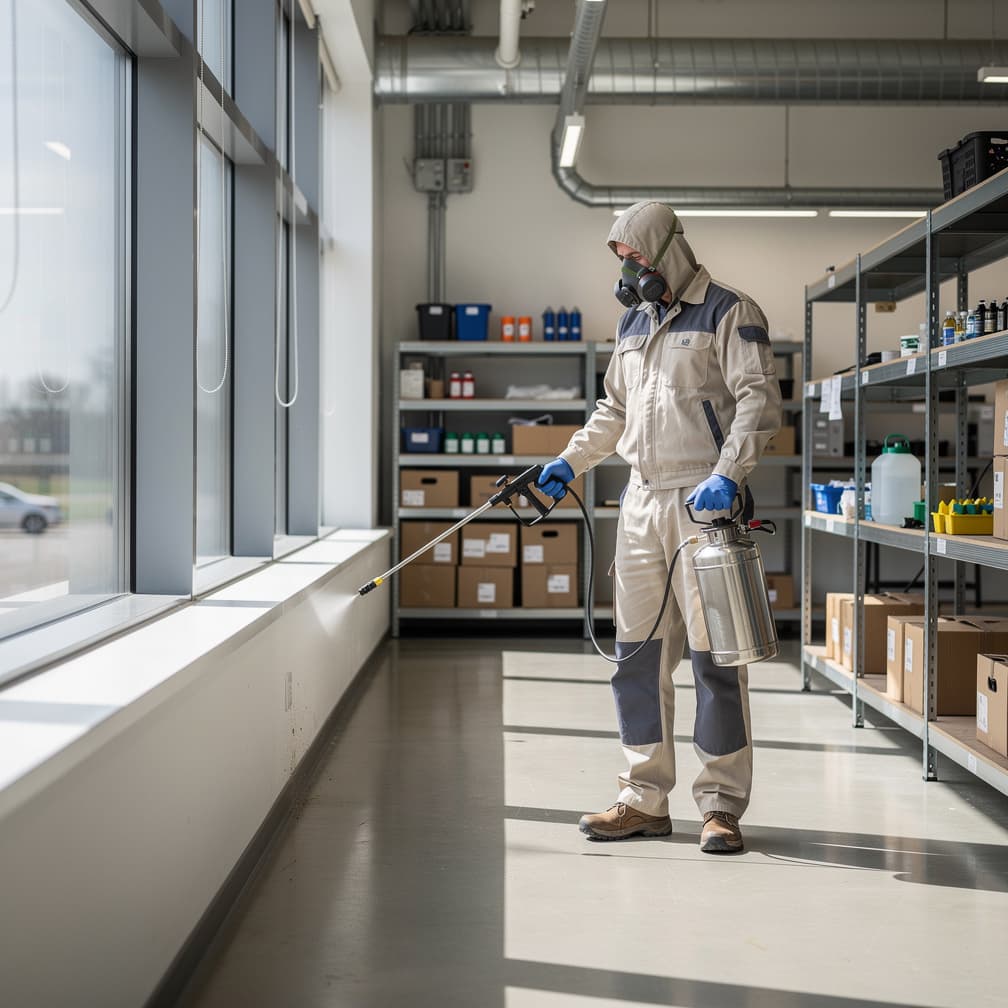

As a pest control business in Pasadena, you take on the food-safety anxiety of every restaurant on your route the day you sign them. A kitchen that fails an inspection after your visit will look for a reason, and your service ticket is the most recent document in the file. Pest control insurance in Pasadena gets tested by arguments about causation as often as by obvious accidents. Whether your treatment caused the loss can take months and lawyers to establish, and defense costs run the entire time. Restaurants also carry their own insurers, and insurers pursue whoever they can name. The service agreement you signed may already say who defends whom. Read the indemnity clause before you assume your limits are the only ones in play.
What Makes Pasadena Different
The market decides how much of your revenue rides on commercial accounts rather than kitchen tables. Harris County has about 110,000 businesses, and the density pulls route operations toward warehouses, restaurants, and multifamily buildings. Those buyers carry lawyers, insurers, and risk managers who all have opinions about your policy. A homeowner who dislikes a treatment complains; a facility with an insurer subrogates against you instead. That difference changes what a claim looks like from the day it opens. Third-party recovery efforts land on your carrier, and your carrier remembers them at renewal. Frequency of contact drives frequency of claims more reliably than anything else you control. Buy for the counterparty you actually serve, because they are the ones who will file.
Local Risk Factors in Pasadena
Before the season, walk your building and your vehicle schedule as though the storm has already been named. Where does the product live, what happens when power fails, and which trucks can leave Pasadena at all. Carriers in Texas commonly stop binding new coverage once a storm is named, so the window to change anything closes early and without warning. That timing rule catches more owners than any coverage gap does. Commercial property can help cover wind damage at your insured location, though the named-storm deductible usually applies before anything else does. Get the number, do the arithmetic once, and decide what you are actually carrying.
What Coverage Does a Pest Control in Pasadena Need?
General Liability
Every service visit puts your technician inside somebody else's building, and this is the line that answers when the visit goes wrong. It may help cover property damage from a misapplied treatment, a customer hurt during the appointment, and the legal costs that follow. Landlords and commercial accounts generally demand it before granting access. It typically does not respond to damage to your own equipment, or to work done deliberately outside a label.
Example: A technician sprays near an aquarium, the fish die, and the customer wants the tank, the stock, and the cabinetry replaced. General liability may respond to that property damage claim, subject to your limit.
Commercial Auto
Route trucks are the largest severity exposure most pest control operations carry, and personal auto policies commonly exclude business use entirely. This line is meant for vehicles you own and operate: liability when a technician causes an accident, and physical damage to the truck itself where those terms are on the schedule. A vehicle that never made it onto the schedule may be treated as uninsured when the claim arrives.
Example: A loaded van rear-ends a sedan on the way to the second stop, and two people go to the hospital. Commercial auto is designed to answer for the injuries and the other vehicle, up to the limit you bought.
Workers Compensation
Technicians climb, crawl, lift tanks, and handle materials in attics that run far hotter than the outside air. When one of them gets hurt on the job, this is the coverage intended to handle medical care and lost wages, and it exists partly so an injured worker does not have to sue you to be treated. Rating runs per hundred dollars of payroll, and how you classify roles moves the price. Requirements vary by state.
Example: A technician passes out in a crawlspace during a long afternoon and needs an emergency room. Workers compensation is meant to pick up the treatment and the time off, subject to how the state handles the claim.
Commercial Property
Shop, chemical inventory, sprayers, spare parts, and the monitoring gear waiting to go out are what this line is built around. It may help cover that property when fire, theft, or a covered event damages it at your insured location. Equipment that travels or sits in a vehicle overnight is often treated separately, sometimes with its own limit. Standard forms typically exclude flood, which is bought and priced on its own.
Example: A break-in at the shop takes three sprayers, a stock of concentrate, and the detection equipment for the whole week's route. A property policy could help with the replacement, depending on your deductible and schedule.
How Much Does Pest Control Insurance Cost in Pasadena?
Pest Control Insurance is a bundle of separate policies, priced separately. The ranges below are typical figures for Pasadena for each line, except workers compensation, which is rated per $100 of payroll; a quote prices each one against your own operations.
| Coverage | Typical range | What moves your price |
|---|---|---|
| General Liability Insurance | $150 - $500 per month | Industry and risk classification, annual revenue, number of employees |
| Commercial Auto Insurance | $360 - $900 per month | Fleet size and vehicle types, driver records and experience, coverage limits and deductibles |
| Workers Compensation Insurance | $0.75 - $2.74 per $100 of payroll | Employee classification codes, total annual payroll, experience modification rate |
| Commercial Property Insurance | $110 - $400 per month | Building value and construction type, roof age and condition, fire protection class |
Prices shown are general estimates, not guaranteed rates or quotes. Your actual premium will depend on the insurer, coverage selected, business details, location, claims history, and other underwriting factors.
What Are the Insurance Requirements for a Pest Control in Pasadena?
Workers' comp is not mandatory for most private employers here. Texas leaves workers' compensation optional for most private employers. Skipping it leaves injury costs on you, and many clients and landlords still demand proof of it by contract — check the Texas Department of Insurance's guidance before deciding.
State auto liability minimums apply to business vehicles. Texas's minimum auto liability limits are $30,000/$60,000/$25,000 (bodily injury per person / per accident / property damage). Contracts and lenders often require more than the state floor.
Flood damage is typically excluded from standard policies. Standard commercial property and builders-risk-type policies typically exclude flood. Given Pasadena's coastal flood exposure, a separate flood policy is worth pricing; FEMA's National Flood Insurance Program is the usual starting point.
Where to verify licensing and coverage rules. The Texas Department of Insurance publishes consumer guidance and current insurance requirements for Texas businesses. When a contract or lease demands specific wording, the Texas Department of Insurance's guidance is the authoritative place to check.
Get Your Pest Control Quote in Pasadena
Compare rates from multiple carriers. Free quotes, no obligation.
Operating in Pasadena
- Multifamily turnover work runs on the leasing office's clock. A unit sits empty while a compliance system verifies your paperwork, and the delay costs the landlord money he will remember at renewal.
- Subcontracting overflow work in Harris County does not hand off the liability. The customer signed with you, so your name is on the claim regardless of whose truck showed up.
- An underwriter will ask for motor vehicle records on every person who touches a truck, which sometimes surfaces a driver the owner had stopped thinking about. Carriers in Texas price the list, not the memory.
- Sensitive accounts like clinics and food plants keep vendor logs, and those logs put your technician's name and time stamp next to any incident that follows the visit.
How to Buy: Advice for Pasadena Owners
Certificates are the part of this that stops your work, so build the logistics before you need them. Decide who in your shop can request one, how fast it arrives, and where the file lives when a manager at a Pasadena account asks at eight in the morning. Ask whether your General Liability policy allows blanket additional-insured wording, because chasing individual endorsements account by account will eat your week. Set a reminder six weeks ahead of renewal, since compliance systems suspend vendors the day a certificate lapses regardless of whether coverage lapsed. The Texas Department of Insurance publishes consumer guidance on proof-of-coverage documents. Once the process is settled, compare quotes from participating carriers through CPK and weigh how quickly each one issues paperwork alongside the premium.
FAQ
Pest Control Insurance in Pasadena: FAQ
An additional insured endorsement extends your policy to defend and answer for another party, usually the client whose building you enter. Clients ask for it so a claim arising from your work lands on your insurer rather than theirs. The endorsement your policy allows and the wording a contract demands are not always the same document, so send the insurance page to whoever is quoting you before you sign.
The per-occurrence limit is the most a policy may pay for one claim. The aggregate is the most it may pay across the whole policy term. A route business making hundreds of customer visits a month can generate several claims in one year, so the aggregate is the number that actually runs dry. Two claims settled at half your per-occurrence limit can eat more of the aggregate than owners expect, and carriers in Texas restore nothing midterm.
Sometimes, and the details decide it. Commercial property forms can help cover business equipment, but where the property sits when it disappears often changes the answer, and tools left in an unattended vehicle are a common gap. Some policies handle equipment away from your premises under separate wording with its own limit. Ask specifically about overnight vehicle storage before you assume anything.
Often the same day once a policy is in force, though the process is worth settling before somebody needs it at eight in the morning. Decide who in your shop can request one and where the file lives. The bigger delay is usually the endorsement behind it, since naming a new party can take an underwriter days. Ask whether your policy allows blanket additional-insured wording, which removes most of that wait.
Not automatically, and this is where owners get caught. Many policies limit or exclude work performed by subcontractors unless those operators carry their own coverage and you collect the certificate. If a subcontractor damages a client's building, the client comes to you first because your name is on the agreement. Collect certificates from anyone working under your contract, and keep them current.
Most commercial policies get audited. You give an estimate of payroll and revenue at the start, the carrier reconciles it against your books at the end, and then bills or credits the difference. An optimistic estimate buys a low monthly figure and an unpleasant reconciliation twelve months later. Keep the estimate honest and the audit stops being an event. Participating carriers in Texas all work this way, so shopping around does not avoid it.
Sources
- 1.U.S. Census Bureau, County Business Patterns (2022), Harris County(Harris County has about 110,000 business establishments.)
- 2.Texas Department of Insurance(Texas Department of Insurance publishes consumer guidance for insurance buyers.)
- 3.FEMA / FloodSmart(Flood coverage is typically purchased separately; FEMA administers the National Flood Insurance Program.)


